Italy Electrical Cable Imports From Bangladesh: Genoa Gateway Guide
Genoa terminal choice, Italian importer duties, CPR and CE papers, EORI and ICS2 border file, IVA and broker-confirmed duty, and a worked landed-cost example for importing electrical cables from Bangladesh to Italy.
Short answer
Importing electrical cables from Bangladesh to Italy works when the Genoa terminal, the Italian importer file and the cable papers are settled before price is discussed. Choose the terminal and onward leg first, name the EORI holder, hold the declaration of performance and fire class for the exact construction, and have the broker confirm the heading 8544 line, duty and any Everything But Arms preference in writing before ordering.
On this page
Key takeaways
Choose the Genoa-basin terminal and the onward rail or road leg first: the terminal, first warehouse and named delivery place shape the whole order.
Name the Italian importer and EORI holder in writing before sailing, with the 10-year conformity file and Italian-language instructions settled.
Hold the declaration of performance and fire class for the exact construction ordered, plus substance evidence per homogeneous material.
No duty rate is stated: the broker confirms the heading 8544 TARIC line, duty and any Everything But Arms preference from the opened schedule.
Example figures only: 7,200 m at EUR 3.40 totals EUR 27,795.00 before duty and VAT, or EUR 3.86 per metre, on the stated lines.
An Italian buyer who starts with the unit price and leaves the port decision until last usually pays for the order twice: once in the quotation, and again in storage, re-handling and inland haulage after the drums land somewhere inconvenient. For electrical cables from Bangladesh, the entry point into Italy decides which terminal receives the drums, which rail or road leg carries them onward, who files the customs papers, and who answers when a document is short. This guide puts that decision first, then works through the importer duties, the cable papers, the contract terms, the border file and a worked cost example, so the price compared is the price of goods delivered to a named Italian place, with papers that match.
Genoa first: the port decision that shapes the whole order
Genoa is not one quay. The Western Ligurian Sea Port Authority governs four ports, with specialised terminals for containers and general cargo, forest products and perishable goods, project cargo, dry and liquid bulk, and cruise and ferry work, run by international terminal operators.1 A cable buyer therefore chooses inside a system: a container terminal for drums in containers, a multipurpose terminal when the load needs stuffing, stripping, weighing or lashing, and a rail or road leg onward from the basin chosen. The authority also records more than 1,100 concessions across the system, a reminder that the port side of the order is a set of separate commercial relationships, not a single counter.1
Two named facilities show the range. Vado Gateway at Vado Ligure is described by the authority as the first semi-automated deep-sea container port in Italy, with a 700 metre berth, 17.25 metres of depth alongside, yearly capacity of 900,000 TEU, and 10 direct weekly rail links to inland centres in northern Italy including Milan, Padua, Rubiera, Piacenza and Verona, moving 30 percent of its container volumes by rail.2 Genoa Port Terminal covers 159,000 square metres and offers stevedoring, storage, container stuffing and stripping, and weighing and lashing of project cargo, with a new on-terminal rail link added to its intermodal services.3 A containerised drum load travelling onward by rail to Lombardy or the Veneto is a different booking from a load needing terminal handling before it moves, and the two should not be priced as if they were the same arrival.
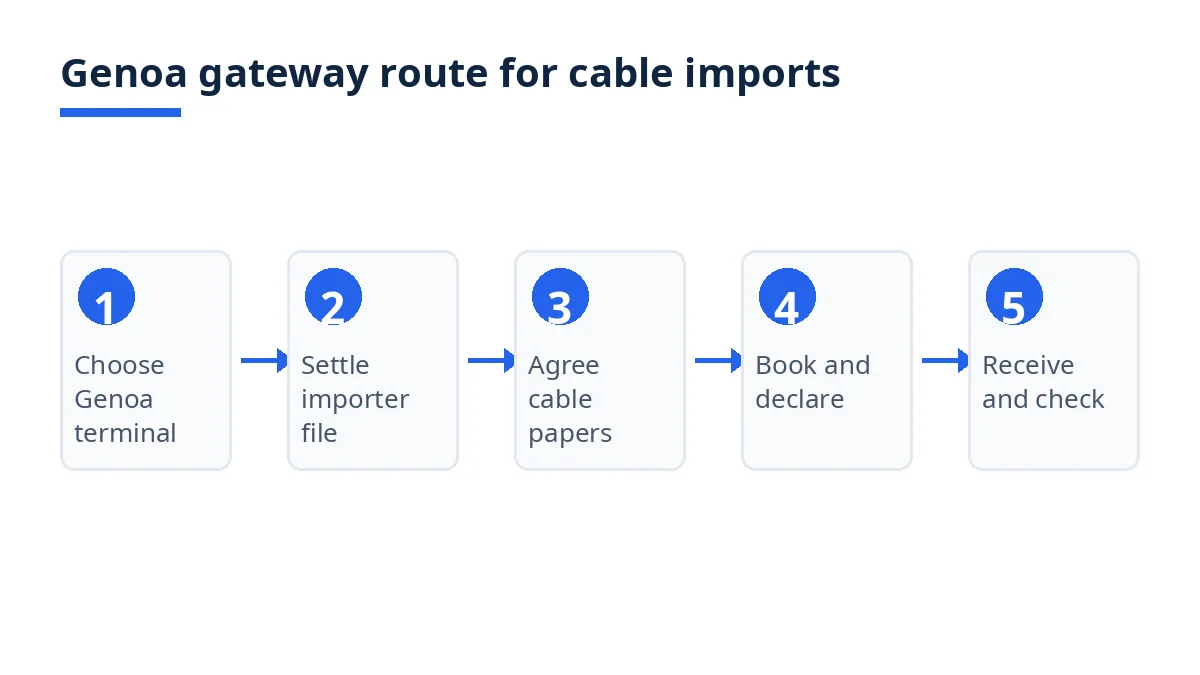
Settle four points with the carrier and the forwarder before any supplier is asked for a price: the named terminal and the vessel service calling there; the first warehouse or depot after discharge; every onward destination, including any split delivery; and the named place in the delivery term, written in full, so the contract, the booking and the customs papers all point at the same place. If the final destination sits on the Adriatic side of Italy, ask the forwarder to price an Adriatic entry beside the Genoa price and compare the two totals, including inland haulage and extra handling, rather than assuming the Ligurian route is cheaper because the sea leg looks shorter. No sailing time is stated in this guide: the carrier schedule for the named service on the named dates is the only figure to use.
The Italian importer file: who carries each duty
In European Union law the importer is the party established in the Union who places goods from a third country on the Union market, and the duties that follow are personal to that role. An Economic Operators Registration and Identification (EORI) number is mandatory for customs clearance in the European Union, and no operator holds two valid numbers at once.4 The number is assigned by a single customs authority: for an operator established in the Union, the authority of the country where it is established, and for an operator with no Union establishment, the country where it intends to carry out its first customs operation.4 Its format is a two-letter country code followed by an identifier of up to 15 characters.4 An Italian buyer who already holds an EORI number issued in another Member State uses that number; a buyer lodging the declaration in Italy for the first time takes the matter up with the Italian customs authority before the goods sail, not after they arrive.
The Low Voltage Directive shows why the role cannot stay vague. Importers must check whether manufacturers carried out the conformity assessment correctly and inform the safety monitoring authority if they consider equipment does not conform, the declaration of conformity and technical documentation must be kept for 10 years, instructions and safety information must be in a language easily understood by end users as determined by the national authority, and manufacturers and importers must indicate their contact details on the electrical equipment.5 Under the hazardous substances rules, importers must check that equipment has been approved as meeting the required standards, and distributors must also ensure the standards are met.6 The substance limits are measured material by material: each homogeneous material, a material of uniform composition that cannot be mechanically separated into different materials, must clear its limit on its own.7 A cable passing as a whole product but failing in one sheath compound or plating layer is not a passing cable.
Italy adds a national layer no foreign supplier can settle from Dhaka. The Italian Electrotechnical Committee, known as CEI, is the private, non-profit association for technical standardisation in the electrotechnical, electronic and telecommunication field at national level, representing Italy in CENELEC and the IEC, and its standards provide the presumption of conformity to the rule of the art of electrical products, systems, installations and processes under Italian Law 186/1968.8 The buyer, or the buyer's Italian installer or adviser, must confirm which CEI installation rules the finished installation will be judged against, and the language of every instruction, label and marking for the Italian end user. Where the buyer is not the importer, name the importer in writing, state who holds the EORI number, and state who keeps the conformity papers for the 10-year period.
Settle the cable before you settle the price
Three decisions fix the cable, and each changes the papers travelling with it. The first is classification. Heading 8544 covers insulated wire, cable and other electric conductors, whether or not fitted with connectors, together with optical fibre cables of individually sheathed fibres, and its six-digit lines split winding wire by conductor material, coaxial cable, wiring sets for vehicles, aircraft or ships, conductors by voltage and connectors, and optical fibre cables.9 Treat heading 8544 as indicative: the broker confirms the full eight-digit Combined Nomenclature line and the TARIC measures for the entry date and origin claimed, and each cable type travels as a separate invoice line with its own confirmed code.
The second decision is the conductor description. IEC 60228:2023 specifies nominal cross-sectional areas from 0.5 mm2 to 3,500 mm2 for conductors in electric power cables and cords, covering solid, stranded and Milliken copper, aluminium and aluminium alloy conductors in cables for fixed installations and flexible copper conductors, and it does not apply to conductors for telecommunication purposes.10 The quotation must state the conductor material, the conductor class, the nominal cross-sectional area in square millimetres, and the cable type standard the construction follows, using the same figures in the specification sheet, the test reports and the drum markings. A quotation stating only a trade description and a price per metre cannot be checked against a test report.
The third decision is the fire performance class for cables permanently incorporated in construction works. EN 50575 is the CEI-adopted European standard for power, control and communication cables for general applications in construction works subject to reaction to fire requirements, covering power cables, control and communication cables and optical fibre cables for use in buildings and other civil engineering works with the objective of limiting the generation and spread of fire and smoke.11 Cables for safety installations where continuity of power or signal supply must be assured, such as alarm, way guidance and fire fighting installations, are not covered by this standard, and the standard does not replace the electrical, mechanical and environmental requirements of other applicable cable standards.11 Record, for each construction, whether the cable falls inside the EN 50575 route or outside it, and if outside it, which route governs instead. Never accept a fire class without the test route behind it.
The Genoa route in the contract: delivery terms that fit drums and containers
Incoterms 2020 is the current edition of the International Chamber of Commerce rules, and each of the eleven rules states the delivery point, the transfer of risk, the costs each side bears, who contracts for transport, who insures where the rule requires it, and who completes export and import formalities.12 The four-rule sentence governs the first choice: the sea and inland-waterway-only rules are four, FAS, FOB, CFR and CIF. CPT is any-mode. DPU is any-mode. DDP is any-mode, with the seller clearing import customs and paying duty. DDP is distinguished on import clearance and duty and on unloading, which stays with the buyer.
For containerised drums, the FCA and FOB distinction decides where risk moves in practice. Under FCA the seller delivers to the carrier or the buyer's designated person at the agreed location, which may be the seller's premises or a container terminal, and FCA suits any mode of transport including multimodal shipments.12 Under FOB the seller delivers once the goods are loaded on board the vessel at the named port of shipment, and FOB is to be used only for maritime or inland waterway transport, meaning port-to-port shipments.12 A drum load sitting at a container terminal for days before loading fits FCA better than FOB, because the risk point under FCA can sit at the terminal handover instead of waiting for the vessel. Name the rule, the named place and the edition in the contract, for example FCA Chattogram container terminal, Incoterms 2020, or DAP Milan warehouse, Incoterms 2020, and never shorten the named place to a city alone when the drums must reach a specific depot.
Rule | Where risk moves | Who books the main leg | Genoa fit |
|---|---|---|---|
FCA Chattogram terminal | At handover to the carrier at the named terminal | Buyer | Containerised drums; risk moves before vessel loading |
FOB Chattogram | On board the vessel | Buyer | Port-to-port loads only; weak fit for drums waiting at a terminal |
CIF Genoa | On board at origin; seller pays freight and insurance to Genoa | Seller | Seller carries freight and insurance cost, not risk, past loading |
DAP named Italian place | At the named place, ready for unloading | Seller | Seller carries the Genoa and inland legs; buyer clears import |
DPU named Italian place | At the named place, unloaded | Seller | Adds seller unloading; confirm crane and labour at the place |
DDP named Italian place | At the named place, duty paid, ready for unloading | Seller | Only where the seller can clear Italian import and pay duty |
Papers at the Italian border: EORI, ENS, declaration and origin
The border file has three layers, each with a different owner. The first is security data before arrival. Economic operators must submit a complete Entry Summary Declaration (ENS) in the ICS2 system for all goods transported to or through the European Union before their arrival, and customs authorities perform pre-loading or pre-arrival safety and security risk analysis on the information provided.13 Incomplete declarations may be rejected, or risk mitigating referrals may be issued asking for additional information, screening, or no loading, and those referrals must be answered before the risk assessment can resume.13 The carrier and forwarder normally handle the filing, but the buyer must confirm in writing who files the ENS, under whose EORI number, and with which data.
The second layer is the customs declaration, drafted from the settled papers: commercial invoice, packing list, transport document, confirmed classification code, customs value on the basis the Incoterms rule produces, and origin evidence. TARIC, the integrated tariff of the European Union, is a multilingual database integrating all measures relating to the Common Customs Tariff and commercial and agricultural legislation, giving economic operators a transparent overview of the requirements for importing goods into the Union.14 TARIC does not contain information relating to national levies such as rates of VAT and rates of excise.14 The broker therefore reads the duty and measures line in TARIC for the confirmed code, and reads the VAT position in Italian law, and the two readings are never merged into one figure.
The third layer is origin and preference. Bangladesh, as a least developed country, benefits from the Everything But Arms arrangement, which grants duty-free, quota-free access for all exports except arms and ammunition, and the European Commission records 19 billion euro in exports benefitting from the preferences in 2024 at a 96 percent utilisation rate.15 The arrangement is not a blanket exemption: the preference for a given shipment depends on the classification, the origin rules for the product, and the proof of origin the supplier provides. Ask the broker, before pricing, what proof of origin the shipment needs and what happens to the duty figure if the proof is rejected. No duty rate is stated anywhere in this guide: no rate table for heading 8544 was consulted while this article was prepared, so the broker must confirm the rate from the opened schedule before the total is used for pricing. Confirm the rate with the broker for the exact code, origin and entry date, and keep that confirmation in writing with the order file.
What the cable must prove in Italy: CPR, LVD and RoHS
Three European instruments meet on one drum, and each asks for different papers. Under the Construction Products Regulation, where a construction product is covered by a harmonised standard, the manufacturer must draw up a declaration of performance containing the product type reference, the systems of assessment and verification, the reference of the harmonised standard, the intended uses, and the declared performance, and must then affix CE marking.16 Member States remain responsible for fire safety and other requirements applicable to buildings and construction works, so the European declaration does not by itself settle which fire class an Italian building or installation requires.16 Importers must ensure the product bears CE marking and is accompanied by the required documentation, must avoid placing it on the market if they consider it does not conform, and must ensure transport and storage do not jeopardise its performance.16
For the fire class, the classes run from Aca to Fca, with supplementary classifications for smoke production, flaming droplets and particles, and acidity, and the assessment route and notified-body involvement depend on the class claimed. Require the declaration of performance for the exact construction ordered, the test reports behind the declared class, the identification of any notified body involved, and drum markings matching the declaration, and have an adviser check the class against the Italian requirement for the intended installation before the order is placed. Where the cable is a safety-installation cable outside EN 50575, the order must name the governing route instead of borrowing a fire class from a different product.
The Low Voltage Directive covers electrical equipment designed for use with a voltage rating between 50 and 1,000 V for alternating current and between 75 and 1,500 V for direct current, and it lays down the responsibilities of manufacturers, importers and distributors, the CE marking duty, the conformity assessment, the declaration of conformity and the 10-year retention of the declaration and technical documentation.5 Instructions and safety information must be in a language easily understood by end users as determined by the national authority.5 A cable whose rated voltage sits outside that band, or whose use sits outside the directive, is not proved by a Low Voltage Directive declaration; the order must say which instrument covers it.
The hazardous substances position is separate again. The restriction of hazardous substances rules now apply to all electrical and electronic equipment and to cables and spare parts, with a short list of exclusions, and the directive places obligations on manufacturers to design and produce in line with the requirements, on importers to check approval, and on distributors to ensure the standards are met.6 The ten restricted substances and their maximum concentration values tolerated by weight in homogeneous materials are as follows.7
Substance | Maximum concentration value |
|---|---|
Lead | 0.1% |
Mercury | 0.1% |
Cadmium | 0.01% |
Hexavalent chromium | 0.1% |
Polybrominated biphenyls (PBB) | 0.1% |
Polybrominated diphenyl ethers (PBDE) | 0.1% |
Bis(2-ethylhexyl) phthalate (DEHP) | 0.1% |
Butyl benzyl phthalate (BBP) | 0.1% |
Dibutyl phthalate (DBP) | 0.1% |
Diisobutyl phthalate (DIBP) | 0.1% |
Require the supplier to state, per homogeneous material, which substances were tested, which test method was used, and which exemption, if any, is relied on, and require the declaration of conformity to cite Directive 2011/65/EU alongside the other directives that apply. A single certificate stating a product is compliant, without the material breakdown behind it, does not answer the question the table asks. Confirm the current exemption list with an adviser before relying on any exemption, because the exemption lists are updated in line with technical progress.6
Quantities, samples and the split quotation
Cable quantities are agreed in metres, and the metre figure alone does not settle the order. The quotation must break the metres into drum lengths, state the number of drums, state the tolerance on each drum length, and state how short lengths, if any, are priced and marked. A sample arriving as a short cut length proves the construction and the markings; it does not prove drum winding, drum protection, or handling survival. Approve the sample against the frozen specification sheet, record the approval in writing with the sample identification retained, and freeze the specification sheet before quotations arrive, attaching the frozen sheet to the order so the production, inspection and customs papers all describe the same goods.
Compare quotations only after each one is split into the same lines. Require every supplier to quote in euros, on the same Incoterms basis and the same named place, broken into goods, main freight and insurance with cover level stated, inspection and testing with the test list stated, broker and border charges, inland delivery with unloading responsibility stated, and duty and VAT stated as broker-confirmed figures or as to-be-confirmed, never as a supplier guess, with a validity date covering the sailing. No typical minimum quantity is stated in this guide, because no opened source states one for cables from Bangladesh. Where a supplier states a minimum, record whether it applies per order, per construction, per colour or per drum length, and record the price effect of ordering below it.
Worked landed-cost example
Example figures: every figure in this section is illustrative. The figures are not a real price, freight rate or charge for any product, route or supplier. Duty is excluded from the total because no duty rate is stated in this guide, and the broker must confirm the rate from the opened TARIC schedule before the total is used for pricing. A buyer orders 7,200 metres of cable at EUR 3.40 per metre on a CIF Genoa basis, Incoterms 2020, for onward delivery to a warehouse in Milan.
Line | Example figures (EUR) |
|---|---|
Goods: 7,200 m at EUR 3.40 per metre | 24,480.00 |
Freight and insurance to Genoa, included in the CIF price | 1,975.00 |
Customs value (goods plus freight and insurance) | 26,455.00 |
Inspection and testing | 410.00 |
Customs broker fee | 290.00 |
Terminal, storage and drayage to Milan | 640.00 |
Total before duty and VAT | 27,795.00 |
Total per metre before duty and VAT (27,795.00 divided by 7,200) | 3.86 |
The arithmetic is: 7,200 multiplied by 3.40 equals 24,480.00; 24,480.00 plus 1,975.00 equals 26,455.00; 26,455.00 plus 410.00 equals 26,865.00; 26,865.00 plus 290.00 equals 27,155.00; 27,155.00 plus 640.00 equals 27,795.00; and 27,795.00 divided by 7,200 equals 3.8604, rounded to EUR 3.86 per metre. The VAT illustration is separate from the landed-cost total: Italy's standard VAT rate is 22 percent, with reduced rates of 10 percent, 5 percent and a super-reduced rate of 4 percent.17 At 22 percent, the VAT on the customs value of EUR 26,455.00 is EUR 5,820.10 before any duty is added, and the accountant recalculates the amount once the broker confirms the duty, because duty forms part of the VAT base on import. Whether the import VAT is reclaimable in the buyer's position is a question for the buyer's accountant, not a figure to assume in the quotation comparison. Add the broker-confirmed duty, divided by 7,200, to EUR 3.86 for the final landed cost per metre, and price from that figure.
Before the drums leave Chattogram: a Genoa readiness check
Run the order through four gates, and hold the sailing until each gate is passed. The route gate asks whether the terminal, the first warehouse, every onward destination and the named place in the delivery term are written identically in the contract, the booking and the forwarder instructions. The papers gate asks whether the EORI holder is named, the ENS filer is confirmed, the declaration drafter holds the settled invoice, packing list, transport document, confirmed code and origin evidence, and the broker has confirmed the duty line in writing. The goods gate asks whether the declaration of performance, the test reports, the substance evidence and the drum markings all describe the same construction, fire class and conductor figures as the frozen specification sheet. The money gate asks whether the quotation comparison is on one Incoterms basis, the validity dates cover the sailing, the inspection and broker fees are in the total, and the duty line is marked broker-confirmed or to-be-confirmed rather than guessed. A failure at any gate is cheaper to fix in Chattogram than in Genoa, where storage and re-handling accrue daily and the drums cannot move until the file is complete.
Does every cable shipment into Genoa need its own EORI number?
No. A person holds one valid EORI number at a time, assigned by a single customs authority.4 Each shipment needs a declarant holding a valid EORI number and named on the declaration. Where the Italian buyer is the declarant, the buyer's own number is used. Where a broker or another party lodges the declaration, that party's number and authority must be confirmed before the goods sail, and the buyer should keep a copy of the declaration showing which number was used.
Which Genoa terminal should a cable shipment use?
The terminal follows the carrier service and the onward leg, not the other way round. Vado Gateway offers deep-sea container capacity with direct weekly rail links to Milan, Padua, Rubiera, Piacenza and Verona,2 while Genoa Port Terminal offers multipurpose handling including stuffing, stripping, weighing and lashing.3 Ask the carrier which basin terminal its service calls at, ask the forwarder what the terminal charges and the rail or road leg cost from that terminal to the final place, and choose on the combined total. A terminal chosen for a lower sea freight figure that adds a long inland leg or an extra handling step is not the cheaper arrival.
What duty applies to electrical cables from Bangladesh into Italy?
No duty rate is stated in this guide. The rate comes from the TARIC line for the confirmed code, the origin claimed and the entry date, read by the broker from the opened schedule, together with any preference under the Everything But Arms arrangement where the origin rules and proof of origin support it.14 15 The broker confirmation must be in writing, must name the code and the origin, and must state what changes if the proof of origin is rejected. Never price from a rate copied from another product, another code or another entry date.
How do I know the CPR class on a quotation is real?
Ask for the declaration of performance for the exact construction, the test reports behind the declared class, and the identification of any notified body involved, and have an adviser check the class against the Italian requirement for the intended installation.16 The declaration must contain the product type reference, the assessment systems, the harmonised standard reference, the intended uses and the declared performance.16 A class stated on a quotation without those papers is a claim, not evidence, and a class for a different construction does not transfer to the drums in the order.
Can a supplier quote DDP to my warehouse in Milan?
A supplier can quote DDP only where it can perform the DDP duties: clearing Italian import customs, paying duty, and delivering to the named place ready for unloading, with the buyer unloading.12 Ask who holds the EORI number for the import clearance, who is registered for Italian VAT for the transaction, whether a fiscal representative is needed, and who pays if the duty figure changes on assessment. Non-EU businesses selling in Italy are generally required to appoint a fiscal representative who is jointly liable for Italian VAT, while businesses established in the European Union or in a country with a VAT mutual-assistance agreement with Italy can instead register directly.17 If the supplier cannot answer those questions in writing, price the order on DAP or FCA instead and keep the import file with the party who can perform it.
How do I check a Bangladeshi cable supplier before ordering?
Check the same points for every candidate, in writing, and keep the answers with the quotation. Ask for the legal company name and registered address, the export registration papers, and confirmation that the name on the quotation, the invoice and the bank account is the same legal entity. Ask which constructions the supplier has shipped to the European Union before, which fire classes and substance evidence it can produce for the exact construction, and whether it will accept third-party inspection at the stages the buyer names. Ask for a sample cut length with markings, approve it against the frozen specification sheet, and record the approval. A supplier answering slowly or partially on papers will answer slowly or partially on a production problem, and that pattern is visible before any money moves.
Next steps on Exportain
Start from the full import sequence from specification to clearance, then search Exportain listings for Bangladeshi cable makers and compare their quotations on the split format in this guide, using the per-unit method for comparing delivered totals to convert every offer to the same named Italian place. The code-by-code walkthrough for this heading sits beside this guide for the code discussion with the broker, and how ordering, quotations and payment holds work on the platform sets out the RFQ, quotation and funds-hold steps. Post a free RFQ on Exportain and get quotes from verified Bangladeshi suppliers → https://exportain.com/rfqs
Sources
- Ports of Genoa. Western Ligurian Sea Port Authority (accessed )
- Vado Gateway - APM Terminals Vado Ligure S.P.A.. Western Ligurian Sea Port Authority (accessed )
- Gruppo Spinelli - Genoa Port Terminal. Western Ligurian Sea Port Authority (accessed )
- Economic Operators Registration and Identification number (EORI). European Commission, Taxation and Customs Union (accessed )
- Directive 2014/35/EU on electrical equipment designed for use within certain voltage limits — summary. EUR-Lex, European Union (accessed )
- Directive 2011/65/EU - Restriction of the use of certain hazardous substances in electrical and electronic equipment. European Union, (accessed )
- RoHS Directive (2011/65/EU): Substance Restrictions. EUVerify (accessed )
- Il CEI - CEI - Comitato Elettrotecnico Italiano. Comitato Elettrotecnico Italiano (accessed )
- Classification Detail — HS 2017 Code 8544: Insulated wire, cable and other electric conductors. United Nations Statistics Division (UNSD) (accessed )
- IEC 60228:2023 - Conductors of insulated cables. International Electrotechnical Commission, (accessed )
- CEI EN 50575 - Power, control and communication cables - Cables for general applications in construction works subject to reaction to fire requirements. Accuris Standards Store (accessed )
- FCA & FOB Incoterms 2020 explained: Key differences. ICC Academy (accessed )
- Import Control System 2. European Commission (accessed )
- EU Customs Tariff (TARIC). European Commission, Taxation and Customs Union (accessed )
- EU trade relations with Bangladesh. European Commission, (accessed )
- Construction products. EUR-Lex (accessed )
- VAT in Italy: Rates, Registration and Compliance Guide. Taxually, (accessed )
About the author
Sourcing from Bangladesh?
Post a request for quotation and suppliers on Exportain can send you their quotes directly.
Post an RFQ