Custom Sandals and Slippers Manufacturer in Bangladesh: OEM Process From Tech Pack to Bulk
Follow one buyer-designed sandals and slippers order in Bangladesh from tech pack to bulk: sole and mould decisions, sample approvals, cost blocks, inspection, labelling, classification, and shipment papers.
Short answer
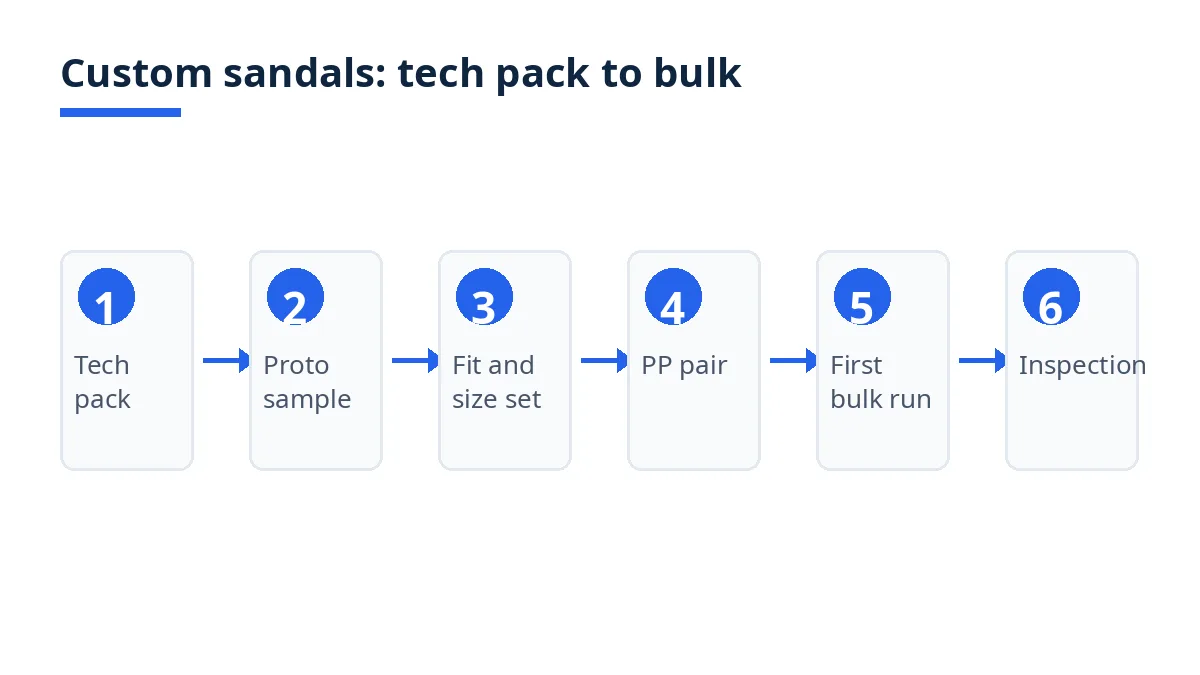
A custom sandals and slippers order in Bangladesh runs from a tech pack through proto, fit and size-set samples, a pre-production pair, and a first production pair. The buyer controls the sole route, the mould set, the strap join, and the inspection plan at each gate, and bulk starts only when the pre-production pair and its pack version agree.
On this page
Key takeaways
Name the sole route and the mould set before sampling, because a later sole change is a new mould decision.
Treat each sample round as one approval, and keep the pre-production pair beside the pack version it matches.
Spread fixed charges such as a mould set across the order on paper before ranking quotations.
Agree fault classes, sampling levels, labelling, and classification in writing before bulk starts.
Buy a sandal by its sole and its strap. The sole gives the pair its shape and its tread. The strap holds the foot. The join between strap and sole decides whether the pair survives daily wear. A buyer who chooses colours first and settles the join last will pay for that order twice: once in a new mould, and again in a second round of samples.
This guide is written for buyers in the USA, the UK, the EU, or the UAE who want a factory in Bangladesh to make a sandal or slipper design they own. It walks through the order in the order decisions are made: sole route, specification file, samples, price, bulk checks, label and heading, and papers. No figure here is a market price, a standard minimum, or a standard lead time for Bangladesh. Figures that show arithmetic are marked as example figures. A customs broker settles duty.
Choose the sole route first
Three ways of making the sole cover most orders of this kind. Pick one before any sample is cut, and write the choice into the specification file in plain words.
Injection moulded EVA starts with pellets. The pellets are heated until they melt, pushed into a metal mould cut to the sole shape, left to expand and cure in the mould, then taken out and cooled before bonding or finishing.1 One mould can form a whole slide or sandal sole, and the same method can form soles with more than one density, or soles joined in the mould to rubber or TPU parts.1 A change to the sole outline after the mould exists means cutting or changing a mould. It is not a comment on a sample.
A plug join keeps sole and strap apart until assembly. The strap ends carry plugs. The plugs sit in holes cut in the sole. The UK tariff lists this build on its own line: footwear with upper straps or thongs assembled to the sole by means of plugs, under 6402 20.2 For a plug build, the specification file must give plug size, hole spacing, the pull test the join must pass, and the finish on the plug head, so nothing sharp touches the foot.
A moulded rubber or PU sole is formed as one unit, and the strap is fixed to it by cement, by stitching, or by both. The route limits which strap materials will bond well, which tread shapes can be formed, and which bond tests matter. Moving from one route to another after a fit check voids that check. Weight, flex, and footbed height all move when the route moves.
Moulds belong to sizes, not to styles. One set holds a cavity for each size in the range. Before sampling ends, settle who owns the set, where it is kept, how long it is kept, and whether another buyer may use it. Settle too whether the mould charge is paid once, folded into the pair price, or split across repeat orders, and over how many pairs any split runs.
Write one specification file for one style
A tech pack is the file a factory uses to quote, to sample, and to produce. One style gets one file. For sandals and slippers, the file should contain flat drawings, a measurement sheet, a list of materials, construction notes, colourways with artwork, label and packing notes, and a log of changes made after each sample.3 Put a version number and a date on each page. A sample is then judged against the file version that was current when the sample was made.
Start the material list before the drawings are finished. The list names the sole compound, the strap, the footbed, plugs, buckles, thread, labels, and cartons. Each line gives a supplier or swatch, a colour reference, and a quantity for one pair.3 Describe materials by makeup and by weight or density where those apply. Do not describe them by feel. A word like soft lets a factory choose the lowest-priced material that answers to the word.
Draw the pair in three views: side, top, and sole. The side view gives profile and heel height. The top view gives strap layout, plug holes, and footbed outline. The sole view gives tread and heel shape. Add enlarged drawings for a buckle, a plug head, or a strap join that cannot be read at full size. Flat drawings with callouts show every strap edge and trim position.3 A fashion sketch, by contrast, leaves shape and hidden parts open to interpretation.
Measurements for open footwear are few. Give each one a target and a tolerance: total length, ball width, heel width, sole thickness at front and heel, strap length, strap width, plug-hole distance from the heel, and entry width. Show, with arrows on the drawing, where each measure is taken. A sample with no tolerance has no pass mark. Grading rules then scale the measures across sizes. Do not leave scaling to the factory's eye.
Colourways sit on their own page. Each one lists colour references, artwork size and place, and which trims change colour. Freeze the list before material batches are bought. A colour added late can bring its own minimum, and it reopens shade approval and the sample for that colour.
Let each sample answer a single question
Footwear development runs in two phases. The first phase turns an idea into samples a buyer can judge. The second phase scales a judged design for factories and shops, checking fit across sizes, passing quality checks, and meeting dates.4 Sample names differ from factory to factory. Agree what each name means with the factory you use, before you pay for a round.
Sample | What changes at this step | What you keep |
|---|---|---|
Development sample | Shape, strap hold, and proportions, in substitute materials | Notes on shape and construction, with the file updated |
Refined sample | Materials and build, closer to the finished pair | Wear notes and fit notes, with real materials named |
Colour and sales sample | Colourways, artwork, and trims, in standard sizes | Pairs for selling and for colour approval, not a bulk standard |
Fit check, base size and extremes | Last and pattern, at the base size and at the end sizes | Fit notes for each size checked, with last changes logged |
Size run | Grading, one pair for each size | A grading check against the file, size by size |
Bulk sample | Bulk materials, bulk trims, final labels, final packing | The pair bulk must match, kept with its file version |
Line sample | The first bulk run, checked against the bulk sample | A hold or release decision for the rest of the run |
Handle each pair yourself. Photographs do not show strap stretch, shade drift, plug seating, or bond strength. Agree the price of sampling before the first round: how many rounds the price includes, what a further round costs, and who pays to ship samples. Keep the bulk sample with the file version it matches. Together, they are the record if bulk arrives wrong.
The diagram below shows the steps in order.
Work out what the pair costs before you compare prices
Split a quotation into blocks that match the specification file. Material and grading give the material block. Drawings and construction notes give the labour block. Artwork gives the decoration block. Testing and market rules give the testing block. A quotation that omits the sample line, the mould line, or the inspection line has not priced the order. It has left those costs out. Ask for the omitted lines before you rank quotations.
A mould charge falls per pair as the order grows. Example figures only: divide USD 2,400 by 2,400 pairs and the charge is USD 1.00 a pair. Divide the same USD 2,400 by 12,000 pairs and the charge is USD 0.20 a pair. Run the same division for any sample or size-run charge folded into the pair price, and keep the working in the order file. A later quotation can then be compared on the same footing.
Link payment to approvals, not to dates alone. Example figures and an example timetable only: sample and mould charges are settled before bulk, a deposit is released when the bulk sample is approved, and the balance is paid when inspection passes and shipping papers are ready, with each payment tied to the approval it pays for. Write down what happens to the deposit if an approval fails. No split is claimed here as common practice for this product, because no such split was checked. Give each approval a date and a named owner, and treat no number of days in this guide as a norm. Mould cutting, mould trials, and a late colourway each add a stage of their own.
Only FAS, FOB, CFR, and CIF are confined to sea and inland waterway transport. CPT is any-mode. DPU is any-mode. DDP is any-mode, and the seller clears import customs and pays duty, while the buyer unloads. Cartons in containers often suit FCA better than FOB, because cartons pass to a carrier at a terminal well before loading.5 Ask every factory to quote on one delivery term, with the named place in full, so no quotation hides costs another one includes.
Agree how bulk will be checked
Checks run at three points: materials in, work in progress, and finished pairs. How much is examined, and which traits are examined, is often settled when the order is placed and written into the contract.6 Set the plan in the commercial terms before bulk begins: who checks, at which points, measured against which approved pair, and the remedy for pairs that fail. Checks during production catch strap cutting errors, plug seating errors, moulding and cooling errors, and bond errors while they can still be fixed. A check of finished pairs alone finds them too late.
Footwear has no worldwide sampling rule of its own. Checking once a season, once a style, or once a colour is common for some traits, but checking each batch, or each day, is stronger for key traits.6 ISO 2859-1 sets out sampling by attributes. Under that standard, a buyer and a seller agree an acceptable quality level, inspect a share of a batch, and accept the batch if faults stay within the agreed level, on the basis that the rest of the batch behaves in the same way.6 Inspection level and batch size set how many pairs are looked at. The agreed level sets pass or fail.6 Keep checking key traits through the run. A change of material, of material supplier, or of method mid-run can change quality, even after a clean pre-production check.6
Sort faults before anyone inspects, in words that leave no room for argument. Safety faults stop a shipment: a sharp plug end, a strap that comes free in normal use. Serious faults drive returns: a strap join that fails, a sole that parts from the strap. Small faults cause some returns: loose thread ends, a small glue mark.6 A batch should hold no safety faults. Serious faults are commonly capped at 1 percent or 2.5 percent, and small faults at 2.5 percent or 4 percent.6 Write the caps, the fault list, and the sample spread into the order: the spread must cover the end sizes and every colourway. Write rework terms too: who reworks, who pays, and which approval reworked pairs must pass.
Put the label, the heading, and the chemical tests in the order file
Write label wording and label place yourself. Check both on the bulk sample. In the EU, a footwear label covers three parts, and the material named for each part follows a share test.
Part | Share test | If no material reaches the share |
|---|---|---|
Upper | 80 percent of surface area | Name the two main materials |
Lining and sock | 80 percent of surface area | Name the two main materials |
Outer sole | 80 percent of volume | Name the two main materials |
Words or pictograms may be used. The label must be plain to see, fixed so it stays put, and within reach, on one item of each pair at least. Where footwear is imported, the person who first puts it on the EU market carries responsibility for the label being right.7 This guide does not state the USA, UK, or UAE label rules. A broker confirms those for each market.
Classification starts with the pair in front of you. For the upper, take the material with the greatest outside surface, leaving aside accessories and reinforcements. For the outer sole, take the material with the greatest area touching the ground.2 Rubber or plastics uppers with rubber or plastics outer soles fall under heading 6402. Strap or thong uppers fixed to the sole with plugs fall under 6402 20. Slippers and other indoor footwear with plastics uppers fall under 6402 9950.2 On the UK tariff page for heading 6402, dated 5 April 2025, the third-country duty shown for those lines is 16.00 percent. Do not treat that snapshot as the duty for a Bangladeshi shipment. Origin, preference, and trade date can move the figure. A broker settles the duty for the shipment itself. A heading is a starting point, not a duty answer.
Leather parts bring chemical tests with them. Under UK REACH guidance for trading standards, three limits are stated for leather in skin-contact goods.8
Substance or group | Limit stated | Scope in the guidance |
|---|---|---|
Chromium VI | 3 mg/kg of total dry leather weight, or more, is barred | Leather articles and leather parts touching skin |
Dimethyl fumarate | Above 0.1 mg/kg is barred | Leather products |
Azo dyes releasing listed aromatic amines | Above 30 mg/kg is barred | Articles in direct, prolonged skin contact, including footwear |
Those limits are for leather. EVA, PU, rubber, and textile pairs need a different test list. Ask the lab which market rules apply to the pair you are buying, and write the test list into the specification file before bulk.
Gather the Bangladesh shipment papers
A buyer does not clear goods out of Bangladesh, but a buyer should know the file that must travel with the shipment. The commercial invoice describes the goods, their value, and the sale terms, and forms the basis for customs valuation. In Bangladesh it must list the Export Registration Certificate number alongside the HS code.9 The packing list shows package type, quantity, and weight for each package.9 The Export Registration Certificate comes from the Export Promotion Bureau. A certificate of origin comes from a chamber of commerce in the locality, or from a body authorised for the purpose.9 For sea freight, the bill of lading acts as a document of title. For air freight, the air waybill does not.9 Some destinations ask for an inspection certificate covering quality, quantity, and specification.9 Keep the quotation, purchase order, approvals, inspection record, invoice, and packing list in one file, and check style code, size split, colourway list, carton marks, and HS code against each other before booking.
Nine decisions that go wrong first
A sketch goes to the factory instead of flat drawings, and strap positions move.
A strap is described by feel, and the factory chooses the lowest-priced material that answers to the description.
A sales sample is treated as the bulk standard, and bulk is judged against a pair made to sell.
The sole route changes after the fit check, and the fit check no longer belongs to the pair being made.
A size is added after moulds are cut, and the new size has no cavity and no grading check.
A colourway is added after batches are bought, and shade, sample, and count are settled again from scratch.
Bulk is judged from photographs, and strap stretch, plug seating, and bond strength go unseen.
Label wording is left to the factory, and a market rule is missed.
Mould and pattern ownership is left unwritten, and the first good order turns into a dispute.
A factory that will not state who owns the moulds, will not name the plug or bond test, or will not keep a bulk sample with its file version has not offered a cheaper order. It has offered an order with decisions still open. Close those decisions before you rank its price.
Hold this record before bulk starts
An empty line means a decision is still open. Fill each line from the file version and sample pair it names. Do not fill any line from memory.
Item | Paper to keep | Signed by |
|---|---|---|
Route and ownership | Route confirmed, design and mould ownership, return or destruction terms | Buyer and factory |
Sole and moulds | Sole route, cavities for each size, mould charge and split, storage terms | Buyer |
Strap join | Strap material and length, plug size and holes, join test result | Buyer |
Colourways | Colour references, colourway list, batch for each colourway | Buyer |
Labels and packing | Label wording and place, pairs per carton, carton marks, artwork version | Buyer |
Sample approvals | Development, fit, size run, and bulk approvals, with signer, date, and file version | Buyer |
Bulk checks | Fault classes, caps, sample size, checker, rework terms | Buyer and checker |
Price and payment | Pair price, delivery term and named place, validity, payments tied to approvals, failure terms | Buyer and factory |
Papers | Quotation, purchase order, approvals, inspection record, invoice, packing list | Factory, copies held by buyer |
What should I know first about a custom sandals and slippers order from Bangladesh?
First, settle whether the design is yours or the factory's. Your own design needs a full specification file: drawings, measures with tolerances, a material list, construction notes, colourways, and labels. A factory design with your brand on it needs a shorter file. Name the route, settle mould ownership, and share the file in stages under a confidentiality term before sampling.
What are the typical costs and timelines for a custom sandals order?
This guide states no typical cost or timeline for Bangladesh, because none was checked for this product. Price splits into material, labour, decoration, testing, sample, mould, and inspection blocks. A mould charge falls per pair as volume rises. Give each approval a date and an owner in the order file, and treat any day count from a factory as that factory's estimate for that order, not as a norm.
Which documents are needed for a custom sandals shipment from Bangladesh?
Keep the quotation, purchase order, approvals with file versions, inspection record, commercial invoice, and packing list in one file. The invoice must list the Export Registration Certificate number alongside the HS code, and the packing list must show package type, quantity, and weight.9 Add a certificate of origin and a bill of lading or air waybill, plus an inspection certificate where the destination asks for one.9
What are the most common mistakes on a first custom sandals order?
The mistakes that recur are treating a sales sample as the bulk standard, changing the sole route or adding a size after moulds are cut, adding a colourway after batches are bought, and judging bulk from photographs. The guard is the same in each case: hold the bulk sample with its file version, raise the file version after every change, and run a new sample whenever the sole, the strap join, a material, the colourway list, or the label artwork changes.
Next steps on Exportain
Start from the file, not from a factory list. Browse the supplier listings on Exportain. Read how badge checks are recorded for suppliers before sending anything. Then check the order total against the guide to counting a minimum quantity. Give every factory the same file version.
Sources
- Injection Molded EVA: Revolutionizing Footwear Design. Tien Kang Co., Ltd., (accessed )
- Other footwear with outer soles and uppers of rubber or plastics - UK Integrated Online Tariff. GOV.UK (accessed )
- What Is a Tech Pack? How to Make One, Step by Step (2026). Apparel Entrepreneurship, (accessed )
- Development & Commercialization Process in Footwear. The Footwear Edge, (accessed )
- Incoterms 2020 Explained: All 11 Rules. Blue Ocean Academy (accessed )
- Assessing footwear using statistical sampling techniques. SATRA (accessed )
- Directive 94/11/EC on labelling of the materials used in the main components of footwear. EUR-Lex, (accessed )
- Leather goods | Business Companion. Business Companion (accessed )
- Essential export documents for shipping from Bangladesh. DHL (accessed )
About the author
Sourcing from Bangladesh?
Post a request for quotation and suppliers on Exportain can send you their quotes directly.
Post an RFQ