France Electrical Cable Imports From Bangladesh: Ports, CPR and Duty
Le Havre or Fos-sur-Mer, the CPR fire class and the French customs file decide a cable import before price does. This France guide sets the gateway, the product papers and the broker checks in decision order, with a worked landed-cost example in euros.
Short answer
Importing electrical cables from Bangladesh to France works when the gateway, the product papers, and the border file are settled before price is discussed. Choose Le Havre or Fos-sur-Mer by destination and terminal, hold the declaration of performance with the fire class the French project requires for the exact construction, and have a broker confirm the heading 8544 code, any Everything but Arms preference, and the import VAT position in writing.

On this page
Key takeaways
Choose the gateway by destination and terminal: Le Havre for the north, Paris and the west; Fos-sur-Mer for the south and the Rhone valley; confirm the terminal, storage terms and onward service before comparing freight.
Get the fire class and additional ratings from the French project in writing for the exact construction, and hold the declaration of performance, CE label information and test reports that name that construction.
Place the cable in the Low Voltage Directive voltage band by its rated voltage and settle the RoHS scope position in writing; papers that name a different construction do not cover the order.
No duty rate is stated in this guide: the broker must confirm the heading 8544 code, the measures in force, any Everything but Arms preference and the origin evidence in writing.
Price on a worked landed cost in euros with duty as a separate line to be inserted, and compare suppliers line by line on the same delivery basis.
A French cable order is decided at three points before price matters: the port where the container enters France, the papers that travel with the drums, and the customs file that releases them. Get those three points wrong and a low unit price turns into storage charges, a rejected delivery, or cable that cannot be installed where it was meant to go. This guide is written for a buyer in France who is importing electrical cables from Bangladesh and wants the gateway decision, the product papers, and the border file settled in the right order.
Decide the gateway: Le Havre, Fos-sur-Mer, or entry through a neighboring port
France has two deep-sea container gateways that matter for a shipment from Chattogram. Le Havre, on the Channel coast, serves Paris, the north, and the west, with river and rail links along the Seine. Fos-sur-Mer, near Marseille on the Mediterranean coast, serves the south, the Rhone valley, and onward routes toward the Mediterranean basin. A third route exists: clear the goods at a port in Belgium or the Netherlands and move them onward into France by road or rail. That route can suit a buyer whose warehouse or first customer sits near the Belgian border, but it adds a second handling point and a decision about where customs clearance happens. Ask the broker which office clears the goods and where the goods sit while that happens, before choosing the route for its headline freight rate.
At Marseille Fos, rail already carries 15% of containerized freight, with more than 200 commercial rail offers and 20 destinations, including five in Europe.1 The port describes itself as Europe's southern gateway, with road, rail, river, and pipeline connections, and its western harbours at Fos-sur-Mer form a 10,000-hectare industrial-port area built for large intercontinental flows.2 For a buyer in Lyon, Grenoble, Toulouse, or Montpellier, that southern entry can shorten the inland leg enough to change the landed cost even when the ocean freight to Fos-sur-Mer costs more than the freight to Le Havre. For a buyer in Paris, Lille, Rennes, or Bordeaux, Le Havre usually keeps the inland leg shorter, and the Seine river and rail options give the forwarder more than one way to move drums inland.
Le Havre's container terminals show why the choice is a terminal choice, not just a port choice. The Terminal de France lists annual capacity of 1.5 million TEUs with rail and road connections, and the Terminaux de Normandie lists 1.8 million TEUs with rail tracks and road access, while the port's multimodal terminal connects the maritime terminals with river and rail services.3 Several terminals hold TSF status, meaning a customs inspection area sits on site.3 Ask the forwarder to name the terminal, not only the port, and to confirm where the container is unloaded, where drums are stored if inspection holds the box, and how many days of free storage apply before charges start. Those three answers differ by terminal and they belong in the quotation comparison, not in a phone call after arrival.
Gateway | Suits best | Onward movement to confirm | Question to settle first |
|---|---|---|---|
Le Havre | Paris region, north, west, Seine valley | River, rail, or road from the named terminal | Which terminal, and how many free storage days apply there |
Fos-sur-Mer | South, Rhone valley, Mediterranean onward routes | Rail or road from Fos-sur-Mer | Which rail or road service runs on the delivery week, and where drums are unloaded |
Neighbouring EU port, then France | Border regions, existing warehouse near Belgium or the Netherlands | Road or rail into France after clearance | Which customs office clears the goods, and what moves under transit |
Name the French destination in full before the first quotation
A quotation that says "France" is not a quotation a buyer can compare. Write the destination as the project or warehouse address, the person who receives the drums, the storage available on arrival, and the date the cable must be on site. Drum deliveries fail most often on the last meters: a site with no forklift access, no covered storage, or no one authorized to sign for a heavy load will refuse or delay a delivery that the ocean leg completed on time. Put the unloading point, the receiving hours, and the contact name in the order, and make the supplier and the forwarder confirm the same address in writing.
The second destination fact is the installation setting. Cable that will be fixed inside a building faces a different set of questions from cable that will run outdoors, underground, or inside machinery, and the project specification or the person responsible for the installation design is the source for what the setting requires. Ask that person to state the required reaction-to-fire class and any additional smoke, droplet, and acidity ratings in writing, with the construction the ratings apply to. Do not let a supplier choose the class. The class belongs to the building and the project, and a supplier who picks it is guessing at the buyer's risk.
The third destination fact is the split of the order across constructions. If the project needs two constructions, treat them as two separate purchases inside one shipment: two specifications, two sets of papers, two sample approvals, and two lines in the landed-cost table. Mixing constructions into one average price hides the construction that costs more to make compliant and makes it impossible to tell which line caused a delay. A buyer who orders one construction on the first shipment learns the route, the papers, and the supplier on a single, checkable basis, and can add a second construction once the first has cleared and been accepted.
The European papers that must match the exact cable
European rules for cable used in construction works turn on reaction to fire. EN 50575:2014 covers power, control, and communication cables, plus optical fibre cables, intended for general applications in construction works where reaction-to-fire performance is required, with the aim of limiting how fire and smoke develop and spread.4 The standard classifies reaction to fire from Aca down to Fca, with additional classifications for smoke production, flaming droplets or particles, and acidity, and it sets out assessment and verification arrangements plus CE marking and labelling information in its Annex ZZ.4 Two limits in the standard matter for a French buyer. Cables that must keep safety installations running during a fire, such as alarm and fire-fighting systems, fall outside this standard, so a fire-alarm or safety-circuit cable needs its own route to compliance rather than an EN 50575 class alone.4 And the standard states that it does not replace the electrical, mechanical, and environmental requirements in other cable standards, so a fire class never stands in for the construction standard itself.4
For each construction, hold three items that name that construction and nothing else: the declaration of performance with the declared class and the additional ratings, the CE marking information as it will appear on the drum label, and the test reports behind the declaration. When the declared class is high, the assessment arrangements behind it involve more independent checking than a lower class, so ask which assessment system applies to the class on the declaration and who performed the type testing. A declaration that names a product family can be acceptable where the standard allows family grouping, but the buyer still needs the sentence or schedule that places the ordered construction inside that family. If the supplier cannot show that link, the declaration does not cover the order.
The conductor side of the construction has its own standard. IEC 60228:2023 fixes the nominal areas that may be used for conductors — 0.5 mm2 at the small end and 3,500 mm2 at the large end — and sets wire-number, wire-size, and resistance requirements, measured on the finished cable.5 Ask the supplier to state the conductor size, the standard, and the edition on the quotation and on the test evidence, and to confirm that the size was measured on the finished cable. A quotation that gives only a trade size or a nominal figure without the standard behind it cannot be checked against the test report.
Voltage decides a second file. Directive 2014/35/EU, the Low Voltage Directive, covers electrical equipment rated from 50 V up to 1,000 V on alternating current and from 75 V up to 1,500 V on direct current, and compliance includes CE marking and an EU declaration of conformity.6 Place the cable inside or outside that band by its rated voltage, stated on the specification, and ask for the declaration that covers the cable where the band applies. Specialized equipment for ships, aircraft, or railways sits outside the directive in the cases the directive lists, so a marine or rail cable needs a separate scope answer rather than an assumption.6 The directive's obligations run through the supply chain, which is why the buyer asks for the declaration rather than accepting a CE mark printed on a drum as proof on its own.6
Restricted substances form the third file. The RoHS Directive restricts ten substances in electrical and electronic equipment: lead, cadmium, mercury, hexavalent chromium, polybrominated biphenyls (PBB), polybrominated diphenyl ethers (PBDE), and four phthalates — DEHP, BBP, DBP and DIBP.7 Ask in writing whether the cable falls inside the RoHS scope for its intended use, which declaration covers it, and what test evidence supports the declaration for the exact construction. Do not accept a general company statement about RoHS in place of a declaration tied to the construction. Where the cable is part of a larger assembly, ask who in the chain holds the substance information for the cable itself, because the assembler and the cable maker may each point at the other.
Paper | What it must name | Ask |
|---|---|---|
Declaration of performance | The exact construction, the declared class, the additional ratings | Which assessment system applies, and who did the type testing |
CE marking information | The class and ratings as they will appear on the drum label | A label proof for the construction before production |
Test reports | The construction tested, the standard, the edition | Whether the report covers the ordered construction or a family member |
EU declaration of conformity | The cable, the directives it covers | The voltage band the cable sits in, stated on the specification |
RoHS declaration | The construction, the substances position | Scope answer in writing, plus test evidence for the construction |
Ask the installer what the French site requires
The product papers settle what the cable is. They do not settle whether the cable suits a particular French installation. That answer belongs to the installer, the project engineer, or the person who signs off the installation, and it should arrive before the order, not at the delivery gate. Ask that person three questions in writing: whether the declared class and ratings match the installation as designed, whether the drum marking and labelling will pass the checks made on arrival at the site, and whether any site rule requires a document beyond the European papers, such as a certificate or attestation the installer keeps with the installation file. Keep the answers with the order. If the installer later rejects a drum, the written answers show whether the rejection concerns the cable, the papers, or a site requirement nobody recorded.
This step also protects the buyer against a common timing trap. A cable that is correct for one building can be wrong for the next building on the same estate, because the class follows the building and the route the cable takes through it. A buyer who reorders "the same cable" for a second site without re-checking the class may receive a compliant cable for the wrong building. Treat every site as a fresh class question, even when the supplier and the construction stay the same, and record the class answer per site in the order file.
Compare suppliers on the French file, not on headline price
Send every shortlisted supplier the same request: the destination in full, the construction with its standard and edition, the declared class and ratings, the quantity and drum terms, the delivery rule with named places, and the date the cable must reach the site. Suppliers who quote against different constructions, different classes, or different delivery rules cannot be ranked, and the lowest headline number in such a comparison is usually the quotation that left something out. Compare the replies line by line on the same table, and keep the written answers attached to each quotation so a later dispute can be settled from paper rather than memory.
Score each supplier on four points. First, whether the papers name the construction and class requested, with test evidence the buyer can read. Second, whether the supplier answers scope questions directly, including voltage band, RoHS scope, and any construction the supplier will not cover. Third, whether the supplier states drum, length, and remainder terms in numbers rather than general assurances. Fourth, whether the delivery rule, the port and terminal, and the handover point are named. A supplier who scores well on price and poorly on the first two points is the most expensive supplier on the list, because the cost of a rejected delivery or a retest lands after the deposit is paid.
Samples prove the file, not just the cable. Approve a sample length in writing against the specification, keep a retained piece marked with the construction and the approval date, and require the bulk drums to match the approved sample on marking and labelling as well as on construction. Where a test report is supplied, check that the report, the sample, and the production drums all name the same construction. A sample that passes and bulk drums that arrive under a different construction name have not been tested at all. For a first order, a trial length that the installer can inspect on site is worth more than a second round of brochure claims, and the cost of the trial belongs in the first order budget, not in a later complaint.
Fix quantity, drum, and length terms in the order
Cable is bought by length, shipped on drums, and installed in runs, so the order must fix all three. State the total length, the length on each drum, the tolerance on drum lengths, and what happens to short lengths and remainders. State who owns the drums, whether drums return to the supplier, and what a damaged or short drum costs the buyer in time as well as money. A shipment of drums that cannot be unloaded in the order the installer needs them will be restacked at the warehouse, and restacking heavy drums is slow, costly, and easy to damage. Agree the drum sequence with the installer before loading, and put the sequence on the packing list.
Minimum quantities need the same precision. A supplier minimum may apply per construction, per class, or per production run, and the buyer who assumes it applies per order will under-order or over-order. Ask the supplier to state the basis of the minimum in writing, and test the minimum against the installation lengths plus a stated allowance for cutting, waste, and spares. Splitting a small order across two constructions to meet two minimums doubles the paper file and the inspection work for a quantity that may not justify either. Where the minimum exceeds the need, ask what changes the minimum: a different drum size, a shared production run, or a later delivery split. Record the answer as a number, not as a promise.
Price parts belong in the same order document. A cable quotation should separate the product price, the freight and insurance position under the chosen delivery rule, and any charges the buyer pays at the port, at customs, and on the inland leg. The landed-cost table later in this guide shows the split. A single all-in figure that does not name the delivery rule hides the point where the seller's cost ends and the buyer's cost begins, and that point is where most quotation disputes start. Convert every offer to the same delivery basis before ranking, and rework the ranking when a supplier changes the basis.
Move drums from Chattogram to the French warehouse
Delivery rules decide who arranges carriage, who bears risk at each stage, and who clears customs. Only FAS, FOB, CFR and CIF are confined to sea and inland waterway transport. Seven more rules work for any mode. CPT, DAP, DPU and DDP are the rules this guide uses for container and road movement. Under DDP the buyer still unloads, but the seller handles import clearance and duty payment.8 The ICC Academy's summary of the rules stresses naming the place or point of delivery precisely, because a vague port name can leave the seller free to choose a terminal the buyer did not expect, with the inland cost falling on the buyer.8 For drums in containers, the same summary notes that FCA is typically the better rule than FOB even for maritime transport, because risk under FOB passes only when goods go on board the vessel, while containerized goods spend time at a terminal before loading.8 A French buyer who buys drums in containers on FOB should ask the forwarder who bears the risk during terminal handling, and put the answer in the contract.
The C rules split risk and cost in a way buyers often misread. Under CPT and CIP, and under CFR and CIF, the seller contracts and funds carriage as far as the named destination, but the buyer carries the transit risk from an earlier point: handover to the carrier for CPT and CIP, and loading on board for CFR and CIF.8 CIP and CIF add a seller insurance obligation, while CPT and CFR do not.8 For the D rules, the handover point is the named destination itself: DAP when the seller hands the goods over at the named destination, ready to unload, with the buyer taking them from the arriving vehicle, DPU when the seller unloads them, and DDP when the seller also clears them for import.8 For a first French order, DAP to a named warehouse often gives the cleanest handover, because the seller organizes the move to France while the buyer keeps control of the customs file and the duty position. DDP can suit a buyer who wants the seller to handle import clearance, but the seller then needs a French VAT number and a customs representative, and the buyer should confirm both exist before agreeing the rule.
This guide states no transit time. Sailing schedules, transshipment, terminal congestion, and the onward rail or road service all move the arrival date, and a figure copied from another route or another season will mislead the installer. Get the sailing, the expected arrival at the named terminal, and the onward service for the actual shipment week from the carrier or forwarder, and build the site date from those three figures plus a buffer for inspection. Record the buffer as days, not as optimism, and tell the installer the buffer exists so a one-day slip does not become a site shutdown.
The French border file: EORI, advance data, declaration, duty, and VAT
The border file has five parts, and each part has an owner. The buyer owns the EORI number and the French VAT position. The carrier owns the advance safety and security filing. The broker owns the import declaration, the classification, and the duty and origin positions. The supplier owns the origin evidence and the commercial documents that support the declaration. A file that assigns all five parts to "the forwarder" will stall at the first question customs asks, because the forwarder cannot invent an EORI number or a VAT number the buyer has not supplied.
No customs operation in the EU moves without an EORI number: import, export, and transit all require one, and each person holds a single valid number at any time.9 The number opens with the issuing country's two-letter code, then an identifier unique in that country.9 A French buyer uses the French-issued number, and a non-EU seller who lodges declarations in its own name needs an EORI number from the country of its first customs operation.9 Check the number before the shipment leaves Bangladesh, and check that the name and address tied to it match the name on the declaration. A mismatch found at the port costs days.
Advance data comes before arrival. The carrier lodges an entry summary declaration carrying safety and security data, and the EORI system lists lodging such a declaration among the activities that require an EORI number.9 The buyer does not need to master the filing system, but the buyer does need to confirm who files, what goods description the filing uses, and that the description names the cable construction rather than a generic term. A vague description invites questions and holds. Give the carrier the construction description from the order, in the same words as the commercial invoice, and keep a copy of the filing reference with the shipment papers.
Classification starts at heading 8544. Heading 8544 is where the Harmonized System places insulated wire, cable, and similar conductors, with or without connectors, together with optical fibre cables. Its six-digit subheadings separate winding wire by metal, coaxial cable, vehicle wiring sets, and conductors by whether they exceed 1,000 volts and whether connectors are fitted, with optical fibre cables as the last line.10 The broker places the exact construction under the subheading that matches its voltage and fitting, then extends the code into the EU tariff. TARIC, the integrated tariff of the European Union, brings together the measures of the Common Customs Tariff and related commercial legislation so they apply uniformly across EU countries, and it records tariff measures, preferences, quotas, trade defence instruments, and prohibitions and restrictions.11 TARIC does not carry national VAT rates, so the broker confirms duty in TARIC and VAT separately.11 This guide gives no duty rate. The broker must confirm the full EU code, the measures applying on the import date, and any preference, in writing, before the buyer prices the order.
Preference is a file, not a flag. Under Everything but Arms, Bangladesh's exports enter the EU without duty and without quota, apart from arms and ammunition. The Commission page puts the share entering without duty and without quota at 91%, and records EBA preference use worth 19 billion euros in 2024, at a 96% utilization rate.12 Those figures describe the arrangement, not a single shipment. Whether a cable construction earns the preference depends on the classification, the origin rule for that code, and the origin evidence the supplier provides. Ask the broker to confirm all three in writing, and ask the supplier to prepare the origin evidence before loading. Late evidence, or evidence on the wrong form, leaves the preference unclaimed at the border, and the duty then falls on the buyer under most delivery rules.
Import VAT in France follows the reverse charge. Since 1 January 2022, use of the import VAT reverse charge has been compulsory for businesses registered for VAT in France, with management and collection transferred from French Customs (DGDDI) to the French Tax Authority (DGFiP), and the declaration and payment made in the VAT return as a self-assessed reverse charge.13 The online VAT declaration is pre-filled with the import VAT amount from the customs declaration, the pre-filled return is available on the 14th of each month, and the filing deadline for businesses liable for import VAT is the 24th of the month.13 The buyer must give the French intra-community VAT number to the customs representative before importation so it appears on the declaration, and a business without one should obtain it from the tax authority, with a fiscal representative possibly required for businesses based outside the EU.13 Reconcile the pre-filled amount against the shipment papers before filing, because a pre-filled figure is only as good as the declaration behind it.
Border file item | Owner | Confirm before |
|---|---|---|
EORI number, name and address matching | Buyer | Loading in Chattogram |
Advance safety and security filing, construction description | Carrier, with buyer data | Vessel departure |
Import declaration, classification, customs value | Broker | Arrival at the French terminal |
Origin rule, origin evidence, preference position | Broker and supplier | Loading in Chattogram |
French VAT number on the declaration, reverse-charge return | Buyer and accountant | First import under the arrangement |
Worked landed cost in euros, with the duty line left open
The table below is an illustration only: treat every figure as an example, and leave the duty line open until the broker confirms the code, the measures, and any preference in writing. The basis is FOB Chattogram, Incoterms 2020, for 15,000 meters of one construction, and import VAT is left out of the total because the reverse charge makes it a return item for a VAT-registered buyer who can deduct it. Rework the table with real quotations and the broker figures before pricing, and keep the reworked table with the order.
Line | Example figures (EUR) |
|---|---|
Product cost: 15,000 meters at 1.60 per meter, FOB Chattogram | 24,000.00 |
Ocean freight, Chattogram to the named French terminal | 1,950.00 |
Cargo insurance | 210.00 |
Subtotal before duty | 26,160.00 |
Import duty: customs value x broker-confirmed tariff rate | Your figure |
Customs broker fee | 265.00 |
Destination port and terminal charges | 395.00 |
Inland delivery to the French warehouse | 520.00 |
Inspection and testing | 450.00 |
Bank and currency costs | 110.00 |
Total landed cost | 27,900.00 + your duty figure |
Landed cost per meter before duty | 1.86 |
The arithmetic is: 24,000.00 + 1,950.00 + 210.00 = 26,160.00; 26,160.00 + 265.00 + 395.00 + 520.00 + 450.00 + 110.00 = 27,900.00; 27,900.00 / 15,000 = 1.86 per meter. Before duty, each meter already costs 1.86 against a quoted 1.60, about 16% higher, from freight and shipment charges alone. Add the duty figure divided by 15,000 for the final landed cost per meter, and price from that number. Pricing from 1.60 would give away the freight, inspection, broker, and delivery cost, plus the duty, out of margin. Compare suppliers on this table, line by line, on the same delivery basis, and reject any comparison that mixes delivery rules or leaves the duty line blank without saying so.
The order to decide in: gateway, papers, supplier, border file
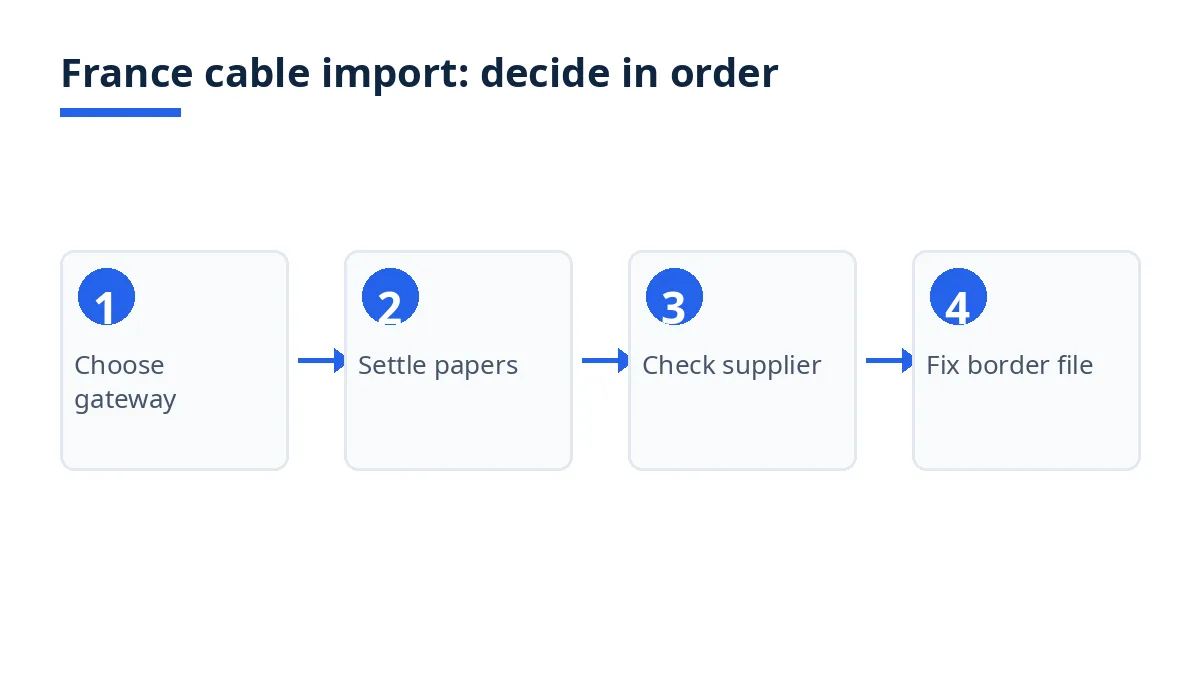
Decide in this order, and do not let a later step reopen an earlier one without recording the change. First, fix the destination, the installation setting, and the class answer from the person responsible for the installation design. Second, choose the gateway and the terminal, and get the forwarder to confirm the terminal, the storage terms, and the onward service in writing. Third, settle the European papers for the exact construction, including the declaration of performance, the voltage-band file, and the restricted-substances position. Fourth, score suppliers on the French file and approve a sample length in writing. Fifth, fix quantity, drum, and length terms, with the drum sequence agreed with the installer. Sixth, choose the delivery rule with named places and confirm who files the advance data and who owns the border file. Seventh, rework the landed-cost table with the broker figures and price from the reworked total. A buyer who follows that order will find that most problems surface as paper questions, where they are cheap, rather than as port problems, where they are not.
Which French port should a cable shipment from Bangladesh use?
Use Le Havre for Paris, the north, and the west, Fos-sur-Mer for the south and the Rhone valley, and a neighboring EU port only where the warehouse or first customer sits near that border and the broker confirms where clearance happens. The deciding facts are the terminal, the onward service in the delivery week, the storage terms at the terminal, and the customs office that clears the goods. A port chosen on ocean freight alone, without those four facts, is not a decision.
What fire class should a French building project specify for its cable?
The class comes from the project specification or the person responsible for the installation design, stated in writing for the exact construction and the exact building. EN 50575 provides the classification framework, from Aca to Fca with additional smoke, droplet, and acidity ratings, but the framework does not choose the class for a building.4 Ask for the class, the additional ratings, and the assessment system behind the declaration before ordering, and record the answer per site.
What import duty does a France buyer pay on electrical cables from Bangladesh?
This guide states no rate, because the rate depends on the full EU tariff code for the exact construction, the measures applying on the import date, and whether the origin rule and evidence support a preference. Bangladesh trades under Everything but Arms, which removes duty and quota on exports other than arms and ammunition, but the preference must be confirmed for the code and construction.12 Have the broker confirm, in writing, the code, the duty that applies without a preference, the preference position, and every other measure in force, and insert the confirmed figure into the landed-cost table before pricing.
How does a France buyer check a Bangladeshi cable supplier before the first order?
Send the same written request to each supplier, score the replies on papers that name the construction, direct answers on voltage band and restricted substances, numbered drum and length terms, and a named delivery rule with places. Approve a sample length in writing, keep a retained piece, and require bulk drums to match the sample on marking and labelling. Treat reluctance to answer a scope question, or papers that name a different construction, as a failed check, and move to the next supplier while walking away is still free.
Next steps on Exportain
Read the how to import from Bangladesh guide for the full import sequence behind this France guide, compare suppliers in the supplier directory on Exportain, and rework your figures with the landed-cost method for imports from Bangladesh before accepting a quotation. For the ordering route, see the buying steps on Exportain.
Post a free RFQ on Exportain and get quotes from verified Bangladeshi suppliers
Sources
- Multimodality. Port of Marseille Fos (accessed )
- Multi-purpose port. Port of Marseille Fos (accessed )
- Container terminals catalogue on the Seine axis, 2026 (English edition). HAROPA PORT (accessed )
- EN 50575:2014 - Power, control and communication cables - Cables for general applications in construction works subject to reaction to fire requirements. Slovenian Institute for Standardization, (accessed )
- IEC 60228:2023 - Conductors of insulated cables. International Electrotechnical Commission, (accessed )
- Low Voltage Directive. Eland Cables (accessed )
- RoHS Directive. European Commission (accessed )
- Place of delivery & risk transfer in trade contracts. ICC Academy (accessed )
- Economic Operators Registration and Identification number (EORI). European Commission, Taxation and Customs Union (accessed )
- Classification Detail — HS 2017 Code 8544: Insulated wire, cable and other electric conductors. United Nations Statistics Division (UNSD) (accessed )
- EU Customs Tariff (TARIC). European Commission, Taxation and Customs Union (accessed )
- EU trade relations with Bangladesh. European Commission, (accessed )
- Changes to import VAT in France come into effect January 1, 2022. Avalara (accessed )
About the author
Sourcing from Bangladesh?
Post a request for quotation and suppliers on Exportain can send you their quotes directly.
Post an RFQ