When Does Risk Transfer Under FAS? A Visual Guide for Importers
Definition
Under FAS (Free Alongside Ship, Incoterms 2020), risk passes from seller to buyer the moment the goods are placed alongside the vessel nominated by the buyer at the named port of shipment, on a quay or barge. From that point the buyer bears the risk of loss or damage, including during loading and the sea voyage, even though the goods are not yet on board. The seller remains responsible only until that alongside point, including export clearance.
Published 8 min read
On this page
Key takeaways
Under FAS, risk passes the moment the goods are placed alongside the vessel nominated by the buyer at the named port of shipment, on a quay or barge, before loading begins.
The buyer bears loading cost and risk, main carriage, import clearance and onward transport, while the seller bears inland transport and export clearance up to the alongside point.
Risk can pass early: if the buyer fails to nominate a vessel on time, communicate the loading point, or the nominated vessel does not arrive, risk passes from the agreed delivery date.
FAS imposes no duty on either party to arrange cargo insurance, so the buyer should arrange cover that starts at the alongside point and includes the quay period and loading.
Name the terminal or berth in the contract, not just the port city, and keep proof of delivery alongside the vessel, since claim outcomes turn on timing relative to that moment.
The shortest answer to the question in the title is a place, not a date. Under FAS, risk passes at the side of the ship: the moment the goods are placed alongside the vessel the buyer has nominated, at the named port of shipment, the seller's risk ends and the buyer's risk begins, even though the goods are still on the quay and not yet on board.
FAS stands for Free Alongside Ship, one of the 11 Incoterms 2020 rules published by the International Chamber of Commerce (ICC), which allocate cost, risk and obligations between seller and buyer.1 FAS is for sea and inland waterway transport only.2
What FAS means in plain English
Under FAS, the seller delivers when the goods are placed alongside the vessel nominated by the buyer at the named port of shipment, for example on a quay or a barge.2 The seller clears the goods for export and bears the cost and risk up to that alongside point. The buyer then takes over: loading, main carriage, import clearance and onward transport.3
Two limits shape every FAS decision. First, FAS fits cargo that can actually be placed at a berth, such as bulk, breakbulk or project cargo. It is a poor fit for containerized cargo, which typically goes to a container terminal and may sit there for days, so it is never truly alongside the ship in the way FAS envisions.3 Second, the vessel must actually be present: dropping cargo on the quay days before the ship arrives does not count as delivery under FAS.3
The risk-transfer moment, step by step
The diagram shows the risk line in five steps: everything before step 3 is the seller's risk, and everything from step 3 onward is the buyer's risk.
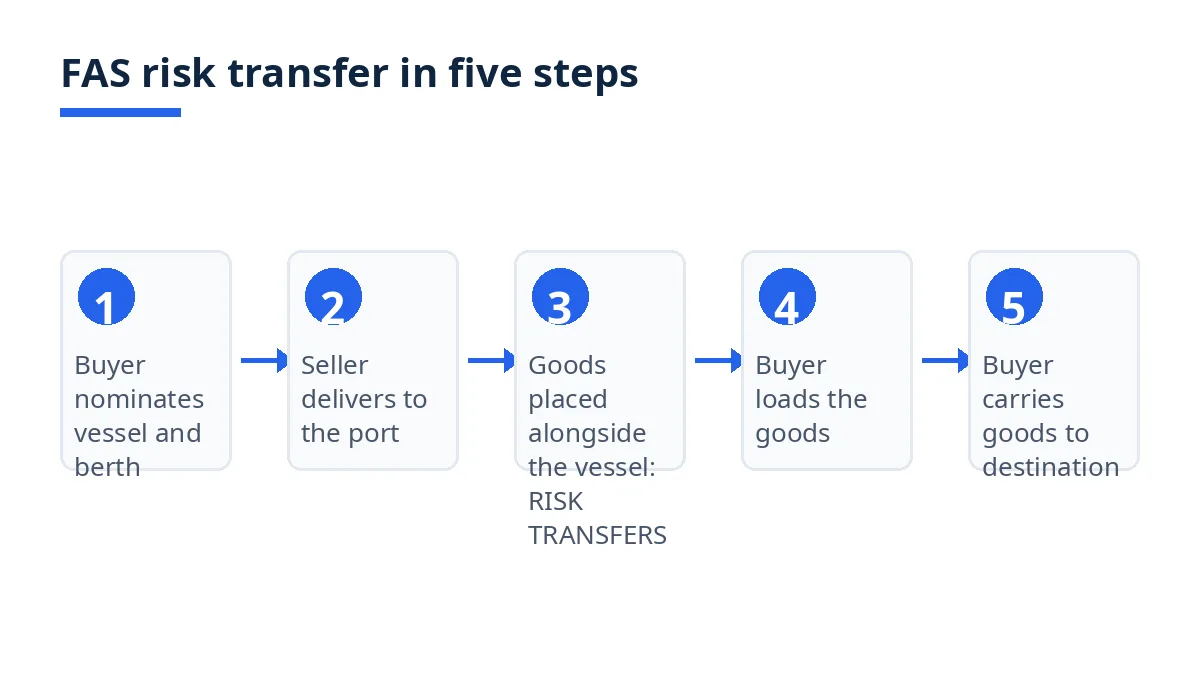
The buyer nominates the vessel and the loading point. The buyer must tell the seller the vessel name, the specific berth or loading point, and the delivery timeframe.3 Naming only a port city is not enough: cargo delivered to the wrong terminal is not alongside the buyer's vessel.
The seller moves the goods to the port and clears them for export. Export clearance falls entirely on the seller under FAS, and damage during inland transport or terminal movement toward the berth remains the seller's loss.3
The seller places the goods alongside the vessel. This is the delivery moment: risk of loss or damage passes to the buyer, and the buyer bears costs from that point forward.2 3
The buyer loads the goods at its own cost and risk. Loading is the buyer's responsibility under FAS, including crane or stevedore charges, unless the contract says otherwise.3 Crane damage during loading therefore falls on the buyer.
The buyer carries the goods onward. The buyer contracts the main carriage, pays the ocean freight, clears the goods for import, and arranges onward transport.3
Before and after the alongside point
Stage | Who bears the risk and cost |
|---|---|
Inland transport from factory to the port | Seller |
Export clearance | Seller |
Damage on the truck or in the terminal before the alongside point | Seller |
Damage on the quay after the goods are alongside the vessel | Buyer |
Loading the goods on board | Buyer |
Main sea carriage | Buyer |
Import clearance, duties and onward transport | Buyer |
The table states the default FAS allocation; a contract can change who pays for a specific item, but it should say so in writing.1
When risk passes early
Risk does not always wait for the alongside moment. If the buyer fails to nominate a vessel on time, fails to communicate the loading point, or the nominated vessel does not arrive, risk passes to the buyer from the agreed delivery date, provided the goods have been identified to the contract.3 The seller cannot be left carrying the risk indefinitely because the buyer's logistics failed. Buyers should therefore confirm vessel, berth and timeframe in writing, and tell the seller immediately if any of them changes.
Insurance and claims: what the transfer means in practice
FAS imposes no duty on either party to arrange cargo insurance. Unlike CIF and CIP, where the seller must arrange cover, FAS leaves insurance optional as a matter of contract.3 That silence creates one dangerous window: the goods sitting on the quay alongside the ship, but not yet loaded. The seller's inland transit policy will typically not extend past the delivery point, and the vessel's own insurance does not cover cargo that is not on board.3 A buyer using FAS should therefore arrange cover that starts at the alongside point, not at loading, and confirm it covers the quay period and loading.
When damage is discovered, the first question in any claim is timing: before or after the alongside moment. Proof of delivery alongside the vessel is therefore the key document, often a dock receipt or similar port documentation, rather than an on-board bill of lading, because the seller's obligation ends before loading.3 Sellers that need a copy of the bill of lading should negotiate that requirement into the contract in advance.3
A Bangladesh shipment, walked through the risk line
Consider a consignment of jute goods sold FAS from Bangladesh, with Chittagong as the named port of shipment. The walkthrough below is illustrative: it shows where the risk line falls, not prices or dates for any real shipment.
The seller clears the goods for export first. In Bangladesh, goods may not be loaded for export unless an export declaration, the Bill of Export or Shipping Bill, is submitted to Customs and approved, with the invoice, packing list, EXP form and certificate of origin enclosed.4 The seller then places the goods alongside the nominated vessel at the agreed berth, and risk passes.
Three damage scenarios show why the moment matters: damage on the road to Chittagong falls on the seller; storm damage on the quay after the goods have been positioned alongside the vessel falls on the buyer, even though loading has not started; and crane damage during loading also falls on the buyer, because loading is the buyer's operation and risk already passed.
FAS vs FOB and FCA: where the risk line moves
Rule | Risk passes when |
|---|---|
FAS | Goods are placed alongside the nominated vessel at the named port of shipment |
FOB | Goods are loaded on board the nominated vessel at the named port of shipment |
FCA | Goods are delivered to the buyer's carrier at the named place, which can be inland |
Common mistakes to avoid
Naming only the port, not the berth. A contract that says only a port city leaves the seller free to deliver to a terminal where the buyer's vessel is not berthed.
Behaving as if FAS were FOB. If both sides assume the seller will load, the dispute over crane damage during loading becomes expensive, because FAS places loading and its risk on the buyer.3
Leaving the quay window uninsured. Cover that starts at loading leaves the alongside period exposed. Confirm the policy covers the quay period and loading.3
Delivering before the vessel arrives. Cargo left on the quay days before the ship berths is not delivered under FAS, and the seller that treats it as delivered has not yet passed the risk.3
Using FAS for containerized cargo. Containers handed to a terminal do not sit alongside a ship in the FAS sense. FCA is the better fit for containerized shipments.3
How Exportain helps
On Exportain, browse suppliers and post the FAS terms on the RFQ board: the named port of shipment, the terminal or berth, the vessel nomination deadline, and the delivery period. Read how to buy before you post.5 A badge records checks the Exportain team has reviewed; it is not a guarantee of quality or delivery. Post a free RFQ on Exportain and get quotes from Bangladeshi suppliers through the RFQ board.
FAQs
What is FAS?
FAS, or Free Alongside Ship, is an Incoterms 2020 rule for sea and inland waterway transport: the seller delivers by placing the goods alongside the vessel nominated by the buyer at the named port of shipment, and risk passes at that moment.2 3
How does FAS work in practice?
The buyer nominates the vessel, berth and timeframe; the seller clears the goods for export and places them alongside the vessel; risk passes at that moment; the buyer then loads the goods and pays for main carriage and import clearance.3
Is FAS used for shipments from Bangladesh?
FAS can be used for sea shipments from Bangladeshi ports such as Chittagong where cargo can be placed alongside a nominated vessel at an agreed berth, with export clearance including an approved Bill of Export.4 For containerized goods, FCA usually fits better.3
What are common mistakes with FAS?
Naming only the port instead of the berth, treating FAS as if the seller loads, leaving the quay period uninsured, treating early delivery to the quay as delivery, and using FAS for containerized cargo.3 Each is preventable in writing before the vessel is nominated.
Next steps on Exportain
Read the Incoterms guide for shipments from Bangladesh to place FAS among the other rules, and the CIF cost, insurance and freight guide to compare a rule where the seller arranges cover. Before you post, read how to buy so your RFQ states the named port, berth and nomination deadline in full.
Sources
- Incoterms® 2020. International Chamber of Commerce (ICC) (accessed )
- Incoterms 2020 FAS: Spotlight on Free Alongside Ship. Shipping Solutions (accessed )
- Free Alongside Ship (FAS): Incoterm Rules Explained. LegalClarity (accessed )
- Customs Clearance Procedures for Export. Bangladesh Customs, National Board of Revenue (accessed )
- How to source and buy from Bangladesh. Exportain (accessed )
Reviewed by Naim Islam
About the author
Sourcing from Bangladesh?
Post a request for quotation and suppliers on Exportain can send you their quotes directly.
Post an RFQ