Top Jute Bags Manufacturers in Bangladesh: How to Find and Verify Them
No audited ranking of jute bag makers exists, so build your own shortlist. Here is how to find makers through the JDPC and verify them in four steps.
Short answer
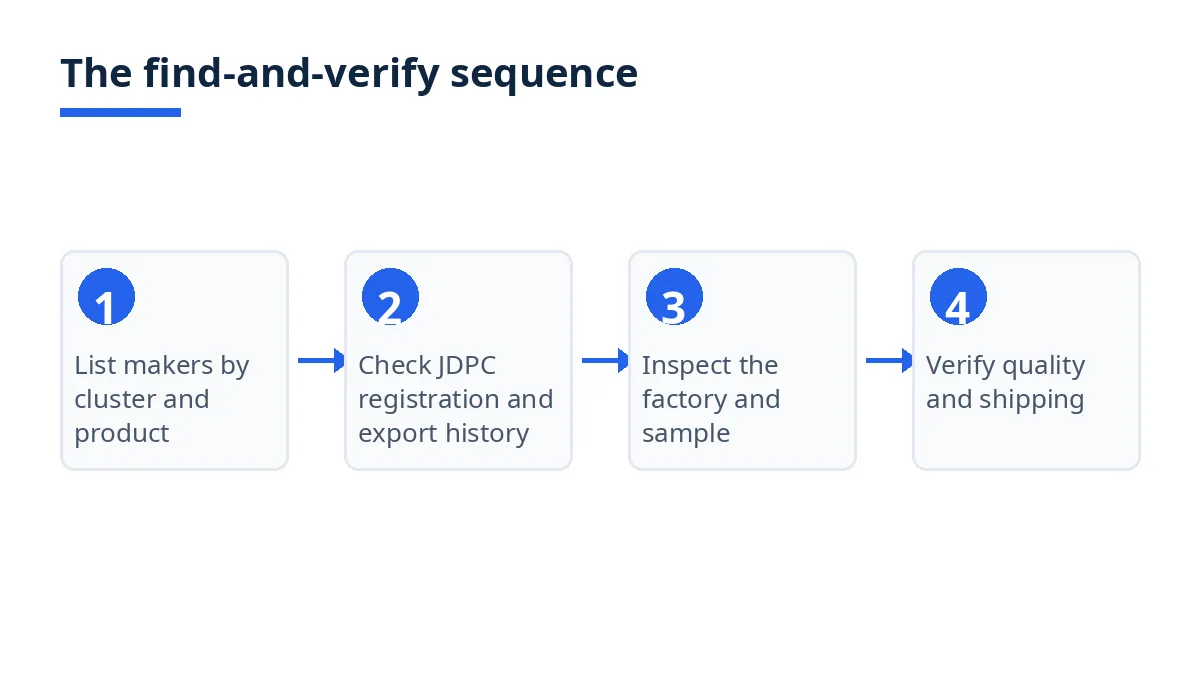
There is no published, audited ranking of jute bag manufacturers in Bangladesh, so build your own shortlist from the JDPC directory and verify each maker in four steps: business and JDPC registration, export history, factory inspection, and a sample made to specification. The JDPC was established in 2002, has 1,100 registered entrepreneurs and works with 282 product types, and the government offers a 20% cash subsidy on diversified jute exports.
On this page
Key takeaways
No audited ranking of jute bag manufacturers exists; build your own shortlist.
Start with the JDPC directory: 1,100 registered entrepreneurs, 282 product types.
Verify in four steps: business, export history, factory, sample.
A 20% cash subsidy applies to diversified jute exports with JDPC certification.
Approve the sample in writing before bulk production starts.
Bangladesh grows the jute, spins the yarn, weaves the fabric and sews the bags, all in one country. That makes it the natural place to buy jute bags, from plain shopping bags to laminated promotional totes and heavy-duty sacks. The question for a buyer is not whether Bangladesh can make the bag, but which maker to trust with the order. This guide explains how to find makers and how to verify them, because a shortlist built on checks is worth more than any ranking.
A note on the title: there is no published, audited ranking of jute bag manufacturers in Bangladesh, so this article does not present one. "Top" here means the makers that pass the checks below. Any guide that ranks factories without audit data is inventing its list, and a buyer that orders from an invented list is ordering on hope.
Where the makers are
The Jute Diversification Promotion Centre (JDPC) is the government body for diversified jute products, and it is the best starting point for a buyer. The centre was established in 2002, has 1,100 registered entrepreneurs, and works with 282 product types, supported by six Jute Entrepreneurs Service Centres in Dhaka, Rangpur, Jashore, Chattogram, Tangail and Jamalpur.1 A maker that is registered with the JDPC has a verifiable identity and a place in the official system; a maker that is not registered is not necessarily unreliable, but it is harder to check.
The product range is wide. The Daily Star reported 232 listed diversified jute products, and the government offers a 20% cash subsidy on diversified jute exports, with JDPC certification as the route to it.2 That matters for a buyer because a certified maker can price more keenly, and because the certification is itself a check: it confirms the maker is in the system and its products are recognised as diversified jute goods.2
Makers cluster around the jute mills and the ports. Dhaka and Narayanganj hold the largest concentration of bag makers, with Chattogram serving the export trade and the northern districts supplying raw jute and handloom fabric. A buyer that wants a large, machine-made order will look at Dhaka and Chattogram; a buyer that wants handloom fabric or a craft product will look further afield. The cluster to search depends on the product, not on the size of the maker's advertisement.
How to find makers
Start with the JDPC directory and the Export Promotion Bureau's exporter lists, then narrow by product. A maker of laminated shopping bags is not the same as a maker of heavy-duty sacks, and a maker that lists every product usually makes none of them well. Ask for the product list with the bag types the maker actually produces, and check whether it makes the fabric itself or buys it in: a maker that weaves its own fabric controls the quality and the lead time, while a maker that buys fabric is dependent on its supplier.
Trade fairs are the next step. Dhaka's jute and textile fairs bring the makers together, and a buyer that walks the fair can see the bags, feel the fabric, and meet the people who will make the order. Exportain's supplier search is another route: search Bangladeshi suppliers by product and read the profiles before making contact. Referrals from other buyers are the most reliable route of all, because a maker that has already shipped to a buyer in your market has already passed that market's checks.
How to verify a maker
Verification runs in four steps, and each step should be finished before the next one starts. The table below is the whole check in one place.
Step | Evidence to collect | What it tells you |
|---|---|---|
Business identity | Trade licence, export registration, bank details in the company name, JDPC certification where claimed | Whether the maker is a registered exporter, and whether the subsidy claim is real2 |
Export record | Two buyer references, shipping documents for a recent order with prices and buyer names blanked out | Whether the maker has shipped jute bags abroad, and to markets with real documentation rules |
Factory visit | A visit, or an inspector's report, covering the looms or fabric store, cutting, stitching, printing and packing, plus daily capacity and the current order book | Whether the maker can actually make your order on the date it promised |
Product sample | A sample made to your specification, approved in writing before bulk production, kept as the inspection reference | Whether the fabric, weave, stitching, handles and print match what you ordered |
A maker that has shipped to the European Union or the United States has already handled the labelling and documentation those markets require. A maker that has only sold domestically has not, and the first export order will be a learning exercise for both sides. On the factory visit, look at how the jute fabric is stored: jute absorbs moisture, and a damp store is a quality problem waiting to happen. And check the daily capacity against the delivery date: a maker that promises a date it cannot meet will either hand your order to another factory without telling you, or ship late.
What to check in the product
Jute bags fail in predictable places, and the inspection should cover each of them. Check the fabric weight and the weave: a bag that is lighter than specified will tear at the handles. Check the stitching, especially at the handle attachments and the base, where the load concentrates. Check the printing: jute is a rough surface, and a print that looks sharp on a sample can smudge in bulk if the ink and the fabric are not matched. Check the handles, the lining if there is one, and the finishing: loose threads, uneven seams and a musty smell are all signs of a maker cutting corners.
Our jute bags quality control checklist works through these checks in detail, and the HS code for jute bags explains the classification to use on the customs declaration. Agree the inspection standard before production starts, and use a third-party inspector for the first order with a new maker.
Costs and terms
Compare orders on landed cost, not on the factory price alone. The lines to add up are the factory price, the fabric cost where the maker buys it in, the printing and finishing, the freight, the insurance, and the duty and tax at destination. A maker that weaves its own fabric usually prices lower than one that buys fabric in, because it does not pay a middleman's margin on the main material.
Write the Incoterm into the order. FOB leaves freight and insurance with the buyer; CIF puts both with the seller; CFR splits them, with the seller paying the freight and the buyer the insurance.3 Payment is usually by letter of credit or by telegraphic transfer against the shipping documents. Confirm the minimum order quantity, the lead time, and who owns the printing plates or screens when the order ends.
Check | Evidence | Warning sign |
|---|---|---|
Business and JDPC standing | Trade licence, export registration, JDPC certification | Papers in another name, or no export registration |
Export record | Two buyer references, shipping papers for a recent order | No export shipments, or references that cannot be checked |
Factory and capacity | Visit or inspection report, daily output, order book | No visit allowed, or a date promised with no output behind it |
Product and sample | Sample built to specification, written approval before bulk | Bulk begun before the sample is approved |
Quality and inspection | Agreed inspection standard, third-party inspector | No inspection agreed, or cartons packed before approval |
Costs and terms | Landed cost, Incoterm, payment method, plate ownership | Factory price quoted without printing or freight costs |
Common mistakes
The first mistake is ordering from a ranking. No audited ranking of jute bag manufacturers exists, so a list that claims to rank them is a guess. Build your own shortlist from the JDPC directory and the checks in this guide, and let the factory visit decide.
The second mistake is skipping the factory visit. A maker that will not show you its looms, its fabric store or its stitching lines is a maker to pause on. Photographs are not a substitute for a visit, and a video call is not a substitute for seeing the fabric store.
The third mistake is approving a sample that is not made to specification. A sample in a heavier fabric than the bulk order, or with a different print method, is not an approval: it is a different product. Insist the sample is made to the exact specification, and keep it as the reference.
The fourth mistake is leaving the shipping term and the cover out of the contract. FOB puts the insurance on the buyer, CIF on the seller. A shipment lost or damaged at sea with no policy in place leaves the loss with whoever owned the goods.3
Next steps on Exportain
For the details behind this guide, read our jute bags quality control checklist and the HS code for jute bags. When you are ready, search Bangladeshi suppliers or post an RFQ — give the bag type, fabric weight, print method and quantity in the requirement — and see how to buy for the steps after you quote.
Sources
- Jute Diversification Promotion Centre: entrepreneurs and product types. Daily Sun (accessed )
- Diversified jute products: 232 listed items and 20% cash subsidy. The Daily Star (accessed )
- FOB vs CIF, CFR or DAP for Food Shipments. Maqboola (accessed )
About the author
Sourcing from Bangladesh?
Post a request for quotation and suppliers on Exportain can send you their quotes directly.
Post an RFQ