Quality Control Checklist for Jute Bags From Bangladesh
Jute bags quality control checklist for Bangladesh orders: weave and fabric, measurements, stitching, handles, lining and lamination, printing, odour and mould checks, labels, buyer-specified tests, and bale and carton packing, with a numbered checklist, failure fixes, and a summary table.
Short answer
This jute bags quality control checklist covers weave and fabric checks, measurements, stitching and seam construction, handle and strap attachment, lining and lamination, printing, odour and mould checks, labels, buyer-specified tests, and bale and carton packing, with a numbered checklist, a published-table sampling example, failure fixes, and a summary table.
On this page
A jute bag fails in ways photographs hide: a handle that looks anchored can part at the first loaded carry, a seam that looks closed can open along the base, and a bale that looks dry can carry mould found only after the container is opened. Jute is coarse, and weave, stitching and finish vary by lot, so checking only the outside of a bag says little about whether the order will hold up.
A jute-bag check has to start with the fabric and end with the bale. Tighter weaves indicate higher strength, while large gaps in the surface suggest a bag that may tear easily.1 Jute fabric is described in hessian, plain weave and twill weave forms, and its treatments include lamination and dyeing.2 Jute also absorbs moisture quickly and can be prone to mould if it is not treated or stored properly.2
Why this checklist matters
Most jute-bag complaints trace back to a few construction points. Stitching quality is judged by double or triple stitching at stress points such as handles and corners, and lockstitch is described as more durable than chain stitch.1 Handles should be securely anchored, with canvas reinforcement at the joints on some models.1 Printed bags carry a further risk: ink quality varies, and low-grade dyes may fade or leach.1 Laminated bags add a water-resistant inner layer, which changes how the bag should be checked.1
Writing these points down before production changes the inspection. The checklist below turns each point into a pass, fail or not-applicable decision, tied to an approved bag and a specification, so a later disagreement is about evidence, not memory.
Before you start
Freeze the reference set: one sealed approved bag per style and colour, tech pack, measurement chart with tolerances, fabric standard, artwork, labels, barcode, and packing specification. Bag type matters: a tote, a heavy-duty bag and a laminated bag are judged on different points.1
Agree three things in writing in the purchase order: the defect list, each defect classed as critical, major or minor, with reference photographs for borderline cases; the sampling plan, with the standard, level, and acceptance and rejection numbers per class; and the buyer-specified tests, each named with its method and result. AQL, defined in ISO 2859-1, sets how many units to sample and how many defective units can be found before the lot is rejected.3 No test here carries a universal pass mark: name the method, record the result, and judge it only against the value written in the order. Book final inspection when production is complete and goods are mostly packed: a pre-shipment inspection samples finished, mostly packed goods, not every piece, and is not a guarantee.4
The full checklist (numbered, printable)
Tick each item Pass, Fail, or Not applicable.
Approved bag and style map. Each style and colour has its own sealed approved bag, so a laminated tote is never judged against an unlined sack.
Fibre and fabric identity. Check the fibre, any blend, and the fabric against the approved bag and the order.1
Weave type and density. Check the weave type, hessian, plain weave or twill, and feel for large gaps.1 2
Weave faults. Check for holes, broken yarns, slubs and thin places, photographing any fault with its position.
Fabric weight as a buyer-spec item. Where the order names a fabric-weight test, record the method and the result against the order value only.
Shade and colour. Check colour evenness within each bag and across the lot against the approved bag under the agreed light.2
Measurements. Measure length, width, gusset, base and height against the chart, flat and without stretching the fabric.
Handle length and drop. Measure each handle against the chart, and compare both handles on the same bag.
Shape and symmetry. Check squareness, straight side seams, and a base that sits flat.
Stitching and seams. Check thread lines, broken or skipped stitches, open seams, puckering and loose ends at handles and corners.1
Seam strength as a buyer-spec item. Where a seam-strength test is named, record the method, result and seam tested, against the order value only.
Handle attachment. Check handle material, width and anchoring against the approved bag, including joint reinforcement.1
Handle pull by hand. Pull each handle by hand as specified, and record slipping stitching, tearing at the joint, or a detached handle.
Straps and hardware where fitted. Operate any adjustable strap, buckle or fitting, and check anchoring and hardware fixing against the approved bag.
Lining fit and attachment. Check lining material, fit and attachment against the approved bag, with no bunching or loose lining seams.
Lamination as a buyer-spec item. Where lamination is specified, check coverage, adhesion and edge sealing, and record any peeling or bubbling.
Closures. Operate every zip, drawstring, button, snap and flap, checking for snagging, a zip that will not close, or a drawstring that pulls free.
Printing. Check print position, spelling, colour, registration and coverage against the artwork, and note smudging, fading or ink transfer.1
Embroidery and applique where fitted. Check stitch coverage, thread ends and attachment against the approved bag.
Pockets, inserts and base boards. Check pocket position and stitching, any rigid insert for shape retention, and base-board fit.1
Odour check. Check for a strong chemical smell or odour atypical of jute, which may indicate synthetic treatments or poor-quality dyes.1
Dampness, mould and soiling. Check the bag and its packing for dampness, mould, mildew, stains and dirt, and photograph affected bags.1 2
Labels and barcodes. Check fibre, care, size and origin labels for correct content and spelling in position, and that the barcode scans and matches the carton.
Buyer-specified lab tests. Where the order names colourfastness, fabric-weight or seam-strength tests, each runs by its named method, result recorded, with no universal grade applied.
Metal and needle check where required. Where the order requires it, pass sampled bags through metal detection and record the result.
Quantity and assortment per carton. Count bags per carton and per bale against the packing list, by style and colour, and record any shortage or mixed assortment.
Bale and carton packing. Check packing as specified: count, folding, covering, moisture protection where specified, and carton or bale condition, with no crushing.
Shipping marks. Check carton and bale marks, numbering and handling marks against the packing instructions.
Sampling decision on the finished, packed lot. As a published-table example only, a lot of 501 to 1,200 jute bags at General Inspection Level III gives code letter K and a sample of 125 bags.3 With buyer-specified AQL 2.5 for major and AQL 4.0 for minor defects, the published table gives 7 and 8 for major defects and 10 and 11 for minor defects.3 Those are buyer-agreed order values from the published table, not standard-mandated values for jute bags.5 A pre-shipment inspection samples finished, mostly packed goods, and is not a guarantee.4
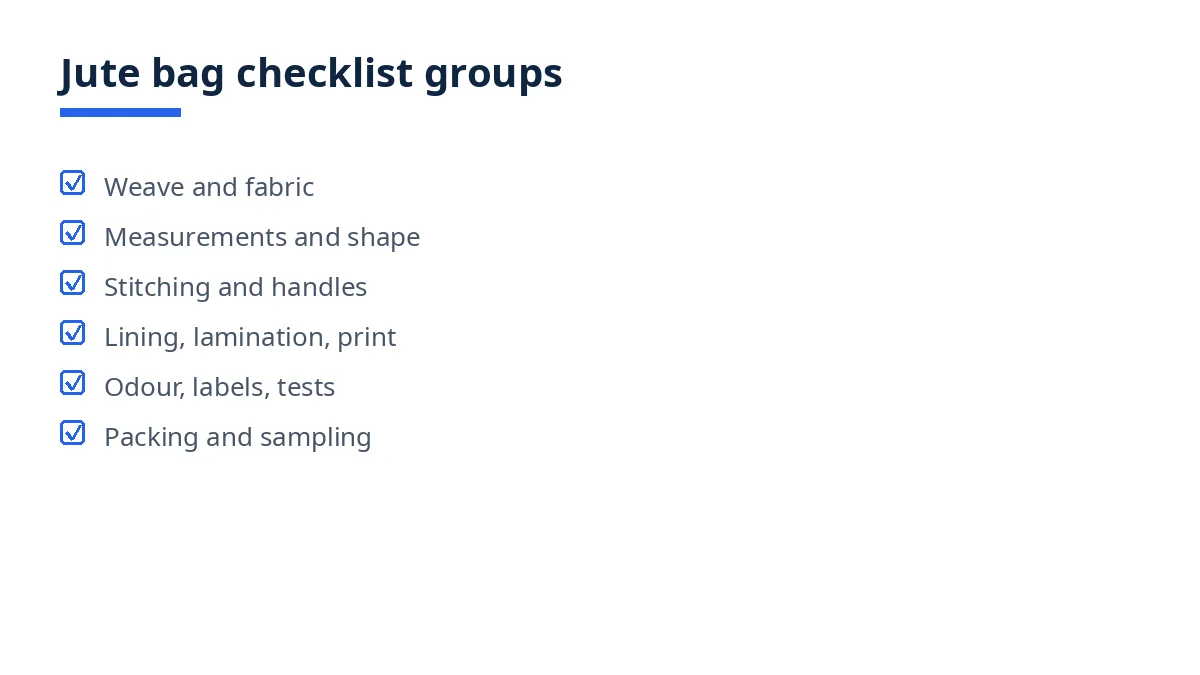
Diagram: jute bag checklist groups.
Common failures and how to fix them
Handle parting at the joint. A handle that pulls free points to anchoring or reinforcement on that run. Hold the run, check joint stitching, and re-check after rework.
Seam opening along the base. A base seam opening while side seams hold points to base seam construction, not the fabric. Isolate the style, rework the base seam, and re-check on a fresh sample.
Loose weave with gaps in the panel. A panel showing gaps while others do not points to fabric lot variation. Hold the lot, compare weave density, and segregate the faulty fabric.
Print smudging or misaligned artwork. Print that smudges or sits off position points to ink or registration on that run. Hold the lot, compare with approved artwork, and re-print or reject it.
Lamination peeling at the edge. A layer lifting at an edge or bubbling points to adhesion on that batch. Hold the batch, check edge sealing, and re-check adhesion after rework.
Mould or dampness in the bale. Bags smelling damp or showing mould inside packing point to storage or packing before shipment. Hold the bale, dry and re-check as the order allows, and trace storage conditions.
Shade split across cartons. Bags matching under one light and differing under another point to dye lots or lighting. Re-check under a second light, trace the lot, and keep dye lots apart.
Downloadable template / summary table
No file download is offered with this article. The table below is the template.
Group | What to record | Result |
|---|---|---|
Weave and fabric | Weave type, faults, fabric weight, shade | Pass/fail |
Measurements and shape | Length, width, gusset, handles, symmetry | Pass/fail |
Stitching and handles | Seams, handle attachment, hand pull | Pass/fail |
Lining, lamination, print | Lining, lamination, closures, print | Pass/fail |
Odour, labels, tests | Odour, mould, labels, barcode, lab tests | Pass/fail |
Packing and sampling | Counts, bale packing, marks, sampling | Pass/fail |
For sampling, use your agreed plan values; item 29 shows a Level III plan for 501 to 1,200 bags.
How Exportain helps
Exportain connects international buyers with Bangladeshi sellers and service providers; buyers can post a requirement describing bag style, fabric, print and inspection scope. The inspection services category page currently shows "No services published in this category yet", so confirm any provider, scope and price directly before booking. The inspection contract is between buyer and provider, and Exportain does not inspect goods.4
FAQs
When should this checklist be used?
Use it once the approved bag per style and colour is sealed, during production, and at final inspection on finished, packed goods.
Who should complete it?
The buyer writes the checklist and defect list; an independent inspector or the buyer's quality team completes the checks against the agreed plan.
What are the most common failures?
A handle parting at the joint, a base seam opening, a loose weave with gaps, smudged or misaligned print, lamination peeling at the edge, mould or dampness in the bale, and a shade split across cartons. Record style, colour and carton number with every failure.
Can a third party do it?
Yes. A third-party firm works to the buyer's checklist and pass criteria, and the booking party receives the report.4 Agree scope, sampling plan, tests and re-inspection payer first.
Next steps on Exportain
Read the AQL acceptance quality limit guide for the code letter and sample size for your lot.
Read the pre-shipment inspection guide for the timing and scope of the final inspection.
Browse the inspection services category, which currently shows "No services published in this category yet", and confirm any provider directly.
Sources
- How to Choose the Best Jute Bags: A Complete Buying Guide. Alibaba (accessed )
- What is Jute Fabric: Properties, Varieties, Uses & Global Market. Fibre2Fashion (accessed )
- AQL Calculator | Sample Size and ISO 2859-1 Tool. AQMBD (accessed )
- Pre-Shipment Inspection (PSI). Exportain (accessed )
- AQL Meaning: Acceptance Quality Limit, Tables. Exportain (accessed )
About the author
Sourcing from Bangladesh?
Post a request for quotation and suppliers on Exportain can send you their quotes directly.
Post an RFQ