Typical MOQ for Jute Rugs and Carpets in Bangladesh
A US buyer needs 300 hand-braided jute rugs; the maker quotes 100 per size per colour. How rug minimums are counted, why weave, size and dye lot move them, and how to negotiate the number down.
Short answer
A typical MOQ for jute rugs and carpets in Bangladesh starts at 50 to 100 rugs per size per colour, with dyed, tufted and hand-knotted rugs higher. The floor comes from the loom or braid setup, the dye lot and packing, and it is usually quoted per size and per colour, not per order. Cut colours before sizes, share a dye lot, commit repeat volume and pay a deposit to bring it down.
On this page
Key takeaways
Rug minimums in Bangladesh start at 50 to 100 rugs per size per colour, and the number is usually quoted per size and per colour, not per order.
Weave, size and dye lot set the floor: braided and hand-knotted rugs carry more hand work, large sizes cost more per piece, and each colour needs its own dye lot.
A dye lot is usually three to five times the factory's own minimum, so a 100-rug quote can hide yarn dyed for 300 rugs.
Example figures cut a 600-rug ask to a 300-rug first order for a US buyer at 7,250 dollars, with a 300-rug sage repeat at 6,800 dollars.
A home-goods buyer in the United States wants hand-braided jute rugs in three sizes for a spring range. The maker in Bangladesh replies with a minimum of 100 rugs per size per colour. The buyer needs 300 rugs in total, not 600. The gap is how a rug minimum is counted.
One Bangladeshi exporter publishes rug minimums starting at 50 to 100 units, against 500 to 1,000 pieces for bags.1
What a rug MOQ counts: pieces, sizes and colours
A minimum order quantity is the smallest quantity a supplier will produce or sell in a single purchase order, and it exists because every production run carries fixed costs that must be recovered regardless of volume.2 For rugs, the unit is the piece: there is no bale to fill and no spinning batch to spread.
The number almost always applies per size and per colour, not per order. A maker that quotes 100 rugs may mean 100 rugs of one size in one colour, so three sizes in two colours is six separate minimums and 600 rugs. A 500-unit minimum per variant across eight colours and four sizes becomes a 16,000-unit commitment.2 Ask in writing whether the quoted minimum is per order, per size, per colour, or per size and colour together.
Why the minimum moves with the weave
Rugs from Bangladesh come in four main constructions, and the construction decides how much hand work each rug carries, which decides the floor. Our manufacturers guide for jute rugs and carpets sets out the four constructions and how to check each one.
Construction | How the rug is built | Why the minimum sits where it does |
|---|---|---|
Braided | Yarn braided into rope, stitched in a spiral | High hand work, floor per size and colour |
Flatweave | Warp and weft crossed on a loom, no pile | Fast loom runs, usually the lowest floor |
Tufted | Yarn punched through backing, second backing glued on | Backing adds a second setup, so the floor rises |
Hand-knotted | Knots tied one by one, pile cut by hand | Slowest build by far, so the floor is the highest |
Braiding suits the coarse, firm jute yarn, and the work is done by hand in small workshops and in larger units too, which is why braided rugs are a common Bangladeshi export form.3 Flatweave rugs are thin and flexible and produced in high volumes.1
Size moves the number too: a maker offers custom sizes from 2 by 3 feet to 12 by 14 feet, with fabric weights between 180 and 350 grams per square metre.1 A large rug uses more yarn, braid and floor space per piece, so the same 100-rug minimum costs far more in a large size.
The three costs behind the number
Three costs set a rug minimum.
The first is the loom and braid setup: machine calibration, tooling changes, raw material staging and quality control setup cost the same whether the maker produces 100 units or 10,000.2 A size the maker already weaves needs no new setting, while a new size means a run of its own.
The second is the dye lot, and it is the one buyers most often miss. A dye lot is fabric coloured together in one run, and it is the smallest quantity a mill will dye in one colour in one batch, usually three to five times the factory's own minimum.4 A quote at 100 rugs can be honest about the braiding and still leave the dye question open, because the mill still dyes enough yarn for 300 rugs and folds the difference into the unit price.4
The third is packing and the shipment. Rugs ship rolled or folded in cartons, and a part-filled carton still pays for the carton and the handling. Shipping small volumes internationally is disproportionately expensive per unit, and full container loads against less-than-container loads create strong incentives for minimum volumes that fill a container.2
What the usual minimums look like by construction
There is no published standard minimum for jute rugs: each maker sets its own floor per construction, size and colour, so the bands below are indicative enquiry bands, labelled example figures, built around the one published rug figure available: a Bangladeshi exporter lists rug minimums starting at 50 to 100 units.1 Jute and jute goods earned Bangladesh 820.16 million dollars in exports in fiscal year 2024-25, with jute yarn and twine at 461.83 million dollars.5
Construction and finish | Indicative band per size per colour | What usually sets it |
|---|---|---|
Flatweave, natural, standard size | 50 to 100 rugs | Loom run already set, no dye lot |
Braided, natural, standard size | 50 to 100 rugs | Braid and stitch setup per size |
Braided, one dyed colour | 100 to 200 rugs | Dye lot on top of the braid setup |
Flatweave, Pantone-matched colour | 100 to 200 rugs | Dye lot plus shade matching |
Tufted, with latex or felt backing | 100 to 200 rugs | Backing step and glue setup |
Hand-knotted, any finish | 200 rugs or more | Slowest build, highest hand work per rug |
Sample MOQ is a different number
The sample and the bulk order run on different minimums. Export-grade samples are usually sent by courier within 5 to 7 business days, and makers offer free or paid samples depending on the product type and order volume.1 A sample rug is made to your size, construction and shade, and it is the reference the bulk lot is judged against.
Never pay in full for the bulk order before the sample is approved: approve the sample rug unrolled, keep one sealed as the reference, and only then release the bulk deposit. Bulk lead times run 2 to 6 weeks.1
Four ways to bring the number down
The number falls when the run behind it changes, not when you ask for a favour.
Share a dye lot that is already running
Ask which shades are already scheduled in the next four to six weeks, and whether your rugs can join that dye lot: it asks the maker to add to a batch it is running anyway, while a smaller lot of its own is the thing it is set up not to do.4
Take the standard shade and the standard size
Start with the size and shade the maker already produces: standard sizes from 2 by 3 feet to 12 by 14 feet, in natural jute or a shade already on the maker's card, need no new loom setting, braid pattern or dye lot.1 Pure jute rugs stain more easily than blends, while a cotton blend adds softness and is often reversible.3
Commit the volume and split the shipment
Agree a larger total in writing and take it in parts: settle the full quantity for six to twelve months and ship part of it now.2
Pay more per rug, and pay earlier
A maker that waits for payment carries the cost of the yarn, the dye lot and the packing until the money arrives. Offer a larger advance for a smaller first quantity: a 30 to 50 per cent advance reduces the maker's financial risk and often opens a lower minimum threshold.2 You rarely get both a low minimum and the lowest price, so a small premium per rug costs far less than holding 300 rugs you do not need.
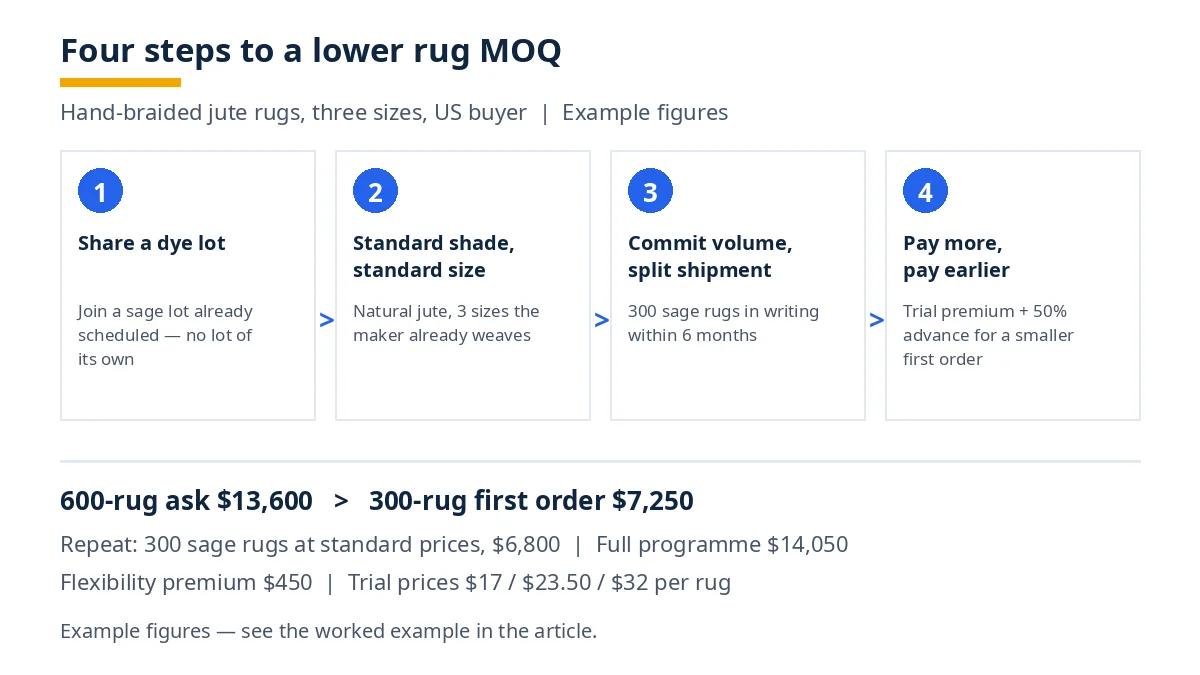
The diagram below sets out the negotiation in four steps.
Worked example: hand-braided rugs in three sizes for a US buyer
Example figures. A home-goods buyer in the United States orders hand-braided jute rugs from a maker in Bangladesh: three sizes, two colours, natural and sage. The maker quotes a minimum of 100 rugs per size per colour at 16 dollars for the small rug, 22 dollars for the medium and 30 dollars for the large. The buyer needs 300 rugs in total, not 600.
The buyer asks which minimum binds. The maker answers that the floor comes from the dye lot for the sage colour, and that the natural rugs carry no dye lot. The buyer drops the sage colour from the first order, takes the natural shade across all three sizes, and commits in writing to 300 sage rugs within six months at the standard price.
Line | Original ask | Agreed first order |
|---|---|---|
Quantity | 600 rugs, 3 sizes × 2 colours | 300 rugs, 3 sizes × 1 colour |
Small rug, 90 by 150 cm | 200 rugs at 16 dollars | 100 rugs at 17 dollars |
Medium rug, 120 by 180 cm | 200 rugs at 22 dollars | 100 rugs at 23.50 dollars |
Large rug, 160 by 230 cm | 200 rugs at 30 dollars | 100 rugs at 32 dollars |
Goods value | 13,600 dollars | 7,250 dollars |
Repeat commitment | None stated | 300 sage rugs within 6 months at 16, 22 and 30 dollars |
The first order is 100 small rugs at 17 dollars, 100 medium at 23.50 dollars and 100 large at 32 dollars: 1,700 plus 2,350 plus 3,200 dollars, or 7,250 dollars, a premium of about 7 per cent on each size. The repeat order is 300 sage rugs at the standard prices, or 6,800 dollars. The full 600-rug programme then costs 14,050 dollars, against 13,600 dollars for the original ask: 450 dollars for the flexibility.
Those terms go into the proforma invoice: 300 natural rugs now, the trial prices per size, and 300 sage rugs at the standard prices if the range sells.
Common mistakes that push the minimum back up
Asking for a rug count when the maker sells per size per colour: 300 rugs across three sizes and two colours is six minimums, not one. Splitting one order across three shades: each shade needs its own dye lot. Paying in full before the sample is approved: approve the sample rug first, then pay the bulk deposit. Accepting a minimum above 4 to 6 months of projected demand, or above 30 to 40 per cent of available working capital on one stock line, is typically too high for a new relationship.2
Locking the agreed minimum into the order
Write the agreed minimum into the order before anything else. The order should state the construction, the blend as a percentage, each rug size, the shade with its dye lot number, the backing where the rug has one, and the price for the first order and for the repeat. Record those terms on the proforma invoice and the purchase order. Judge the bulk lot against the values in the order, using our rug quality control checklist as the reference. Confirm the classification with your broker and put the HS code on the invoice: most jute rugs fall under heading 5705, as our HS code classification for rugs and carpets sets out. Keep one approved sample rug sealed as the reference for the bulk lot.
Questions buyers ask about rug MOQs
Is there a standard MOQ for jute rugs in Bangladesh?
No. There is no published standard minimum for jute rugs: each maker sets its own floor per construction, size and colour. One exporter publishes rug minimums starting at 50 to 100 units.1
Can I order fewer rugs if I pay more per rug?
Often yes. A higher per-unit price lets the maker recover the same fixed costs across fewer rugs, and a packaged proposal offering a higher price for a 30 to 40 per cent lower minimum is more likely to be accepted.2
Next steps on Exportain
Start with our manufacturers guide for jute rugs and carpets to shortlist makers by construction, then set the inspection points with our rug quality control checklist. Then open search Bangladeshi suppliers and post an RFQ for the range, stating construction, sizes, shade and quantity per size per colour.
Sources
- Wholesale Woven Jute Bags & Rugs From Bangladesh. Imperial Jute (accessed )
- MOQ (Minimum Order Quantity) Explained: Complete Guide for Manufacturers & Distributors. GTsetu (accessed )
- What Is a Jute Rug? Complete Guide to Natural Fiber Rugs. Base Handicrafts, (accessed )
- Why the fabric minimum is bigger than the factory's MOQ. Splot (accessed )
- Exports of jute and jute goods keep falling. The Financial Express, (accessed )
About the author
Sourcing from Bangladesh?
Post a request for quotation and suppliers on Exportain can send you their quotes directly.
Post an RFQ