CIP vs DPU: Key Differences, Costs and Which One to Choose
CIP buys a Clause A policy inside the seller price but hands the risk to you at origin; DPU keeps the seller responsible until the yarn is unloaded at your warehouse. Compare the cover, the cost split and a worked jute yarn shipment to Leeds.
Short answer
Under CIP the seller pays carriage to the named destination, buys Clause (A) cargo insurance, and the risk passes to you when the goods reach the first carrier in Bangladesh. Under DPU the seller pays the carriage, carries the risk to the named place and unloads the goods there, with no insurance duty. Import clearance, duty and taxes stay with you under both rules. Choose CIP for a claimable policy; choose DPU for delivery set down at your warehouse.
On this page
Key takeaways
CIP and DPU both put the carriage on the seller; the split is insurance and unloading. Under CIP the seller buys Clause (A) cover for your benefit, under DPU no rule obliges either side to insure.
Risk passes at the first carrier handover in Bangladesh under CIP, and only after unloading at your warehouse under DPU.
DPU is the only Incoterms 2020 rule that makes the seller unload; under the other ten rules, unloading at destination is the buyer's job unless the contract says otherwise.
Example figures price the same jute yarn shipment at $22,643 under CIP and $22,783 under DPU; the $140 gap is the unloading margin alone.
A buyer in Leeds orders 20 tonnes of jute yarn from a supplier in Narayanganj and asks for two quotations: CIP Leeds and DPU at the buyer warehouse in Leeds. The yarn, the vessel and the sailing are the same, yet the two prices answer different questions. The CIP price buys a named insurance policy inside the seller price. The DPU price buys delivery after the yarn has been lifted off the truck at the warehouse, with no policy promised by either rule. The freight is the seller's under both terms, so the choice turns on cover and on unloading, not on who books the ship.
The insurance question first: a policy in the price, or risk carried to your door
CIP stands for Carriage and Insurance Paid To. DPU stands for Delivered at Place Unloaded. Both are among the eleven rules of Incoterms 2020, published by the International Chamber of Commerce and in force since 1 January 2020.1 Both put the main carriage on the seller. The split runs through two places: where the risk moves, and whether a policy exists at all.
Under CIP, the risk moves to you when the seller hands the goods to the first carrier in Bangladesh, even though the seller keeps paying the carriage to Leeds.2 The seller must also buy cargo insurance for your benefit. Under DPU, the seller keeps the risk for the whole journey and hands the goods over only once they have been unloaded at your warehouse.2 The rule asks neither side to buy a policy.3
What CIP gives you: Clause A cover bought for your benefit
Under CIP the seller must obtain cover under Institute Cargo Clauses (A), or equivalent wording, for 110 percent or more of the contract price, or a lower figure where the contract says so in writing.4 The policy must be issued in your favour, so you can claim on it directly. The 2020 edition lifted the CIP floor from Clause (C) to Clause (A); the 2010 edition had asked only for Clause (C).1
Clause (A) is the widest of the three standard clause sets published by the Lloyd's Market Association and the International Underwriting Association, in the edition dated 1 January 2009.4 It pays for loss or damage from any accident the wording does not exclude, while Clauses (B) and (C) pay only for perils on their list, and the Clause (C) list is the shortest.4 Theft, pilferage and handling damage are covered under Clause (A) only.4
For jute yarn, the losses that happen are the ones Clause (A) answers:
Loss to the jute yarn | Clause A, the CIP minimum | No policy in place |
|---|---|---|
Bales soaked by rain on the quay at Chattogram | Covered | No payment |
Bales missing after pilferage at a transit port | Covered | No payment |
Bales crushed by rough handling during loading | Covered | No payment |
Clause (A) is broad rather than boundless. The same causes sit outside all three clause sets: wilful misconduct, delay, war and strikes unless bought under separate wordings, packing unfit for the journey, inherent vice, and ordinary leakage and wear.4 The premium is folded into the seller price, which means the seller picks the insurer and the excess, not you. Across the eleven rules, an insurance duty falls on the seller in two cases only: CIF and CIP.4 For sea cargo, cover ends 60 days after discharge from the vessel.4
What DPU gives you instead: delivery after unloading, no policy promised
Under DPU the seller delivers the goods, and the risk moves, once the goods are off the arriving vehicle and set down at your disposal.2 The seller answers for every risk of the trip to the named place, including the unloading itself.2 DPU is the single rule in the set that makes the seller unload; under the other ten, unloading at destination is your job unless the contract says otherwise.2
DPU took its name in the 2020 revision: the old Delivered at Terminal (DAT) label gave way to Delivered at Place Unloaded, because the delivery point can be any place and not only a terminal, and because DAP, the neighbouring rule, leaves unloading to the buyer.1
DPU asks neither party to obtain cargo insurance.3 Because the seller holds the transit risk until the yarn is set down, it normally takes out cover of its own, although the rule asks for none.3 That cover protects the seller, not you: you cannot claim on it. If you want a policy you can claim under, write the clause set, the sum insured and the payer into the contract before shipment. Our DPU price guide shows what sits inside a DPU price.
Only DDP shifts import clearance and duty to the seller; DPU leaves both with you.3 The worked example below prices every line, so you can see which side pays each cost.
Worked example: 20 tonnes of jute yarn from Chattogram to Leeds
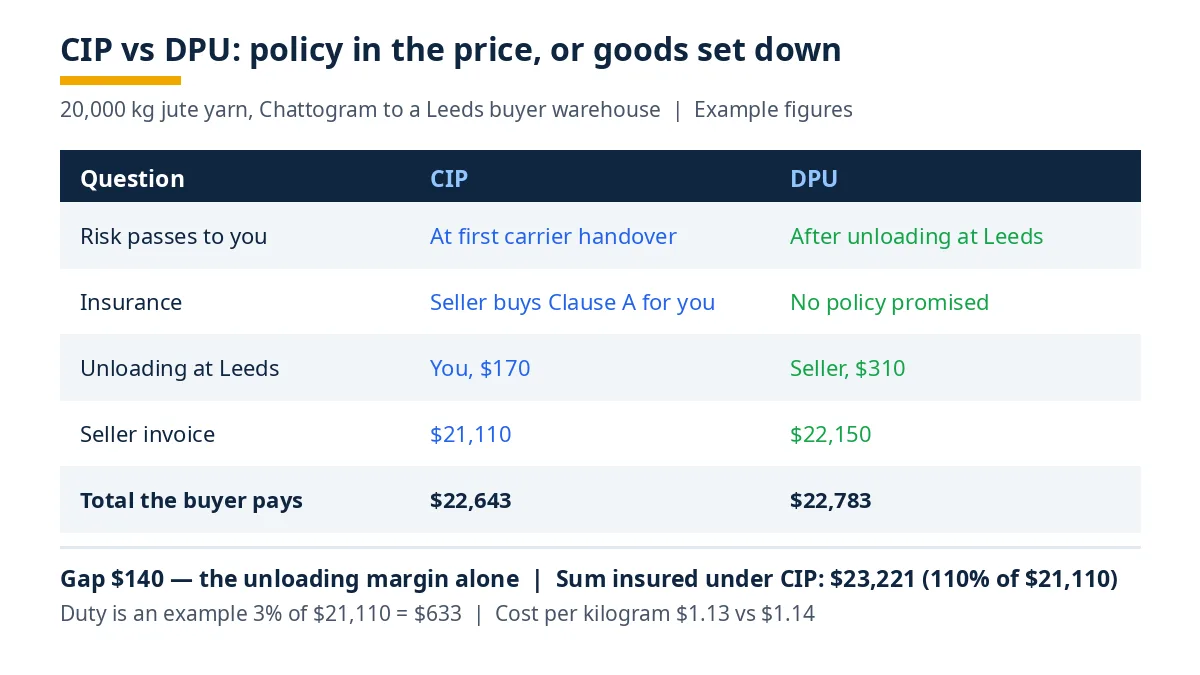
Example figures. A buyer in Leeds orders 20,000 kilograms of jute yarn from a supplier in Narayanganj, goods worth $18,400, shipped in one 40-foot container from Chattogram to Felixstowe and by road to the buyer warehouse in Leeds. The figures are illustrative.
Cost line | Under CIP | Under DPU |
|---|---|---|
Goods, packing, inland carriage, export clearance | $18,400, in the seller price | $18,400, in the seller price |
Ocean freight, Chattogram to Felixstowe | $2,480, paid by the seller | $2,480, paid by the seller |
Cargo insurance premium, Clause A | $230, inside the seller price | $230, paid by the seller |
Terminal handling at Felixstowe | $310, paid by the buyer | $310, paid by the seller |
Road carriage to the Leeds warehouse | $420, paid by the buyer | $420, paid by the seller |
Unloading at the Leeds warehouse | $170, paid by the buyer | $310, paid by the seller |
Import duty, example 3% of $21,110 | $633, paid by the buyer | $633, paid by the buyer |
Total the buyer pays | $22,643 | $22,783 |
Cost per kilogram | $1.13 | $1.14 |
Under CIP the seller invoice is $21,110 and the buyer pays a further $1,533. Under DPU the seller invoice is $22,150 and the buyer pays only the $633 duty. The totals differ by $140, the unloading line alone: $310 under DPU against $170 under CIP.
Duty is an example 3% of $21,110: $633.30, rounded to $633. The CIP policy must cover 110 percent or more of the contract price — $23,221 on $21,110.4 A buyer with no policy under CIP would show $22,413, $230 below the insured CIP total. That $230 is not money saved: it is the price of carrying the whole exposure on $18,400 of yarn with nothing to claim under. Our CIP vs DAP guide works through the same cover question where the goods stay on the truck.
Import clearance in the UK: still the buyer's job
Under both, the seller clears the goods for export in Bangladesh, while you act as importer of record in the UK and settle the duty and taxes.3
For imports into the United Kingdom, the value for import VAT starts from the customs value for duty. You must add incidental expenses such as transport and insurance costs incurred up to the first destination in the UK, plus any customs duty payable.5 If a further destination in the UK is known at the time of import, the transport costs to that place must be included as well.5 Confirm the customs value, classification and VAT treatment with your customs broker before the vessel sails.
Five mistakes buyers make with CIP and DPU
Reading a DPU price as an insured price. DPU promises delivery after unloading, not a policy. The seller usually insures its own risk, but the rule asks for no policy at all, and you hold no certificate to claim under.3
Taking a CIP certificate that shows Clause (C). The 2020 floor for CIP is Clause (A), so a Clause (C) certificate falls short unless the contract agreed otherwise.1
Judging the two quotations by the seller price alone. The CIP figure holds the premium and the DPU figure holds the handling, the road leg and the unloading, so the two seller prices are built differently. Judge the buyer totals.
Leaving the named place vague. "CIP Leeds" and "DPU Leeds" do not settle where carriage ends or where unloading happens. Name the warehouse address in full, with the edition.2
Assuming the DPU seller can unload where you named. A seller with no crew, equipment or contacts at a warehouse it has never worked in cannot perform the delivery it promised. If the seller is not in a position to organise unloading at the named place, DPU should be avoided and DAP used instead.2
Before you sign: the Bangladesh side of the deal
The export file starts with the Export Registration Certificate and the BIN, which Customs counts among its general export documents, together with the invoice, packing list, transport document, certificate of origin, LC or sales contract and EXP form.6 Within 14 days of the sailing, the exporter hands its authorised dealer bank the signed EXP copy and the shipping documents.6
Export proceeds must reach Bangladesh within four months of shipment, except that raw jute and jute goods may take as long as 360 days where the sale is backed by an irrevocable confirmed letter of credit.6
A 2026 guide to the export rules gives Bangladesh Bank's allowed list as EXW, FCA, FOB, FAS, CFR, CIF, CPT and CIP — DPU does not appear on it.6 A DPU quotation under a letter of credit needs a word with the seller's bank before the credit opens. Our CPT vs CIP guide compares two rules that both appear on that list, with insurance as the dividing line.
Decide with three tests
Do you hold a policy you can claim under. Under CIP the Clause (A) policy is already inside the price and issued in your favour. Under DPU you hold no policy until the yarn is set down, so place your own cover from delivery onward, or write the cover into the contract.4
Who should carry the voyage risk. Choose DPU when you want the seller to stay liable for the cargo until it is set down at your warehouse. Choose CIP when you would rather claim on a certificate in your own name from the first carrier handover.2
Can the seller do the unloading at your warehouse. A seller with no people, kit or contacts at your warehouse cannot promise what a DPU quotation claims.2
Questions buyers ask about CIP and DPU
Is DPU always more expensive than CIP?
No fixed gap exists: in the worked example the two buyer totals sit $140 apart, and that $140 is the unloading margin alone. The DPU seller price runs higher because it carries the handling, the road leg and the unloading.
Does the seller insure the goods under DPU?
No. The rule puts no insurance duty on either side.3 The seller normally covers its own risk, since that risk stays with it until unloading is done — but that cover belongs to the seller, not to you.
What should the CIP certificate show?
Three lines: the words Institute Cargo Clauses (A), a sum insured of at least 110 percent of the contract price, and cover running to the named destination, not only to the port of discharge.4 It should name you as claimant. Our CIP insurance guide covers the checks in full.
Next steps on Exportain
Get both quotations for the same order to the same place, with the premium, freight, handling and unloading shown as separate lines, and compare what you pay in total. Then search Bangladeshi suppliers for jute yarn makers quoting both terms, and post an RFQ that names your term, place, edition and the cover you need. The Incoterms guide covers all eleven rules in one place.
Sources
- Incoterms® 2020. International Chamber of Commerce (ICC) (accessed )
- Trade Terms Definitions. DHL (accessed )
- DPU Incoterms (Delivered at Place Unloaded) Explained. iContainers (accessed )
- Cargo Insurance for Brazil: Coverage, Incoterms and Claims. DHL (accessed )
- Working out the VAT value using the customs value of the imported goods. GOV.UK (accessed )
- Start an Export Business in Bangladesh (2026 Guide). Entrepreneurs.bd (accessed )
About the author
Sourcing from Bangladesh?
Post a request for quotation and suppliers on Exportain can send you their quotes directly.
Post an RFQ