

Insurance Under CIP: Who Must Insure the Cargo and for How Much?
Under CIP, the seller arranges Clause A insurance for at least 110% of the contract price while the buyer bears transit risk from the first carrier. How to read the certificate, work the insured value, and claim.
Short answer
Under CIP (Carriage and Insurance Paid To), the seller must arrange and pay for cargo insurance covering the buyer's risk from delivery to the first carrier to at least the named destination. The default cover is Institute Cargo Clauses (A), the broadest tier, for at least 110% of the contract price in the contract currency. Risk passes to the buyer at handover, so the buyer claims on the seller's certificate if cargo is lost or damaged.
On this page
Key takeaways
Under CIP the seller must arrange insurance at its own cost, while the buyer bears transit risk from handover to the first carrier.
The CIP default is Institute Cargo Clauses (A) cover for at least 110% of the contract price, in the contract currency.
Clause A is broad but not unlimited: exclusions, conditions and deductibles in the policy wording decide what a claim recovers.
The certificate is the claim document: check the clause tier, insured value, goods description, voyage and destination before handover.
On damage, record it, note it on the receipt, notify insurer and seller, and hold goods and packing for the surveyor.
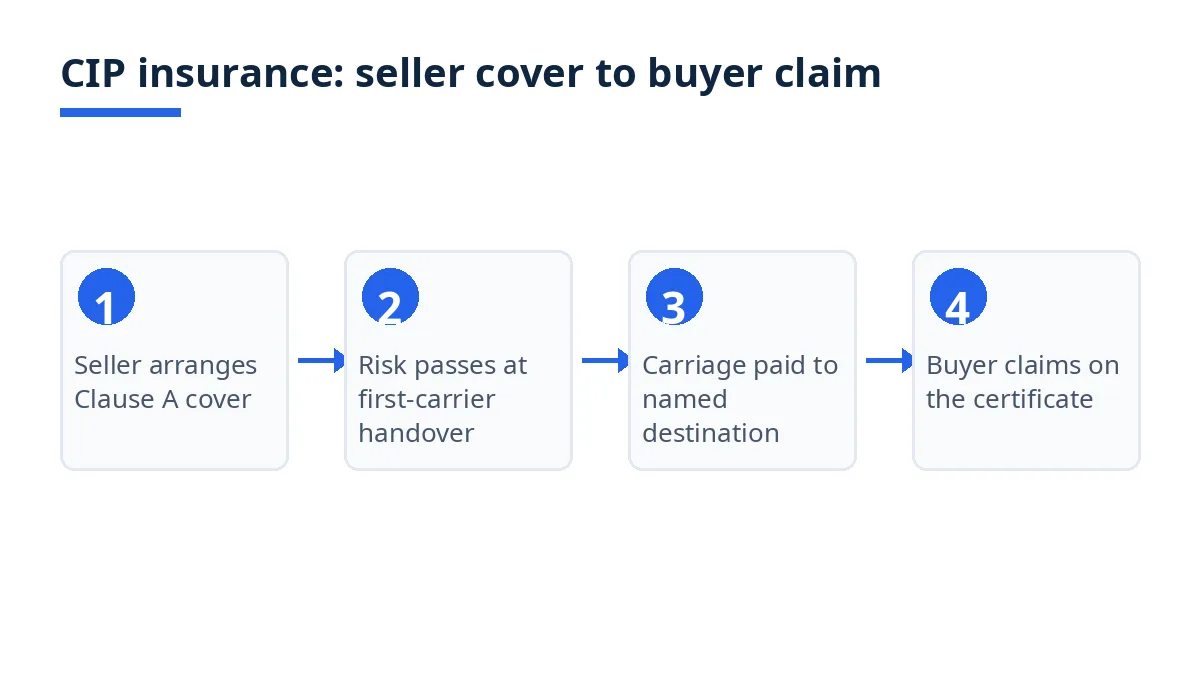
Under CIP, risk passes to the buyer when the goods are handed to the first carrier, but the seller keeps paying for carriage and insurance to the named destination.1 That split is the reason the insurance wording matters: the buyer bears the transit risk, and the policy the seller buys is the protection the buyer relies on if something goes wrong on the way.
This guide is for buyers importing from Bangladesh under CIP (Carriage and Insurance Paid To). It covers only the insurance obligation: who must insure, what level of cover the rule requires, how the insured value is worked out, what to check on the certificate, and how a claim is made.
The seller must insure, and the buyer carries the risk
CIP, along with CIF, is one of only two Incoterms rules that require the seller to purchase insurance.1 Under CIP the seller delivers the goods to the carrier, contracts and pays for the main transport to the final destination, arranges the required cargo insurance to the named destination, handles export clearance, and provides the necessary documentation.1 The buyer pays for the goods, bears the risk from delivery to the carrier, handles import clearance including duties, taxes and VAT, and covers extra costs such as unloading and storage.1
The seller must arrange cargo insurance covering the buyer's risk from the agreed delivery point to at least the named destination.1 The seller arranges it at its own cost, for at least 110% of the invoice value, and provides an insurance certificate or policy to the buyer for claims.2 The buyer may also purchase additional insurance if greater coverage is desired.1 If the buyer would rather arrange insurance independently, CPT is the rule to consider, because CPT requires the seller to pay carriage but does not require the seller to obtain insurance.1
State the insurance level in the contract before shipment. The CIP clause should name the destination precisely, state Incoterms 2020, and state the cover: "CIP Hamburg Cargo Terminal, Incoterms 2020, seller to provide insurance under Institute Cargo Clauses (A) for 110% of the contract value" leaves far less room for dispute than "CIP Hamburg" alone.
Clause A is the default, and it is not cover for everything
Under Incoterms 2020, the default coverage under CIP is Institute Cargo Clauses (A) or equivalent, unless the parties expressly agree otherwise.1 That default changed with the 2020 edition: under Incoterms 2010 the CIP default was Institute Cargo Clauses (C), and the 2020 revision raised it to Clauses (A).1 The default applies only where the contract is silent.1
Institute Cargo Clauses (A), (B) and (C) are standardized sets of terms that specify coverage and exclusions for a marine insurance policy.3 Clause (A) is the most complete coverage under the clauses: it covers all risks of loss or damage in transit, aside from the exclusions in the policy.3 Clause (B) covers only particular named perils, such as fire, explosion, vessel grounding and capsizing, and it does not cover theft, pilferage or weather damage except where directly associated with a named peril.3 Clause (C) offers the most limited protection, covering a small set of identified risks including fire, explosion and vessel stranding.3
Broad coverage remains subject to policy exclusions, conditions and any applicable deductibles, and "all risks" does not mean every possible loss is covered.1 Exclusions under Clause (A) include shipper-induced harm, regular wear and tear, and inherent vice, meaning harm caused by the natural characteristics of the merchandise itself.3
Clause tier | How cover works | Fit for CIP |
|---|---|---|
Institute Cargo Clauses (A) | All risks, except listed exclusions | The CIP default under Incoterms 2020 |
Institute Cargo Clauses (B) | Named perils only | Below the CIP default; use only if expressly agreed |
Institute Cargo Clauses (C) | A smaller set of named perils | The CIF default; below the CIP default |
Do not accept a certificate naming Clauses (C) on a CIP shipment without asking why. Clauses (C) is the default level for CIF, not for CIP: CIP requires the broader Clauses (A) cover, while CIF still defaults to Clauses (C), with the same 110% minimum in both cases.1
How much cover: 110 percent of the contract price
The insured amount under CIP must be at least 110% of the contract price, in the contract currency.1 The same minimum is expressed as at least 110% of the invoice value.2 The extra 10% is headroom for the costs and margin around the goods. Work the figure from the contract price in the sales contract, and check that the certificate shows the same figure.
Example figures: a contract for denim jeans from Bangladesh sold CIP Hamburg Cargo Terminal, Incoterms 2020, at a contract price of $40,000, requires insured cover of at least $44,000. If the parties agree a higher insured value, the certificate should show the agreed figure. If the contract price changes, check the insured value again, because a certificate issued for the original price does not automatically grow with the order.
The premium is not the insured amount. The insurance premium is the price paid for the policy, and it is different from the insured amount.1 The premium amount is determined by the value of the cargo, the route and the kind of products being transported.3 Compare CIP quotations on the insured value and the clause tier shown on the certificate, not on the premium, which the buyer does not pay under CIP.
Worked example | Example figures |
|---|---|
Contract price, denim jeans, CIP Hamburg | $40,000 |
Minimum insured value, 110% of contract price | $44,000 |
Clause tier required by the CIP default | Institute Cargo Clauses (A) |
Who pays the premium | Seller, at its own cost |
From the first carrier to the named destination: where the cover runs
Cover under CIP must run from the agreed delivery point to at least the named destination.1 The agreed delivery point is where the goods are handed to the first carrier, and that is also where risk passes to the buyer.1 The seller continues to bear the cost of transport and insurance up to the agreed destination, even though the buyer bears the risk from handover.1 A certificate that ends at a transshipment port, or at a port that is not the named destination, does not match the CIP bargain.
Check the start and end points on the certificate against the contract: the named destination, the goods description and the currency should all match the CIP clause and the carriage contract.
CIP is available for any transport mode, including multimodal shipments, and the cover must follow the goods through the whole contracted carriage to the named destination.1 Where goods move by truck, then by sea or air, then by truck again, ask the seller to confirm in writing that the single CIP policy covers each leg.
The certificate is the claim document: what to check before handover
The seller provides the buyer with the insurance certificate or document so the buyer can claim directly from the insurer.2 Ask for the certificate before the goods are handed to the first carrier, and read it while there is still time to fix it.
Check six points on every CIP certificate: the clause tier, the insured value, the goods description matched to the invoice and packing list, the voyage and named destination matched to the CIP clause, who can claim, and the insurer and its claims route.
Keep the certificate with the transport document and the commercial invoice, in the same file, with a copy where the person who receives the goods can reach it. If the sale is financed, check what the bank requires on the insurance document before shipment.
When cargo is damaged: who claims, and in what order
When cargo is lost or damaged after risk has passed, the buyer claims on the insurance the seller arranged, using the policy or certificate the seller provided.2 The seller paid for the cover, but the loss is the buyer's, because risk passed at handover.1 The claim runs against the insurer under the policy terms.
Work in this order when damage is found. First, record the damage before moving the goods further than needed for inspection: photographs, carton counts, seal numbers, and the condition of the outer packing. Second, note the damage on the delivery document. Third, notify the insurer through the route on the certificate, and notify the seller at the same time. Fourth, keep the goods and packing for inspection, because the insurer sends a surveyor to examine the damage and reimburses the buyer when the claim is approved.3
Do not repair, re-pack or dispose of damaged goods before the surveyor has inspected them, unless safety or further damage makes waiting impossible, and record the reason if that happens. Do not sign a clean receipt for damaged goods. The claim will be measured against the policy wording, the exclusions and any deductible.1 A loss caused by inherent vice, ordinary wear and tear, or the shipper's own act may fall inside an exclusion, and a loss below the deductible is a loss the buyer carries.3 Read the exclusions and the deductible before shipment, when extra cover can still be agreed.
Raising the cover above the CIP minimum
The CIP minimum is a floor, not a recommendation. The buyer can request a specific level of insurance coverage, and the seller is ultimately responsible for arranging and paying for it.2 Use that opening before the contract is signed: ask for an insured value above 110%, for named additional risks, or for cover running beyond the named destination to the buyer's warehouse, and put the agreed level in the contract.
Consider extra cover where the default leaves a gap. Goods that suffer from rough handling, water entry or pilferage need the all-risks breadth of Clause (A), because those are the losses the narrower tiers do not cover.3 Goods whose value at destination is well above the contract price may need an insured value above 110%. Price the extra cover as part of the CIP quotation, and if a seller will not confirm it in writing or show it on the certificate, treat it as not agreed.
Red flags that leave a CIP shipment underinsured
A certificate naming Clauses (B) or (C) on a CIP shipment, with no express agreement to a lower tier, is the first red flag. The CIP default is Clauses (A), and a lower tier should be visible, agreed and priced, not discovered after a loss.1 An insured value below 110% of the contract price is the second red flag: a simple check before shipment that cannot be fixed after a total loss.1 A named destination on the certificate that differs from the CIP clause is the third red flag, because cover must run to at least the named destination.1
A goods description that does not match the invoice is the fourth red flag. A certificate arriving only after handover, or only after damage is reported, is the fifth: ask for the policy details and the insurer's confirmation. A CIP price far below comparable quotations is the sixth. The premium depends on the value of the cargo, the route and the kind of products, so a price with no room for a Clause (A) premium at the full insured value should prompt a question about what was actually bought.3 Ask the seller to show the certificate. If it is not forthcoming, do not treat the shipment as insured.
Insurance checklist before you agree CIP
Name the destination precisely in the CIP clause, with the Incoterms 2020 version stated.
State the insurance level in the contract: Institute Cargo Clauses (A), or the agreed equivalent, and the insured value.
Work the insured value at 110% of the contract price, in the contract currency.
Ask for the certificate before handover, and read the clause tier, value, goods description, voyage and destination.
Confirm who can claim on the certificate, and how the claim is presented.
Check that cover runs to at least the named destination, across every leg of a multimodal journey.
Read the exclusions and the deductible, and agree any extra cover before shipment.
Keep the certificate, transport document and invoice together, where the receiver can reach them.
On arrival, record damage before moving the goods, note it on the receipt, notify the insurer and the seller, and hold the goods and packing for survey.
Must the seller insure under CIP, or can the buyer insure instead?
The seller must insure under CIP. CIP is one of only two Incoterms rules that require the seller to purchase insurance, covering the buyer's risk from the agreed delivery point to at least the named destination.1 The buyer may buy additional insurance, but that does not remove the seller's obligation.1 If the buyer wants to arrange all insurance itself, the parties should use CPT, under which the seller pays carriage but is not required to obtain insurance.1
How much insurance must the seller buy under CIP?
The seller must buy cover for at least 110% of the contract price, in the contract currency, under Institute Cargo Clauses (A) or equivalent as the default.1 The seller arranges the insurance at its own cost and provides the certificate to the buyer for claims.2 The parties may agree a higher insured value or a different level of cover, but the agreement should be in the contract and reflected on the certificate.1
What does Clause A cover that Clause C does not?
Clause (A) covers all risks of loss or damage in transit, except the exclusions listed in the policy, while Clause (C) covers only a small set of named perils such as fire, explosion and vessel stranding.3 Clause (B) sits between the two, covering named perils only.3 That difference is why the CIP default was raised from Clauses (C) to Clauses (A) in Incoterms 2020.1
What should I do first if CIP cargo arrives damaged?
Record the damage before moving the goods, note it on the delivery document, notify the insurer through the route on the certificate, and notify the seller at the same time.2 Keep the goods and packing for inspection, because the insurer sends a surveyor to examine the damage and reimburses the buyer when the claim is approved.3 Do not sign a clean receipt for damaged goods, and do not repair or dispose of them before the surveyor has inspected them unless safety requires it.
Next steps on Exportain
Read the CIP risk transfer guide for the handover point where risk passes, and the CIF insurance guide for the narrower Clauses (C) default under CIF. Then post a free RFQ with the named destination and insurance level stated, and compare quotations on the same cover, not only on price.
Sources
- CIP Incoterms (Carriage and Insurance Paid To) Explained. iContainers (accessed )
- CIP (Carrier and Insurance Paid) Incoterm Explained. Tata AIG, (accessed )
- Understanding Institute Cargo Clauses In Marine Insurance. ICICI Lombard (accessed )
About the author
Sourcing from Bangladesh?
Post a request for quotation and suppliers on Exportain can send you their quotes directly.
Post an RFQ


