

When Does Risk Transfer Under CIP? A Visual Guide for Importers
Definition
Under CIP, risk passes from seller to buyer when the seller hands the goods to the first carrier the seller contracted, at the agreed place of delivery. The seller still pays carriage and buys Clause A insurance to the named destination, but loss or damage after handover is the buyer's risk, claimed under the seller-bought policy. Delivery happens at handover, not on loading and not at the destination.
Published 10 min read
On this page
Key takeaways
Risk passes to the buyer at handover to the first carrier, not when the goods are loaded and not when they reach the named destination.
The seller must buy Institute Cargo Clauses (A) cover for at least 110 percent of the contract price, for the buyer's benefit.
The insurance runs from delivery to at least the named destination, and the buyer claims directly under the seller-bought policy.
Name the place of delivery as precisely as the destination, and hold the insurance document and transport document together.
Picture the moment you first hold the insurance document for a shipment. The seller bought the policy and named you as the party who can claim. It is easy to read it as a promise that the seller still carries the risk. Under CIP it is not that promise: you have carried the risk since the goods were handed to the first carrier, and the policy is the route by which you recover a loss that is already yours.
Quick answer: risk at handover, insurance to destination
Under CIP, risk transfers from seller to buyer when the seller hands the goods to the first carrier the seller contracted, at the agreed place and point of delivery. Delivery happens at handover, not when the goods are loaded onto an aircraft, vessel, or train, and not when they reach the named destination. The seller still contracts and pays for carriage to the named destination, completes export formalities, buys insurance for the buyer's benefit, and must notify the buyer that delivery has occurred, but loss or damage after handover is the buyer's risk.1
Reading the letters: carriage, insurance, paid to
CIP stands for Carriage and Insurance Paid To. It is one of the 11 Incoterms 2020 rules published by the International Chamber of Commerce (ICC), and it applies to any mode of transport.1 The name describes what the seller pays for: the carriage to the named destination, and the insurance that covers the goods on that carriage. Neither word describes how long the seller carries the risk.
Read a CIP citation in two parts. The part after the letters names the destination, as in CIP Frankfurt, Incoterms 2020, where the seller's carriage and insurance duties end. The delivery point, where risk passes, is a separate place that the parties are encouraged to agree just as precisely, and it usually sits much earlier in the journey, in the exporting country.1 For the full set of 11 rules, see the Incoterms guide for shipments from Bangladesh.
The insurance the seller must buy — and what it does not do
CIP is one of only two Incoterms 2020 rules that oblige the seller to buy insurance for the buyer. The other is CIF, at a lower default level.1 2 Under CIP, the seller must obtain cover that meets Institute Cargo Clauses (A), described as maximum coverage, for at least 110 percent of the contract price. The policy or certificate must be issued in favor of the buyer or another party the buyer designates, so the buyer can claim compensation directly from the insurer when goods are lost or damaged.1
Three limits matter before you rely on the policy. Cover must extend from the point of delivery to at least the named destination.1 Clause A is the default level, not cover for every conceivable loss, and wider cover must be specified in the sales contract.1 The insurance does not move the risk point: it pays for a loss the buyer already bears. Check the clause level, the sum insured, the beneficiary, and the cover period before the goods move.
Follow one shipment from Gazipur to Frankfurt
Take a consignment of ceramic tableware packed in Gazipur, sold CIP Frankfurt, Incoterms 2020, and carried by air from Dhaka.
The seller packs the goods. The tableware is packed for air carriage and checked. Risk sits with the seller until delivery.1
The seller completes export formalities. The seller handles export clearance at its own cost and meets transport security requirements at its own risk and cost.1 In Bangladesh, goods may not be loaded or stuffed for export until a Bill of Export has been submitted to Customs and approved.3
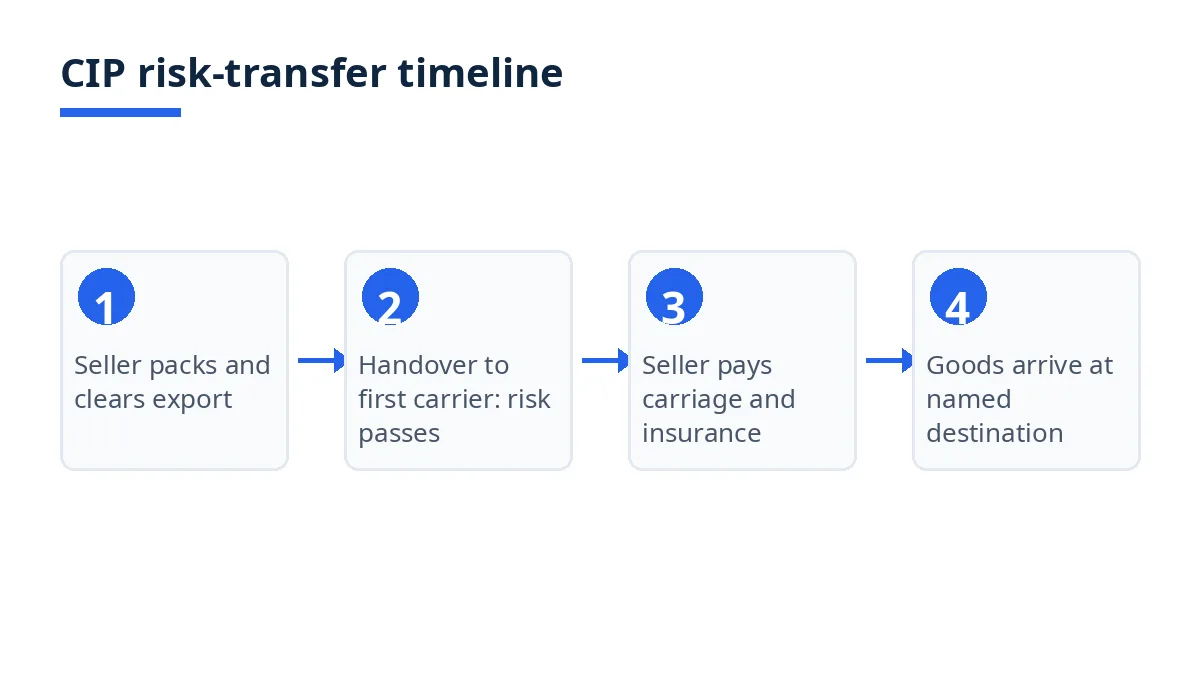
The goods are handed to the first carrier. The seller delivers the consignment to the carrier it contracted, at the carrier depot at Dhaka airport. This handover is the transfer, and delivery does not wait for loading onto the aircraft.1 From this moment, the buyer bears the risk.
The seller gives notice and hands over the insurance document. The seller must notify the buyer that delivery has occurred, with the information the buyer needs to receive the goods, and provide the insurance certificate so the buyer can claim directly from the insurer.1
The air carriage runs at the buyer's risk. The seller paid for carriage and Clause A cover to Frankfurt, but a loss in transit is the buyer's loss to claim under that cover.1
The goods arrive at Frankfurt. The buyer completes import formalities and arranges and pays for any further transport beyond the named destination.1
The diagram below marks the transfer on the same journey, from the seller's premises to the named destination.
Who pays, who bears risk, who claims
Question at each stage | Seller | Buyer |
|---|---|---|
Packing, export clearance, security | Arranges and pays | No duty |
Handover to the first carrier | Delivers the goods | Bears the risk from this moment |
Carriage to the named destination | Contracts and pays | No freight duty to the destination |
Insurance to the named destination | Buys Clause A cover, at least 110 percent, for the buyer | Claims directly under the policy |
Loss or damage after handover | No risk, unless the contract says otherwise | Bears the loss, then claims |
Import formalities and duty | No duty | Arranges and pays |
Transport after the destination | No duty | Arranges and pays |
Where the delivery place and point were never agreed, and no trade practice settles them, the seller may choose the place and point that suit its purpose.1 Name the delivery place and point, the date or period for delivery, and the named destination in the contract.
Worked example: ceramic tableware, Dhaka to Frankfurt
Example figures only. Confirm the premium, the sum insured, and the duty position with your insurer and broker.
A buyer agrees CIP Frankfurt, Incoterms 2020, for ceramic tableware packed in Gazipur and handed to the carrier at Dhaka airport, at a contract price of USD 28,500.
Element of the example | Example figure (USD) |
|---|---|
Contract price, CIP Frankfurt | 28,500 |
Minimum sum insured, 110 percent of the contract price | 31,350 |
Insurance premium, example figure paid by the seller | 320 |
Damage found on arrival, example figure | 2,400 |
The minimum sum insured is 110 percent of USD 28,500, which is USD 31,350.1 The premium figure is illustrative only, not a quoted rate. If tableware worth USD 2,400 at cost is found damaged on arrival at Frankfurt, the loss falls on the buyer, because risk passed at handover in Dhaka. The buyer claims under the seller-bought Clause A policy, using the insurance document, the transport document, the invoice, and the packing list, and photographs the damage at unloading. Work the premium, the duty, and the onward delivery into your landed cost for imports from Bangladesh before you price the goods for resale.
CIP against CPT, CIF and FCA: choose by insurance and handover
CPT is the closest neighbor, and the comparison turns on one duty only. CPT shares the CIP risk point exactly: risk passes at handover to the first carrier, the seller pays carriage to the destination, and the rule applies to any mode. CPT requires no insurance from the seller, so a CPT buyer arranges cover from the handover date. CIP adds the seller-bought Clause A policy. Read the CPT risk transfer guide to see the same handover without the insurance duty.
CIF differs on both the risk point and the cover. Risk passes when the goods are loaded on board the vessel at the port of shipment, CIF is for sea and inland waterway transport only, and the seller's default cover is the lower Institute Cargo Clauses (C) level.2 For goods handed to a carrier at a terminal or depot before loading, the CIF risk point may never match the real handover, while the CIP point does. Read the CIF cost, insurance and freight guide for the sea-only rule.
FCA shares the handover idea without the carriage and insurance package. Risk passes when the goods are delivered to the carrier the buyer nominates, the buyer arranges and pays the main carriage, and neither party owes the other insurance under the rule. Choose FCA when you want to control the carrier and the policy yourself; choose CIP when you want the seller to arrange the carriage and the insurance, while accepting that the risk is yours from the first handover.
Term | Where risk passes | Seller pays carriage to | Seller must insure |
|---|---|---|---|
CIP | Handover to the first carrier | Named place of destination | Yes, Clause A, at least 110 percent |
CPT | Handover to the first carrier | Named place of destination | No |
CIF | On board at the port of shipment | Named port of destination | Yes, Clause C minimum |
FCA | Delivery to the buyer's nominated carrier | No, the buyer arranges it | No |
Five checks before you agree CIP
Name the delivery point, not only the destination. Write the place and point of delivery, the date or period for delivery, and the named destination into the contract. If the delivery point is missing, the seller may choose it.1
Hold the insurance document before the goods move. Check the clause level, the sum insured, the beneficiary, and the cover period from delivery to destination.1
Do not date your cover from loading. Delivery does not occur on loading. Any top-up cover should run from the handover date.1
Do not read prepaid freight and insurance as seller risk. The seller pays both to the destination while the buyer bears the risk from handover. If the deal was that the seller carries the goods safely to the destination, the term that records that deal is a D rule, not CIP.1
Agree the claim steps in writing. Record who notifies the insurer and which documents the buyer will hold. Keep the transport document with the delivery notice and the insurance document.
How Exportain helps
On Exportain, state CIP, the named destination, and the place of delivery in your request for quotation, and ask each supplier to confirm the insurance clause level, the sum insured, and the beneficiary in writing before you accept a quotation. An RFQ states quantity and unit, target price, destination, Incoterm, required certifications, and deadline.4 Compare quotations only on the same term and the same named places. Badges on Exportain record document and photo reviews, not factory inspections, and a badge is not a guarantee. Follow the how to buy guide for the steps from first search to shipment.
What is CIP?
CIP stands for Carriage and Insurance Paid To. It is an Incoterms 2020 rule under which the seller delivers goods to the first carrier, pays carriage to a named place of destination, completes export formalities, and buys Institute Cargo Clauses (A) insurance for at least 110 percent of the contract price for the buyer's benefit, while risk passes to the buyer at handover.1
How does CIP work in practice?
The seller hands the goods to the carrier it contracted, at the agreed place of delivery, pays carriage to the named destination, and provides the insurance document. Risk passes at that handover, the seller notifies the buyer, and the buyer handles import formalities, pays for transport after the destination, and claims under the seller-bought policy if goods are lost or damaged after handover.1
Is CIP used for shipments from Bangladesh?
Yes. CIP is a standard Incoterms rule that can be used for shipments leaving Bangladesh by any mode, including air freight from Dhaka and container shipments handed to a carrier at a depot or terminal, provided the delivery point and the named destination are stated in the contract.1 Export clearance requires an approved Bill of Export before loading, with the documents Customs lists for the consignment.3
What are common mistakes with CIP?
Treating the named destination as the risk point, accepting a contract with no named delivery point, relying on an insurance document never checked for clause level, sum insured, beneficiary, or cover period, dating cover from loading, and reading prepaid freight and insurance as seller risk. Fix each the same way: name both places, check the insurance document before shipment, and keep the delivery notice, transport document, and policy together.
Next steps on Exportain
Read the full rule in the Incoterms guide for shipments from Bangladesh, compare the uninsured twin in the CPT risk transfer guide, and work the buyer-side costs into your landed cost for imports from Bangladesh. The how to buy guide explains the buying steps on Exportain.
Post a free RFQ on Exportain and get quotes from Bangladeshi suppliers → https://exportain.com/rfqs
Sources
- CPT & CIP Incoterms 2020 explained: Key differences. ICC Academy (accessed )
- Incoterms® 2020. International Chamber of Commerce (ICC) (accessed )
- Customs Clearance Procedures for Export. Bangladesh Customs, National Board of Revenue (accessed )
- How to source and buy from Bangladesh. Exportain (accessed )
Reviewed by Naim Islam
About the author
Sourcing from Bangladesh?
Post a request for quotation and suppliers on Exportain can send you their quotes directly.
Post an RFQ


