

When Does Risk Transfer Under CPT? A Visual Guide for Importers
Definition
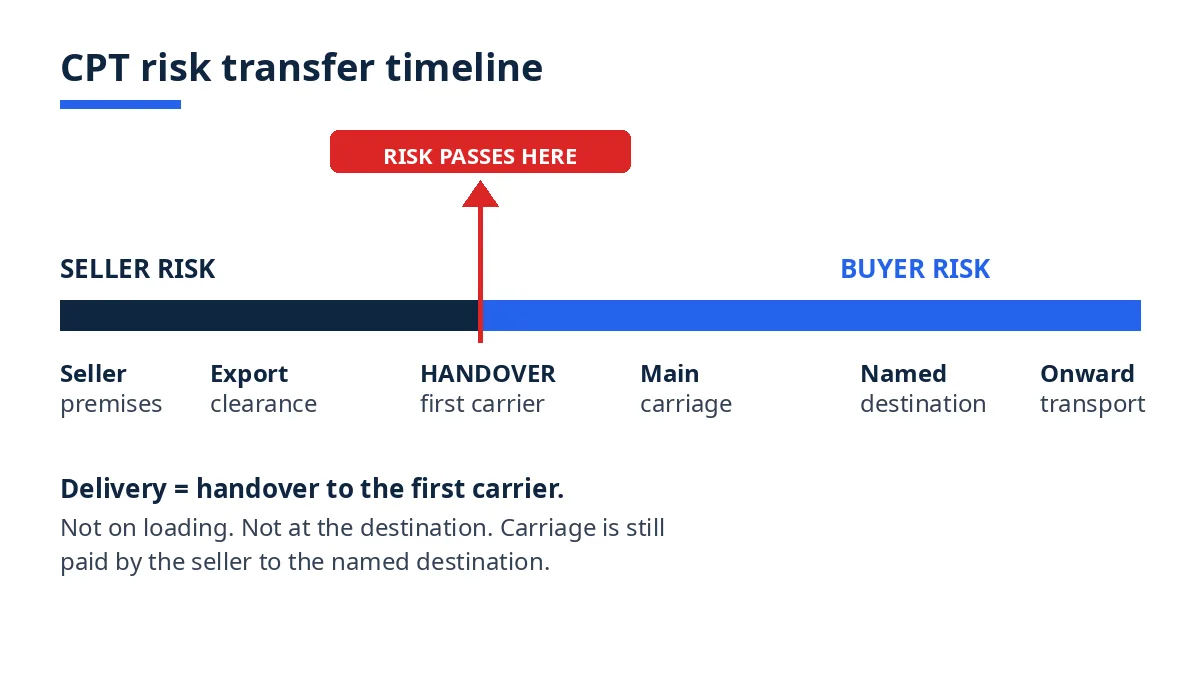
Under CPT, risk transfers from seller to buyer when the seller hands the goods to the first carrier the seller contracted, at the agreed place and point of delivery. Delivery happens at handover, not on loading and not at the named destination. The seller still pays carriage to the named destination and completes export formalities, but loss or damage after handover is the buyer's risk.
Published 8 min read
On this page
Key takeaways
Risk passes to the buyer at handover to the first carrier, not when the goods are loaded and not when they reach the named destination.
CPT has two points: the place of delivery, where risk passes, and the named place of destination, where the seller's carriage duty ends. Name both in the contract.
The seller has no insurance duty under CPT, so the buyer arranges cover from the handover date, using the seller's delivery notice as the trigger.
The transport document and carrier receipt fix the handover place and time, and are the evidence a claim will turn on.
Most buyers picture risk travelling with the freight bill. Under CPT it does not. The buyer starts carrying the risk while the goods are still in the exporting country, sometimes before they have left the seller's town, while the seller keeps paying for the journey to the destination. This guide pins down the exact moment that change happens, and what evidence proves it.
Quick answer
Under CPT, risk transfers from seller to buyer when the seller hands the goods to the first carrier the seller contracted, at the agreed place and point of delivery. Delivery happens at handover, not when the goods are loaded onto a vessel, aircraft, or train, and not when they reach the named destination. The seller still contracts and pays for carriage to the named destination, completes export formalities, and must notify the buyer that delivery has occurred, but loss or damage after handover is the buyer's risk.1
What CPT means in plain English
CPT stands for Carriage Paid To, one of the 11 Incoterms 2020 rules published by the International Chamber of Commerce (ICC), and it applies to any mode of transport, including sea, road, rail, air, and combinations.2 Where several carriers are involved, delivery occurs at handover to the first carrier, and the seller still pays carriage across the whole chain to the named destination.1
Like the other C terms, CPT has two points, and confusing them is the most common mistake in the rule. The place of delivery is where the seller hands the goods to the carrier. The named place of destination is the point named after the letters CPT, to which the seller pays carriage. Risk transfers at the first point; cost runs to the second.1
The ICC Academy guidance is explicit that the citation for a C term names the destination, not the delivery point, even though delivery happens much earlier. Parties are encouraged to agree the delivery place and point as precisely as the destination, because the delivery point is where the risk argument will be fought.1 A contract reading "CPT Dubai, Incoterms 2020" says where the freight is paid to. It does not, on its own, say where the goods changed hands.
The handover moment, step by step
Risk does not move gradually. It moves in one step, at one handover, and each step below has a different risk holder.
The seller prepares and packs the goods. Risk sits with the seller. Damage found at this stage is the seller's to put right before delivery.1
The seller completes export formalities. The seller handles export clearance at its own cost, and meets transport security requirements at its own risk and cost.1 In Bangladesh, goods may not be loaded for export until a Bill of Export has been submitted to Customs and approved.3
The goods are handed to the first carrier. This is the transfer. The carrier is the one the seller contracted. Delivery is fulfilled at handover, for example at the carrier's terminal or warehouse, and it does not wait for loading onto the aircraft, train, or vessel.1
The seller gives notice of delivery. The seller must notify the buyer in a timely manner that delivery has occurred, and provide the information the buyer needs to receive the goods at the destination. That notice is also the buyer's prompt to put insurance in place from the handover date, since CPT places no insurance duty on the seller.1
The main carriage runs at the buyer's risk. The goods travel under a carriage contract the seller paid for, but the risk of loss or damage during that carriage is the buyer's. Any recovery comes through cover the buyer arranged.1 4
The goods arrive at the named destination. The buyer arranges and pays for any further transport beyond that point, and completes import formalities, including customs procedures in transit countries.1
The diagram below marks the transfer on a single timeline, from the seller's premises to the named destination.
Who carries the risk, stage by stage
Stage | Risk holder | Evidence that fixes the point |
|---|---|---|
Packing and preparation at the seller | Seller | Packing records, inspection notes |
Export clearance | Seller | Approved Bill of Export and export documents |
Handover to the first carrier | Buyer, from this moment | Carrier receipt, transport document, handover time and place |
Main carriage to the named destination | Buyer | Transport document showing freight prepaid to the destination |
Arrival at the named destination | Buyer | Arrival notice, delivery records |
Transport after the destination | Buyer | Buyer's own carriage documents |
Where the delivery point was never agreed, the seller may choose the place and point that best suits its purpose, if no trade practice settles it. That is a weak position for a buyer to discover after a loss, and it is why the delivery point should be written into the contract with the same care as the destination.1
Three claim scenarios: where the loss falls
Damage before handover. A carton of home textiles is crushed by a forklift in the seller's warehouse while being loaded onto the truck that will take it to the carrier. Risk has not transferred, because the goods have not been handed to the carrier. The loss sits with the seller.1
Damage after handover, before loading. The same carton reaches the carrier's warehouse, is accepted and receipted, and is damaged by water before loading onto the aircraft. Delivery has occurred at handover, so risk has passed to the buyer, even though the goods have not left the origin country. The buyer's cover, arranged from the handover date on the seller's notice, is the route to recovery.1 4
Damage in transit. A container is damaged at sea on the leg to the named destination. The seller paid the freight for that leg, but risk passed at the first carrier handover, long before the sea leg began. The buyer bears the loss. This is the scenario buyers most often dispute, and the two-point structure of the C terms exists to settle it.1
In each scenario, the transport document matters because it records the handover. In the ICC Academy's worked CPT case, the air waybill carried the carrier, shipper, and consignee, the departure and destination airports, the goods description, a "Freight Prepaid" notation, and the carrier's signature and date. Ask for that document promptly after the delivery notice, and check that the handover place and date on it match the contract.1
CPT beside CIP, CIF and DAP: the risk point is the difference
CIP shares the CPT risk point exactly. Risk passes at handover to the first carrier under both rules. The difference is insurance only: CIP requires the seller to obtain Institute Cargo Clauses (A) cover for at least 110 percent of the contract price, for the buyer's benefit, while CPT requires no insurance from the seller.1
CIF moves risk when the goods are loaded on board the vessel at the port of shipment, and CIF is for sea and inland waterway transport only. For goods handed to a terminal or a first carrier before loading, the CIF risk point may never match the real handover, while the CPT point does.2 4
DAP looks like CPT on an invoice, because the seller pays transport to a named destination under both. The risk points are opposites: under DAP the seller keeps the risk until the goods arrive at the named place, ready for unloading, while under CPT the buyer has carried it since the first carrier handover.4
Term | Where risk passes | Seller pays carriage to | Seller must insure |
|---|---|---|---|
CPT | Handover to the first carrier | Named place of destination | No |
CIP | Handover to the first carrier | Named place of destination | Yes, Clause A, at least 110 percent |
CIF | On board at the port of shipment | Named port of destination | Yes, Clause C minimum |
DAP | At the named place, ready for unloading | Named place of destination | No |
Four mistakes that move the risk without the buyer noticing
Treating the named destination as the risk point. The destination is where the freight bill ends. Risk ended at the first carrier handover. Reading the contract the other way leaves the buyer uninsured for the whole main leg.1
Accepting a delivery point the contract never names. If the delivery place is not agreed, the seller may choose it. Name the place and point of delivery, and the date or period for delivery, in the contract.1
Waiting for loading before arranging cover. Delivery does not occur on loading. Cover arranged from the loading date starts too late for damage in the carrier's warehouse after handover. Arrange it from the handover date, on the seller's notice.1
Using CPT wording for a DAP bargain. If the commercial deal was that the seller carries the goods safely to the destination, CPT does not record that deal. DAP does. Match the term to the bargain, not to the freight arrangement.4
Next steps on Exportain
Read the full rule in the Incoterms guide for shipments from Bangladesh, compare the sea-only counterpart in the CIF cost, insurance and freight guide, and work the buyer-side costs into your landed cost for imports from Bangladesh. The how to buy guide explains the buying steps on Exportain.
Post a free RFQ on Exportain and get quotes from Bangladeshi suppliers → https://exportain.com/rfqs
What is CPT?
CPT stands for Carriage Paid To. It is an Incoterms 2020 rule under which the seller delivers goods to the first carrier, contracts and pays for carriage to a named place of destination, and completes export formalities, while risk passes to the buyer at handover to that carrier. The seller has no obligation to insure the goods.1
How does CPT work in practice?
The seller hands the goods to the carrier it contracted, at the agreed place of delivery, and pays carriage to the named destination. Risk passes at that handover, the seller notifies the buyer, and the buyer arranges any insurance, handles import formalities, and pays for transport after the destination.1
Is CPT used for shipments from Bangladesh?
Yes. CPT is a standard Incoterms rule that can be used for shipments leaving Bangladesh by any mode, provided the delivery point and the named destination are stated in the contract.1 Export clearance in Bangladesh requires an approved Bill of Export before loading, with the documents Customs lists for the consignment.3
What are common mistakes with CPT?
Treating the named destination as the risk point, leaving the delivery point unnamed, arranging insurance only from loading, ignoring the carrier's receipt, and using CPT wording for a bargain that was really DAP. Each is fixed the same way: name both places in the contract, arrange cover from handover, and keep the delivery notice and transport document together.
Sources
- CPT & CIP Incoterms 2020 explained: Key differences. ICC Academy (accessed )
- Incoterms® 2020. International Chamber of Commerce (ICC) (accessed )
- Customs Clearance Procedures for Export. Bangladesh Customs, National Board of Revenue (accessed )
- CPT (Carriage Paid To) Meaning in Incoterms: Risk Transfer and Who Pays. GoFreight, (accessed )
Reviewed by Naim Islam
About the author
Sourcing from Bangladesh?
Post a request for quotation and suppliers on Exportain can send you their quotes directly.
Post an RFQ


