CPT vs CIP: Key Differences, Costs and Which One to Choose
CPT vs CIP for Bangladesh imports: the two rules share carriage, risk and customs, and differ on a single line — seller-bought Clause A cover under CIP against buyer-arranged cover under CPT.
Short answer
CPT and CIP are the same Incoterms 2020 rule except for insurance. Under both, the seller pays carriage to the named destination and risk passes at handover to the first carrier. Under CIP the seller must buy Institute Cargo Clauses (A) cover for 110 percent or more of the contract price; under CPT the buyer arranges its own cover. Choose CIP for a first shipment or valuable cargo, and CPT when you already hold an open cargo policy.
On this page
Key takeaways
CPT and CIP match on carriage, risk, modes and customs; the only difference is that CIP obliges the seller to buy Clause A cargo cover.
Under CIP the seller must insure for 110 percent or more of the contract price at Institute Cargo Clauses (A) level; under CPT the buyer arranges its own cover.
Risk passes at handover to the first carrier under both rules, long before the goods reach the named destination, even though the seller keeps paying freight.
Example figures put 800 kg of knit polos by air to London at $19,406 under CPT and $19,392 under CIP, a $14 gap from the premium alone.
A buyer in London orders 800 kilograms of knit polo shirts from a Dhaka supplier, to be flown in. Two quotations come back, one on CPT London Heathrow and one on CIP London Heathrow, and the CIP seller price is higher by a single line: the cargo insurance premium.
The verdict in one table
CPT (Carriage Paid To) and CIP (Carriage and Insurance Paid To) are the two multimodal rules in the C group of Incoterms 2020. Under both, the seller books and pays the carriage to the named destination, with risk passing at handover to the first carrier.1 2 The single difference is insurance: CIP obliges the seller to buy cargo cover for the buyer.3
Point | CPT | CIP |
|---|---|---|
Seller pays carriage to | Named place of destination | Named place of destination |
Risk passes to the buyer | Handover to the first carrier | Handover to the first carrier |
Seller must buy cargo insurance | No | Yes, for the buyer |
Minimum cover | None set by the rule | Institute Cargo Clauses (A) |
Minimum sum insured | None set by the rule | 110 percent or more of the contract price |
Import clearance, duty and tax | Buyer | Buyer |
Mode, risk and carriage are identical in the two columns; only the insurance rows change. Our CFR vs CIP guide turns on a sea-only rule against an any-mode rule, and our CIF vs CIP guide turns on Clause C against Clause A.
What the two rules share
Both rules sit in the C group, where the seller pays carriage to a distant destination while risk moves to the buyer at origin.3 The seller keeps paying freight after the buyer already carries the risk, so a loss in transit falls on the buyer.2 3 Both rules work for any mode, alone or combined: road, rail, air, sea and multimodal journeys.1 2 That is why they suit air freight from Bangladesh, where they cover the whole chain from the Dhaka cargo terminal to London Heathrow.
Delivery happens at handover to the first carrier, not when the goods are loaded onto the aircraft.2 Out of Dhaka, risk passes when the cartons reach the airline or its handling agent at the cargo terminal. Name the place in full — "CPT London Heathrow, Incoterms 2020" — since "CPT UK" does not settle where the seller's carriage ends. Neither rule sets the price, the payment method, or the moment ownership passes.3 Only two of the eleven rules oblige the seller to insure the goods: CIF and CIP — see our Incoterms guide, covering every rule.1 3
The one line that differs: insurance
Under CIP the seller must obtain cargo insurance under Institute Cargo Clauses (A), the widest of the three standard sets, for 110 percent or more of the contract price, unless the parties agree a different level.1 3 The policy must be issued in favour of the buyer. Under CPT no party is required to insure the goods, so a buyer that wants protection arranges its own policy, starting at the first-carrier handover.2 Incoterms 2020 changed the CIP minimum: the 2010 edition asked only for Clause C, while the 2020 edition asks for Clause A and CIF still asks only for Clause C.1 A seller working from an old template can still offer CIP on Clause C, so read the certificate.
What Clause A cover actually buys
The Lloyd's Market Association (LMA) and the International Underwriting Association (IUA) publish the Institute Cargo Clauses; the current editions, CL382 (A), CL383 (B) and CL384 (C), took effect on 1 January 2009.4 Clause A is all-risks, covering loss or damage from any accidental cause except those the wording excludes; Clauses B and C pay only for a peril on their list, and the Clause C list is the shortest.4
For knitwear travelling by air, the losses that actually happen are the ones Clause A answers and an uninsured CPT shipment leaves on the buyer:
Loss to the knitwear | Clause A (CIP minimum) | No policy (CPT without own cover) |
|---|---|---|
Cartons soaked by rain on the tarmac | Covered | No payment |
Cartons missing after pilferage | Covered | No payment |
Any other accidental cause, not excluded | Covered | No payment |
Clause A is broad rather than boundless: all three sets leave out the same causes — wilful misconduct, delay, war and strikes unless added by separate wordings, inherent vice, ordinary leakage and wear, and packing unfit for the journey.4 Cartons shipped without moisture protection can fall outside the cover, so photograph them.
The premium question: what cover costs under each term
A cargo premium is a rate multiplied by an insured value. The market standard is to insure 110 percent of the CIF value, the extra 10 percent covering the profit and expenses lost if the goods never arrive.5 For sea freight, typical rates run about 0.2 to 0.5 percent of cargo value, and most insurers set a minimum premium of 25 to 50 euros per shipment.5 Air rates differ, and the rate depends on the commodity, the packing, the route, the cover level and the deductible.5
Under CIP the premium sits inside the seller price; under CPT the buyer pays it separately, to an insurer the buyer chooses. Ask for the premium as its own line on both quotations, since a padded CIP premium cannot be compared with a CPT quotation that hides no premium at all. The third route is the open policy: a buyer already covered by an open Clause A policy may prefer CPT, while a buyer with no standing cover usually gains more from CIP.5
Worked example: 800 kg of knit polos by air to London
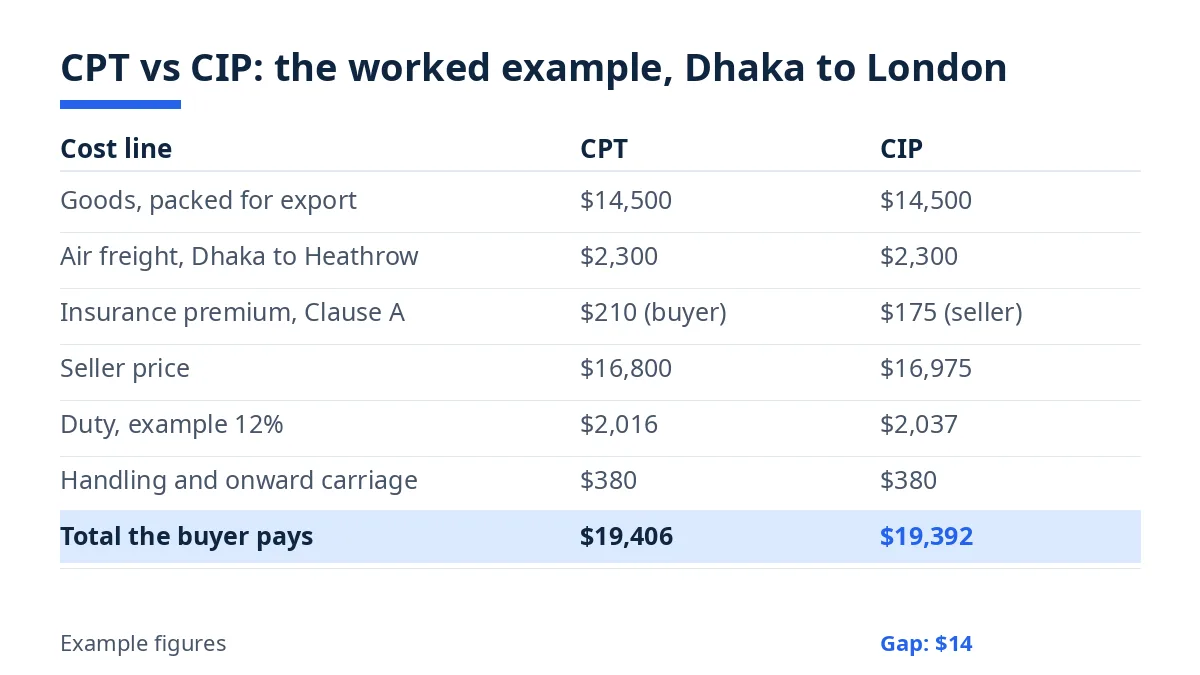
Example figures. A buyer in London orders 800 kilograms of knit polo shirts from a Dhaka supplier, goods worth $14,500, flown from Dhaka to London Heathrow. The only difference is the insurance route: under CIP the seller buys Clause A cover as part of the seller price; under CPT the buyer buys a Clause A policy separately.
Cost line | Under CPT | Under CIP |
|---|---|---|
Goods, packed for export | $14,500 | $14,500 |
Air freight, Dhaka to London Heathrow | $2,300, paid by the seller | $2,300, paid by the seller |
Insurance premium, Clause A | $210, paid by the buyer | $175, inside the seller price |
Seller price | $16,800 | $16,975 |
Duty, example 12 percent of CPT or CIP value | $2,016, paid by the buyer | $2,037, paid by the buyer |
Destination handling and onward carriage | $380, paid by buyer | $380, paid by buyer |
Total the buyer pays | $19,406 | $19,392 |
Under CPT, 14,500 plus 2,300 is 16,800, and 16,800 plus 210 plus 2,016 plus 380 is 19,406. Under CIP, 14,500 plus 2,300 plus 175 is 16,975, and 16,975 plus 2,037 plus 380 is 19,392. The $14 gap is a $35 premium gap less $21 of duty, and the sum insured under CIP must reach 110 percent of the contract price: $18,672.50 on $16,975.
A buyer with no policy under CPT would show $19,196, $210 below the insured CPT total. That gap is not money saved: it is the cost of carrying the full exposure on $14,500 of goods, with no policy to claim under.
When CPT wins and when CIP wins
Three questions settle most cases. First, do you already hold cover. A buyer whose open Clause A policy already covers every shipment may prefer CPT, since the CIP price would bill again for protection already held. A buyer with no standing policy usually gains more from CIP, since the Clause A cover comes inside the seller price.5 Second, what would a loss cost. If the goods are theft-prone, water-sensitive, easily crushed, or valuable for their weight, use CIP: Clause A covers the losses the cartons actually suffer, subject to its exclusions.4 If the goods are low in value and sturdy, CPT with a policy bought at home stays open. Third, who should choose the insurer. Under CIP the seller chooses the insurer and the deductible, and the buyer claims on a policy it did not place. A buyer that wants that control should take CPT; a buyer that wants one price and one certificate should take CIP.
Bangladesh specifics: air cargo, documents and the certificate
The goods are handed to the carrier at the Dhaka cargo terminal, and the air waybill is the transport document for the leg. Under both terms the seller handles export clearance: goods cannot load until Bangladesh Customs has approved a Shipping Bill, backed by the EXP form certified by an Authorized Dealer, the commercial invoice, the certificate of origin, the packing list, the Export Registration Certificate and the VAT registration certificate.6
The certificate is where the two terms part company. Under CIP, ask for it before handover, and read the clause set, the sum insured and the destination. The wording should read Institute Cargo Clauses (A), or CL382, and not Clause C: the 2010 edition asked only for Clause C from both CIP and CIF, and some sellers still quote on that old basis.4 It should name the buyer as claimant and run to the named destination, not just the airport of discharge. Under CPT the buyer must place its own policy before handover; a policy that starts only at take-off leaves the terminal stage outside the cover.4
Write the term into the contract
Five lines settle the position before anyone books anything.
The term line: "CPT London Heathrow, Incoterms 2020" or "CIP London Heathrow, Incoterms 2020", naming the edition and the destination.
The cover line: which clause set, what sum insured, which insurer, and who places the policy, with the certificate in hand before handover. Under CIP, write Clause A and 110 percent into the contract.1
The carriage line: the carrier, the departure window, and which destination charges the carriage price already contains.
The packing line: moisture protection, carton strength, marking, and packing photographs.4
The documents line: what the seller sends, the transport document and the insurance certificate under CIP.
Any wider cover or higher sum insured must be written into the sale contract before shipment.1
Questions buyers ask about CPT and CIP
Which is cheaper, CPT or CIP?
Neither term is cheaper as a rule: the CIP seller price is higher because it contains the Clause A premium. In the worked example the buyer totals differ by $14, so compare buyer totals with the premium shown separately.
Which is safer for a first shipment?
CIP is usually the safer pick for a first shipment: the seller books the carriage and the Clause A policy comes inside the price. Still read the certificate and confirm the 110 percent sum.
Can I switch terms after the PO?
Yes, when both sides agree in writing before shipment, with the price reworked to match. Moving from CPT to CIP means the seller takes on Clause A cover, so the seller price rises by the premium. Moving from CIP to CPT means the buyer must already hold its own booking and cover.
Which do Bangladeshi suppliers prefer?
There is no survey that ranks supplier preference between these two rules, so treat the question as a test of the quotation instead. A seller that can quote CIP with the clause and the sum insured named, and put the certificate in your hands before handover, has the routine in place. Ask for both quotations, with premium and freight lines separated, and let the two totals decide.
Next steps on Exportain
Ask for both quotations on the same goods to the same named place, with the premium and freight lines separated, and compare the buyer totals. Then search Bangladeshi suppliers and post an RFQ stating the term, the place, the edition and the cover you require. The how to buy page covers the steps after you order.
Sources
- Incoterms® 2020. International Chamber of Commerce (ICC) (accessed )
- CPT (Carriage Paid To) Meaning in Incoterms: Risk Transfer and Who Pays. GoFreight, (accessed )
- What Are Incoterms? Rules, Risk, and Responsibilities. LegalClarity (accessed )
- Institute Cargo Clauses (A), (B), (C) Explained. VoyageCover (accessed )
- Cargo Insurance: Coverage, Costs and When You Need It. Primo Nautic, (accessed )
- Bangladesh Trade Portal FAQ: Export Registration Certificate (ERC). Bangladesh Trade Portal (accessed )
About the author
Sourcing from Bangladesh?
Post a request for quotation and suppliers on Exportain can send you their quotes directly.
Post an RFQ