CIP vs DDP: Insurance, Duty and Who Clears the Import
CIP promises a Clause A cargo policy in the buyer's name; DDP promises import clearance and duty paid. Compare the insurance gap, the VAT reclaim and a worked leather wallet shipment to London.
Short answer
Under CIP the seller pays carriage and buys Clause A cargo insurance for at least 110 percent of the contract price, but you clear import and pay duty and VAT. Under DDP the seller clears import and pays duty and VAT, yet the rule requires no insurance at all. If you are VAT-registered, CIP costs less net because you reclaim the import VAT; if you have no broker, DDP suits you provided the seller can name its importer of record.
On this page
Key takeaways
CIP is the only pair member that promises a policy: Clause A cover for at least 110 percent of the contract price, issued in the buyer's favour.
DDP is the only Incoterms rule that puts import clearance, duty and import VAT on the seller, yet it requires no insurance at all.
In the worked example the gross totals differ by $20, but the net totals differ by $4,533, the import VAT a VAT-registered buyer reclaims under CIP and no one reclaims under DDP.
Before accepting DDP, ask the seller to name its importer of record and UK broker; a Dhaka seller with no UK presence cannot file the entry itself.
A buyer in London orders 4,000 leather wallets from a Dhaka supplier and asks for two quotations: one on CIP London and one on DDP at the buyer warehouse in London. The two seller prices differ by thousands of dollars, yet both cover the same wallets. The difference is what each term promises. CIP promises a named cargo policy bought for the buyer. DDP promises a border already cleared, with duty and import VAT inside the price.
The two promises side by side
CIP (Carriage and Insurance Paid To) and DDP (Delivered Duty Paid) are two of the eleven rules in Incoterms 2020.1 Both put the main carriage on the seller and work by any mode. Past that shared start they move in opposite directions: CIP spends its extra effort on insurance, DDP on the border.
Question | CIP | DDP |
|---|---|---|
Delivery happens when | Goods are handed to the first carrier | Goods arrive at your named place, cleared for import |
Risk passes to you | At handover to the first carrier | At arrival at your named place |
Seller must buy cargo insurance | Yes, Clause A cover for your benefit | No policy is required by the rule |
Import clearance handled by | You | The seller |
Who pays import duty and VAT | You | The seller |
Named importer of record | You | The seller, or a party the seller appoints |
Under CIP the risk moves to you at the first-carrier handover, while the seller still pays the carriage and the insurance to the destination.2 Under DDP the seller carries the risk until the goods arrive cleared for import and ready for unloading.2 Our CPT vs DDP guide looks at the same border question from the term with no insurance duty at all.
What CIP promises: a Clause A policy in your name
Under CIP the seller must take out cargo insurance on Institute Cargo Clauses (A), or matching all-risks wording, for 110 percent or more of the contract price, in the contract currency, and the policy must name the buyer as the claimant, so you claim on it yourself.3 Incoterms 2020 lifted the CIP floor from Clause (C) to Clause (A); CIF still asks only for Clause (C) as its default.1
Of the three clause sets, Clause A gives the widest cover. The clauses come from the Lloyd's Market Association and the International Underwriting Association, current editions CL382 (A), CL383 (B) and CL384 (C).4 Clause A pays out for any accidental loss or damage the wording does not exclude. Clauses (B) and (C) pay only for the perils they name, and the Clause (C) list is the shortest.4
For leather wallets in a container, the everyday losses are the ones Clause A answers. Theft, pilferage and non-delivery are covered under Clause A and under neither of the other two sets, and the same holds for malicious damage and rough handling damage.4 Water entering the container is covered under Clauses (A) and (B) but not under Clause (C).4
Clause A still has limits. All three sets leave out wilful misconduct, ordinary leakage and wear, packing unfit for the journey, inherent vice in the goods, delay, and war and strikes unless separate wordings are added.4
What DDP promises: the border cleared and the duty paid
Under DDP the seller carries the shipment from start to finish: export clearance, carriage, import clearance, duty and taxes, and handover at your named place.2 It is the heaviest obligation of any Incoterms rule, and the only rule that puts import clearance and duty on the seller.
The promise only holds where the seller can actually perform the import. The importer of record brings the goods through customs in its own name and answers for the duties, taxes and accuracy of the entry, and on DDP that is the seller or someone the seller appoints.5 In the United Kingdom a business usually needs premises in the country to get a GB EORI number, and HMRC says a person without a UK establishment needs someone to deal with customs for it, completing the import declaration and, where needed, getting an EORI instead.5 In the European Union the declarant has to be established inside the customs territory, so a non-EU seller normally works through an EU-established indirect representative.5
Before you agree to a DDP quotation, ask for the importer of record by name, and which broker files the entry. A Dhaka seller with no UK presence cannot file the entry itself; the usual route is a UK-established agent appointed by the seller.5
The insurance gap under DDP
Here is the gap the DDP price hides. DDP promises no insurance at all. The seller carries the transit risk and most sellers buy their own cover for it, but the rule itself asks for no policy, no clause level and no sum insured. A buyer under DDP holds no certificate, names no insurer and cannot file a claim on a policy it has never seen.
After a loss at sea, the positions differ. Under CIP the Clause A policy sits in your name and runs to the named destination, so you claim on it directly.3 Under DDP the loss is the seller's, and the seller must replace the goods or refund the price under the sale contract. That gap matters most for goods that are easy to steal, easy to damage or valuable for their weight, and leather wallets tick all three boxes. A DDP buyer who wants the same protection should write the cover into the contract: the clause set, the sum insured and the insurer, with the certificate in hand before the goods move. Our DDP insurance guide and CIP insurance guide explain what to ask for.
Worked example: 4,000 leather wallets from Chattogram to London
Example figures. A buyer in London orders 4,000 leather wallets from a Dhaka supplier, goods valued at $18,400, shipped from Chattogram to Felixstowe and then by road to the London warehouse. The duty rate is an example rate, and both columns use the same customs value, $21,080.
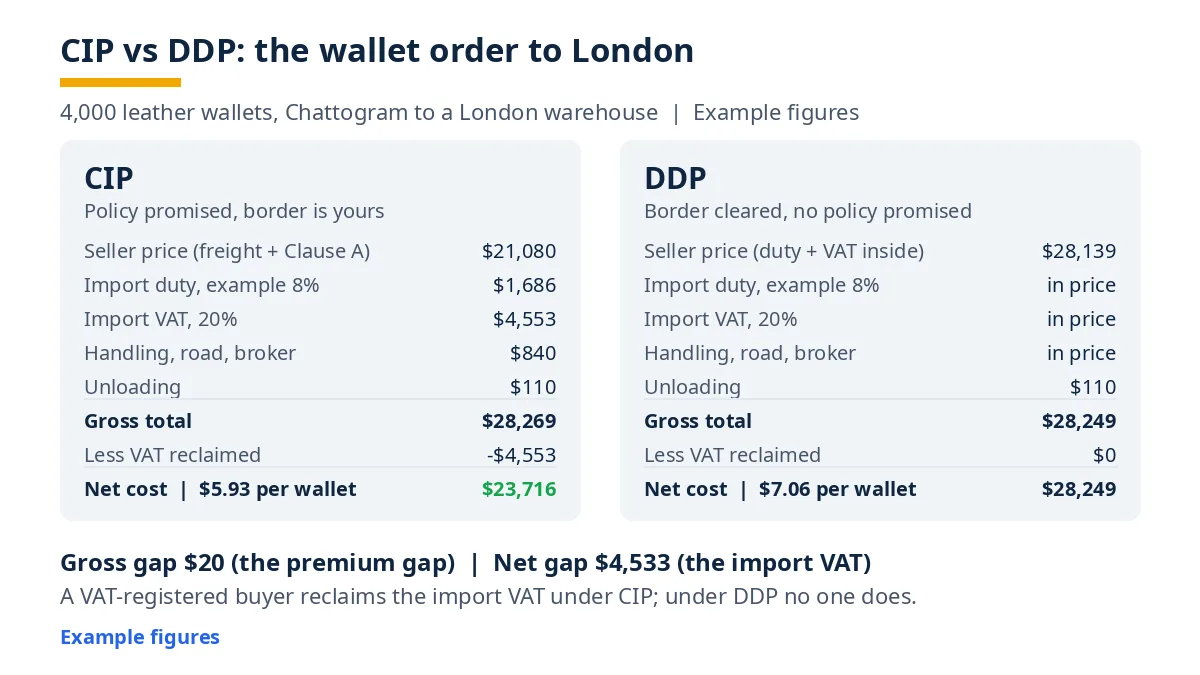
Cost line | Under CIP | Under DDP |
|---|---|---|
Goods, packing, export clearance | $18,400 | $18,400 |
Ocean freight to Felixstowe | $2,450, seller | $2,450, seller |
Cargo insurance premium | $230, Clause A, in seller price | $210, seller's own cover, in seller price |
Seller price | $21,080 | $28,139 |
Import duty, example 8% of $21,080 | $1,686, buyer | $1,686, in seller price |
Import VAT, 20% of $22,766 | $4,553, buyer | $4,553, in seller price |
Port handling at Felixstowe | $310, buyer | $310, in seller price |
Road leg to London warehouse | $360, buyer | $360, in seller price |
Broker and clearance fees | $170, buyer | $170, in seller price |
Unloading at the warehouse | $110, buyer | $110, buyer |
Gross total the buyer pays | $28,269 | $28,249 |
Less import VAT reclaimed | -$4,553, via the buyer's VAT return | $0, seller holds no UK VAT registration |
Net cost to the buyer | $23,716 | $28,249 |
Net cost per wallet | $5.93 | $7.06 |
Under CIP the lines add to 28,269; under DDP the seller price plus the 110 unloading charge is 28,249. The gross totals differ by only $20, the premium gap. The net totals differ by $4,533, the import VAT reclaimed under CIP and stuck inside the DDP price.
Duty is an example 8 percent of $21,080: $1,686.40, rounded to $1,686. The VAT value is $22,766, and 20 percent of that is $4,553.20, rounded to $4,553. For CIP cover, the insured amount has to be at least 110 percent of the contract price: $23,188 on $21,080.3
Import VAT: the reclaim that decides the real cost
Most goods entering the United Kingdom attract import VAT at 20 percent.6 It is charged on the VAT value, which starts with the value of the goods plus shipping and insurance to the UK, then adds the customs duty first, so you can end up paying VAT on top of the duty.6
A VAT-registered buyer can normally get import VAT back, with a C79 certificate or a postponed VAT statement as the proof, and postponed VAT accounting puts the charge and the reclaim on the same VAT return.6 That is why the CIP column ends at $23,716 after the reclaim, while the DDP column stays at $28,249. Under DDP the seller settles the import VAT at the border, and a Dhaka exporter holds no VAT registration there, so the amount stays inside the DDP price.
If you are not VAT-registered, the reclaim does not apply and the totals sit close together. If you are VAT-registered and import regularly, CIP usually leaves you better off by the full VAT line.
Common mistakes buyers make with CIP and DDP
Reading a DDP price as a landed price with insurance inside it. The DDP price covers delivery, duty and taxes, not a named policy. Ask in writing what cover the seller holds.
Taking a CIP certificate that shows Clause C at face value. Incoterms 2020 sets Clause A as the CIP floor, so a Clause C document fails the rule unless the contract agreed a lower level.3 Look for CL382 on the certificate, not CL384.4
Pricing the two quotations by the seller price alone. The CIP price holds the premium while duty and VAT sit outside it; the DDP price holds everything except unloading. Decide on net totals after the VAT reclaim.
Treating import VAT as a cost under both terms. Duty is a cost under both terms. Import VAT is a cost only where no one can reclaim it: under CIP a VAT-registered buyer reclaims it; under DDP no one does.6
Accepting DDP from a seller that cannot name its importer of record. If the seller cannot name the party that files the UK entry, the DDP price is a guess at the largest lines in the order.5
Bangladesh checks before you sign
Leather and leather goods from Bangladesh earned $1.14 billion in FY2024-25, up 10.19 percent on the year before, Export Promotion Bureau figures show.7 A supplier quoting CIP or DDP on leather goods should be able to show recent shipments on the same term into your market.
The export file is the same under both terms. What changes is what you must check before the goods leave Chattogram. Under CIP, ask for the insurance certificate before handover and read three lines: the clause set, the sum insured and the destination. Look for Institute Cargo Clauses (A), or CL382, and a sum insured of at least 110 percent, running to the named destination.3 Under DDP, ask for the name of the importer of record, the UK broker and the duty and VAT figures for the HS code, in writing, before you pay the deposit.
Questions buyers ask about CIP and DDP
Is DDP always more expensive than CIP?
No: the buyer totals differ by $20. The split shows up after the VAT return, when a VAT-registered buyer gets $4,553 back under CIP and nothing under DDP.
Does DDP include cargo insurance?
No. DDP promises no policy at all. The seller bears the transit risk and usually insures it, but the rule sets no clause level or sum insured, and the buyer holds no certificate to claim on.
Can a Dhaka seller act as importer of record for the UK?
Only with a UK setup behind it: the seller needs a UK-established party to stand behind the entry.5
Next steps on Exportain
Get both quotations for the same order, with freight, premium, duty, VAT and broker lines shown separately, then compare net totals. Then find Bangladeshi suppliers and raise an RFQ naming the term, the place and the cover you need. Our Incoterms guide covers the full set of eleven rules, and our landed cost guide builds the full cost picture.
Sources
- Incoterms® 2020. International Chamber of Commerce (ICC) (accessed )
- Trade Terms Definitions. DHL (accessed )
- CIP Incoterms (Carriage and Insurance Paid To) Explained. iContainers (accessed )
- Institute Cargo Clauses (A), (B), (C) Explained. VoyageCover (accessed )
- Who Is the Importer of Record (IOR)? DDP in the US, EU, UK. Triplicate, (accessed )
- Import VAT and customs duties: What UK businesses need to know. Xero, (accessed )
- Exports rose 8% to $48b in FY25 despite economic headwinds. The Daily Star, (accessed )
About the author
Sourcing from Bangladesh?
Post a request for quotation and suppliers on Exportain can send you their quotes directly.
Post an RFQ