Insurance Under DDP: Who Must Insure the Cargo and for How Much?
Under DDP no party must buy cargo insurance, but the seller bears loss or damage risk until delivery at the named place. This guide shows how to turn that risk-bearing into written, checkable cover.
Short answer
Under DDP, neither the seller nor the buyer must buy cargo insurance, but the seller bears the risk of loss or damage until the goods are placed at the buyer's disposal at the named place, cleared for import and ready for unloading. A buyer who wants cover that can be claimed on should agree the clause level, sum insured, cover period and proof in the sales contract, or buy separate cover for unloading and the period after delivery.
On this page
Key takeaways
DDP imposes no insurance duty on either party, while the seller bears the risk of loss or damage until delivery at the named place, cleared for import and ready for unloading.
Only CIF and CIP oblige the seller to insure for the buyer, at Clause (C) and Clause (A) respectively, with a 110% minimum that DDP buyers can borrow as a contract benchmark.
Name the sum-insured base in the contract: goods value alone, goods plus freight, or the full DDP landed base including duty and taxes, since each base gives a different sum.
Clause (A) still excludes packing, inherent vice, delay, war and strikes risks, and cover ends at the destination named in the policy, so check the wording, the excess, and the cover window before shipment.
DDP insurance starts from a gap buyers merge. The seller carries the risk of loss or damage almost to the buyer's door, and clears import customs and pays duty. That does not mean the seller has bought insurance.
No insurance duty, full delivery risk: the distinction that decides claims
Under DDP, the seller must deliver the goods at the named place, cleared for import, on the arriving means of transport and ready for unloading. Risk passes only at that point. The ICC Academy states the point: because the seller must deliver the goods in sound condition, whether to insure in transit is the seller's decision, for the seller's protection.1
The Export Council of Australia reaches the same result: the seller is not obliged to the buyer to conclude an insurance contract, and the buyer has no such obligation either. The buyer's only insurance-related duty is to give the seller, at the seller's request, the information needed to obtain insurance.2 Risk-bearing answers who suffers a loss before delivery: the seller. Insurance answers who holds a contract with an insurer that will pay.
How DDP sits beside CIF and CIP on insurance
Only two of the eleven Incoterms 2020 rules place an insurance duty on the seller: CIF and CIP. Under CIF the duty is at the minimum level of Clause (C) of the Institute Cargo Clauses, and under CIP at the wider Clause (A) level. In both cases the insurance should cover at least 110% of the value of the goods as provided in the sales contract, at least to the point of delivery.3 DDP has no equivalent duty, no minimum clause level and no minimum sum.
The sea-only set has four members: FAS, FOB, CFR and CIF, for sea and inland waterway transport only. CPT is an any-mode rule. DPU is an any-mode rule. DDP is an any-mode rule, set apart because the seller clears import customs and pays duty, while the buyer unloads.
Rule | Must the seller insure for the buyer? | Minimum clause level | Where risk passes |
|---|---|---|---|
CIF | Yes | Institute Cargo Clauses (C) | On board the vessel at the port of shipment |
CIP | Yes | Institute Cargo Clauses (A) | When handed to the first carrier |
DDP | No | None set by the rule | At the named place, cleared for import, ready for unloading |
How much cover to write into a DDP contract when no minimum applies
Because DDP sets no minimum, the sum insured is a contract figure. Agree four points before shipment: the value the sum is based on, the uplift over that value, the currency, and the place or places the cover runs to. A phrase such as "seller to insure" without them leaves the buyer arguing about each one after a loss.
The 110% figure from CIF and CIP is a useful reference point, though it does not bind a DDP sale. Under CIF and CIP the minimum is 110% of the contract value.3 Three bases are common: goods value only, which leaves freight, duty and taxes outside the sum; goods value plus freight; and goods value plus freight plus duty and taxes, the full DDP landed base. Ask for the sum insured, clause wording, excess, and period of cover in writing. If the seller will not disclose them, price the order as uninsured, or change the rule.
Compare the eleven rules in the guide that puts all eleven Incoterms rules compared in one place, and the CIF duty in the explanation of the minimum Clause (C) cover that CIF requires.
Clause (A), (B) and (C): what each wording leaves out
Clause (A) is the broad wording: it covers all risks of loss of or damage to the insured goods except as excluded by the exclusion clauses that follow it.4 Clause (C) is the narrow, named-perils wording used as the CIF minimum, covering major casualties such as fire, explosion, stranding, collision and jettison, and leaving ordinary handling, water and theft losses outside the wording unless the facts fit a named peril.3 Between them sits Clause (B), a middle named-perils tier.
Clause (A) is often called "all risks" cover, but the label overstates the position. The 2009 wording excludes, among other matters, wilful misconduct of the assured, delay even when caused by an insured risk, inherent vice, insufficiency or unsuitability of packing, ordinary leakage, ordinary loss in weight or volume, ordinary wear and tear, and insolvency of the vessel owners, managers, charterers or operators.4 War and strikes risks are excluded in separate clauses and need separate wordings.4 Check the excess too: a wide clause with a large excess can leave a buyer worse off on a moderate loss than a narrower clause with a small excess.
Where cover must start and end on a DDP journey
Under the Clause (A) transit wording, cover begins at the first movement of the goods for immediate loading, and ends when unloading finishes at the destination named in the policy, or earlier on another termination event, including the 60-day limit that runs after discharge from the overseas vessel at the final port of discharge.4 The named places in the insurance contract decide the cover window. If the policy names a port, cover may end at the port, even though the DDP named place is the buyer's warehouse inland.
Two moments need attention. The first is unloading: under DDP the buyer bears the risk of unloading, and the seller is not responsible for unloading.2 Buy cover that expressly runs through unloading, or agree in writing that the seller's cover does. The second is storage: if the goods are held outside the ordinary course of transit, the transit wording may terminate cover, so tell the insurer about any planned storage in advance.
Worked example: sizing cover on a Chattogram to Hamburg order
Example figures only, to show the arithmetic. Confirm all figures in a live quotation and with a customs broker for the destination country.
A buyer orders garments from Chattogram for delivery DDP at a named warehouse in Hamburg. Example figures: goods value USD 40,000; freight USD 2,400; import duty and taxes paid by the seller USD 3,600; goods plus freight USD 42,400; full DDP landed base USD 46,000. Apply the 110% reference figure from CIF and CIP to each base:
110% of the goods value alone: USD 40,000 x 1.10 = USD 44,000.
110% of goods plus freight: USD 42,400 x 1.10 = USD 46,640.
110% of the full DDP landed base: USD 46,000 x 1.10 = USD 50,600.
The gap between the narrowest and widest base is USD 6,600. A buyer who agrees "110% cover" without naming the base may receive USD 44,000 and discover, after a total loss, that USD 6,600 of freight, duty and taxes has no cover. Test any offer: divide the sum by 1.10 to find the base used (USD 44,000 / 1.10 = USD 40,000).
Who claims, and on whose policy, when cargo arrives damaged
First, the seller holds a policy for the seller's own account. The seller bears the DDP risk, so the seller claims on the seller's policy, and the buyer claims against the seller under the sales contract. The buyer should still preserve the evidence: photographs of the container, seal, cartons and goods, the delivery receipt with damage noted, and the transport document.
Second, the seller holds a policy for the buyer's benefit, under a contract clause that requires it. The buyer, or the assignee named in the policy, claims directly from the insurer. The buyer needs the policy or certificate before shipment, to check it against the contract.
Third, the buyer holds a separate policy. The buyer claims on the buyer's own policy, and the insurer may then pursue recovery against the seller or the carrier. Recovery under the Clause (A) wording requires the buyer to hold an insurable interest when the loss happens.4
In every position, the assured must act reasonably to avert or reduce a loss, and must ensure that all rights against carriers, bailees or other third parties are properly preserved and exercised. The insurer reimburses charges properly and reasonably incurred in carrying out those duties.4 Give written notice to the carrier and the insurer promptly, invite survey, keep the damaged goods and packing available for inspection, and act with reasonable despatch.4
The letter-of-credit trap: asking for an insurance document under DDP
A letter of credit that calls for an insurance policy or certificate sits awkwardly with a DDP sale. DDP creates no duty to provide such a document, because DDP creates no duty to insure.2 The demand must therefore be agreed deliberately in the sales contract, with the clause level, sum insured and destination named, or the seller may present a document that meets the credit wording and still leaves the buyer without useful cover.
If the credit demands a document in vague terms, the seller may present a narrow Clause (C) certificate for a sum covering only the goods value, and the buyer discovers the gap only after a loss. Before opening a credit on DDP terms, settle three points in the sales contract: whether an insurance document is required at all, what wording and sum it must show, and who bears the premium. Then write the credit to match the contract.
Bangladesh departure notes: export papers, packing and the long leg
Goods must not be loaded — into containers or onto a ship — until Customs has approved the export declaration, the Bill of Export or shipping bill, filed in the prescribed format.5 The enclosure set runs from payment to identity: the export letter of credit or, absent one, the export contract, purchase order or export guarantee the negotiating bank has approved; then the commercial invoice and the packing list; then the EXP form certified by an authorized dealer bank, an origin certificate, the VAT registration certificate, and the taxpayer identification number.5
The same documents that clear the export also prove the value, quantity and description of the goods if a claim follows, so keep the invoice, packing list and transport document consistent with the sum insured. Ask the seller to confirm the Bill of Export is approved and the seal number recorded before loading.
The Clause (A) exclusion for insufficiency or unsuitability of packing applies where packing was carried out by the assured or the assured's employees, or before attachment of the insurance.4 Agree packing standards in the contract: carton strength, moisture barriers, pallet and stowage requirements, and marking.
Six signs the DDP insurance promise will not pay
Watch for these signs in a quotation or draft contract. Each one is a reason to pause, ask for the document, and amend the wording before shipment.
The quotation says "DDP, fully insured" with no clause letter, no sum insured, no excess and no insurer named.
The certificate names a destination port while the DDP named place is an inland warehouse, so cover may end at the port.
The sum insured is 110% of the goods value only, with freight, duty and taxes outside the base.
The wording is Clause (C) or an unnamed "standard cover" for goods that suffer handling, water or theft losses in practice.3
War and strikes risks are not mentioned for a route or destination where they are a live concern, and no separate wording is offered.4
The seller will not share the policy or certificate before shipment, or will share it only after payment.
Before shipment: the DDP insurance checklist
Work through this list in order, from the contract to the claim file. The diagram below summarises the same six moves.
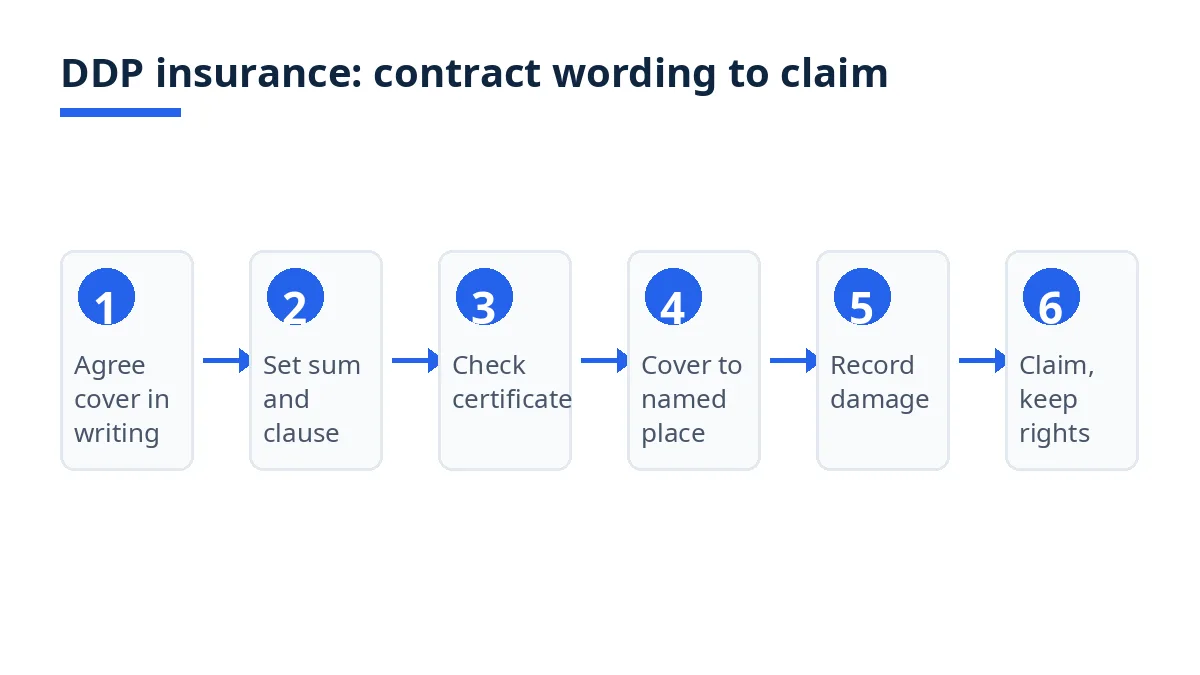
Agree who insures, and for whose benefit, in the sales contract.
Name the clause wording, the sum insured and its base, the currency, the excess, the named destination in the policy, and the period of cover.
Decide war and strikes cover by route and destination, and record the decision.
Ask for the policy or certificate before loading, and check it against the contract.
Give the seller the risk and cost information the seller asks for to obtain insurance, as the DDP rule requires the buyer to do at the seller's request.2
Confirm the Bill of Export is approved before loading, and keep the invoice, packing list, transport document and seal record consistent with the insured value.5
At delivery, inspect before signing. Note damage on the delivery receipt, photograph the container, seal, cartons and goods, and notify the seller, carrier and insurer in writing the same day.4
Keep the claim file together: policy or certificate, invoice, packing list, transport document, survey report, delivery receipt, photographs, and every notice sent with proof of sending.
Is DDP insurance required by the Incoterms rule itself?
No. DDP requires neither the seller nor the buyer to conclude an insurance contract.2 The seller still bears the risk until delivery at the named place.1 A buyer who wants insurance must agree it in the sales contract, naming the clause, the sum insured, the payer and the proof.
How much insurance should a buyer ask for under DDP?
Ask for a sum matching the full DDP landed base: goods value plus freight plus duty and taxes, with the 110% reference figure used for CIF and CIP applied to that total.3 Name the base, currency and excess in the contract, and test any offer against the worked example arithmetic before accepting it.
Who pays if cargo is damaged during unloading under DDP?
The buyer bears the risk of unloading under DDP, and the seller is not responsible for unloading.2 Damage during unloading falls on the buyer unless the contract or policy provides otherwise. Buy cover running through unloading, or agree in writing that the seller's cover runs through unloading.
What papers prove insurance cover before a DDP shipment leaves?
The policy or certificate itself, read in full. Check the cargo, voyage and destination, the sum insured and its base, the clause wording, the excess, and the claims agent at destination. A one-line assurance in a quotation, a broker's note, or a certificate arriving after sailing does not prove cover in the same way.
Next steps on Exportain
The hub guide that sets out all eleven Incoterms rules compared in one place will help the buyer choose between DDP, DAP and the C rules, and the guide to the minimum Clause (C) cover that CIF requires shows the benchmark to copy into a DDP clause. For the buying steps, read how buying on Exportain works, from search to shipment.
Post a free RFQ on Exportain and get quotes from verified Bangladeshi suppliers → https://exportain.com/rfqs
Sources
- DDP & EXW Incoterms® 2020 explained: Key differences. ICC Academy (accessed )
- DDP - Delivered Duty Paid - Incoterms 2020 Rule. Export Council of Australia, (accessed )
- Incoterms 2020 CIF: Spotlight on Cost, Insurance and Freight. Shipping Solutions, (accessed )
- Institute Cargo Clauses (A). Lloyd's Market Association (LMA) and International Underwriting Association of London (IUA), (accessed )
- Customs Clearance Procedures for Export. Bangladesh Customs, National Board of Revenue (accessed )
About the author
Sourcing from Bangladesh?
Post a request for quotation and suppliers on Exportain can send you their quotes directly.
Post an RFQ