How to Import Leather Jackets From Bangladesh: 2026 Buyer Guide
Leather jackets from Bangladesh start with the leather: nappa, aniline, suede or shearling, chrome or vegetable tanned. This guide covers the 4203.10 code, the 4 percent duty and the zero rate under Everything But Arms, plus a worked example for 1,500 nappa biker jackets to Hamburg.
Short answer
To import leather jackets from Bangladesh, name the leather, tannage, lining, hardware and style in one specification, then shortlist makers, approve a pre-production sample in bulk materials, and fix the inspection plan in the order. Leather jackets classify under 4203.10, which carries a 4 percent duty in the EU, reduced to zero under the Everything But Arms preference with a statement on origin. German import VAT runs at 19 percent.
On this page
Key takeaways
Name the leather by animal, layer, tannage and finish in the specification: nappa, aniline, suede and shearling behave differently, and 'genuine leather' says nothing about quality.
Leather jackets classify under 4203.10; the EU third-country duty is 4 percent, and Bangladesh qualifies for 0 percent under Everything But Arms with a statement on origin.
Example figures price 1,500 nappa biker jackets to Hamburg at 72,321 euros with the EBA claim, against 75,172.24 euros without it.
A 1,500-piece lot at ISO 2859-1 Level II takes a 125-piece sample: 7 major defects pass the lot at AQL 2.5, 8 fail it.
A leather jacket order goes wrong in the cutting room, not at the port. The leather, the lining and the hardware decide the fit, the feel and the returns rate before the cartons reach Hamburg.
Pick the jacket by leather, lining and style
Start with the leather, because every other choice follows from it. Nappa is unsanded smooth leather, grain side out, once the name for buttery-soft glove leather.1 Aniline is open-pore smooth leather with no pigment layer: water rubbed in is absorbed and darkens it briefly.1 Suede covers roughened leather, above all nubuck, grain-side sanded, and velour, the reverse or flesh split.1 Shearling is sheep or lambskin sanded outside, wool inside.1
The animal sets the hand and the weight. Cowhide is heavier and tougher, lamb is soft and light for casual jackets, goat suits velour, and pigskin suede is the cheaper, less durable option.1
The four styles buyers order most are the biker, with an asymmetric zip and snap lapels; the bomber, with a zip front and ribbed cuffs; the trucker, with a button front and chest pockets; and the field jacket, with four patch pockets. Match the style to the leather: a biker in cowhide, a bomber in lambskin nappa, a trucker in top-grain cowhide.
Then the lining and the hardware. A quilted lining adds warmth, a plain lining keeps the jacket light, and a shearling lining turns the same shell into a winter jacket. Name the zip type and the snap and buckle finish in writing, and work every zip on the sample.
Tanning and finishing: the choices inside the leather
Chrome tanning uses chromium salts, turns a hide into leather in about a day, and accounts for roughly 80 to 90 percent of the leather made in the world.2 Its sealed surface leaves the leather soft and uniform from the first day.2 Vegetable tanning uses natural tannins from bark, wood and leaves, takes weeks, and leaves the surface open, so the leather darkens and softens where it is handled: the patina.2 Chrome tanning covers almost all garment leather; vegetable tanning is the usual choice for belts, sole leather and riding leather.1
Layer and tannage are separate choices: the top layer of a split hide is full grain, or top grain if sanded, while the split underneath carries a pressed-in imitation grain.2 "Genuine leather" says nothing about quality: in practice it usually describes the split.2
Many smooth leathers receive a pigmented colour layer, known as top dyeing, with a clear top coat to protect it.1 Ask for the rub fastness grade in writing, wet and dry, with the number of cycles used: it runs from 1 to 5, and it decides whether a dark jacket leaves colour on a light shirt.2
What code and duty apply in Germany?
Leather jackets classify under heading 4203, which covers apparel and clothing accessories made of leather or composition leather, at subheading 4203.10, articles of apparel.3 The EU line is 4203 10 00, at a third-country duty of 4.000 percent.3
Bangladesh escapes that 4 percent under the EU Everything But Arms scheme, which lets least developed countries export to the EU without tariffs or quotas on virtually all products except arms.4 The European Commission puts the Bangladeshi exports that benefited in 2024 at 19 billion euros, with a utilisation rate of 96 percent.4 The United Nations has postponed Bangladesh's graduation from the least developed country category until 24 November 2029, so the preference stays in place until then.4
German import VAT runs at the standard rate of 19 percent. The base is the customs value, with duty and the freight and insurance to the first EU destination added.5 A VAT-registered business reclaims it as input VAT, so it hits cash flow rather than margin.5 Leather and leather products from Bangladesh reached $1.23 billion in FY2025-26, up 7.09 percent on the year before.6
The import in five stages
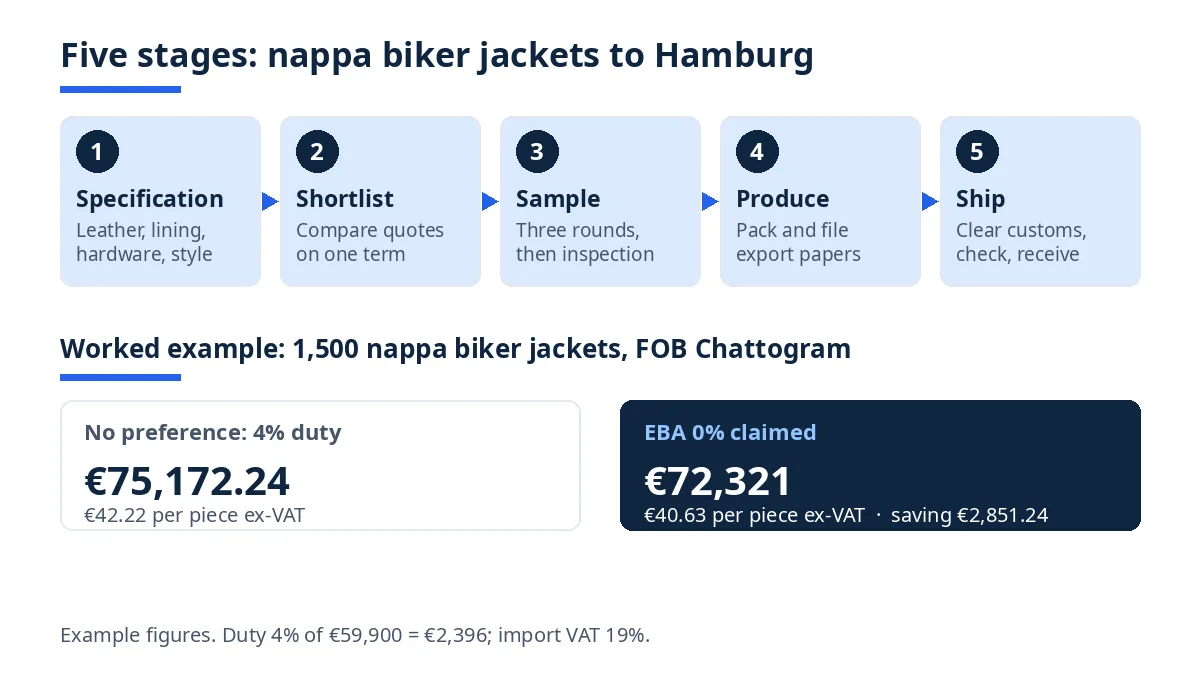
Write the leather specification. Draft it before any maker is contacted: animal, layer, tannage, finish, lining, hardware, style, sizes, colours, labels, packing, tests, quantities and term. Give every candidate the same document, and shortlist with our leather jackets manufacturers guide.
Shortlist makers and compare quotations on one term. Pick three to five makers, and check leather cutting, zip setting and edge finishing before price. Ask each for an itemised quotation, and put one delivery term and one named place on every quotation. The eleven rules are compared in our Incoterms guide.
Approve samples in three rounds, and set the inspection plan. Sign off each round in writing: a fit sample in substitute leather, to settle the pattern; a size set in the same leather, to settle the grading. A pre-production sample follows in the bulk leather, lining, hardware and labels, measured and rub-tested before bulk is released. Keep one sealed sample as the bulk reference, and name the inspector, timing and references in the order.
Produce, pack and file the Bangladesh export papers. Inspect the leather lots as they arrive, the cut panels during production and the finished jackets, then fold and bag each jacket. For the export file, Customs counts the Export Registration Certificate and the BIN among the general papers, with the letter of credit or sales contract, the EXP form, certificate of origin, invoice, packing list and transport document.6 The exporter files the EXP form through its authorised dealer bank and hands the bank the signed EXP copy with the shipping documents inside 14 days of shipment.6
Ship, clear German customs and receive. Book the freight and insurance, confirm the sailing, and collect the bill of lading and container numbers once the carrier issues them. Give your broker the code, the origin statement and the EBA claim ahead of the vessel. On receipt, count the cartons and measure a sample against the sealed reference.
Worked example: 1,500 nappa biker jackets to Hamburg
Example figures. A German retailer orders 1,500 men's nappa biker jackets from a maker in Dhaka, priced FOB Chattogram, shipped to Hamburg and on to the retailer warehouse. Duty is shown both ways: the 4 percent third-country rate, and zero under Everything But Arms with a statement on origin.3 4
Cost line | Without preference (EUR) | With EBA 0% (EUR) |
|---|---|---|
Product price, FOB Chattogram (1,500 x €38) | 57,000 | 57,000 |
Freight and insurance to Hamburg | 2,900 | 2,900 |
Customs value (CIF) | 59,900 | 59,900 |
Duty at 4% / 0% of 59,900 | 2,396 | 0 |
Value for VAT | 62,296 | 59,900 |
Import VAT at 19% | 11,836.24 | 11,381 |
Broker, port handling, delivery | 1,040 | 1,040 |
Total cash outlay | 75,172.24 | 72,321 |
Net cost ex-VAT | 63,336 | 60,940 |
Cost per piece ex-VAT | 42.22 | 40.63 |
Check it: 57,000 plus 2,900 is 59,900; 4 percent of 59,900 is 2,396; 19 percent of 62,296 is 11,836.24. With the preference claimed, the total is 72,321, a saving of 2,851.24: 2,396 of duty and 455.24 of VAT charged on that duty. A VAT-registered buyer recovers the import VAT on its return.
How inspection works on a 1,500-piece lot
Write the inspection clause before production starts, naming the inspector, the visit timing, the reference sample and the consequence of a rejection. The sampling tables come from ISO 2859-1, and most orders run at General Inspection Level II.7 For a 1,500-piece lot that level gives code letter K, so the inspector draws 125 pieces: the major-defect limit at AQL 2.5 is 7 to pass and 8 to fail, and the minor-defect limit at AQL 4.0 is 10 to pass and 11 to fail.7 Put ISO 2859-1:2026 in the order.7
Settle the defect classes before production: a broken zip or a seam split counts as critical and fails the lot on its own; colour transfer, uneven dye and a weak snap count as major; loose threads and small scuffs count as minor. Add leather checks: rub the dark panels with a white cloth, work every zip, and check the dye across panels from different hides. Our leather jackets quality control checklist lists the inspector checks.
Labels: fibre, origin and care
In the United States, the FTC Leather Guides treat the bare word "leather" as deceptive unless the product is made almost entirely of leather.8 Non-leather material that looks like leather must be disclosed, with wording such as "Not leather", "Imitation leather" or "Vinyl", and leather processed to simulate another kind or type must name the kind and type, for example "Top Grain Cowhide With Simulated Pigskin Grain".8 Ground, pulverised, shredded, reconstituted or bonded leather must not be represented as leather, and "bonded leather" needs the percentages, as in "Bonded Leather Containing 60% Leather Fibers and 40% Non-leather Substances".8 Put each disclosure on the product itself, or on a tag, label or card fixed to it, and repeat it in any advertising that could mislead without it.8
Fit and sizing across markets
Leather does not forgive a bad pattern: it holds the shape it is cut to, and a tight shoulder stays tight. Approve the fit on a sample in the production leather, worn over the layers your customer will wear under it, and measure shoulder, chest, sleeve length and body length against the size chart. Check the smallest and largest sizes on a form, and confirm the size system.
Six mistakes that cost leather jacket importers money
Ordering on "genuine leather" alone. The term says nothing about the layer, the tannage or the finish.2
Approving a sample in another tannage or finish. A chrome nappa sample proves nothing about a vegetable-tanned bulk order, which starts stiffer and ages differently.2
Comparing an FOB price with a CIF price. The CIF figure already includes the sea leg and the cover, so restate every quotation on the same term before you compare.
Filing the entry without the origin statement. Without it there is no EBA claim, and the full 4 percent is charged.3 4
Skipping the rub-fastness test. A dark jacket that marks a light shirt is a return, and the grade would have caught it.2
Paying the balance before the inspection report arrives. Write the inspection clause, with its sample size and its pass and fail counts, into the order before production starts.7 Once the money has moved, you are negotiating a discount, not rejecting a lot.
Import checklist
Jacket defined: animal, layer, tannage, finish, lining, hardware, style.
Code and duty settled: 4203.10, EU 4 percent, EBA claim, origin statement.
Three to five makers shortlisted; quotations compared on one term.
Three sample rounds signed off in writing, in bulk leather, rub-tested.
Inspection plan: level II, code K, 125 samples, AQL 2.5 and 4.0.
Order confirmed: spec version, quantities, price, terms, packing, date.
Export file ready: EXP form, origin certificate, invoice, packing list, ERC, BIN.
Freight booked; broker holds code, origin statement, EBA claim.
Goods checked against the sealed sample; labels checked on proof.
FAQs
What duty do leather jackets from Bangladesh pay in Germany?
The 4203 10 00 line carries a 4 percent third-country duty, but Bangladesh qualifies for 0 percent under Everything But Arms with a statement on origin.3 4
Should I choose chrome or vegetable tanned leather for jackets?
Chrome tanning is the default for garment leather: soft from the first day, uniform across a batch, and open to a wide range of dyes.1 2 Vegetable tanning suits structured goods; it starts stiffer and darkens with use.2
What must the label say about the leather?
In the United States, the FTC Leather Guides ask for the kind and type where leather has been processed to look like another kind, and for percentages where bonded leather is named.8 Imitation material that looks like leather must be disclosed as such.8
Next steps on Exportain
Start by confirming the code in our HS code guide for leather jackets, then shortlist makers in our leather jackets manufacturers guide and post an RFQ with the leather, the style and the target delivery term. Our Bangladesh import guide covers the full sequence from order to delivery.
Sources
- Leather types and terminology – a small glossary. Lederzentrum (accessed )
- Vegetable tanned or chrome tanned leather: what to specify. Splot (accessed )
- Customs tariff number 42031000 – Articles of apparel, of leather or composition leather. Tariff Number (accessed )
- Bangladesh Pushes Back LDC Graduation, Securing Continued Commercial Benefits in Europe. Modaes, (accessed )
- Guide to Import VAT in Germany for Foreign Companies. Commenda (accessed )
- Start an Export Business in Bangladesh (2026 Guide). Entrepreneurs.bd (accessed )
- ANSI/ASQ Z1.4 vs ISO 2859-1: Same AQL Tables? What Buyers Should Know. SSTI (accessed )
- Guides for Select Leather and Imitation Leather Products, § 24.2. U.S. Government Publishing Office (accessed )
About the author
Sourcing from Bangladesh?
Post a request for quotation and suppliers on Exportain can send you their quotes directly.
Post an RFQ