HS Code for Leather Jackets: Classification Guide for Importers
A leather jacket with a leather outer surface is indicatively classified at 4203.10, articles of apparel, under heading 4203. Confirm the full national code in the destination tariff, since outer material, fur lining, and national splits can change the answer.
Short answer
A leather jacket with a leather or composition leather outer surface is indicatively classified under heading 4203, articles of apparel and clothing accessories of leather, at subheading 4203.10 for articles of apparel. Treat that line as indicative only. Confirm the full national code in the destination tariff for the exact jacket, because outer material, fur lining, and national splits can change the final line.
On this page
A buyer ordering leather jackets from Bangladesh usually starts with a style name: a biker jacket, a bomber jacket, a blazer-cut jacket. Customs does not classify style names. It classifies a garment worn on the upper body, of a stated outer material, lining, and construction.
This guide covers classification only and states no duty rates. The hs code for leather jackets here is indicative: heading 4203 and subheading 4203.10 are the starting point for a jacket whose outer surface is leather or composition leather. Confirm the full national code in the destination tariff for the exact garment on the entry date.
Quick answer: indicative HS heading (with verify note)
The indicative heading is 4203, articles of apparel and clothing accessories, of leather or of composition leather. Inside it, the indicative subheading for a leather jacket is 4203.10, articles of apparel. The United States schedule lists that line as "Articles of apparel" and splits it nationally between reptile leather and other leather.1
Article as presented | Indicative treatment |
|---|---|
Leather jacket, leather outer surface | 4203.10, articles of apparel |
Leather coat, leather outer surface | 4203.10, same subheading |
Leather jacket, textile or quilted lining | 4203.10, lining changes nothing |
Jacket lined with furskin, or fur outside beyond mere trimming | Excluded from Chapter 42, test 4303 or 4304 |
Jacket with a textile outer surface | Outside heading 4203, test the textile chapters |
Leather bag, wallet, belt, or glove | Bags and wallets in 4202, belts at 4203.30, gloves at 4203.21 or 4203.29 |
Verify note: heading 4203 and subheading 4203.10 are indicative. Confirm the subheading and national extension for the exact jacket; never file one ten-digit code as universal.
How HS codes are structured (2-4-6 digits)
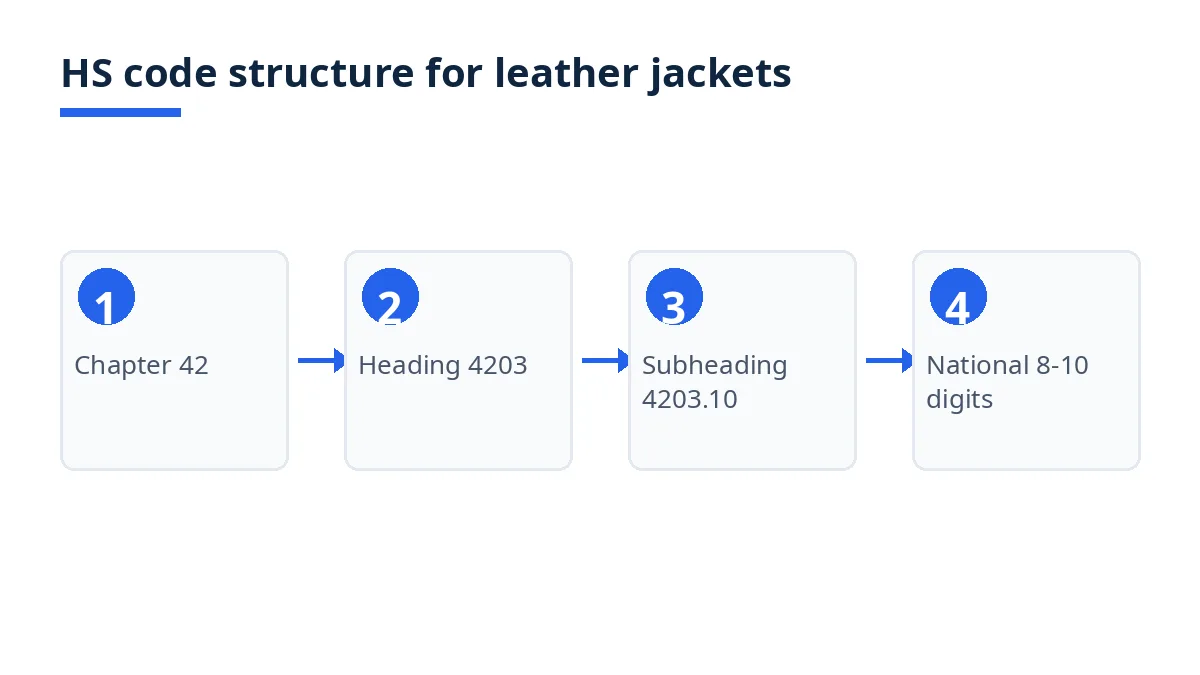
The Harmonized System is a multipurpose international product nomenclature developed by the World Customs Organization (WCO), comprising more than 5,000 commodity groups, each identified by a six-digit code, and used by more than 200 countries and economies as a basis for their customs tariffs.2 The current version is HS 2022.3 Only the first six digits are shared internationally; each country adds its own digits after them.
Level | Digits | For a leather jacket |
|---|---|---|
Chapter | 42 | Articles of leather and similar goods |
Heading | 4203 | Articles of apparel and clothing accessories, of leather or of composition leather |
Subheading | 4203.10 | Articles of apparel |
National extension | 8 to 10 digits | Set by the importing country |
The European Union extends the six digits to eight in its Combined Nomenclature.3 The United States and the United Kingdom work to ten digits. So the leather jackets tariff code and the leather jackets customs code can agree on 4203.10 yet differ in their final digits.
Factors that decide the code for leather jackets
Worn apparel comes first, before garment length. A jacket is apparel because it is worn on the body, placing it at 4203.10 rather than with containers or accessories. A leather bag is carried, so it sits in heading 4202. A leather belt is an accessory at 4203.30, and a leather glove sits at 4203.21 or 4203.29. This worn-versus-carried and apparel-versus-accessory boundary is the main difference between this guide and the guides for leather bags, wallets, and belts, which turn on container kind, pocket-article form, or belt type.
Length does not split jackets from coats inside 4203.10. A cropped jacket, a hip-length jacket, and a knee-length coat share subheading 4203.10 when each has a leather outer surface. The United States schedule reports coats and jackets together under the same apparel line, with statistical splits by wearer rather than a separate jacket subheading.1
The outer surface material decides whether heading 4203 applies at all. The heading covers articles "of leather or of composition leather".1 For this chapter, leather includes chamois leather, patent leather, patent laminated leather, and metallised leather.1 A jacket whose outer surface is textile, coated fabric, or plastics sheeting is not a leather jacket for classification purposes, even when the finish imitates leather.
Lining alone does not change the heading, but fur lining can. A quilted lining, a plain lining, and no lining all leave a leather jacket at 4203.10. The exception is fur. Chapter 42 does not cover apparel or accessories, except gloves, mittens, and mitts, lined with furskin or artificial fur, or with furskin or artificial fur attached outside, except as mere trimming, and those articles fall under heading 4303 or 4304.1 Describe fur exactly: where it sits and whether it is trimming or lining.
The textile boundary must be tested, not assumed away. A jacket with a textile outer surface leaves heading 4203 entirely. Knitted textile jackets are tested in the knitted apparel chapter, woven ones in the not-knitted apparel chapter, and heading 6211, other garments, is the heading to test for a textile jacket fitting none of the named garment headings. The harmonized system code for a textile jacket therefore cannot be copied from this guide.
National splits and trimmings are later checks. In the United States schedule, apparel splits nationally between reptile leather and other leather.1 That split does not exist at the international six-digit level, so it must not be carried into a European or United Kingdom entry. Articles of headings 4202 and 4203 with precious-metal parts stay in those headings unless those parts give the article its essential character, in which case it moves to Chapter 71.1
National codes: US HTS, EU CN/TARIC, UK commodity code
Each line below belongs to one country only; use the line for the country of declaration, on the entry date.
Destination | National line for a leather jacket |
|---|---|
United States (HTS) | 4203.10.40, other articles of apparel; reptile leather apparel sits at 4203.10.20 in the same schedule.1 Coats and jackets carry statistical splits by wearer. |
European Union (CN/TARIC) | 4203 10 00, articles of apparel, the eight-digit Combined Nomenclature line under 4203.10. Check TARIC for measures on the entry date.3 |
United Kingdom (commodity code) | 4203 10 00 00, articles of apparel, a single commodity under heading 4203, with no wearer split and no hand-made split at this line.4 |
The contrast with belts is instructive. Under the same heading, the United Kingdom tariff splits belts and bandoliers at 4203.30 into hand-made and other, but it does not split apparel that way.4 So each subheading must be read in its own national schedule.
How to confirm the code officially
Write a precise description: jacket or coat, outer material and leather type, lining and any fur, construction, and attached parts.
Read the heading text for 4203 and the Chapter 42 notes in the destination schedule, including note 2(b) on fur-lined apparel and note 1 on what counts as leather.1
Compare subheadings only at the same level: compare 4203.10 with the other one-dash lines of heading 4203, namely gloves, belts, and other accessories, before looking at national detail.4
Extend the six digits in the destination tariff, record the national line and the date checked, and keep the specification sheet beside it so a later material change triggers a fresh check.
Cross-check published rulings for similar jackets, and where the jacket is borderline, apply for a binding decision before shipping. In the United Kingdom, an Advance Tariff Ruling is legally binding and generally valid for three years.5 For EU movements, a Binding Tariff Information decision comes from the customs authority of the country concerned.5
Common classification mistakes
Filing a jacket at 4203.30 because it shares heading 4203 with belts. Jackets are apparel at 4203.10; belts and bandoliers are at 4203.30. Sharing a heading is not sharing a code.
Calling every jacket a leather jacket. A textile-shell jacket, a plastics-surface jacket, and a jacket with leather only as trim are not leather jackets for classification purposes. The outer surface test comes before the style name, and a photograph cannot show whether the outer surface is leather, coated textile, or plastics sheeting.
Treating a fur-lined jacket as a plain leather jacket. A quilted lining changes nothing, but a furskin lining, or furskin attached outside beyond mere trimming, removes the garment from Chapter 42 under note 2(b).1 The mistake usually comes from describing a jacket as "lined" without saying what the lining is.
Copying a supplier code as the import code. A supplier code is a starting point for the six digits. The full national code belongs to the destination tariff, and the digits after the sixth may not exist, or may mean something different, in the importing country.
Using length or wearer as a subheading test. Neither coat length nor a men's, women's, or infants' label creates a new subheading inside 4203.10. Those facts matter for description and statistical reporting, but the subheading turns on apparel status and outer surface material.
Stating a duty treatment from memory. No duty rate appears in this guide for a reason: the treatment follows the confirmed code, the origin of the goods, and the measures in force on the entry date, and it must be read in the destination tariff at that time.
Related duties and documents
This guide states no duty rates, and no rate should be read into any code in it. The code decides which duty line an entry uses, but the treatment itself is set in the destination tariff for the entry date and the origin of the goods, and it must be read there. Confirm the code first, then have the broker confirm the treatment that follows from it.
The commercial invoice and packing list should describe the jacket in the same terms used for classification: jacket or coat, outer surface material and leather type, lining material including any fur, and attached parts. Where a binding decision has been obtained, keep it with the entry papers.
For the wider method, read the HS code hub and the how to classify your product guide.
FAQs
What is the HS code for leather jackets?
The indicative international subheading is 4203.10, articles of apparel, under heading 4203, articles of apparel and clothing accessories, of leather or of composition leather.1 Treat it as indicative: confirm the subheading and the full national extension in the destination tariff for the exact jacket, since outer surface material, fur lining, and national splits can change the final line.
Is the HS code the same in every country?
The first six digits should be the same internationally for the same garment, because they come from the shared WCO system.2 The full code is not the same everywhere, because countries add their own digits and measures after the first six. Always confirm the full code in the destination tariff.
How do I confirm the correct code?
Write a precise description covering outer surface material, lining including any fur, and construction. Read the heading text and Chapter 42 notes in the destination schedule, compare subheadings at the same level, extend the six digits in that tariff, and record the date checked. Where the jacket is borderline, ask a customs broker in the destination country or apply for a binding decision before shipping.5
What happens if I use the wrong code?
Customs can reclassify the goods, reassess duty and taxes, delay clearance, and impose penalties, and a wrong code can mean a missed licence or measure. Tell a broker promptly if an error is found, and correct the entry through the proper route rather than reusing the wrong code on the next shipment.
Next steps on Exportain
Once the jacket description is settled, share it with the supplier and the broker so all documents describe the same garment. To source leather jackets from Bangladesh, browse suppliers and compare offers on the same description, then post a free RFQ on Exportain at https://exportain.com/rfqs with the outer material, lining, and construction stated in full.
Sources
- Harmonized Tariff Schedule of the United States, Chapter 42 (2026 Revision 18). U.S. International Trade Commission (accessed )
- What is the Harmonized System (HS)?. World Customs Organization (accessed )
- Harmonised System. European Commission (accessed )
- Articles of apparel and clothing accessories, of leather or of composition leather - UK Integrated Online Tariff. GOV.UK, HM Revenue and Customs (accessed )
- Check what you'll need to get a legally binding decision on a commodity code. GOV.UK, HM Revenue and Customs (accessed )
About the author
Sourcing from Bangladesh?
Post a request for quotation and suppliers on Exportain can send you their quotes directly.
Post an RFQ