How to Import Finished Leather From Bangladesh in 2026: Complete Buyer Guide
Finished leather is bought by the square foot, and the sheet you receive depends on the tannage, the grade, the thickness and the finish. This guide covers the 4107 code, the Savar tanneries, the tests that matter, and a worked order of 12,000 square feet to London.
Short answer
To import finished leather from Bangladesh, name the animal, layer, tannage, finish, thickness range and area in one specification, then shortlist tanners, approve a production swatch with a chromium VI report, and fix the inspection plan in the order. Bovine finished leather classifies under heading 4107, which carries 0 percent duty in the United Kingdom, and skin-contact leather must stay below 3 mg/kg of chromium VI under REACH. Price the order per square foot on usable area.
On this page
Key takeaways
Finished leather is leather further prepared after tanning or crusting: bovine and equine leather classifies under heading 4107, while wet-blue and crust stay under headings 4104 to 4106.
Name the tannage, the layer, the thickness range and the area in the specification: chrome tanning takes about a day, vegetable tanning takes weeks, and chrome-free means under 1,000 mg/kg of total chromium.
Skin-contact leather must stay below 3 mg/kg of chromium VI under REACH, tested by EN ISO 17075, and an LWG medal rates the tannery, not the sheet.
Example figures price 12,000 square feet of finished cowhide to London at 33,160 dollars in cash, or 3.21 dollars per usable square foot at a 72 percent cutting yield.
A shoe factory in London orders finished leather by the square foot, not by the piece. The buyer names the animal, the tannage, the thickness and the finish, and the tannery ships flat sheets stamped with the area. What can go wrong is the gap between the words on the order and the material in the carton: crust sold as finished, chrome where the buyer expected vegetable, or a thickness that suits a wallet, not a boot upper.
In 1990 the government banned wet-blue exports, pushing tanners toward crust and finished leather.1 Exports of raw hides and skins peaked at 422 million dollars in 2013 and fell to 126 million dollars in 2023.1
What "finished leather" means in tariff terms
Finished leather is leather further prepared after tanning or crusting. In the United Kingdom tariff, heading 4107 covers that material for bovine, including buffalo, and equine animals, without hair on, other than leather of heading 4114.2 A wet-blue hide and a crust hide are not finished leather in tariff terms. Headings 4104 to 4106 cover tanned or crust hides, and the chapter notes define crust to include hides retanned, coloured or fat-liquored before drying.2 Only leather finished after that stage moves to 4107. Our HS code guide for finished leather sets out the six-digit lines for other animals.
Stage | What it is | Tariff treatment |
|---|---|---|
Wet-blue | Tanned with chromium salts, still wet | Tanned hide, not finished leather |
Crust | Dried after tanning, retanning, colouring or fatliquoring | Tanned or crust hide, not finished leather |
Finished leather | Crust with its surface finish and final colour | Heading 4107 for bovine and equine animals |
From hide to finished sheet: the three stages
Tanning turns a raw hide into a stable material that will not rot. The hide then passes through retanning, dyeing and fatliquoring, and is dried to crust. Finishing is the third stage: the surface is conditioned, the colour is set and a top coat is applied.
Chrome, vegetable or chrome-free: choose the tannage first
The tannage sets the lead time, the feel and the chemical file. Chrome tanning uses chromium salts, takes roughly a day, and accounts for about 80 to 90 percent of world leather output.3 Vegetable tanning uses tannins from bark, wood and leaves, takes weeks, and leaves an open surface that darkens with handling.3 Chrome-free leather is a separate claim: leather counts as chrome-free when its total chromium stays under 1,000 mg/kg on a dry weight basis, under the BS EN 15987 standard.4 Name the tannage in the order.
Tannage | Agent | Time | Surface |
|---|---|---|---|
Chrome | Chromium salts | About a day | Sealed, soft, uniform |
Vegetable | Natural tannins from bark, wood and leaves | Weeks | Open, darkens with handling |
Chrome-free | Aldehydes or synthetic agents, no chromium salts | Varies by system | Depends on the agent |
Grades, thickness and area: how to specify the sheet
The grade names describe layers of the same hide. A thick hide is split horizontally: the top layer is full grain, or top grain where the surface has been sanded, while the split underneath carries a pressed-in imitation grain.3 "Genuine leather" usually describes the split.3
Leather is bought by area and by thickness, and the two numbers are independent. Area is measured in square feet and stamped on the flesh side.5 One square metre equals 10.7639 square feet; a whole bovine hide averages 45 to 54 square feet, while a half hide, or side, runs 19 to 26 square feet.5 Thickness is measured in millimetres or in ounces, where one ounce is about 0.4 millimetres.5 Tanners quote a range, not a single figure: a splitting machine targets a half-ounce window, such as 3.5 to 4.0 ounces, or 1.4 to 1.6 millimetres.5
Thickness | Millimetres | Typical use |
|---|---|---|
3 to 4 oz | 1.2 to 1.6 mm | Wallet exteriors |
4 to 5 oz | 1.6 to 2.0 mm | Tote bags, boot uppers |
8 to 10 oz | 3.2 to 4.0 mm | Work belts, saddlery |
Quality checks and tests before you pay
A material order needs a different test file from a finished-goods order. There is no sample garment to try on, so the reports carry the whole weight of the decision. Ask for them on the production article.
The Leather Working Group audit covers the tannery, not the sheet. Its audit standard was first launched in 2005 and runs across 17 sections.4 Gold needs 85 percent and Silver 75 percent; Bronze needs 65 percent and Audited 50 percent, and the final medal is the lowest rating across the sections.4 Certification runs for 24 months.4
Check | Method or limit | What to ask for |
|---|---|---|
Chromium VI | Under 3 mg/kg in skin-contact leather, tested by EN ISO 17075 | Test report on the production article |
Rub fastness | ISO 11640:2018, wool felt, grey-scale grading | Grade 1 to 5, wet and dry, with cycles |
Chromium VI is the chemical test that stops leather at the European border. Under REACH, leather that touches the skin cannot be sold in the EU when its chromium VI reaches 3 mg/kg in the total dry weight of the leather, and EN ISO 17075 is the only internationally recognised method for measuring it.6 For Gold and Silver LWG ratings, chromium VI above 3 mg/kg is an automatic failure.4 Rub fastness decides whether a dark sheet marks pale goods. Under ISO 11640:2018, wool felt rubs one side of the specimen for a set number of motions, and the staining of the felt and the change in the leather are graded against grey scales.7 Ask for the grade from 1 to 5, wet and dry, with the number of cycles used: a grade without its cycles is not a result.3 Our finished leather quality control checklist turns these checks into an inspector's list.
Where the leather is tanned: Savar and the CETP question
Most Bangladeshi tanneries now work at the Savar estate. The relocation project was approved in January 2003 and completed in June 2021, after around 18 years.8 The estate has a central effluent treatment plant, known as the CETP, but an official evaluation found its effectiveness remains limited. At the CETP outlet, chemical oxygen demand measured 737 mg/L against a permitted limit of 200 mg/L, and biochemical oxygen demand 299 mg/L against 30 mg/L.8 Most tanneries there still lack Leather Working Group certification.8
The government moved on the estate again in November 2026. Tanners yet to start production are to receive support to restart, every factory covering 50,000 square feet or more must install its own effluent treatment plant, and all tanneries in Savar must obtain LWG certification.9 The sector earned 1.23 billion dollars from leather and leather products in the 2025-26 financial year, up 7.09 percent, according to Export Promotion Bureau data.10
Worked example: 12,000 square feet of finished cowhide to London
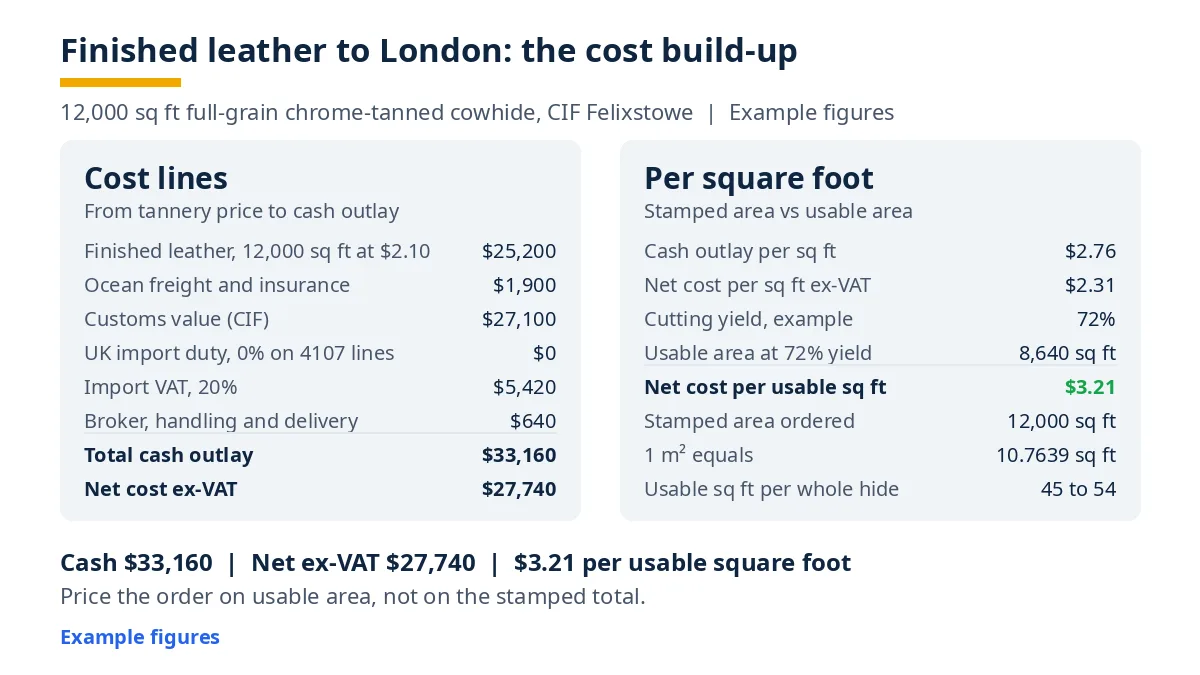
Example figures. A shoe factory in London orders 12,000 square feet of full-grain, chrome-tanned bovine cowhide at 1.4 to 1.6 millimetres, finished in black, shipped from Chattogram. The price is 2.10 dollars per square foot, and the order runs on CIF terms to Felixstowe.
Cost line | Amount (USD) |
|---|---|
Finished leather, 12,000 sq ft at $2.10 | 25,200 |
Ocean freight and insurance to Felixstowe | 1,900 |
Customs value (CIF) | 27,100 |
UK import duty, 0% on 4107 lines | 0 |
Import VAT, 20% of $27,100 | 5,420 |
Broker, handling and delivery | 640 |
Total cash outlay | 33,160 |
Net cost ex-VAT | 27,740 |
Cost per square foot ex-VAT | 2.31 |
Cost per square foot, cash | 2.76 |
Check it: 12,000 square feet at 2.10 dollars is 25,200 dollars; plus 1,900 dollars of freight and insurance, the CIF value is 27,100 dollars. The United Kingdom tariff shows 0.00 percent third-country duty on the 4107 lines and import VAT at 20 percent.2 Twenty percent of 27,100 dollars is 5,420 dollars, and the lines add to 33,160 dollars.
The usable cutting yield across irregular hides runs 68 to 78 percent depending on pattern size.5 At a 72 percent yield, the 12,000 square feet give 8,640 usable square feet, so the net cost per usable square foot is 3.21 dollars. Our finished leather price guide breaks down the FOB lines, and our landed cost guide walks through every charge to the factory.
The order in six moves
Write the material specification. One document for every candidate: animal, layer, tannage, finish, thickness range, rub-fastness grade and delivery term. Shortlist with our finished leather manufacturers guide.
Shortlist tanners and compare quotations on one term. Ask each for an itemised quotation in dollars per square foot, with the area basis stated. With FOB Chattogram you pay the sea leg and the insurance; with CIF Felixstowe the seller arranges both; with DAP London the seller delivers to your factory. Our Incoterms guide explains FOB, CIF and DAP for a leather shipment.
Approve the swatch, then the bulk sheet. First a cutting of the production article with the chromium VI report, then a full sheet from the bulk lot, measured and rub-tested, before the rest is released.
Fix the inspection plan in the order. Set the inspection plan before the order ships: the inspector, the timing and the checks.
Produce, pack and file the export papers. The export file runs on the Export Registration Certificate and the business identification number, with the EXP form, the commercial invoice, the packing list and the certificate of origin.10 The exporter lodges the EXP form electronically with its authorised dealer bank, and the signed EXP copy, certified Bill of Export and shipping documents go to the bank within 14 days of shipment.10
Ship, clear United Kingdom customs and receive. Book the freight and insurance and collect the bill of lading once the carrier issues it. Hand your broker the code, invoice, packing list, origin statement and bill of lading before the vessel berths. Our importing guide covers the wider sequence.
Three mistakes that cost finished-leather importers money
Ordering "finished leather" and receiving crust. Crust is not finished leather in tariff terms, so name the finishing steps in the order.2
Approving a swatch and never testing the bulk sheet. Chromium VI can form when process control slips.6 Test the production article.
Reading an LWG medal as a chemical pass. The audit covers the tannery, not the sheet.4 The EN ISO 17075 report is the evidence about your leather.
Import checklist
Material defined in numbers: animal, layer, tannage, finish, thickness range, area.
Code settled: heading 4107, UK duty 0 percent, VAT 20 percent.
Tannery named, with its LWG certificate number and expiry date.
Swatch approved in writing, with the chromium VI report on the production article.
Rub-fastness grade agreed, wet and dry, with the cycles used.
Quotation compared on one delivery term, priced per square foot.
Export papers ready: ERC, BIN, EXP form, Bill of Export, certificate of origin.
Questions buyers ask about finished leather
How is finished leather priced?
By area, in dollars per square foot. Without the area basis and the thickness range, quotations cannot be compared.
What duty does finished leather from Bangladesh pay in the United Kingdom?
The United Kingdom tariff shows a third-country duty of 0.00 percent on the 4107 lines, with import VAT at 20 percent.2 Confirm the full commodity code with your broker before the goods ship.
Next steps on Exportain
Confirm the code in our HS code guide for finished leather, then post an RFQ with the animal, tannage and thickness range. Then find Bangladeshi suppliers and compare quotations on the same term.
Sources
- Investing in Bangladesh's Leather Industry: Challenges and Solutions. United Nations Development Programme (accessed )
- Leather further prepared after tanning or crusting, including parchment-dressed leather, of bovine (including buffalo) or equine animals, without hair on, whether or not split, other than leather of heading 4114. GOV.UK (UK Integrated Online Tariff) (accessed )
- Vegetable tanned or chrome tanned leather: what to specify. Splot (accessed )
- Certification - Leather Working Group. Leather Working Group (accessed )
- Leather Hide Measurement: Area (m²/sq ft) & Oz. Zeugma Leather, (accessed )
- Commission Regulation (EU) No 301/2014 amending Annex XVII to Regulation (EC) No 1907/2006 as regards chromium VI compounds. EUR-Lex, (accessed )
- ISO 11640:2018 - Leather Colour Fastness to To-and-Fro Rubbing Test. International Organization for Standardization (accessed )
- Tannery relocation solved one pollution crisis, triggered another: IMED. The Business Standard, (accessed )
- Bangladesh will provide technical, financial support to restart closed Savar tanneries: Minister. The Financial Express, (accessed )
- Start an Export Business in Bangladesh (2026 Guide). Entrepreneurs.bd (accessed )
About the author
Sourcing from Bangladesh?
Post a request for quotation and suppliers on Exportain can send you their quotes directly.
Post an RFQ