Finished Leather Price in Bangladesh: FOB Cost Breakdown for Buyers
An FOB price for finished leather from Bangladesh is a stack of cost lines, not one number. Read each line, its driver and its question before you rank any quotation.
Short answer
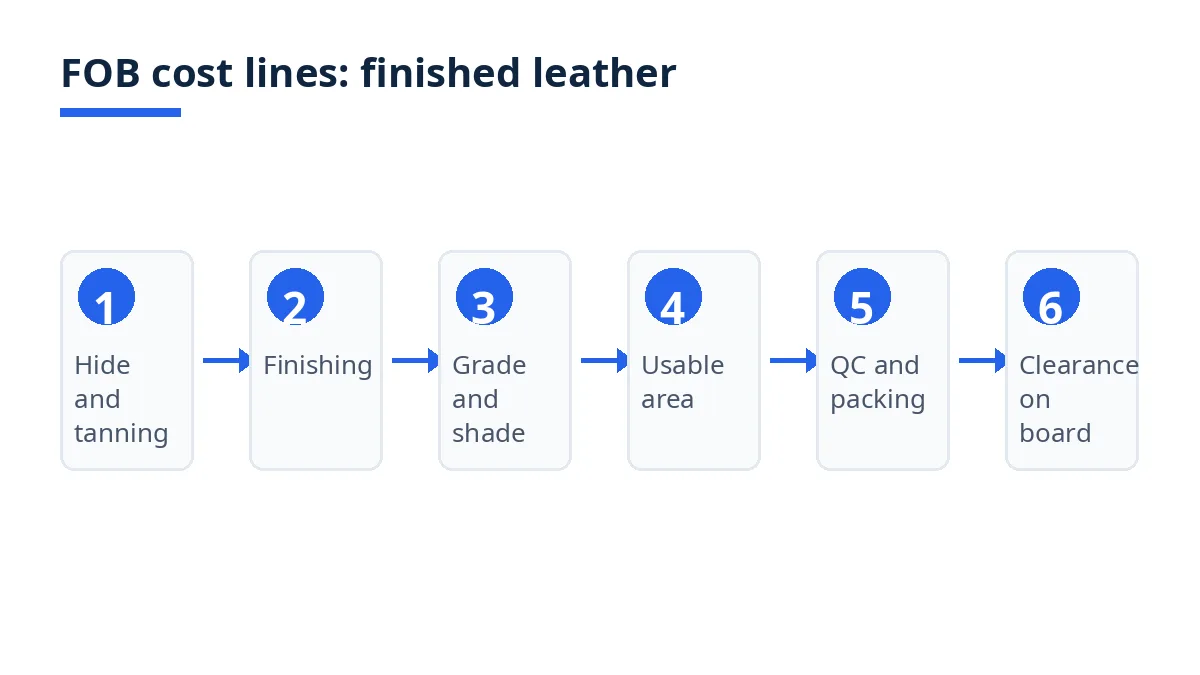
A finished leather FOB price from Bangladesh is the sum of nine cost lines up to loading on board at the named port: hide, tanning, finishing, cutting yield, labor and overhead, quality checks and lab evidence, packing, inland freight, and export clearance with on-board charges. Ocean freight, insurance, import duty and destination costs sit outside FOB. Compare quotations line by line on one identical specification, never on the headline total alone.
On this page
Key takeaways
An FOB price covers nine lines up to loading on board at the named port. Ocean freight, insurance, import duty and destination costs sit outside it.
Compare quotations line by line on one identical specification. Example figures: a 12-point index gap can sit mostly in the hide line and the port charges.
Grade, finish, thickness and shade move the price before negotiation starts. Fix them in writing with sample hides and grade rules.
A lot minimum counts per color and finish combination. Example figures: 3 colors in 2 finishes at 120 hides per combination is 720 hides.
A tannery audit assesses the tannery, never the product. Require lab evidence for the lot itself, by named method, separately from audit evidence.
A finished leather price in Bangladesh is rarely one number: it is a stack of cost lines ending when the leather is loaded on board at a named port, and every line answers to a different part of the specification. This guide reads an FOB quotation line by line: what each line covers, what moves it, and which question tests it.
Read the FOB line before you read the price
FOB stands for Free On Board, one of the Incoterms 2020 rules published by the International Chamber of Commerce (ICC). Under FOB, the seller delivers the goods loaded on board the vessel nominated by the buyer at the named port of shipment, and risk transfers to the buyer at that point.1 The seller carries the goods to the port, loads them, and completes export formalities, while the buyer contracts the carrier, pays the freight, and handles import formalities.1
That boundary decides what the price must contain and what it must not: ocean freight, marine insurance, import duty, and destination transport sit outside FOB. Without a named port of shipment, the inland freight and on-board charges cannot be tested. FOB applies only to sea and inland waterway transport, and where leather is containerized the seller commonly hands goods to a container terminal rather than loading them directly on board, in which case the ICC Academy notes FCA is the more appropriate rule.1 The buyer must tell the seller the vessel name and loading place and point in time; late notice can shift risk and added costs to the buyer even before loading.1
The nine cost lines in a finished leather FOB quotation
The table names the nine lines in order, from hide to ship. No line carries a market figure: every number in the worked example is labelled as example figures, because a real figure depends on the specification, the lot, and the date.
Line | What it covers | Tested by |
|---|---|---|
1. Hide | Hide or skin, by animal and form | Animal, form, area unit in writing |
2. Tanning | Tanning and retanning to crust | Tannage named, crust state stated |
3. Finishing | Dyeing, coating, surface finish | Finish type and approved sample |
4. Cutting yield | Usable area after defects and edges | Grade rules and area method |
5. Labor and overhead | Making-ready work, tannery overhead | What the line includes |
6. Quality checks and lab evidence | Inspection and testing for the lot | Named methods, lot identity |
7. Packing | Rolling, interleaving, cartons | Roll rule and label contents |
8. Inland freight | Tannery to the named port | Port named, route stated |
9. Clearance and on-board charges | Export clearance and loading | Charges itemized, port named |
1. Hide: animal, form, and area unit
The hide line is the material itself: the animal, whether it ships as whole hides, sides, or skins, and the area priced. Finished leather means leather further prepared after tanning or crusting; a wet-blue or crust hide that has not been finished is not finished leather in tariff terms even if a supplier describes it that way.2 The animal and form move the line first, then the area unit: quotations in different units cannot be compared until both are restated in one unit. Ask which animal, which form, and which area unit the price uses, and whether the area is shipped or usable area.
2. Tanning: tannage named, crust state stated
Tanning turns a hide into leather, and retanning and related crust work prepare it for finishing. The tannage affects hand-feel, color behavior, and which finishes are possible, so name it in the specification. The tannage process and crust work required move the line, including retanning, coloring, or fat-liquoring before drying.2 Ask which tannage, and whether the leather is supplied at crust stage and then finished.
3. Finishing: dye, coating, and the approved sample
Finishing sets color, surface, and hand-feel. The finish types are aniline, semi-aniline, and pigmented: aniline shows the pore structure clearly with no topcoat, semi-aniline carries a light pigmented coating with a thin topcoat, and pigmented leather is covered by an opaque pigment layer.3 The finish type, the number of color and finish combinations, and the shade standard move the line, and shade varies from hide to hide and across one hide, so a single-hide sample cannot settle a lot.3 Ask which finish type, how many combinations, and which sealed sample hide sets the shade standard.
4. Cutting yield: grade rules and the area method
Finished leather is graded, not passed or failed as a perfect sheet, and grading turns on position and size: damage in a corner area may mean only a grade drop, while damage in the main area may scrap the hide.3 The price consequence is cutting yield, the share of shipped area you can actually cut. The grade rule, thickness tolerance, and area method move the line. Thickness is gauged under a specified load, and readings differ between the spine and the belly.3 Ask which grade rules apply, where thickness is read, which tolerance applies, and how area is measured.
5. Labor and overhead: what the line includes
Labor and overhead cover making-ready work between the crust store and the packing table: sorting, measuring, trimming, and handling, plus tannery overhead. This line is the easiest to hide inside other lines. Handling intensity moves it: more combinations, more shade-band sorting, and more inspection passes add handling. Ask what the line includes, and whether sorting and measuring sit inside it or are charged elsewhere.
6. Quality checks and lab evidence: named methods, lot identity
Quality checks cover inspection of the finished lot and laboratory testing the buyer specification requires, and they must attach to the lot offered, not to the tannery in general: a tannery audit assesses the tannery, while lab evidence must describe the lot. Require the method by name for each test, the result against your specification, and the lot identity on the report, with no universal pass mark assumed. Ask which tests, by which named methods, on how many hides, and whether the report names the lot.
7. Packing: rolls, labels, and the crease rule
Packing for finished leather is rolling, never folding: hides are rolled, with paper between rolls and no weight on the finish, because folding leaves marks that can stay permanently.3 Rolling runs neck to butt, because the butt is the stiffest part and does not take a sharp bend well.3 The line also covers labels and reconciliation: hide count, area total, color and finish marks, and roll labels checked against the order.3 Roll size, interleaving, carton type, and labeling detail move it. Ask how the hides are rolled, what sits between rolls, and what each roll label carries.
8. Inland freight: tannery to the named port
Inland freight moves the packed leather from the tannery to the named port. Under FOB the seller carries this leg, including transport from its premises to the port.1 The port, distance, and route move the line, and a quotation priced to one port cannot be compared with one priced to another without restating the freight. Ask which port, which route, and whether the line includes terminal handling. If goods are containerized and handed over at a terminal, confirm the delivery rule again, since FOB delivery is on board the vessel.1
9. Clearance and on-board charges: itemized, port named
The last FOB lines are export clearance and the charges of getting the goods on board; the seller must complete export formalities under FOB.1 Port and terminal charges, documentation charges, and loading costs sit on the seller side, while the buyer contracts and pays for ocean carriage.1 The port tariff, documentation, and any storage or waiting time move the line: if the seller cannot load because no vessel is available and the nominated ship is delayed, the buyer can bear the risk and cost of storage at the port until the vessel arrives.1 Settle waiting and storage in writing before the goods travel.
Two quotations, one specification: a line-by-line comparison
Example figures throughout this section. Two quotations for the same specification can differ by 12 index points without either seller mispricing anything. Both price the same animal, form, finish, grade rules, area unit, port, and delivery rule; the totals are indexes, not market prices.
Cost line | Quotation A | Quotation B | Difference |
|---|---|---|---|
Hide | 38 | 43 | +5 |
Tanning | 12 | 13 | +1 |
Finishing | 10 | 11 | +1 |
Cutting yield allowance | 6 | 6 | 0 |
Labor and overhead | 8 | 8 | 0 |
Quality checks and lab evidence | 4 | 5 | +1 |
Packing | 5 | 5 | 0 |
Inland freight | 9 | 11 | +2 |
Clearance and on-board charges | 8 | 10 | +2 |
Total FOB index | 100 | 112 | +12 |
Five of the twelve points sit in the hide line, pointing back to the hide specification; four sit in inland freight and on-board charges, pointing back to the port and route. Negotiate the lines rather than asking both sellers for a lower total.
Example figures: an order of 1,000 square feet at a total FOB price of USD 8,200 costs USD 8.20 per shipped square foot. If only 820 square feet prove usable after defects, edges, and thin areas are removed, the same order costs USD 10.00 per usable square foot (8,200 divided by 820). Compare quotations on usable-area cost for your grade rules, and confirm the area unit matches before you divide anything.
What the specification changes in the price
Grade, finish, thickness, and shade move the price before negotiation starts: a higher grade rule removes more hides or area; a grain-showing finish such as aniline leaves less room to hide surface marks than an opaque pigmented finish, so grade and finish must be set together;3 a tighter thickness tolerance removes hides that read correctly at the spine and thin at the belly; and a tighter shade standard increases sorting into shade bands under one light.3
Classification must be settled per leather type. The indicative heading for finished leather from bovine (including buffalo) or equine animals is 4107, covering leather further prepared after tanning or crusting, with six-digit lines set by whole hides versus sides and by full grain, grain split, or other.4 2 Sheep or lamb leather falls under 4112 and other animals under 4113, while patent, chamois, and metallized leather fall under 4114 and composition leather under 4115.2 There is no single code for all finished leather, and only the first six digits are shared internationally.2 Treat every heading here as indicative, verify the full national code in the destination tariff, and use a separate invoice line per type.2 A wrong heading changes the duty and measures treatment at destination, so confirm it with your broker before shipping.
Quantity, lot, and shade: why the same leather costs differently twice
Quantity changes a finished leather price through the lot, not only through volume: a lot minimum counts per color and finish combination, so three colors in two finishes at a 120-hide minimum per combination is a 720-hide commitment, not a 120-hide order. A minimum can be counted per order, per style or product, or per color, and a supplier can combine a quantity minimum with a minimum order value.5 The agreed price is the one in the accepted quotation.5 For the full counting rules, read the MOQ guide.
Shade sorting is the second quantity effect: hides laid side by side under the same light drift hide to hide, and a lot that matches hide by hide can still drift as a set.3 Sorting, holding out-of-standard bands, and re-checking cost handling time, and a small lot carries that handling across fewer hides. Ask whether the minimum is per combination, how many shade bands the lot will be sorted into, and what happens to a band outside the standard.
Costs, timelines, and documents that sit outside the FOB price
Everything beyond loading on board sits outside the FOB price and belongs in your landed cost: ocean freight and marine insurance are the buyer side, since the buyer contracts the carrier and pays the transportation costs,1 and import duty, taxes, destination charges, and warehouse transport follow. This guide states no duty rate: read the treatment beside your confirmed code in the destination tariff and confirm it with your broker, since a rate on one line does not carry to another line, origin, or entry date.2 For the full lines, see the landed cost guide.
Timelines are quotation terms, not standard periods: a quotation states unit price, minimum order quantity, lead time, Incoterm, payment terms, and validity.5 Agree the lead time, shipment window, and validity date in writing. During the peak period after Eid-ul-Azha, the Savar treatment plant faces far more effluent than its daily capacity, and alternative measures are taken to manage the volume processed there.6 Ask how a peak-period order is scheduled.
Documents are agreed with your forwarder and broker: the commercial invoice and packing list, the bill of lading, the supplier specification, the confirmed classification code for each leather type with any binding decision, and the origin evidence, with each leather type as a separate invoice line.2 Confirm the list before the goods travel.
Bangladesh notes: Savar, effluent evidence, and the tannery audit
Most export tanning in Bangladesh sits at the Savar Tannery Industrial Estate, relocated from Hazaribagh in Dhaka.6 Effluent capacity there constrains peak-time processing: the central effluent treatment plant (CETP) treats between 14,000 and 18,000 cubic meters a day depending on pre-treatment quality, against about 45,000 cubic meters needed during the peak period after Eid-ul-Azha.6 Ask what effluent evidence a tannery can show for the lot. The Leather Working Group audit treats CETP efficiency as part of the final effluent assessment, and third-party evidence of CETP performance is required as part of it.7
The Leather Working Group (LWG) audit is a tannery audit, never a product certificate: a comprehensive assessment of how a tannery measures, controls, and reports the impact of its manufacturing operations, across 17 sections including water and energy use, environmental and chemical management, waste and effluent treatment, and health and safety.7 Ratings are awarded per section at Gold (85 percent), Silver (75 percent), Bronze (65 percent), or Audited (50 percent), and a manufacturer must reach a rating across all categories or be certified at the level of its lowest category.7 Certification is valid for 24 months for manufacturing facilities, commissioning manufacturers, and subcontractors, and 12 months for traders of part-processed material.7 For Gold and Silver, chromium VI levels must be below 3 mg/kg, and any level above that results in automatic failure.7 LWG certification does not guarantee no restricted substance failures in a final product, and traceability is rated separately as a percentage.7 Read an audit certificate as evidence about the tannery and its validity dates, then require lab evidence for the lot itself, separately, by named method.
Mistakes and red flags in a finished leather price
Ranking on the headline total. A single total hides which line differs. Compare the nine lines on one identical specification.
Mixing area units. Restate every quotation in one unit, and confirm whether the area is shipped or usable area.
Pricing wet-blue or crust as finished leather. Leather only tanned or brought to crust stays under the crust headings; only leather further prepared after tanning or crusting is finished leather.2
Leaving the grade unstated. Without grade rules by position and size, a scar in the prime area and a scar in a corner area cost the same argument later.3
Accepting one sample hide as the shade standard. Shade varies hide to hide and batch to batch; a lot must be laid out under one light and sorted into bands.3
Reading an audit certificate as a product certificate. LWG certification assesses the tannery and does not guarantee no restricted substance failures in a final product.7 Lot lab evidence by named method is separate.
Leaving the port unnamed. Name the port, the route, and the delivery rule, and confirm the container handover point.1
Treating the listing price as the agreed price. Tiered listings show a starting price above a quantity range; the agreed price is the one in the accepted quotation, with unit price, minimum, lead time, Incoterm, payment terms, and validity stated.5
Quotation checklist: the lines to confirm before you rank
Animal, form, tannage, finish type, and preparation state in writing, with the area unit and method stated.
Grade rules by position and size, thickness readings and tolerance, and sealed sample hides setting grain, shade, softness, and finish.
The nine FOB lines itemized, with the port of shipment named, the route stated, and the delivery rule confirmed for containerized goods.
The lot minimum counted per color and finish combination, with the shade-band sorting rule and the treatment of out-of-standard bands.
Quality checks and lab evidence by named method, with lot identity on the report and a sampling plan for the finished, packed lot.
Packing method, roll rule, interleaving, and roll label contents, checked against the packing list and order.3
Classification per leather type, indicative until the full national code is confirmed in the destination tariff, with a separate invoice line per type.2
Validity date, lead time, payment terms, and the waiting and storage rule if the nominated vessel is delayed.1 5
Badge meanings read from the checks behind each badge: verification on Exportain is a review of documents and photos by staff, not a factory visit, not a database check, and not a guarantee. Read how supplier verification works before you shortlist.8
The shipment document list agreed with your forwarder and broker before the goods travel, including the specification and classification file.2
What should I know first about finished leather price in Bangladesh?
Know the boundary first and the material second: a finished leather FOB price covers nine lines up to loading on board at a named port, and nothing beyond it. The material is leather further prepared after tanning or crusting, graded by position and size, with a finish type, thickness tolerance, and shade standard set by sample hides.2 3
What are the typical costs and timelines in an FOB finished leather order?
The costs inside FOB are the nine lines in this guide. Outside FOB sit ocean freight, insurance, import duty and taxes, destination charges, and warehouse transport. Timelines have no standard length: lead time, shipment window, and validity are quotation terms to agree in writing, and peak periods can change scheduling.5 6
Which documents are needed with an FOB finished leather shipment?
Agree the list with your forwarder and broker before shipment: the commercial invoice and packing list, the bill of lading, the supplier specification, the confirmed classification code for each leather type with any binding decision, and the origin evidence, with each leather type as a separate invoice line.2 The seller completes export formalities under FOB, and the buyer handles import formalities.1
What are the most common mistakes when comparing finished leather prices?
Ranking on the headline total, mixing area units, pricing an earlier material state as finished leather, leaving the grade unstated, accepting one hide as the shade standard, reading a tannery audit as a product certificate, leaving the port unnamed, and treating a listing price as the agreed price. Put the specification, the nine lines, the port, and the document list in writing, and compare only quotations that answer the same specification line by line.
Next steps on Exportain
Browse Bangladeshi suppliers and read what each badge records before you shortlist, then post an RFQ with the animal, form, tannage, finish, grade rules, thickness, shade standard, area unit, quantities per combination, named port, and delivery rule in one requirement. Read the finished leather classification guide and the finished leather quality checklist, and confirm the code and document list with your broker before you ship.
Sources
- FOB & FAS Incoterms® 2020 explained: Key differences. ICC Academy (accessed )
- HS Code for Finished Leather: Classification Guide for Importers. Exportain, (accessed )
- Quality Control Checklist for Finished Leather. Exportain, (accessed )
- Classification Detail: HS, 2017, Code 4107. United Nations Statistics Division (accessed )
- MOQ Meaning (Minimum Order Quantity). Exportain (accessed )
- Govt to fix Savar CETP's deficiencies, back tanneries' own ETPs: Commerce minister. The Daily Star, (accessed )
- Certification - Leather Working Group. Leather Working Group (accessed )
- How Supplier Verification Works on Exportain. Exportain, (accessed )
About the author
Sourcing from Bangladesh?
Post a request for quotation and suppliers on Exportain can send you their quotes directly.
Post an RFQ