Top Leather Jackets Manufacturers in Bangladesh: How to Find and Verify Them
Six checks for finding and verifying leather jackets manufacturers in Bangladesh: worn-jacket function, a fixed tech pack, leather and tannery evidence, identity and site, MOQ counting, and classification, with a one-page summary table for each supplier.
Short answer
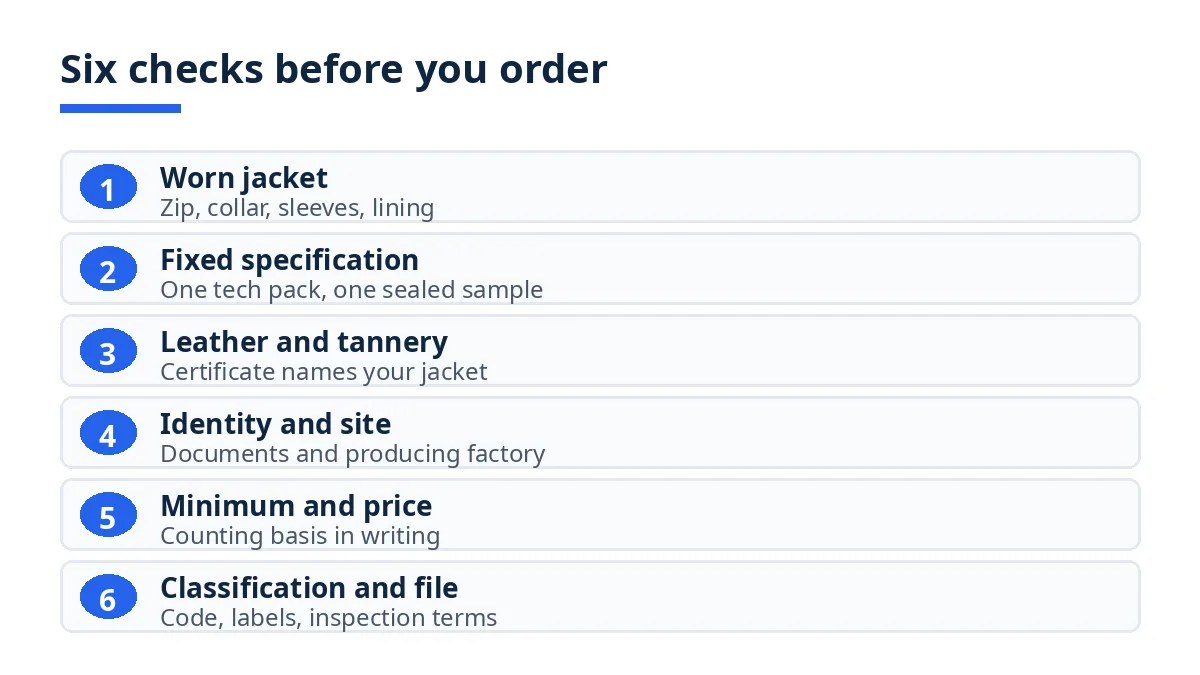
Find leather jackets manufacturers in Bangladesh by checking six things in order: the jacket works when worn, one tech pack fixes every panel, leather and tannery evidence names your jacket, identity and the producing site match the documents, the minimum is counted on a stated basis, and classification, labels, and inspection terms agree. Read each Exportain badge for the checks it records, approve a sample in your leather, and hold the order while any check is open.
On this page
Key takeaways
Judge the jacket worn, not flat: the zip, collar, sleeve pair, and lining decide whether a sample passes before any document is read.
A version-numbered tech pack and a sealed sample fix the jacket, so every quotation prices the same panels, hardware, and size run.
Leather and tannery evidence must name your leather, your tannery, and your product, with scope and expiry checked with the issuing body.
A badge records only the document and photo checks its name records; the producing site, the sample, and the inspection terms stay the buyer's own checks.
A leather jacket is judged with a body inside it. Laid flat, a front can look straight and still pull at the shoulder once zipped, one sleeve can hang longer than the other, and a lining can twist the moment an arm goes through it.1 A good photograph proves none of that, nor that the sample leather is the bulk leather, nor that the company on the quotation will cut and stitch the jacket.
This article names no companies and ranks no supplier. It sets six checks for finding leather jackets manufacturers in Bangladesh and verifying them: worn-jacket function, a fixed specification, leather and tannery evidence, identity and the producing site, the minimum and price basis, and classification with the shipment file. Every calculation figure here is an example figure, and no factory name, capacity, price, or certificate is stated as a fact.
Check 1: The jacket works when worn — zip, collar, sleeves, lining
Verify. Judge the jacket as a wearer meets it.1 Hardware must operate smoothly and sit firmly attached with no rust or scratches; stitching must run straight with reinforced stress points at the shoulders, armholes, and pocket corners.1
Evidence that counts. A sample built to your tech pack, tried on and zipped. Run the full-length front zip several times: no catching, no forced pull, no skipped teeth, teeth meeting evenly, tape lying flat, and no wave or pull at the lapel curve.1 Check collar and lapel symmetry while zipped, measure both sleeves by one method, and test each sleeve lining for twist.1 Check every pocket for position, flap, closure, and a deep, clean bag.1 Agree the measurement method first and use the same condition for every jacket.1
Hold when. The zip catches, one sleeve is longer, the collar sits uneven when zipped, the lining twists, or shade bands across the panels under the agreed light.1 Ask for a corrected sample and test it the same way.
Check 2: The specification fixes every panel before pricing
Verify. Two quotations cannot be compared unless both suppliers priced the same jacket. Fix it in one version-numbered tech pack before asking for prices: leather type and grain, panel layout, collar and lapel shape, pocket style and placement, zip and hardware, lining, stitching, edge finish, labels, and the size run, plus the shade standard, defect classes, and packing method.1
Evidence that counts. The dated, version-numbered tech pack, sent identical to every supplier, plus the sealed approved sample it describes. Genuine leather comes from animal hides, so natural marks such as scars, insect holes, blood veins, and growth wrinkles are inherent, and inspection grades them by position and size: damage in a corner area may mean only a grade drop, while damage in the main material area may scrap the whole hide.1 State which faults count as critical, major, or minor, and agree the sampling plan in writing before production.1
Hold when. A supplier prices from a style name, a photograph, or a partial description. Style names do not fix the outer material, lining, or construction, and customs does not classify them.2
Check 3: Leather and tannery evidence names your jacket
Verify. Tie the leather in the sample to a named tannery and a named test or audit record, per style, per color, and per tannery. Ask which tannery made the sample leather, and what evidence names that tannery and leather, with scope and expiry. Evidence naming a different tannery or leather is background only.
Evidence that counts. A certificate and test report naming your leather, your tannery, and the method, with expiry checked and confirmed with the issuing body.3 The Leather Working Group (LWG) audit, first launched in 2005, assesses a tannery across 17 sections, including water and energy, environmental and chemical management, waste and effluent treatment, and health and safety.4 Each section is rated against minimum thresholds of 85 percent for Gold, 75 percent for Silver, 65 percent for Bronze, and 50 percent for Audited, and the final medal is the lowest category achieved; certification lasts 24 months for manufacturing facilities, and 12 months for part-processed material traders.4
Hold when. The tannery is unnamed, evidence names another leather or has expired, or a claim cannot be confirmed with the issuer. LWG states that certification does not guarantee no restricted substance failures in a final product, and that the audit is not a legal compliance assessment and grants no operating permit.4 Leather counts as chrome-free below 1,000 mg/kg of total chromium on a dry weight basis under BS EN 15987, and Gold and Silver certification requires chromium VI below 3 mg/kg.4 Treat those as tannery certification thresholds, not a pass mark for your jacket: require lab reports naming your product, leather, and method for each limit your market applies, including ISO 17075 for colorfastness to rubbing where specified.1 Retest when leather or tannery changes, and send your restricted substances list before sampling.
Check 4: Identity, site, and the maker behind the profile
Verify. One company can present the profile while another cuts the jackets. Record which site cuts, stitches, and finishes your jacket, which site supplied the leather, and which stages are bought in. For a trading company, record the producing factory for each style before any deposit, and name it in the order terms.
Evidence that counts. The trade licence and Export Registration Certificate (ERC), requested by you, with name and address checked against the quotation and invoice.3 On Exportain, read each badge for the checks its exact name records: Exportain Verified (identity, phone, email, and business registration); Export Verified (the ERC); Factory Verified (factory photos reviewed); Trading Company Verified (office or warehouse photos reviewed); Trusted Trader (orders completed on Exportain with no disputes).3 The profile's trust and verification checklist lists each check as verified or not verified, including a payment account line: when verified, the supplier's business bank account was checked against its verified company name, with no bank details shown to buyers.3
Hold when. Names differ, the producing site is unnamed, a badge is read as more than its named checks, or bank details change late. Verification is a document and photo review by Exportain staff: not a factory inspection, not a check against any government database, and a badge is not a guarantee of capacity, quality, or delivery.3 No badge shows nothing, meaning a check has not been approved, not that it failed.3 Exportain is not a party to your trade and holds money only when both parties agree to a funds hold.3 Verification is free, membership never grants a badge, and certifications marked "Verified by Exportain" appear only while approved and unexpired, while seller-typed entries are marked as declared by the seller and unverified; confirm any certificate with its issuer.3
Check 5: The minimum and the price are counted on the same basis
Verify. A minimum order quantity (MOQ) is the smallest quantity a supplier will accept on its normal terms, counted per order, per style, or per color, sometimes with a minimum order value.5 Ask for the counting basis in writing, and whether more than one applies at once.5
Evidence that counts. A quotation stating unit price, MOQ, lead time, Incoterm, payment terms, and validity, on one identical specification, so quotations compare field by field.5 Example figures: a minimum of 200 pieces per color, across three colors in two styles, means a smallest order of 1,200 pieces, not 200. Three drivers set the minimum: the material, the trims, and the variety.5 Custom leather brings the tannery's minimum into the maker's minimum, and every extra color, size, or style adds changeovers.5 Price moves with the same drivers: leather type, grain, and thickness; hardware finish; lining; the size and color mix; packing; and inspection requirements.
Hold when. A quotation omits the counting basis, leather type or finish, or hardware set, or a low headline minimum hides a trim minimum. To lower a minimum, ask about stock leather, fewer colors and sizes, standard trims and packaging, a small-order surcharge, an honest trial order, small-run capacity, or sharing material or a planned run, and expect a trade-off in unit price.5 In the request for quotation, state quantity per style, per color, and the size breakdown, leather and finish, custom trims, Incoterm and destination, and whether it is a trial.5
Check 6: Classification, labels, and the shipment file agree
Verify. Classification decides the duty line, and a code copied from another product or country does not transfer. The indicative heading is 4203, articles of apparel and clothing accessories, of leather or of composition leather, and the indicative subheading for a leather jacket is 4203.10, articles of apparel.2 The Harmonized System, developed by the World Customs Organization (WCO), comprises more than 5,000 commodity groups, each identified by a six-digit code, and is used by more than 200 countries and economies as a basis for customs tariffs, in its current version HS 2022.2 Only the first six digits are shared; the European Union adds two more, the United States and the United Kingdom four more.2
Evidence that counts. A precise description — jacket or coat, outer material and leather type, lining and any fur, construction, and attached parts — read against the heading text and Chapter 42 notes in the destination schedule.2 Length does not split jackets from coats at 4203.10.2 The outer surface decides whether heading 4203 applies: a textile, coated fabric, or plastics-sheeting outer surface is not a leather jacket for classification, even if the finish imitates leather; a quilted lining changes nothing, while furskin lining, or furskin outside beyond mere trimming, removes the garment from Chapter 42.2 Nationally, the United States line splits reptile leather from other leather, the European Union line is 4203 10 00, and the United Kingdom code is 4203 10 00 00; each line belongs to one country only, on the entry date.2 For a borderline jacket, seek a binding decision before shipping.2 No duty rate is stated here: confirm the code, then have the broker confirm the treatment for the exact product, origin, and entry date.2
Hold when. The code was copied from a belt, bag, wallet, or glove line — belts sit at 4203.30, gloves at 4203.21 or 4203.29 — from another country, or from a supplier code.2 Approve every label proof word for word, per destination market, before the label run: main, care, and size labels where specified, correct in content, spelling, and position.1 Agree inspection terms in the order before production — standard, sampling plan, defect classes and values, action on a failed lot, inspector named, and report format covering lot, sample size, defects with photographs, measurements, and packing.1 As a published standard-table example only, a lot of 35,001 to 150,000 jackets at Level II gives code N, sample 500, and 21/22 at AQL 2.5 major and AQL 4.0 minor: buyer-agreed values, not mandates.1 Confirm hanging packing — hanger, garment bag, tissue, polybag, and carton as specified, hanging, not folded, with no hardware pressing into the leather and no shoulder crease.1
Summary table: six checks, one supplier file
Check | Evidence to hold | Hold signal |
|---|---|---|
1. Jacket worn | Sample record: zip, collar, sleeves, lining, pockets | Zip catches, sleeves uneven, lining twists |
2. Specification fixed | Version-numbered tech pack, sealed sample, defect classes | Quotations price different jackets |
3. Leather and tannery | Certificate naming your leather, tannery, and expiry | Evidence names another leather, or has expired |
4. Identity and site | Documents, producing site per style, badge meanings | Names differ, site unnamed, bank details changed late |
5. Minimum and price | Quotation fields, counting basis in writing | Counting basis unstated, trims drive the minimum unseen |
6. Classification and file | Broker-confirmed code, label proofs, inspection terms | Code copied, labels unapproved, inspection agreed late |
Record a pass or hold for each check, with the evidence held and the owner named. Order only when every check is marked pass, and pay no deposit while a hold remains open.
Red flags that end a shortlist
A supplier who prices from a photograph, cannot name the tannery, will not name the producing factory per style, or asks for payment before the specification, counting basis, and inspection terms are in writing has not passed these checks. The same applies to a certificate that cannot be confirmed with its issuer, a badge presented as a factory inspection or guarantee, and a classification copied from another product. Stop and re-shortlist.
What is the biggest mistake buyers make with leather jacket suppliers in Bangladesh?
Approving the order from a photograph and a headline price. A flat photograph cannot show a zip catching, a sleeve pair out of step, a lining that twists, or leather that differs from the sample. Approve a sample built to your tech pack, tried on and zipped, with tannery evidence naming your leather.1
How can I avoid ordering a jacket that does not match the sample?
Send one version-numbered tech pack to every supplier, seal the approved sample, and judge bulk inspection against that sample. Agree the measurement method, defect classes, sampling plan, and packing method in writing before production, and retest whenever leather, tannery, dye, or finish changes.1
Who is responsible for checking a leather jacket supplier?
The buyer owns the decision. The supplier supplies documents, names sites and tanneries, and produces the sample; a broker can complete the classification parts, and an inspector or laboratory the sample, inspection, and chemical parts. A badge records only the checks its name records.3
Where can I get help verifying a leather jacket supplier on Exportain?
Start on the Trust Center and the supplier verification guide, then open each profile's trust and verification checklist before shortlisting.3 Use the leather jackets quality control checklist and the jackets classification guide, and ask a customs broker where the jacket is borderline.1 2 Report suspected fraud or misrepresentation through the Trust Center.3
Next steps on Exportain
Browse Bangladeshi suppliers and open each profile's trust and verification checklist. Read how supplier verification works on Exportain, the leather jackets quality control checklist, the HS code guide for leather jackets, and the MOQ guide. Then post a free RFQ with your tech pack, quantities per style and color, destination, and delivery term, and compare the versioned quotations on the same fields.
Sources
- Quality Control Checklist for Leather Jackets. Exportain, (accessed )
- HS Code for Leather Jackets: Classification Guide for Importers. Exportain, (accessed )
- How Supplier Verification Works on Exportain. Exportain, (accessed )
- Certification - Leather Working Group. Leather Working Group (accessed )
- MOQ Meaning (Minimum Order Quantity). Exportain (accessed )
About the author
Sourcing from Bangladesh?
Post a request for quotation and suppliers on Exportain can send you their quotes directly.
Post an RFQ