FOB vs CIF: Key Differences, Costs and Which One to Choose
FOB and CIF differ by two steps: freight and insurance. The insurance is the one that matters, because CIF cover is a minimum. Here is how to choose.
Short answer
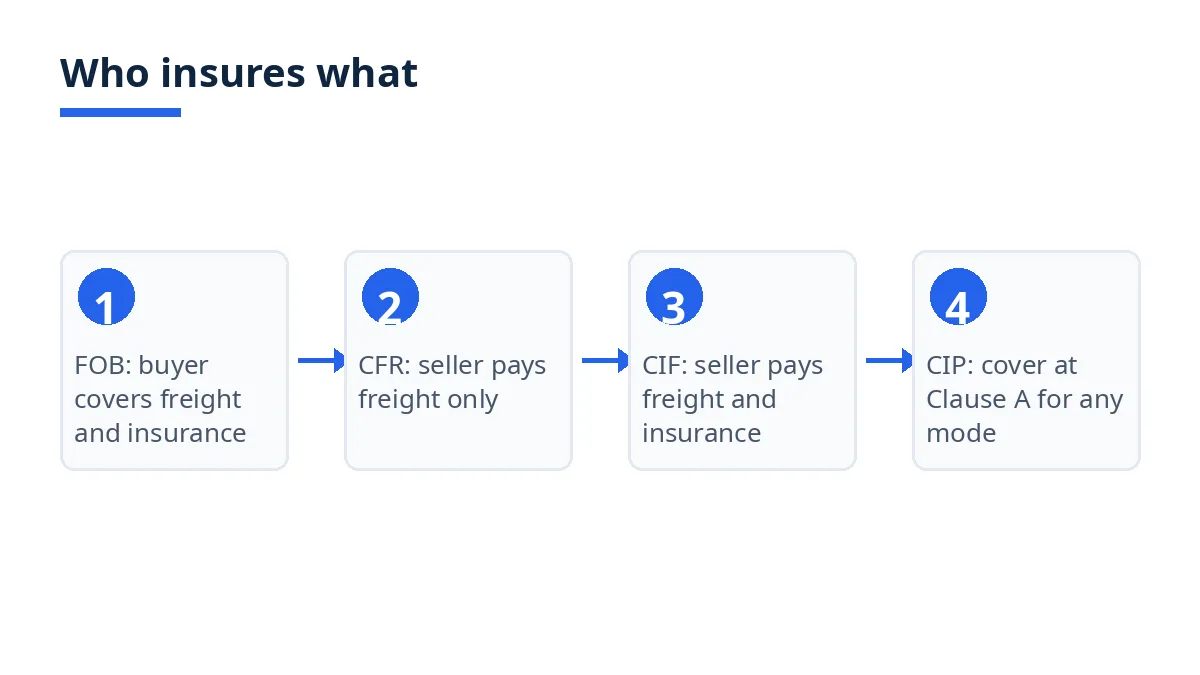
FOB and CIF differ by two steps: who pays the freight and who buys the insurance. Under FOB the buyer arranges both, under CIF the seller. Risk passes to the buyer on board, under both rules. The insurance under CIF is a minimum: Institute Cargo Clause C, which covers major casualties but not theft, pilferage, water damage or breakage. A buyer that wants wider cover should write Clause A into the contract or buy a top-up policy.
On this page
Key takeaways
FOB and CIF differ in who pays the freight and who buys the insurance.
Risk passes to the buyer when the goods are on board, under both rules.
CIF insurance is Clause C minimum cover, not full cover.
Clause C does not cover theft, pilferage, water damage or breakage.
Check the insurance certificate is assignable before the goods sail.
FOB and CIF differ by two steps, not one: who pays the freight, and who buys the insurance. Under FOB the buyer arranges both. Under CIF the seller arranges both. The freight is the visible difference, but the insurance is the one that matters when something goes wrong at sea, because the policy the seller buys under CIF is a minimum cover, and the buyer that assumes it is full cover finds out otherwise at the worst moment.
The two rules in one paragraph
Under FOB, the seller loads the goods on the vessel the buyer has chosen, at the named port, with export clearance done. The buyer then pays the freight, buys the insurance, and clears the goods at destination. Under CIF, the seller loads the goods, pays the freight to the destination port, and buys a Clause C insurance policy for the buyer's benefit. The buyer still clears import and pays the duty. Risk changes hands on board, under both rules, so the seller's freight and insurance payments under CIF do not carry the seller's risk any further.1
FOB hands the buyer both contracts — the freight and the insurance — so the buyer picks the carrier, the service, the routing, the free time at the destination port, and the exact cover on the goods. That is the appeal for an experienced importer: the cover is the clause it wants, at the sum it wants, from an insurer it trusts to pay a claim. CIF hands both contracts to the seller, which suits a buyer that has no freight or insurance set up and would rather take one price. The trade is visibility against convenience, and the cover is the part of the trade that is easy to get wrong.
Both rules are written for the sea and for inland waterways, and for cargo that loads directly onto a vessel. A container that is handed to a terminal days before the vessel arrives is not on board at the delivery point the rule names, so containers should use FCA instead, with the buyer arranging the freight and the insurance from the terminal.1
FOB vs CIF: who does what
Step | FOB | CIF |
|---|---|---|
Loads the goods on the vessel | Seller | Seller |
Clears the goods for export | Seller | Seller |
Books the vessel | Buyer | Seller |
Pays the ocean freight | Buyer | Seller |
Buys the cargo cover | Buyer, any clause it wants | Seller, Clause C minimum |
Bears the risk once the goods are on board | Buyer | Buyer |
Clears import and pays duty | Buyer | Buyer |
Claims on the policy if the cargo is lost | Buyer, on its own policy | Buyer, on the seller's assignable policy |
The table shows the real shape of the choice. FOB and CIF agree on risk, on export clearance and on import clearance. They differ on the two contracts the buyer would otherwise arrange itself: the freight and the insurance. The question is not which rule is cheaper, because the same costs are paid by someone either way. The question is who chooses the carrier and the insurer, and how much cover the buyer ends up with.
The insurance clause in detail
Under the Incoterms 2020 rules, CIF requires cover at Institute Cargo Clause C, the narrowest of the three standard clauses, unless the contract says otherwise.1 The contrast is CIP, the any-mode equivalent, which requires Clause A, the widest cover, by default.2 Clause C covers the major casualties: fire, explosion, the vessel stranding, grounding, sinking or capsizing, collision, discharge of cargo at a port of distress, general average and jettison.1 2 It does not cover theft, pilferage, water damage from rain or seawater, or breakage. A buyer that wants wider cover should write it into the contract, or buy a top-up policy of its own.
Clause C is the minimum, and the minimum is narrow. It covers the vessel's own casualties and the cargo's loss in them, but not the ordinary risks of a sea voyage. A container that arrives with water damage from a leaking hatch, a carton that arrives pilfered, or a pallet that arrives broken is not a Clause C claim. Those are the losses that actually happen most often, and they are the losses a buyer discovers are uncovered only after they happen.
Clause B adds cover for water damage and some other risks. Clause A covers all risks except those expressly excluded. A buyer that wants Clause A cover under CIF should write it into the sales contract in plain words, for example "insurance to be Institute Cargo Clause A, for 110% of the CIF value". The 110% figure is the usual sum insured: the CIF value plus 10%, which covers the buyer's profit and the cost of the claim. Under FOB the buyer simply buys the clause it wants, at the sum it wants, from the insurer it wants, and the question never arises.
The other detail to check is the policy document. Under CIF the seller must provide the buyer with the insurance policy or certificate, and it must be assignable so the buyer can claim directly. Ask for the certificate before the goods sail, check the sum insured and the clause, and confirm the insurer is one your bank and your broker accept. A certificate that arrives after the goods, or that names a different voyage, is a problem to fix before the vessel sails, not after it arrives.
Worked example: the same shipment under FOB and CIF
Example figures. Take 400 cartons of leather handbags, Chattogram to Hamburg, goods worth $15,000. The numbers are illustrative — they compare the two rules on a single shipment.
Cost line | Under FOB | Under CIF |
|---|---|---|
Goods and export clearance | $15,000, in the FOB price | $15,000, in the CIF price |
Freight to Hamburg | $2,600, paid by the buyer | $2,600, paid by the seller |
Insurance, Clause C | $220, paid by the buyer | $220, paid by the seller |
Duty at 6% of the $17,820 CIF value | $1,069, paid by the buyer | $1,069, paid by the buyer |
Final delivery to the warehouse | $450, paid by the buyer | $450, paid by the buyer |
Total the buyer pays | $19,339 | $19,339 |
Add the columns and they land in the same place: $19,339 either way. The CIF invoice is $17,820 because the freight and the insurance sit inside it; the FOB invoice is $15,000, and the buyer pays the rest to its own providers. What changes is not the total but the cover: under FOB the buyer picks the clause, and under CIF it takes the Clause C policy the seller bought. Duty here is charged on the CIF value of $17,820; each importing country sets its own valuation basis, so ask a customs broker to confirm the basis before you fix the rule.1
Common mistakes
The first mistake is assuming Clause C is full cover. It is the minimum, and it does not cover theft, pilferage, water damage or breakage. If those risks matter to the shipment, write Clause A into the contract or buy a top-up policy.
The second mistake is not checking the insurance certificate before the goods sail. The certificate must name the goods, the voyage, the clause and the sum insured, and it must be assignable to the buyer. A certificate that arrives after the goods, or that names a different voyage, is a problem to fix before the vessel sails.
The third mistake is writing a country where a port belongs. "FOB Bangladesh" and "CIF Germany" do not fix a delivery point or a destination port. Name the rule, the port and the edition — "FOB Chattogram, Incoterms 2020" or "CIF Hamburg, Incoterms 2020".2
The fourth mistake is applying FOB or CIF to containers. A container is normally handed to a terminal days before the vessel sails, so it is not on board when the rule's delivery point is reached. For containers, use FCA when the buyer arranges the freight, and CIP when the seller arranges freight and insurance.2
Which one should you choose?
Choose FOB when you ship often, you already have a forwarder and an insurer, and you want to pick the carrier, the routing and the clause yourself. A buyer that consolidates orders from several suppliers gets the most from FOB, because a single freight account and a single policy can cover the whole flow.
Choose CIF when you buy now and then, you have no freight or insurance set up, and you would rather take one price from the seller that covers freight and insurance to your port. Ask the seller to break out the freight and the insurance in the quotation, and to confirm the clause in writing. If the seller offers only Clause C and the cargo is worth protecting, buy a top-up policy, or take FOB and insure the voyage yourself.
For most sea shipments out of Bangladesh to Europe, FOB is the working default and CIF the convenience option. The right choice turns on who holds the better freight and insurance relationships, and on how much cover the buyer wants. Beyond CIF, DAP adds delivery to the destination, and DDP adds the duty as well, with the seller acting as the importer of record.3
Next steps on Exportain
Compare the step below CIF: FOB vs CFR has the seller pay the freight with no insurance, and FAS vs CIF covers the wider gap from the ship's side. When you are ready to decide, search Bangladeshi suppliers or post an RFQ — spell out the rule, the port and the edition in the requirement — and read how to buy for the steps after you have ordered.
Sources
- FOB vs CIF, CFR or DAP for Food Shipments. Maqboola (accessed )
- Incoterms 2020 Explained: All 11 Rules, Chart & Meaning. Xflowpay (accessed )
- DDP Incoterms Explained: Who Pays, Risk Transfer & VAT. LegalClarity (accessed )
About the author
Sourcing from Bangladesh?
Post a request for quotation and suppliers on Exportain can send you their quotes directly.
Post an RFQ