Importing Solar Panels From Bangladesh to UAE: Costs, Duties and Suppliers
The UAE charges 5% VAT on solar modules, but the duty rate is disputed between sources. Here is the import sequence, with the cost of both duty scenarios.
Short answer
Solar modules enter the UAE under HS 8541.43, but the duty rate needs confirmation before ordering: one guide reports them duty-free under UNCTAD 2023 rates, while another applies the general 5% GCC tariff. VAT is 5% on the customs value plus duty, freight and insurance, and the commercial invoice needs attestation at AED 150. The product step is ECAS conformity through MoIAT, under the solar framework of Cabinet Resolution No. 10 of 2020.
On this page
Key takeaways
Solar modules enter under HS 8541.43; confirm the duty rate with a broker before ordering.
VAT is 5% on the customs value plus duty, freight and insurance.
The commercial invoice needs attestation at AED 150.
Check ECAS conformity through MoIAT for the exact module model.
Price the shipment on the higher duty figure until the rate is confirmed in writing.
The United Arab Emirates buys more solar modules every year, and Bangladesh can supply them. The import itself is not complicated, but one number in it is unsettled: published guides disagree on the duty for solar modules, and a buyer that prices the shipment on the wrong figure loses the margin it thought it had. This guide settles what is settled, flags what is not, and works through the cost of both duty outcomes so the order can be priced with confidence.
The duty question comes first
Solar modules enter the UAE under HS code 8541.43. Two published guides give different answers for the duty on that code. One reports solar modules as duty-free under the UNCTAD 2023 rates, against a general GCC tariff of 5%.1 The other applies the general 5% GCC common external tariff to the UAE without a solar exception.2 Both cannot be right for the same code, and the difference is worth $1,061 on a $20,200 shipment once VAT is included.
The way to settle it is a written confirmation from a customs broker before the order is signed. Ask the broker to confirm the rate for HS 8541.43 in writing, and price the shipment on the 5% figure until that confirmation arrives. A buyer that budgets for 5% and finds the modules duty-free has a pleasant surprise; a buyer that budgets for 0% and finds 5% has a shipment that no longer pays.
Product rules: ECAS and the solar framework
The UAE runs its product conformity system through the Emirates Conformity Assessment System, administered by the Ministry of Industry and Advanced Technology. Solar modules sit inside the conformity framework that covers electrical products, and the importer should establish whether the exact model needs an ECAS certificate or a declaration of conformity before the container leaves Chattogram.1 The wider solar sector is governed by Cabinet Resolution No. 10 of 2020, which sets the framework for solar energy systems in the country.1
What that means in practice is a document check, not a product test at the border. Ask the supplier for the IEC 61215 test reports for the precise model being quoted, and check the report covers that model rather than a sibling model from the same factory. Confirm the warranty in writing — product warranty and performance warranty separately — and ask who honours them in the UAE and where spare modules are held. A panel that cannot be serviced where it is sold is a panel the buyer's customers will return.
What the 5% VAT does to your price
VAT is 5%, and it is charged on the customs value plus any duty, freight and insurance. Unlike the duty, the VAT rate is not disputed, and a VAT-registered importer in the UAE can recover it, so for a registered buyer the VAT is a cash-flow item rather than a cost.1 For an unregistered buyer it is a cost, and it should be in the landed-cost calculation from the start.
The commercial invoice also needs attestation, charged at AED 150, about $41. It is a small charge that first-time importers often overlook, and an unattested invoice is a reason for customs to hold a shipment while the paperwork is corrected.1 Keep the values consistent across the invoice, the packing list, the certificate of origin and the bill of lading: customs compares the documents, and a mismatch is the most common reason a solar shipment is held for inspection.
Finding a supplier that knows the Gulf
Bangladesh has a growing base of solar module assemblers, and the supplier check should focus on Gulf experience rather than on the price sheet. A factory that has already shipped to the UAE or Saudi Arabia has handled the conformity documents and the invoice attestation, and it can name the broker it used. A factory that has only shipped to Europe may not know the UAE's documentation rules, and the container can sit at Jebel Ali while the paperwork is fixed.
Ask for the IEC 61215 reports, the factory's export history under the same HS code, and the certificate of origin in the form the UAE requires. Ask for two reference shipments that can be verified, and ask how the modules are packed: pallets braced against movement inside the container, with corner protection, because damage on arrival is usually visible on the pallet before the container is released.
Getting the container to Jebel Ali
The sea leg runs from Chattogram to Jebel Ali, normally in a 20-foot or 40-foot container, and takes roughly two to three weeks depending on the service and any transhipment. The freight quotation should state the Incoterm, the port pair and how many free days you get at Jebel Ali: once those days run out, the daily storage charge on a container of modules adds up fast.
Marine cover follows the term you agree: the buyer pays for it under FOB and CFR, the seller under CIF. Put the term in the contract, and confirm which policy covers the voyage before the container sails, because a loss at sea with no policy in place leaves nobody to claim from.3 When the container arrives, look at the pallets before you sign for them: split frames, dented corners and damp marks are the usual signs of damage. Take photographs on the spot and notify the insurer the same day; a claim raised after the container has left the port is far harder to settle.
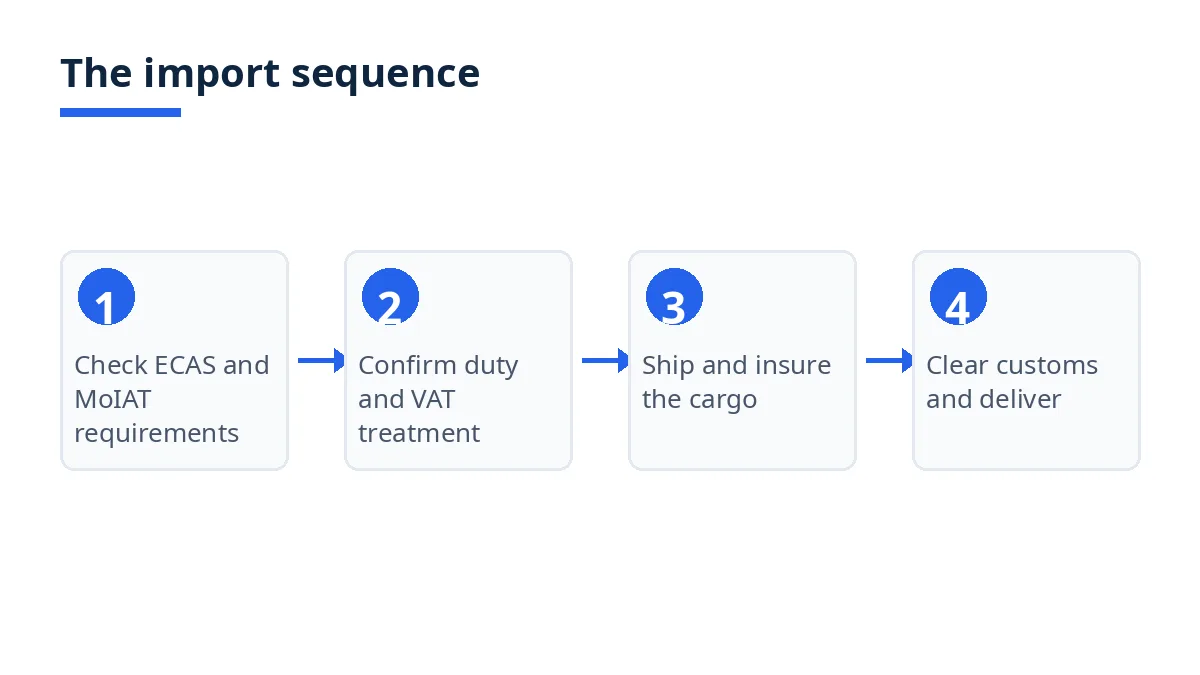
The import sequence as a checklist
Step | Who acts | What it proves |
|---|---|---|
Confirm the conformity route | Buyer and supplier | Whether the model needs an ECAS certificate or a declaration of conformity |
Confirm the duty rate | Customs broker | The rate for HS 8541.43, in writing |
Agree price, term and warranty | Buyer and supplier | Price, Incoterm, payment method and warranty, in writing |
Book freight and insurance | Buyer or seller, per the term | Service, free time at Jebel Ali, and cover for the full delivered value |
Prepare and attest the documents | Supplier | Invoice, packing list, certificate of origin, test reports; attestation AED 150 |
Ship and track | Carrier | Container on its way, arrival date confirmed with the broker |
Clear customs and receive | Broker | Duty and VAT paid, modules released and inspected |
What it costs, both ways
Example figures. Take a single 40-foot container of modules worth $18,000, shipped from Chattogram to Jebel Ali. The numbers below are illustrative — confirm each one with your supplier and broker before you order.
Cost line | Amount |
|---|---|
Module value (FOB Chattogram) | $18,000 |
Ocean freight | $2,000 |
Marine cargo insurance | $200 |
Customs value plus freight and insurance | $20,200 |
Import duty, 0% on HS 8541.43 in this example | $0 |
VAT, 5% of $20,200 | $1,010 |
Invoice attestation | AED 150 (about $41) |
Indicative landed cost | $21,251 |
Now the other outcome. If the 5% GCC tariff applies instead of the duty-free rate, duty adds $1,010, VAT rises to $1,061 on the duty-inclusive base of $21,210, and the landed cost becomes $22,312. The gap between the two outcomes is $1,061, and it is the reason the duty rate should be confirmed in writing before the order is signed. A VAT-registered importer recovers the VAT in either case, so the cash cost is lower than the table shows for a registered buyer.1 2
Four errors to avoid
The first error is pricing on the duty-free figure without a broker's confirmation. The two published sources disagree, and the 5% outcome costs $1,061 more than the duty-free outcome once VAT is included. Budget for the higher figure.
The second error is treating the attestation as a detail. At AED 150 it is cheap, but an invoice without it can hold a container at Jebel Ali, and a held container costs far more than the attestation fee.1
The third error is leaving the insurance term out of the contract. FOB puts the cover on the buyer, CIF on the seller. A buyer that takes cover for granted and learns after a loss that no policy was bought has no claim.3
The fourth error is signing for the modules without looking at them. Damage shows on the pallet: split frames, dented corners, damp marks. Take photographs on the spot and notify the insurer the same day.
Next steps on Exportain
The country guides in this series cover the same import from other markets. For the Australian comparison, with 0% duty and 10% GST, read our guide to importing solar panels to Australia. Canada, Spain, Italy and France are covered in their own guides. Then search Bangladeshi suppliers or post an RFQ — state the module model, the conformity documents and the destination port in the requirement. See how to buy for what happens after the quotation.
Sources
- How to Import Solar Panels into the UAE. Bridgetop (accessed )
- Import duty on solar panels by country 2025. SurgePV (accessed )
- FOB vs CIF, CFR or DAP for Food Shipments. Maqboola (accessed )
About the author
Sourcing from Bangladesh?
Post a request for quotation and suppliers on Exportain can send you their quotes directly.
Post an RFQ