How to Import Solar Panels From Bangladesh to Australia: Step-by-Step Guide
Australia charges 0% duty on solar modules but 10% GST, and the Clean Energy Council listing decides whether your modules can be sold. Here is the full import sequence.
Short answer
Solar modules enter Australia under HS 8541.43 at 0% duty, but GST of 10% applies to the customs value plus freight and insurance, and imports above AUD 1,000 need a formal declaration. The decisive step is product approval: modules must be listed by the Clean Energy Council, with IEC 61215 (2021 edition) testing, or they cannot earn Small-scale Technology Certificates and are hard to sell into the residential market.
On this page
Key takeaways
Solar modules enter Australia at 0% duty under HS 8541.43; GST is 10% on the delivered value.
Modules must be listed by the Clean Energy Council to earn Small-scale Technology Certificates.
Imports above AUD 1,000 need a formal declaration and an import processing charge applies.
Check the CEC listing and its expiry date before paying any deposit.
Compare suppliers on landed cost, not FOB price alone.
Australia is one of the largest residential solar markets in the world, and its import rules for solar modules are clear but strict. The duty on solar modules is 0%, but the goods and services tax is 10%, and the product-approval gate decides whether your modules can be installed and claimed under the country's rebate schemes at all. This guide walks through the rules, the costs and the sequence for importing solar panels from Bangladesh to Australia, step by step.
Start with the product approval gate
Before you order a single module, check whether the product is listed by the Clean Energy Council. The Council runs the product-approval process for solar panels, inverters and batteries sold in Australia, and its lists are the reference installers and state programs use. A module that is not listed is not automatically barred from import, but it is hard to sell, hard to install under rebate schemes, and hard to insure.1
The Council's process is a formal application, not a self-declaration. For PV modules, the application fee was AUD 5,500 plus GST for up to 20 models, with a review that takes 4 to 6 weeks once the application is complete, and the Council reviews applications on a monthly cycle.1 The technical baseline is IEC 61215, with the 2021 edition required for new applications from 1 October 2024.1 Ask your supplier for the Council listing certificate and the IEC test report number before you sign, and check the listing yourself on the Council's product list: listings lapse, and a lapsed listing is a common reason a shipment loses its buyer.1
The approval gate is also tied to the Small-scale Technology Certificate (STC) scheme. Modules that are not on the Council's list cannot create STCs, which is the rebate that makes most Australian residential systems viable.2 If your buyer plans to sell into the residential market, CEC listing is not a nice-to-have; it is the condition of the sale.
Duties, GST and the import declaration
Solar modules enter Australia under HS code 8541.43, and the duty rate is 0%. The tax that matters is GST, charged at 10% on the customs value plus any duty, freight and insurance.2 3 Because duty is 0% for modules, the GST base is usually the customs value plus freight and insurance, but confirm the valuation with your customs broker: it is the delivered value that is taxed, not the factory price alone.3
Any import worth more than AUD 1,000 must be declared through the Integrated Cargo System, and an import processing charge applies on a sliding scale from AUD 23 to AUD 193 depending on the value and the lodgement method.3 Below that threshold the rules are lighter, but a commercial shipment of solar modules will be well above it, so budget for a broker and a formal declaration.
Australia does not impose a general tariff on solar modules, and there is no separate solar import licence. What exists instead is a chain of product rules: CEC listing for the module, separate approval for the inverter, and, in several states, additional requirements for installers. The customs step is the easy part; the product-compliance step is where imports stall.
Choosing a supplier in Bangladesh
Bangladesh has a growing solar module assembly base, and the supplier check matters more than the price sheet. Ask for the IEC 61215 test reports, the CEC listing certificate with its expiry date, and the factory's export history to Australia or a comparable market. Check whether the warranty is a performance warranty and a product warranty, who honours it in Australia, and whether spare modules are held anywhere reachable.
Confirm the supplier's export experience with the exact product you are buying: a factory that has shipped LED lighting or small electronics to Australia has not necessarily shipped solar modules, and the packing, labelling and certification paperwork are different. Ask for the name of the customs broker it used, and for two reference shipments you can verify. If the supplier cannot name the CEC listing for the model it is quoting, treat that as a reason to pause, not as a detail to fix later.
Shipping and insurance
Modules travel by sea from Chattogram to Sydney, Melbourne or Brisbane, usually in 20-foot or 40-foot containers with the pallets braced against movement. Transit takes roughly three to five weeks depending on the service and transhipment. The freight quote should name the Incoterm, the port pair and the free time at destination, because demurrage on a container of modules is expensive and the free period is short.
Insure the cargo for the full delivered value. Marine cargo insurance is the buyer's responsibility under FOB and CFR, and the seller's under CIF, so agree the term in writing and check whose policy covers the voyage. Inspect the modules on arrival and photograph any damaged pallets before the container is released: a claim filed after the container leaves the port is much harder to settle.
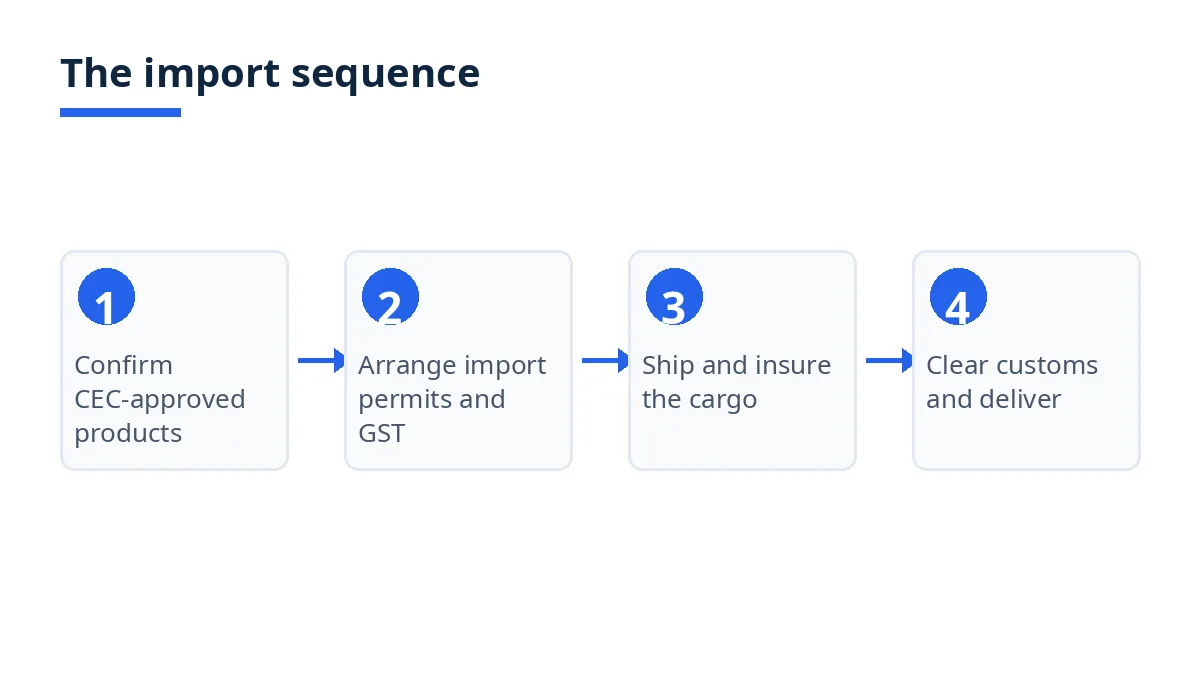
Step-by-step import sequence
Confirm the listing. Verify the exact module model on the Clean Energy Council product list and note the listing expiry date.
Agree the commercial terms. Fix the price, the Incoterm, the payment method and the warranty terms in writing, and name the port pair and the delivery point.
Book the freight. Choose the service, confirm the free time at the destination port, and arrange marine cargo insurance for the full delivered value.
Prepare the documents. The supplier issues the commercial invoice, packing list, certificate of origin and the IEC test reports; the broker prepares the import declaration.
Ship and track. The container leaves Chattogram; track it and confirm the vessel's arrival date with the broker so the declaration is lodged in time.
Clear customs. The broker lodges the declaration, GST is paid on the customs value plus freight and insurance, and the import processing charge is settled.
Receive and inspect. Unload, photograph the pallets, check the modules against the packing list, and confirm the serial numbers match the CEC listing before installation.
Costs at a glance
Example figures. The table below is illustrative, for a single 40-foot container of modules valued at $20,000, shipped Chattogram to Sydney. Confirm every figure with your supplier and broker before ordering.
Cost line | Amount |
|---|---|
Module value (FOB Chattogram) | $20,000 |
Ocean freight | $2,500 |
Marine cargo insurance | $300 |
Customs value plus freight and insurance | $22,800 |
Import duty, 0% on HS 8541.43 | $0 |
GST, 10% of $22,800 | $2,280 |
Import processing charge | AUD 23–193 |
Indicative landed cost | $25,080 plus the processing charge |
The arithmetic is straightforward because duty is zero: the tax is GST on the delivered value. What changes the total is the freight rate, which moves with the season, and the GST base, which is the delivered value rather than the factory price. A quotation that compares two suppliers on FOB price alone hides the freight and GST difference between them; compare landed costs instead.
Common mistakes
The first mistake is ordering modules whose CEC listing has lapsed or was never held. The listing is checked by installers, not by customs, so the shipment clears the port and then cannot be sold. Check the listing before you pay the deposit.
The second mistake is budgeting GST on the factory price. GST is charged on the customs value plus duty, freight and insurance, so the tax on a $20,000 shipment with $2,800 of freight and insurance is $2,280, not $2,000.3
The third mistake is buying on the cheapest Incoterm without checking the insurance. Under FOB the buyer arranges and pays for insurance; under CIF the seller does. A buyer that assumes cover exists and discovers after a loss that nobody bought a policy has no claim.
The fourth mistake is skipping the inspection on arrival. Module damage is usually visible on the pallet: cracked frames, crushed corners, moisture marks. Photograph it at the port, before the container is released, and file the claim with the insurer the same day.
Next steps on Exportain
Before you commit, compare the same import from other markets: importing solar panels to Canada, to Spain, to Italy, to France and to Belgium. When you are ready to order, search Bangladeshi suppliers or post an RFQ — name the module model, the CEC listing number and the destination port in the requirement — and how to buy covers what comes after the quotation.
Sources
- Solar panel product approval information. Clean Energy Council (accessed )
- Import duty on solar panels by country 2025. SurgePV (accessed )
- Australia import tax and customs duty guide. WorldFirst (accessed )
About the author
Sourcing from Bangladesh?
Post a request for quotation and suppliers on Exportain can send you their quotes directly.
Post an RFQ