Importing Solar Panels From Bangladesh to Belgium: Costs, Duties and Suppliers
For 60 residential panels to Antwerp, the example landed cost is EUR 10,935 before VAT recovery, with duty at EUR 0 under Everything But Arms when origin is proved. This guide prices each cost line, checks suppliers and module papers, and sets out the duty, VAT and documents for Belgium.
Short answer
A Belgium buyer importing residential solar panels from Bangladesh pays the module price plus freight and insurance to Antwerp, customs duty, 21% import VAT and border charges. Duty is EUR 0 where a REX statement on origin proves Everything But Arms preference. Import VAT is reported in the VAT return with ET 14.000, or paid at the border without it. Check the module papers, name the Antwerp terminal, and have the broker confirm duty, VAT base and code.
On this page
Key takeaways
Total cost is modules plus freight and insurance, duty, 21% import VAT and border charges, all confirmed for the exact module and named Antwerp terminal.
Duty is EUR 0 under Everything But Arms only where a REX statement on origin proves the preference for the consignment.
ET 14.000 moves import VAT into the periodic VAT return; it does not remove the VAT, and it does not cover goods cleared before it is granted.
IEC 61215 and IEC 61730 prove different things, so both are needed, and each certificate must name the exact model, construction and plant.
In the example, 60 panels of 430 W land at EUR 10,935 before VAT recovery, with EUR 2,435 cash at the border without ET 14.000 and EUR 650 with it.
A Belgium buyer who compares quotations by price per watt alone will miss the part of the bill decided in Antwerp. Duty, import VAT, terminal handling, brokerage and onward delivery decide how much cash leaves the buyer at the border and what the order costs at the warehouse. This guide settles them in that order: total cost, supplier, module papers, duty and VAT, and documents. It is for a buyer importing residential rooftop panels from Bangladesh into Belgium through Antwerp, as importer or through a Belgian customs broker.
The worked example near the end uses 60 all-black residential modules of 430 W each, a total of 25.8 kW, shipped from Chattogram to a named Antwerp terminal. Every figure there is labelled as an example figure. Use its structure with quotations for the exact module, quantity and terminal in the order being placed. For the general import file behind this route, see the guide to importing from Bangladesh.
What does a Belgium buyer pay in total for solar panels from Bangladesh?
A Belgium buyer pays for the modules, freight and insurance to Antwerp, any duty, import VAT, and border and delivery charges after release. Duty and VAT follow the customs value, tariff position and VAT rate on the entry date, confirmed by the broker in writing for the exact modules.
Ask every supplier and forwarder for the same cost lines, in the same currency, on the same delivery basis. A quotation stating only a port name, or only a price per watt with no delivery rule, cannot be compared with one naming a terminal and stating what freight, insurance and destination charges are inside the price. Put the delivery rule, named places, port of loading, named Antwerp terminal, currency, validity and payment terms into the quotation before any deposit is paid. The landed cost guide for imports from Bangladesh uses the same line-by-line method.
Two cash questions matter more than the headline total: how much must be paid at the border before release, and how much is later recovered through the VAT return. A buyer with an ET 14.000 authorisation reports import VAT in the periodic VAT return instead of paying it at customs, which changes the border cash position without changing the VAT due. A buyer without it pays import VAT at the border and recovers it later, where a right to deduct exists. Settle which position applies before the vessel sails, because the authorisation does not cover goods cleared before it is granted.
Freight pricing needs a dated answer. Chattogram cargo for Europe has commonly moved by feeder vessel to a transshipment port and then by mother vessel to Antwerp, Rotterdam and Hamburg, a process reported at about 40 days in 2022.1 Direct services to some European ports were reported at 15 to 20 days in the same period, but Antwerp was reached through the transshipment route in that account.1 Do not plan an installation date on a generic transit time. Ask the carrier for the sailing schedule, the transshipment port if any, and the estimated arrival at the named Antwerp terminal for the booked service.
Which suppliers in Bangladesh can supply residential rooftop panels?
Bangladesh solar panel supply for export is at an early stage. Treat supplier selection as a check of papers and production for the exact module, not a choice from a long list of established exporters. Radiant Alliance, an affiliate of East Coast Group, dispatched the first export consignment of solar photovoltaic modules from Bangladesh to a United States buyer on 19 June 2025, under a four-year agreement for 64.60 MW through 2028, with 12.40 MW scheduled for 2025 alone.2 The modules were made at a fully automated plant in Ashulia, Savar, with annual capacity of 600 MW, in 100 Wp and 200 Wp configurations, and the plant produces sizes from 50 Wp to 700 Wp.2
A rooftop order needs a named wattage class, the specified finish, a frame and glass build suited to roof mounting, and connectors and a junction box that match the inverter and mounting system. Ask for the cell technology, such as PERC or TOPCon, the dimensions and weight, the wattage class and tolerance, and the plant where the quoted build is assembled.
Some suppliers assemble modules from imported cells. That is common in module assembly, but it matters for origin: the statement on origin, bill of materials and production records must support the origin claim for the consignment.
Compare suppliers on the same written terms. Post the exact module, quantity, wattage class, finish, delivery rule with the named Antwerp terminal, and documents required, and compare replies line by line.
How do you check a supplier before you pay?
Check the supplier in four passes before a deposit is paid: identity and export standing, module papers, inspection arrangement, and payment terms. Keep the evidence in one file naming the exact module.
First, confirm the business: trade licence, export registration certificate, tax identification details, and the REX number where registered-exporter status is claimed. Ask for the factory address and photographs of the plant where the quoted module is assembled, and check that the address matches across the registration papers, invoice and origin statement. Exportain verification looks at supplier documents and photographs; it is not an on-site factory check, and a badge does not guarantee capacity, quality or delivery.3
Second, confirm the module papers name the exact build. Hold the certificate, test report and datasheet together and check that all three name the same model, construction and plant. Papers for a neighbouring model, a datasheet whose ratings differ, or a backsheet, encapsulant or junction box changed without fresh assessment do not support the order. The inspection steps behind this check are set out there.
Third, agree inspection before production starts. State in the contract who inspects, at which stages, and what happens when a panel fails. For a first order, a pre-shipment inspection should check module labels against the certificate, the datasheet and the invoice, count cartons against the packing list, and record wattage class and serial numbers.
Fourth, settle payment in stages tied to evidence: a deposit, a payment against inspection evidence, and a balance tied to shipment documents. The proportions and triggers must be written into the accepted quotation.
What module papers does Belgium require for a rooftop panel?
Belgium applies EU product and customs rules at the border. The buyer needs two kinds of evidence: that the module design is qualified and safe, and that the exact module shipped is the module the evidence describes. Check the standards evidence first, because a price agreed before the papers are checked is a price for an unidentified product.
IEC 61215 and IEC 61730 answer different questions about the same module, and a buyer normally needs both. IEC 61215 is the performance and reliability qualification: it covers environmental durability, mechanical strength and retention of electrical performance, and it backs a claim about long-term output.4 IEC 61730 is the safety qualification: it sets construction requirements and then tests electrical insulation, mechanical hazards and fire behaviour.4
Read each certificate for the standard number and edition year, parts covered, construction and bill of materials, application and fire class where they apply, laboratory and accreditation, and any deviations recorded.4 A construction change can put a qualification back in question, so a swapped backsheet or junction box must be assessed against the certificate rather than assumed covered.4
Also ask for the datasheet for the exact model, the EU declaration of conformity, warranty terms stating product and performance warranties separately, and installation instructions for the roof type. Check that model, wattage class, dimensions, weight and connector type match across certificate, datasheet, declaration, invoice and packing list, and confirm any fire or application class the installer needs in writing before ordering.
In Belgium PV CYCLE Belgium runs collection for used photovoltaic panels, with collection points across the country for smaller quantities.5 Ask who carries the producer duty on this order and put the arrangement, including any per-panel contribution, in writing before the order ships.
What duty, VAT and border charges apply at Antwerp?
Duty, import VAT and border charges are three separate lines, each needing written broker confirmation. Duty depends on classification and origin. Import VAT depends on the customs value, any duty, and the VAT rate and base confirmed. Border charges depend on the terminal, broker and inspection channel assigned.
On duty, the starting point is favourable for Bangladesh, but it is a proved preference, not an automatic one. As a least developed country, Bangladesh benefits from the EU Everything But Arms arrangement, which grants duty-free, quota-free access for all exports except arms and ammunition.6 In 2024, EUR 19 billion in exports from Bangladesh benefited from these preferences, at a 96 percent utilisation rate.6 A single consignment still needs its own proof of preferential origin, and the broker must confirm the full tariff code and measures applying on the entry date. The Integrated Tariff of the European Union, TARIC, classifies imported goods, and the code determines the duty rate and any additional measures.7
Proof of origin takes the form of a statement on origin, made out on the invoice or another commercial document by registered exporters in the REX system; exporters trading under the Generalised Scheme of Preferences must be registered in REX.8 An exporter without a REX number may make one out only for a consignment of originating products worth no more than EUR 6,000 ex-works.8 Ask for the REX number, confirm the statement covers the goods in the consignment, and keep copies, since exporters must keep proof of origin and related records for at least three years.8
Belgium applies a standard VAT rate of 21 percent, with reduced rates of 12 percent and 6 percent for specified cases.9 Plan on the standard rate unless the broker confirms a different rate category in writing. Import VAT is calculated on the customs value plus duties and shipping costs, on the account opened for this guide.7
ET 14.000 changes when import VAT is paid, not whether it is due. The authorisation postpones payment of VAT due on goods imported and released for consumption in Belgium until the periodic Belgian VAT return, so the VAT due is declared in the return and deductible VAT is reported in the same return where the right to deduct is open.10 It is not a VAT exemption: the VAT still exists and is moved from the customs payment stage to the VAT return.10 FPS Finance analyses an application within one month, the authorisation applies from the date granted, it is valid for an unlimited period unless withdrawn, and it does not cover goods already cleared before that date.10
Border charges beyond duty and VAT include the broker fee, terminal handling, any inspection cost, and onward transport. After risk assessment, a green channel grants release, an orange channel adds a document check of about a day, and a red channel adds a physical inspection taking several days depending on congestion and inspector availability on the account opened for this guide.7 For the code behind the duty line, see the tariff-code reference.
Which documents must travel with the shipment?
The shipment file has two layers: advance cargo data filed before arrival, and the import declaration filed at Antwerp. Both must describe the same modules in the same words; a mismatch is cheaper to fix before loading.
The EU advance cargo system is the Import Control System 2 (ICS2). For every consignment travelling to or through the EU, a full Entry Summary Declaration goes into ICS2 before arrival, so customs can run safety and security risk analysis; a declaration with gaps may be rejected or referred, which delays processing.11 Connecting to ICS2 needs an EORI number.11 Give the carrier and broker the full data early, worded as in the invoice, and meet the filing deadline the carrier confirms in writing.
An EORI number is mandatory for clearance of all customs operations in the EU, such as import, export and transit.12 A person can hold only one valid EORI number at a time.12 For an operator established in EU customs territory, it is assigned by the national customs authority of the country of establishment.12
The import file should contain the commercial invoice, packing list, bill of lading, statement on origin, IEC test evidence and EU declaration of conformity for the exact module, import declaration, and duty and VAT assessment. The invoice details seller, buyer, goods, quantities and values, and customs use it to determine customs value.7 The packing list details each pallet or box, which matters if customs inspect.7 The bill of lading is the carrier contract and the receipt needed to claim the shipment.7 For the general document list, see the general solar panel import guide.
Worked example: landed cost for 60 residential panels delivered to Antwerp
Example figures. A Belgium installer orders 60 all-black modules of 430 W each, 25.8 kW in total, for delivery to a named Antwerp terminal, as importer. The supplier quotes EUR 118 per module; ocean freight and insurance are EUR 1,420. The exporter provides a REX statement on origin, and the broker confirms the tariff code and measures on the entry date, so the example applies the EBA zero rate, proved by that statement.6 8 The VAT base is EUR 8,500, so import VAT at 21 percent is EUR 1,785.9 Broker, terminal handling and warehouse delivery are allowed at EUR 650. The PV Cycle Belgium arrangement is settled separately and is not inside that allowance.
Line | Example figure | Basis |
|---|---|---|
Modules, 60 at EUR 118 | EUR 7,080 | Example figure, quoted module price |
Ocean freight and insurance to Antwerp | EUR 1,420 | Example figure, booked service to the named terminal |
Customs value | EUR 8,500 | Example figure, modules plus freight and insurance |
Customs duty | EUR 0 | Example figure, EBA preference proved by a REX statement on origin |
Import VAT base | EUR 8,500 | Example figure, customs value plus duty |
Import VAT at 21 percent | EUR 1,785 | Example figure, Belgian standard rate |
Broker, terminal handling and warehouse delivery allowance | EUR 650 | Example figure, named-terminal charges |
Landed cost before VAT recovery | EUR 10,935 | Example figure, customs value plus VAT plus border and delivery allowance |
Landed cost per module before VAT recovery | EUR 182.25 | Example figure, EUR 10,935 divided by 60 modules |
Landed cost per watt before VAT recovery | EUR 0.42 | Example figure, EUR 10,935 divided by 25,800 W |
Cash at the border without ET 14.000 | EUR 2,435 | Example figure, import VAT plus the EUR 650 allowance |
Cash at the border with ET 14.000 | EUR 650 | Example figure, VAT reported in the return instead |
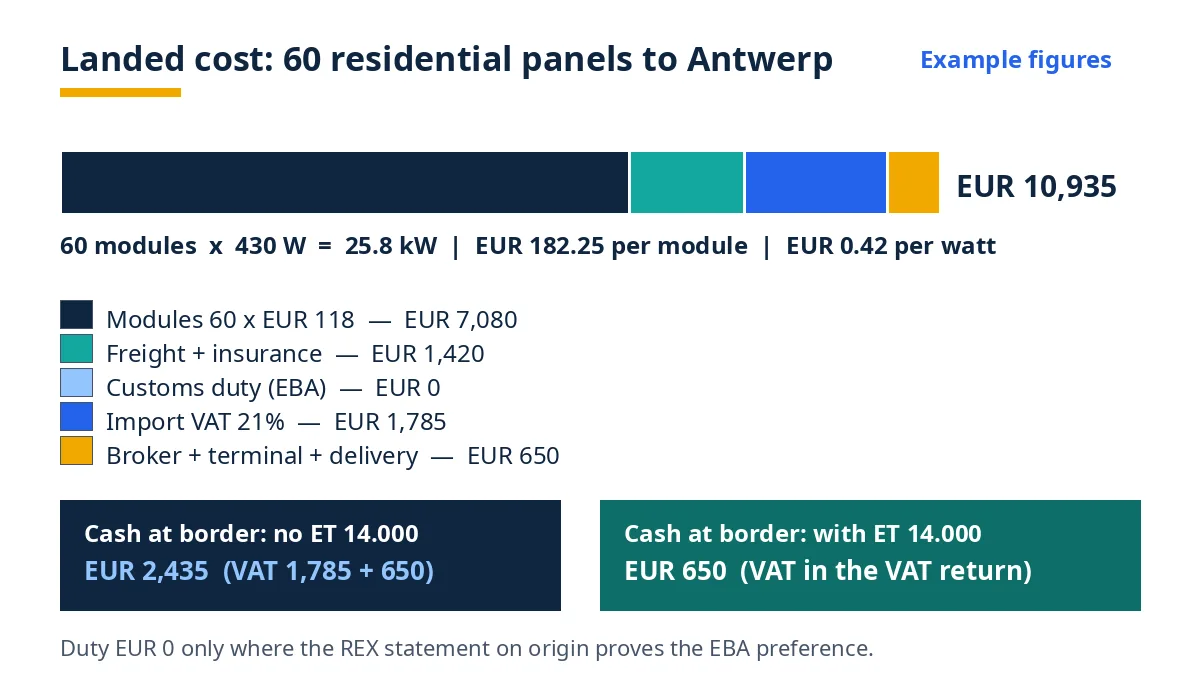
Read the example as a method, not as a price. Check two lines on every order: the VAT base and the border allowance, which depends on the named terminal and warehouse address. Ask the broker to replace each example line with a written figure before ordering.
What can push the cost, duty or delivery date off plan?
The most expensive failure is a file describing three different products: the certificate names one model, the datasheet a second set of ratings, and the invoice a third description, and the shipment waits for matching papers. The second failure is a preference claimed without proof: no REX number, a consignment over EUR 6,000 ex-works, and duty payable at the rate the broker confirms.8 The third is a terminal left unnamed: freight priced to Antwerp, a booked service calling at a terminal the contract never named, and destination charges differing from the quotation compared.
Timing failures follow the same pattern. Advance data filed late or described differently from the invoice can be rejected or referred in ICS2, delaying entry.11 A document check adds about a day and a physical inspection adds days, on the account opened for this guide, and a held container accrues storage.7 Build a buffer between estimated arrival and the installation date, and do not promise a date that depends on a green-channel release.
Do not treat the duty position as settled for all future orders. Bangladesh benefits from Everything But Arms as a least developed country, granting duty-free, quota-free access except for arms and ammunition.6
Questions Belgium buyers ask about solar panel imports
What is the typical MOQ for solar panels from Bangladesh?
No typical minimum is stated here, because it varies by module, production run and supplier. Get the minimum from each supplier in writing, for the precise model quoted, and ask whether it applies per model, wattage class or production run. Radiant Alliance produced sizes from 50 Wp to 700 Wp at Ashulia, which shows the size range a plant can offer, not a minimum quantity.2
How long does shipping take from Bangladesh to Antwerp?
Shipping time depends on the booked service, transshipment port if any, and sailing schedule, so no single transit time is stated here. Chattogram cargo for Europe was reported in 2022 as taking about 40 days through the feeder and mother-vessel route to Antwerp, Rotterdam and Hamburg, while direct services to some European ports were reported at 15 to 20 days.1 Antwerp was reached through the transshipment route in that account.1
What import duty applies to solar panels from Bangladesh to Belgium?
Duty depends on classification and proof of origin. Under Everything But Arms, Bangladesh has duty-free, quota-free access for all exports except arms and ammunition.6 The preference must be proved with a statement on origin from a REX-registered exporter, or, for a consignment worth no more than EUR 6,000 ex-works, from an exporter without a REX number.8
How do I verify a supplier of solar panels in Bangladesh?
Verify the supplier on papers naming the exact module, not on a profile page or price list. Check business and export registration, the REX number where a preference is claimed, and the factory address and photographs. Check that certificate, test report and datasheet name the same model, construction and plant, and that IEC 61215 and IEC 61730 evidence are both present, since one does not imply the other.4 Agree inspection and staged payment in writing before a deposit is paid. Exportain verification looks at documents and photographs; it is not an on-site factory check, and a badge does not guarantee capacity, quality or delivery.3
Next steps on Exportain
Do not pay a deposit while a line is still open. When you post an RFQ naming the exact module, quantity, wattage class and Antwerp terminal, weigh each reply on identical terms via the supplier directory, and read the buying guide before accepting a quotation. Exportain runs a B2B marketplace for RFQs and quotations; verification there is a review of documents and photographs, not a factory visit, and Exportain stays outside the goods contract.3
Sources
- Direct routes from Ctg to major ports halve shipment time and cost. The Business Standard (accessed )
- 'Made in Bangladesh' solar panels go to US for the first time. The Business Standard, (accessed )
- About Exportain. Exportain (accessed )
- IEC 61215 vs IEC 61730: What Each One Actually Proves. Ooitech (accessed )
- PV panel collection in Belgium. PV CYCLE Belgium (accessed )
- EU trade relations with Bangladesh. European Commission, (accessed )
- Belgium Customs Import Regulations: A Guide for Solar Manufacturers. PVKnowHow (accessed )
- Proof of origin. European Commission (accessed )
- Belgium VAT guide 2026. Vatcalc, (accessed )
- ET 14.000 VAT Deferment in Belgium. Eurofiscalis (accessed )
- Import Control System 2. European Commission (accessed )
- Economic Operators Registration and Identification number (EORI). European Commission, Taxation and Customs Union (accessed )
About the author
Sourcing from Bangladesh?
Post a request for quotation and suppliers on Exportain can send you their quotes directly.
Post an RFQ