Kids' Shoes Exporters in Bangladesh: Verified Supplier Checklist
Children's shoes are a regulated product: test reports and a Children's Product Certificate come before price. Here is the full supplier checklist.
Short answer
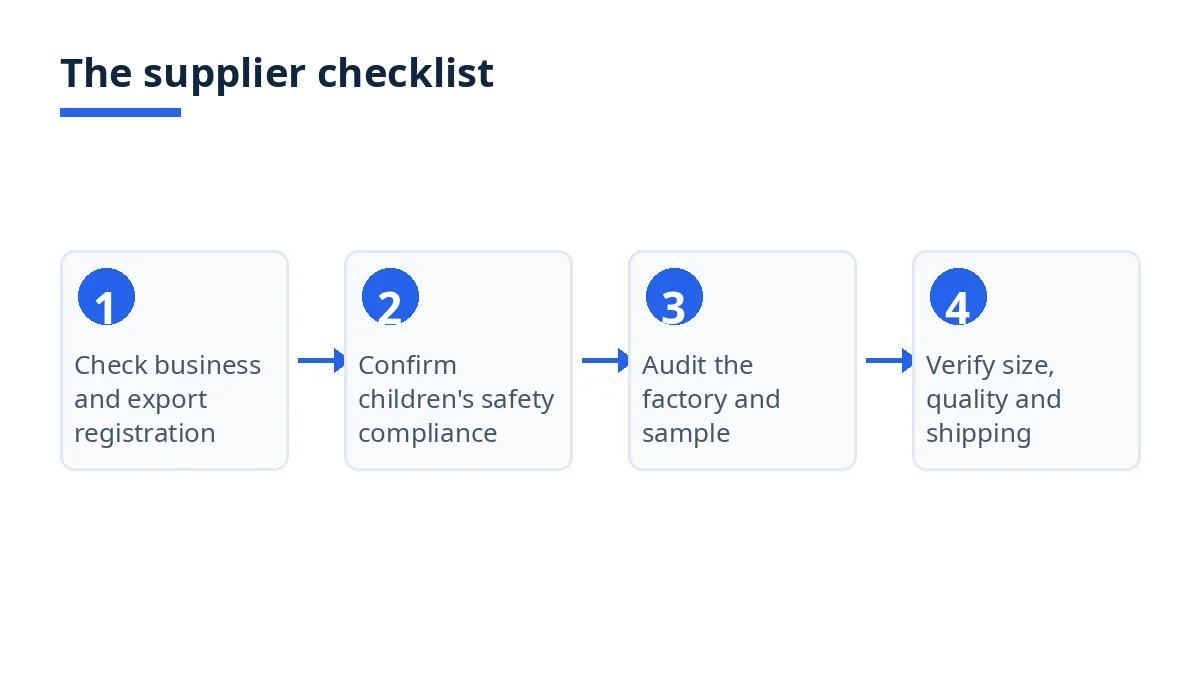
Qualify a Bangladeshi kids' shoes exporter in this order: business and export registration, then children's safety compliance, then the factory, then samples and inspection. In the United States, lead is limited to 100 ppm in substrates and 90 ppm in coatings, and a Children's Product Certificate based on testing by a CPSC-accepted laboratory is required. Fit must be approved on the smallest and largest sizes, not only the middle size.
On this page
Key takeaways
Check business and export registration before discussing price.
US children's products need a Children's Product Certificate from a CPSC-accepted laboratory.
Lead limits are 100 ppm in substrates and 90 ppm in coatings.
Approve fit on the smallest and largest sizes, not only the middle size.
Compare suppliers on landed cost, including testing and tooling.
Children's shoes are not adult shoes made smaller. They are a regulated product in the main buying markets, with chemical limits, labelling rules and a certificate that must exist before the shoes reach a shelf. A supplier that can make a good adult shoe is not automatically a supplier you can buy children's shoes from. This checklist works through the checks that matter, in the order to run them, so a buyer can qualify a Bangladeshi kids' shoes exporter before paying a deposit.
Start with the business basics
Ask for the trade licence, the export registration certificate, and the bank account details in the company name. A genuine exporter has all three and will send copies without delay; a trading agent that cannot show the export registration is a middleman, and that is fine to know, but it changes the price and the control you have over production.
Check how long the company has exported footwear, and to which markets. Ask for the names of two buyers it has shipped children's shoes to, and for the bill of lading or shipping documents for a recent shipment, with prices and buyer names blanked out. A supplier that has shipped children's shoes to the United States or the European Union has already passed the compliance tests those markets require. A supplier that has only shipped adult shoes has not.
Confirm the payment route before you agree a price. Most Bangladeshi exporters work on a letter of credit or a telegraphic transfer against documents. Agree the Incoterm too: under FOB the buyer arranges freight and insurance from the port of loading, under CIF the seller arranges them, and under CFR the seller arranges freight while the buyer arranges insurance.1
Children's safety compliance is the gate
The United States regulates children's products under the Consumer Product Safety Improvement Act, and the limits are strict. Lead is limited to 100 parts per million in substrates and 90 parts per million in surface coatings, and a Children's Product Certificate must be issued on the basis of testing by a laboratory the Consumer Product Safety Commission has accepted.2 3 The certificate is not optional paperwork: it is the document a US importer must hold for every children's product it brings in.2
Phthalates are limited to 0.1% in children's toys and childcare articles, and several US states add their own rules: Washington State requires reporting of chemicals of high concern to children, and California's Proposition 65 requires warnings for listed chemicals.3 Small parts rules also apply: the CPSC guidance notes that products for children under three must not contain small parts that can be detached, and tracking labels are required so a product can be traced to its maker.2
The European Union applies its own framework, including REACH limits on restricted substances and the general product safety rules for children's products. The practical point for a buyer is the same in both markets: the compliance evidence must exist before the order ships. Ask for the test reports by name, check the laboratory is accredited, and confirm the report covers the exact materials and colours you are ordering. A test report for a different upper material or a different colour does not cover your order.
The factory check
Visit the factory, or send an inspector, before the first bulk order. Children's shoes need lasts shaped for children's feet, and fit is approved on the smallest and largest sizes in the range rather than only the middle size, because a child's foot does not scale evenly from an adult pattern. Ask to see the last library, the size run from a recent order, and the fit-approval records.
Check the cutting and stitching lines for the materials your order uses, and check the chemical store: adhesives and finishes are where restricted substances enter a children's shoe. Ask how the factory separates children's production from adult production, if it does, and how it keeps the approved materials apart from the unapproved ones. A factory that cannot show you the material approvals for your order is a factory to pause on.
Capacity matters too. Ask how many pairs per day the factory produces, how many lines it runs, and what its current order book looks like. A factory that promises a delivery date it cannot meet will either subcontract your order without telling you, or ship late. Both are worse than a longer lead time agreed honestly.
Samples, sizing and quality
The sample sequence is the same for children's shoes as for adult shoes, but the checks are stricter. The proto sample confirms the design and the materials. The size run confirms the fit across the range. The salesman samples confirm the colours and the finish. Approve each stage in writing before the factory moves to the next one, and keep one approved sample of each size as the reference for bulk inspection.
Agree the inspection standard before production starts. Most buyers use AQL sampling with a third-party inspector, and the inspection should cover the size range, the stitching, the sole bond, the labelling and the packaging. Children's shoes are often packed in individual boxes with size and care labels; confirm the labelling requirements for your market, including the tracking label the United States requires, before the boxes are printed.2
Costs, terms and the checklist table
Price the order on landed cost, not on the factory price alone. The cost lines to compare are the factory price, the development cost for lasts and tooling, the freight, the insurance, the testing cost, and the duty and tax at destination. Development costs are fixed: they are spread across the order, so a small order carries a higher per-pair development cost, and the contract should state who owns the lasts and tooling when the order ends.
Check | What to ask for | Red flag |
|---|---|---|
Business and export registration | Trade licence, export registration, bank details in the company name | Documents in a different name, or no export registration |
Children's safety compliance | Test reports from an accepted laboratory, Children's Product Certificate | Reports for different materials, or no certificate |
Factory and capacity | Last library, size-run records, daily capacity, current order book | No children's lasts, or a delivery date with no capacity behind it |
Samples and sizing | Proto sample, size run, written approval at each stage | Bulk started before the size run is approved |
Inspection | AQL standard, third-party inspector, labelling check | No inspection agreed, or boxes printed before approval |
Costs and terms | Landed cost, tooling ownership, Incoterm, payment method | Factory price quoted without testing or tooling costs |
Common mistakes
The first mistake is buying on price from a supplier that has never passed children's-product testing. The test report is the product: without it, the shoes cannot be sold in the United States or the European Union, whatever the price.
The second mistake is approving the middle size only. Fit problems show up at the ends of the size range, and a bulk order approved on one size can fail inspection across the rest.
The third mistake is treating the Children's Product Certificate as a formality. It must be based on testing by a laboratory the CPSC has accepted, and it must cover the materials and colours in your order. A certificate based on another supplier's testing is not a certificate for your shoes.2 3
The fourth mistake is leaving the Incoterm and the insurance unagreed. Under FOB the buyer insures the voyage; under CIF the seller does. A shipment that is damaged at sea with no policy in place is a loss nobody can recover.
Next steps on Exportain
For the details behind this checklist, read custom kids' shoes manufacturing in Bangladesh, private label kids' shoes, kids' shoes prices, kids' shoes MOQ and wholesale kids' shoes. When you are ready to buy, search Bangladeshi suppliers or post an RFQ — list the age range, the sizes, the target market and the test reports you need in the requirement. Read how to buy for the steps that follow the quotation.
Sources
- FOB vs CIF, CFR or DAP for Food Shipments. Maqboola (accessed )
- Business Guidance FAQ: Children's Products. U.S. Consumer Product Safety Commission (accessed )
- US legislation on chemicals in children's footwear. SATRA (accessed )
About the author
Sourcing from Bangladesh?
Post a request for quotation and suppliers on Exportain can send you their quotes directly.
Post an RFQ