HS Code for Jute Bags: Classification Guide for Importers
No single code covers every jute bag: a packing sack points to 6305, a shopping tote to 4202, and a bag fitting neither to 6307. Purpose, container character and outer surface decide the heading.
Short answer
There is no single HS code for every jute bag. A jute packing sack is examined under heading 6305, while a jute shopping tote is examined under heading 4202, and a bag fitting neither heading is examined under heading 6307. Purpose, container character and outer surface decide the heading, and the full national code must be confirmed for the entry date.
On this page
There is no single HS code for every jute bag. A jute packing sack and a jute shopping tote are different articles for classification, even when both are made of jute. The code follows the bag's purpose and character, not the fibre alone. The deciding boundary is between heading 6305 for sacks and bags of a kind used for packing goods, heading 4202 for shopping bags and similar containers, and heading 6307 for other made-up textile articles that fit neither heading.
Verify note: every heading named here is indicative only. Before you declare a code, confirm the six-digit subheading and the full national code in the destination tariff for the entry date, and put a doubtful bag to a customs broker or to the binding ruling route for that destination.
Quick answer: indicative HS heading (with verify note)
Start with purpose, not with the word jute. Heading 6305 covers sacks and bags of a kind used for the packing of goods.1 The explanatory note quoted in United States customs rulings states that it covers textile sacks and bags of a kind normally used for the packing of goods for transport, storage or sale, including grain, flour, potato and coffee sacks.2
Heading 4202 covers a different kind of article. United Kingdom guidance describes heading 4202 as containers, including shopping bags, made of, or wholly or mainly covered with, textile materials or the other listed materials.3 Containers under heading 4202 are classified by the material of their outer surface, as visible to the naked eye.3
Heading 6307 is the fallback: made-up articles of textile material not included more specifically in another heading.4 It matters only after 6305 and 4202 have both been tested and neither fits.
Worked example | First test | Indicative treatment, with caution |
|---|---|---|
Plain jute sack for grain or coffee | Normally used for packing goods for transport, storage or sale | 6305 area; the jute split is the 6305.10 line in the tariff opened here, to be confirmed as a national line |
Jute shopping tote with handles, sold empty | Container designed for prolonged use, textile outer surface | 4202 area; the ruling below reached 4202 for a comparable handled burlap bag, for that bag's facts only |
Jute bag sold filled with rice, printed, built to be kept as a shopping bag | Discarded after use, or kept for carrying | A classification question: the ruling below excluded such a bag from 6305 because it was suitable for repetitive use |
Jute wine or beach bag, sold empty, with handles | Container for personal effects, or packing sack | A classification question: test 4202 first, then 6307 if it fits neither; do not assign a subheading from the product name |
Jute drawstring shoe bag | Container under 4202, or made-up textile article | United Kingdom guidance excludes textile drawstring shoe bags from chapter 42 and places them in chapter 63, so test chapter 63 headings, including 6307, on the facts3 |
How HS codes are structured (2-4-6 digits)
The code narrows in stages. The first two digits are the chapter: chapter 63 covers other made-up textile articles, and chapter 42 covers travel goods, handbags and similar containers. The next two digits make the four-digit heading, such as 6305 or 4202. The final two digits of the six-digit code make the subheading, such as the 6305.10 line for sacks and bags of jute or of other textile bast fibres of heading 5303, as shown in the tariff opened for this article.1
Only the first six digits are internationally shared. Beyond them, each destination adds its own digits, so the same jute bag can carry a different full code in the United States, the European Union and the United Kingdom. The tariff opened here shows that extension: under 6305.10 it lists 10-digit commodity codes.1 Always read the full national line, not only the heading.
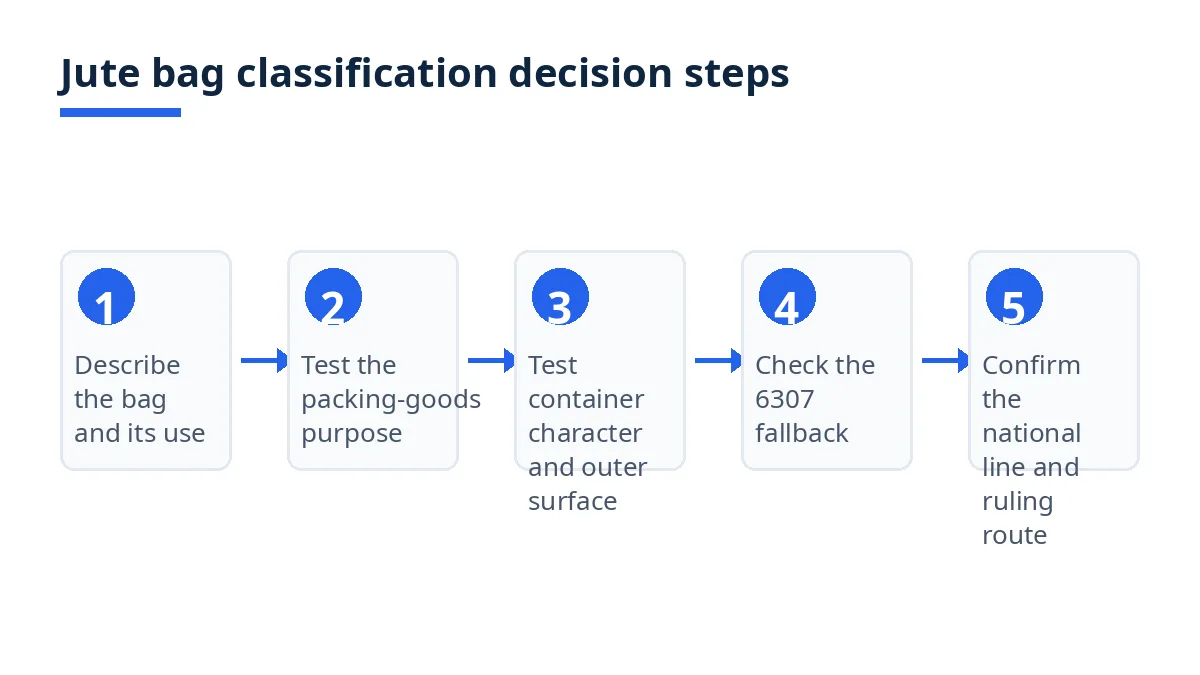
The diagram below shows the decision steps.
Factors that decide the code for jute bags
First, test the packing-goods purpose. A sack made, sold and used to pack, transport or store a bulk good for sale points to 6305.2 A bag made to be carried by a person, to hold purchases or personal effects, points away from 6305 and toward 4202.
Second, test container character and outer surface. Under heading 4202, the questions are whether the article is a container of the kind listed in that heading, whether it is designed for prolonged use, and what its outer surface is made of.3 For a jute bag, the outer surface is textile material, which is why the 4202.92 area, for travel, sports and similar bags with an outer surface of textile materials, is the part of 4202 to examine.
Third, test repetitive use. The burlap rice bag ruling turns on this test. That bag was a woven jute bag with double braided handles, printed with the rice brand and weight, and sold at retail with its contents.2 It looked like a packing bag under 6305, and it looked like a shopping bag under 4202 because of its size, handles, durable construction and design for prolonged use.2 It was excluded from 6305 because it was of substantial construction, would be retained for use as a shopping bag, and would not be discarded once the rice was consumed.2 The holding for that bag was under heading 4202. Do not copy that holding onto a different bag. Copy the test: would an ordinary buyer discard this bag after its first packing use, or keep it for carrying.
Fourth, test whether the bag fits neither heading. In a second ruling, a reusable woven strip bag for yard waste, with handles and ballast pockets, was held to be neither a 4202 bag, because it was not designed for carrying personal effects during travel, nor a 6305 sack, because it was not used for commercial merchandise being transported or stored for sale, usually in bulk.4 It fell to heading 6307 as a made-up textile article not more specifically provided for elsewhere.4
Fifth, record the facts a broker or ruling authority will ask for: fibre and fabric, outer surface material, handles and closures, lining, coating, printing or fittings, dimensions, whether sold empty or filled, and how it is presented for sale. Finally, keep fibre headings in their place: heading 5303 covers jute fibres, raw or processed but not spun, and heading 5307 covers yarn of jute or of other textile bast fibres of heading 5303.5
National codes: US HTS, EU CN/TARIC, UK commodity code
In the United States, the Harmonized Tariff Schedule extends the six-digit subheading to a 10-digit import number. The rulings here show that structure: the burlap bag was classified under a 10-digit subheading within 4202.92, and the yard-waste bag under a 10-digit subheading within 6307.90.2 4 Confirm the current United States line for your bag, its material and its entry date before shipping.
In the European Union, the Combined Nomenclature code builds on the six-digit subheading, and TARIC adds further digits for the import declaration. The tariff opened here, the Northern Ireland (EU) tariff, shows the same layered structure for heading 6305: the subheading 6305.10 for jute or other textile bast fibres of heading 5303, with 10-digit commodity codes beneath it.1
In the United Kingdom, the commodity code is also built on the shared six-digit foundation with national extensions, and United Kingdom guidance refers readers to the UK Global Online Tariff for the full code.3 For Great Britain, use the UK tariff.
How to confirm the code officially
Start with the destination tariff text, not a supplier invoice, a marketplace listing or a search result. Open the current chapter 42 and chapter 63 texts, read the heading wording and the section and chapter notes, and work down from the heading to the subheading and then to the national line.
Next, build a short classification file for each bag style: description, fabric and outer surface, handles and fittings, dimensions, whether sold empty or filled, and intended use.
Where the answer is still doubtful, seek a binding decision. In the United States, a binding ruling request goes to United States Customs and Border Protection. For Northern Ireland and the European Union, a Binding Tariff Information decision is applied for through the EU Customs Trader Portal, with a separate application for each type of goods, and the application must be made before all customs procedures have been completed.6 For Great Britain, the equivalent route is an Advance Tariff Ruling, as the same guidance states.6
Common classification mistakes
The first mistake is quoting the fibre heading for the bag. Heading 5303 is jute fibre and heading 5307 is jute yarn.5
The second mistake is treating every jute bag as a 6305 packing sack. A tote sold empty for shopping, with handles and a design for repeated carrying, must pass the 4202 test before 6305 is assumed. The burlap rice bag shows why: a bag can look like packing and still fall outside 6305 when it is built to be kept and reused as a shopping bag.2
The third mistake is the reverse: treating every handled jute bag as a 4202 shopping bag. A handle does not make a packing sack a container, and a bag that is neither a 4202 container nor a commercial packing sack may fall to 6307, as the yard-waste bag ruling shows.4
The fourth mistake is copying a ruling or a supplier code from a different bag. The fifth mistake is stopping at the heading or subheading, or using a code from the wrong destination or trade date. Writing 6305, or even 6305.10, on an entry leaves the national extension undecided.
Related duties and documents
The HS code does not by itself state what an importer will pay. No rate is stated in this article. Ask your broker for the treatment for your code, origin and entry date.
The documents that normally travel with a jute bag shipment are the commercial invoice, the packing list, the bill of lading or airwaybill, and the certificate of origin where a preference or a buyer requirement calls for one.
FAQs
What is the HS code for jute bags?
There is no single HS code for jute bags. A jute packing sack is examined under heading 6305, with the jute split shown as the 6305.10 line in the tariff opened here.1 A jute shopping tote is examined under heading 4202 as a container with a textile outer surface, and a bag that fits neither heading is examined under heading 6307.3 4
Is the HS code the same in every country?
Only the first six digits are shared. Each destination adds its own digits after the sixth digit, as the 10-digit lines under 6305.10 and the 10-digit holdings in the United States rulings show.1 2
How do I confirm the correct code?
Read the destination tariff text for chapters 42 and 63, apply the heading wording and the section and chapter notes, and test the bag's purpose, container character, outer surface material and repetitive use.1 3 Then get a broker confirmation in writing, or seek a binding decision: a United States ruling, a Binding Tariff Information decision for Northern Ireland and the European Union, or an Advance Tariff Ruling for Great Britain.6
What happens if I use the wrong code?
A wrong code can delay clearance while customs re-examines the goods, and it can change the treatment that applies to the entry. It can also create a mismatch between the entry, the invoice description and any origin or preference claim.
Next steps on Exportain
For background on how the system works, read HS Code: Harmonized System Explained and HS Codes: How to Classify Your Product. When you are ready to source, browse suppliers on Exportain and compare bag construction and intended use before you ask for a quotation. To start sourcing, Post a free RFQ on Exportain.
Sources
- Sacks and bags, of a kind used for the packing of goods - Northern Ireland Online Tariff, heading 6305. GOV.UK (accessed )
- Customs Ruling HQ 956186 - Classification of a burlap bag; shopping bag; sacks and bags, of a kind used for the packing of goods. U.S. Customs and Border Protection (accessed )
- Classifying leather for import and export. GOV.UK, HM Revenue and Customs (accessed )
- Customs Ruling HQ 955639 - Classification of polypropylene strip bag; not classifiable in headings 4202 or 6305; classifiable in heading 6307. U.S. Customs and Border Protection (accessed )
- Chapter 53: Other vegetable textile fibres; paper yarn and woven fabrics of paper yarn (HS 2012). World Customs Organization (accessed )
- Apply for a Binding Tariff Information decision. GOV.UK (accessed )
About the author
Sourcing from Bangladesh?
Post a request for quotation and suppliers on Exportain can send you their quotes directly.
Post an RFQ