CFR vs CPT: Key Differences, Costs and Which One to Choose
CFR is sea-only with risk on board the vessel; CPT covers any mode with risk at the first carrier. Follow a container from Dhaka to Hamburg and see which term fits your route.
Short answer
CFR and CPT both make the seller pay the carriage, but they differ on transport mode and risk. CFR works only by sea and inland waterway, with risk passing when the goods are loaded on board the vessel. CPT works for any mode, including air, road and multimodal routes, with risk passing when the goods are handed to the first carrier. Neither term obliges the seller to insure the cargo, so the buyer arranges cover from the risk point.
On this page
Key takeaways
CFR is sea and inland waterway only; CPT works for any mode, including air, road and multimodal routes.
Under CFR risk passes when the goods are loaded on board; under CPT risk passes at handover to the first carrier.
Both terms make the seller pay carriage to the destination, and neither obliges the seller to insure the cargo.
For containerised cargo handed over at a terminal, CPT matches the real handover; CFR fits bulk cargo loaded directly on board.
A buyer in Hamburg asks a Dhaka supplier for one price to a warehouse, and the supplier answers with two prices on two different terms. One says CFR Hamburg, the other says CPT Hamburg. The goods are the same and the sea leg is the same. What changes is the transport the term can cover, the place where the seller stops paying, and the moment the risk of loss moves from the seller to you.
A container from Dhaka to Hamburg takes more than one leg
Picture a container of home textiles, packed in cartons at a factory outside Dhaka. A truck takes it to a terminal in Chattogram, where it waits for a vessel. The vessel sails from Chattogram, the box changes ships at a hub, and the second vessel docks in Hamburg, where a truck carries it to your warehouse. That is four legs: road, sea, sea again, and road.
The diagram below follows those legs in order.
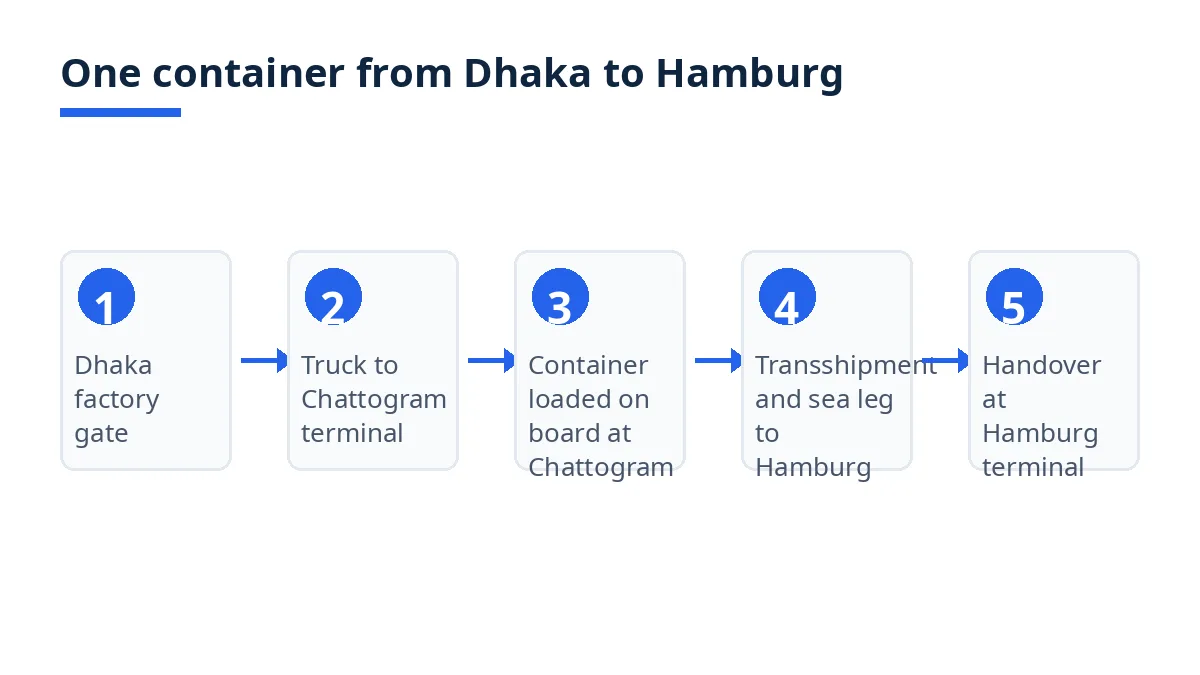
Under CFR, only the sea legs count as the term's own ground. CFR (Cost and Freight) belongs to the four rules that work for sea and inland waterway transport only, while CPT (Carriage Paid To) belongs to the seven rules that work for any mode of transport, alone or combined.1 2 That split is the first filter to apply to any quotation. If the route you plan includes a flight, a truck leg that is part of the carriage contract, or a rail leg, CFR cannot describe it. CPT can, because it was written for any mode and for combinations of modes.3
Transshipment does not change that filter. A container that changes vessels in Singapore or Colombo is still on a sea journey. The problem for CFR starts at the terminal in Chattogram: a container is usually handed to a carrier at a terminal well before it is loaded on board, so a sea-only rule mistimes the risk transfer for a box that has already left the seller's hands.2 The ICC guidance points buyers to FCA, CPT or CIP for containers for exactly that reason.2 CPT fits the box's real journey because its delivery point is the handover to the first carrier, which can be a truck at the factory gate, a rail terminal, or a container yard.3
The endpoint is different: a port, or any named place
Both terms make the seller pay the main carriage, but they pay it to different kinds of endpoint. Under CFR the seller's freight payment runs to the named port of destination, and no further.1 Under CPT the seller pays carriage to the named place of destination, which can be a port, an airport, a terminal, or the buyer's premises, as the parties agree.1
A CFR price to Hamburg covers the goods, packing, inland transport to Chattogram, export clearance and the ocean freight to Hamburg port. It does not cover unloading at Hamburg, import clearance, duty, or the truck from the port to your warehouse. A CPT price to Hamburg can cover the same sea freight and, depending on the named place, further legs as well, but it still does not cover import clearance, duty, or costs after the named destination unless the contract says so.1
Destination terminal handling is the line buyers most often misread. Under CPT the seller pays for carriage to the named destination, while terminal handling charges at the destination port are usually the buyer's duty unless the contract states otherwise.4 Ask the seller to state in writing which destination charges sit inside the carriage contract and which sit outside it. Both terms leave export clearance with the seller and import clearance with the buyer.5 Neither term sets the price of the goods, the payment method, or the moment ownership passes.5
Risk moves at two different moments
The two terms share a cost pattern and differ on risk. Both sit in the "C" group, where the seller pays carriage beyond the point where risk changes hands.2 Under CPT, CIP, CFR and CIF the seller pays the freight all the way to the destination, yet the risk still passes at origin, the moment the goods are handed over or loaded.2
Point | CFR | CPT |
|---|---|---|
Transport modes | Sea and inland waterway only | Any mode, alone or combined |
Seller delivers and risk moves | Goods loaded on board the vessel at Chattogram | Goods handed to the first carrier |
Seller pays carriage to | Named port of destination | Named place of destination |
Cargo insurance | Buyer arranges its own cover | Buyer arranges its own cover |
Export clearance | Seller | Seller |
Import clearance and duty | Buyer | Buyer |
Unloading at destination | Buyer | Buyer |
Under CFR the risk point is the loading of the goods on board the vessel at the port of shipment.5 Under CPT the risk point is the handover to the first carrier, which may occur well before the goods reach the destination the seller paid to reach.5 On a multimodal route the first carrier is the one that matters for risk, even when later carriers take the box onward. The ICC Academy guidance is explicit that delivery under CPT happens when the goods are handed over to the carrier, and not when they are loaded onto the aircraft, train or vessel, and that when several carriers are involved, delivery occurs at the handover to the first carrier.3
That gap between the cost endpoint and the risk point is the trap in both terms, and it is wider under CPT. A container handed to a truck in Dhaka is already at your risk while the seller is still paying for the sea leg to Hamburg. If the box is lost at sea, the loss is yours to claim on your own policy. Neither term obliges the seller to buy cargo insurance, so a buyer that wants cover arranges it from the risk point onward.3 5 A buyer that wants the seller to carry the insurance as well should ask for CIP, which adds seller-bought Clause A cover to the same CPT structure, or CIF, which adds minimum Clause C cover to the CFR structure.3 6
Worked example: home textiles from Chattogram to Hamburg
Example figures. A buyer in Hamburg orders 800 cartons of home textiles from a supplier in Dhaka, shipped in one container from Chattogram to Hamburg. The goods are worth $14,500. The numbers are illustrative. The container is handed to the carrier's terminal in Chattogram, and the named destination is Hamburg in both cases, so the comparison isolates the mode and risk difference.
Cost line | Under CFR | Under CPT |
|---|---|---|
Goods, packing, export clearance | $14,500, in the CFR price | $14,500, in the CPT price |
Carriage, Chattogram to Hamburg | $2,600, paid by the seller | $2,600, paid by the seller |
Cargo insurance | $210, paid by the buyer | $210, paid by the buyer |
Import duty, 4% of the $17,310 CIF value | $692, paid by the buyer | $692, paid by the buyer |
Delivery to the buyer's warehouse | $420, paid by the buyer | $420, paid by the buyer |
Total the buyer pays | $18,422 | $18,422 |
In a live quotation the two totals will rarely match so neatly, because the seller's CFR rate and the seller's CPT rate are struck at different times with different carriers, and the CPT named place may sit further inland than the CFR port. Price both terms to your warehouse on the same sailing window, keeping the carriage line visible in each quotation. Duty in this example is 4% of the $17,310 CIF value; the valuation basis varies by importing country, so confirm it with a customs broker before settling the term.
When the route leaves the sea
The choice is settled most quickly by the legs that are not sea legs. CFR cannot be used for air freight, and for air, road or rail shipments the seller-paid equivalent is CPT, which provides the same seller-pays-freight structure across all transport modes.1 An urgent order of samples flown from Dhaka airport to Frankfurt cannot be written as CFR at any price, because the term has no air leg in it. Write it as CPT Frankfurt airport, with the risk passing when the cartons are handed to the airline.3
Air freight is inherently multimodal, since it combines pickup, airport handling, the flight, destination handling, and often inland delivery, and CPT's flexibility across modes makes it a natural fit for that chain.3 The same logic applies to a road leg after the sea leg: if the seller's carriage contract runs from Chattogram through Hamburg to your warehouse in inland Germany, that contract can be priced as CPT your warehouse, while a CFR price would stop at Hamburg port.
Write the term so it cannot be misread
Five lines settle the position before anyone books anything. First, write the term, the edition, the delivery point and the destination in one line: "CPT Hamburg, delivery at the seller's warehouse in Dhaka, Incoterms 2020" names the destination and the delivery point, while "CFR Hamburg, Incoterms 2020" names the port of destination. Never write a country where a place belongs.5 "CFR Bangladesh" and "CPT Germany" fix neither a delivery point nor a destination.
Second, the carriage line: the carrier, the sailing or departure window, the legs covered, and whether unloading and destination terminal handling sit inside the carriage contract. Third, the validity line: how long the carriage rate holds, and what happens if a surcharge is applied after booking. Fourth, the insurance line: which party arranges cover, and the point from which cover starts. Fifth, the documents line: the transport document the seller must give you, whether a bill of lading, an air waybill, or a multimodal document, and the seller's notice that delivery to the carrier has happened.3
Put those lines in the purchase order itself, where both sides can find them later. Ask the seller to break out the carriage element in the quotation so you can check it against your own rates. A buyer that wants the seller to insure the goods should not assume a policy is included under either term; ask for CIP on a multimodal route or CIF on a sea route, and check the level of cover, since CIF requires only minimum Clause C cover while CIP requires Clause A cover.3 6 Our Incoterms guide for shipments from Bangladesh sets out all eleven rules in one table, FOB vs CFR covers the sea-only comparison, FOB vs CPT covers the any-mode comparison, and FAS vs CPT covers the alongside variant.
Next steps on Exportain
Start from the route, then ask for the term that fits it: CPT for a container, a multimodal movement or any air or road leg, and CFR only for bulk cargo loaded straight onto a vessel at Chattogram or Mongla. When you are ready to get prices, search Bangladeshi suppliers and compare what they offer, then post an RFQ with the rule, the named place and the edition written into the requirement. Our how to buy page walks through the steps once you have ordered.
Sources
- CFR vs CPT Incoterms: Key Differences for Global Shipping. Ship4wd, (accessed )
- Incoterms 2020 Explained: All 11 Rules, Chart & Meaning. Xflowpay (accessed )
- CPT (Carriage Paid To) Meaning in Incoterms: Risk Transfer and Who Pays. GoFreight, (accessed )
- Carriage Paid To (CPT) Incoterms Guide: Risks & Costs. FreightAmigo (accessed )
- Delivery Terms and Incoterms 2020 Guide. Legly (accessed )
- CFR Incoterm Risks: Seller Guide to Costs & Freight. FreightAmigo, (accessed )
About the author
Sourcing from Bangladesh?
Post a request for quotation and suppliers on Exportain can send you their quotes directly.
Post an RFQ