CFR vs CIF: Key Differences, Costs and Which One to Choose
CFR and CIF differ only in insurance, and that single difference decides who pays when cargo arrives damaged. Here is what the seller's Clause C cover pays, and when to buy your own.
Short answer
CFR and CIF differ only in insurance. Under CIF the seller must buy cargo cover for the buyer at minimum Institute Cargo Clauses (C) level for 110% of the contract price. Under CFR the seller has no insurance duty, so the buyer arranges cover or carries the loss. Risk passes to the buyer when the goods are on board under both rules, so the choice turns on which policy covers the losses your cargo is most likely to suffer.
On this page
Key takeaways
CFR and CIF are identical except for insurance: the seller pays freight and risk passes on board under both rules.
A CIF seller must buy at least Institute Cargo Clauses (C) cover for 110% of the contract price, and Clause C covers major casualties only.
Clause C does not cover theft, pilferage, water damage or breakage, the losses buyers meet most often.
A cargo claim runs on the policy, not on the carrier: note the damage, notify the insurer, arrange a survey and watch the time limits.
Buyers who ship regularly should hold their own open cover on Clause A rather than rely on a seller's minimum policy.
CFR and CIF look like two prices for the same sea voyage. The seller loads the goods on board, pays the ocean freight to the named destination port, and clears the goods for export. Risk passes to you, the buyer, the moment the goods are on board. The one point where the two rules part is insurance, and that decides who pays when the cargo arrives wet, short or broken.
Under CIF (Cost, Insurance and Freight), the seller must buy marine cargo insurance for your benefit. Under CFR (Cost and Freight), the seller has no insurance duty at all, and you arrange cover yourself or carry the loss. The difference comes down to one thing: who buys the insurance, and under CIF that cover is a minimum, not full protection.1
What the seller's CIF policy actually buys
A CIF seller must obtain cover that complies with at least Institute Cargo Clauses (C), or similar clauses, for at least 110% of the contract price, in the currency of the contract, running from the point of delivery to at least the named port of destination.2 The extra 10% is a customary margin for your expected profit and incidental costs.2 Clause C is the narrowest of the three standard clause sets, covering named major casualties only: collision, discharge at a port of distress, general average and jettison, fire or explosion, overturning or derailment, and the vessel stranding, grounding, sinking or capsizing.2 If the vessel arrives safely and your cartons are wet, short or broken, Clause C pays nothing.
The policy must also let you claim directly: the CIF seller has to hand over a policy or certificate naming you as the party who can claim from the insurer.2 Get that document while the goods are still at the load port, and read the clause letter and the sum insured on it. Cover attaches when the goods are first moved in the warehouse for immediate loading, and ends on unloading at the final warehouse, or 60 days after discharge at the final port, if earlier.2
Clause A, Clause B and Clause C side by side
The Institute Cargo Clauses, published by the Lloyd's Market Association and the International Underwriting Association, are the standard wording for cargo insurance in many markets, and most marine cargo policies are written on the 2009 edition.2 Clause A covers all risks except those excluded. Clauses B and C cover only the perils listed in them, and anything outside the list is simply uninsured.3
Peril | Clause A | Clause B | Clause C |
|---|---|---|---|
Fire, explosion, stranding, sinking, collision | Yes | Yes | Yes |
Earthquake, lightning, washing overboard | Yes | Yes | No |
Sea water entering vessel, container or store | Yes | Yes | No |
Package lost overboard or dropped in handling | Yes | Yes, total loss | No |
Theft, pilferage, non-delivery | Yes | No | No |
Deliberate damage by a third party | Yes | No | No |
Clause B adds the natural and handling perils that Clause C leaves out: earthquake, volcanic eruption and lightning, washing overboard, entry of sea water into the vessel or container, and total loss of any package lost overboard or dropped while loading or unloading.2 Clause A goes further: theft and pilferage, non-delivery, deliberate damage by a third party, contamination, crushing and rough handling are covered unless an exclusion applies.3
What Clause C leaves out
The losses buyers meet most often on Bangladesh sea shipments sit outside Clause C. Seawater through a leaking hatch, a pilfered carton, or a pallet crushed in handling are all outside Clause C, because it does not cover theft, pilferage, water damage or breakage.1
The exclusions shared by all three clause sets remove more. Wilful misconduct, ordinary leakage, ordinary loss in weight or volume, ordinary wear and tear, insufficient or unsuitable packing, inherent vice, delay, and insolvency of the vessel owners where the assured knew of it are excluded from Clauses A, B and C alike.2 War and strikes are also excluded, and are covered only by adding separate war and strikes wordings.2 Insufficient packing done by the assured is excluded, so a claim for damage caused by weak cartons can be rejected even under Clause A.2 Photographs taken while the container is stuffed show the packing and stow as they were at loading.3
How a claim works when goods arrive damaged
A claim on your own cargo policy is different from a claim against the carrier: the cargo policy pays you for the loss under its terms, and the insurer may then try to recover from the carrier.4 Carrier liability is usually capped, so cargo insurance on your own goods is what closes that gap.4
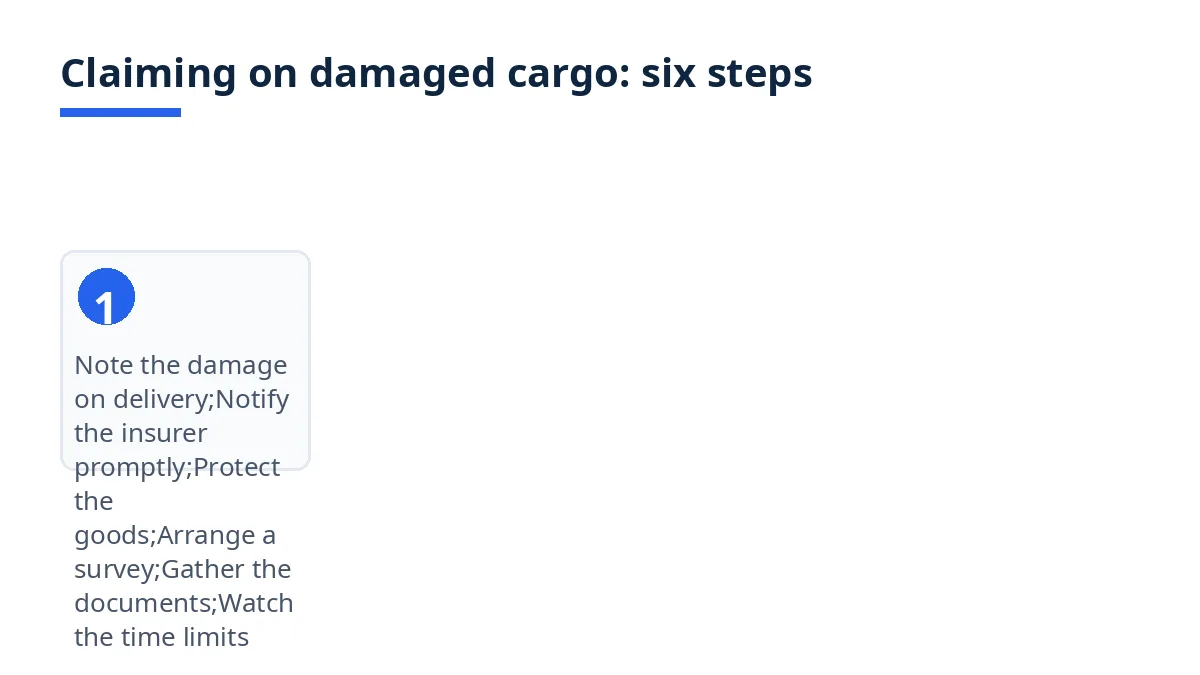
Note the damage on delivery: record it on the delivery documents and take photos before the goods are moved.4
Notify the insurer promptly. Tell your insurer, broker or agency as soon as you find the problem.4
Protect the goods: limit further loss and keep the damaged goods available for inspection.4
Arrange a survey: the insurer usually appoints a surveyor to assess the cause and extent of the damage.4
Gather documents: bill of lading, invoice, packing list, survey report, insurance certificate, and correspondence with the carrier.4
Watch the time limits: both the policy and the carrier's terms have deadlines, and they are not the same. A claim against the shipping line dies at the one year mark under the standard sea carriage rules.3
Under CIF the claim runs on the seller's policy; under CFR it runs on your own policy, so you deal with your own insurer directly.1
CFR and CIF at a glance
The two rules are identical except for the insurance line, so the choice is an insurance decision first and a price decision second.
CFR | CIF | |
|---|---|---|
Full name | Cost and Freight | Cost, Insurance and Freight |
Ocean freight | Seller books and pays | Seller books and pays |
Cargo insurance | Buyer arranges its own cover | Seller must buy Clause C minimum cover |
Sum insured, seller's policy | Not applicable | At least 110% of contract price |
Who claims | Buyer, on its own policy | Buyer, on the seller's assignable policy |
Both rules are written for cargo loaded directly onto a vessel. A container dropped at the terminal days before sailing is not yet on board when the rule's delivery point is reached, so the waiting period can sit in a gap where neither party's insurance clearly covers the goods.1 For containerised cargo the ICC recommends CPT instead, and CIP where the seller also insures, at Clause A level.1
Single-voyage cover or an open cover
Under CFR you buy the policy, so you choose its form as well as its clause set. A single shipment policy covers one named voyage, and suits occasional importers or one-off high-value shipments.4 An annual open cover covers shipments of a stated type on a continuing basis, with each one declared as it ships, and suits businesses that ship regularly.4
An open cover is a longer-term agreement under which certificates are issued per shipment, and each shipment is declared to the insurer, usually before it starts. An undeclared shipment may not be covered when a loss happens.
Worked example: wet towels under Clause C and Clause A
Example figures. A buyer in Antwerp orders 800 cartons of cotton towels from a supplier in Chattogram, goods value $12,000. The numbers are illustrative, and they compare the two insurance outcomes on one shipment.
Cost line | CFR, buyer buys Clause A | CIF, seller buys Clause C |
|---|---|---|
Goods and export clearance | $12,000, in the CFR price | $12,000, in the CIF price |
Freight Chattogram to Antwerp | $1,900, paid by the seller | $1,900, paid by the seller |
Insurance at 110% of $13,900 | $180 Clause A, buyer | $95 Clause C, seller |
Duty at 5% of the $14,075 CIF value, plus delivery | $1,124, buyer | $1,124, buyer |
Total if nothing goes wrong | $15,204 | $15,119 |
The CIF route is $85 cheaper when nothing goes wrong, because Clause C costs less than Clause A. The difference appears when the container arrives wet: seawater entered through a leaking hatch and damaged 200 cartons worth $3,000. Under Clause A the buyer claims $3,000. Under Clause C the claim is refused and the buyer absorbs the $3,000 loss.
If the vessel strands and the cargo is lost, both Clause A and Clause C pay. Clause C suits bulk cargo, not palletised consumer goods, where theft, water damage and handling loss are the realistic losses.3
Accept the seller's cover or buy your own
Accept the seller's CIF cover when the cargo is low value, hard to damage and hard to steal, when you buy once and have no insurer of your own, and when the Clause C gaps do not match the risks on your route. Ask the seller to show the freight and the insurance as separate lines in the quotation.
Buy your own cover, on CFR or as a top-up over CIF, when the goods are fragile, high value or sensitive to moisture, when the seller's certificate does not cover the whole journey to your warehouse, or when you want to deal with the claim directly rather than through an overseas seller.4 A buyer that wants wider cover under CIF has two options: agree an upgrade in the sale contract in writing, or buy a top-up policy. A spoken promise that the goods are fully insured carries no weight when a claim is assessed.3 CFR gives you the whole insurance decision; under CIF you take whatever minimum policy the seller procured.1 See how the same insurance question plays out one step earlier in the chain in our FOB vs CIF guide, and how the freight-only version of the choice works in FOB vs CFR.
Five checks before the vessel sails
Read the clause letter on the certificate: Clause C, Clause B or Clause A, and whether war and strikes wordings are attached.
Check the sum insured: at least 110% of the contract price under CIF.2
Check the route and the dates: cover must run to at least the named port of destination, and the insurance document must be dated no later than the shipment date.2
Confirm the certificate is assignable to you, and note the insurer's claims agent at your port.
Photograph the packing and the container stow at loading.3
Next steps on Exportain
Start with the Incoterms guide for shipments from Bangladesh to place CFR and CIF among the other nine rules, then compare the neighbouring pair in FAS vs CIF if your cargo loads alongside rather than on board. When you are ready to quote, search Bangladeshi suppliers or post an RFQ, and write the rule, the named port, the edition and the clause set into the requirement.
Sources
- CFR Insurance: Why It Falls Entirely on the Buyer. LegalClarity (accessed )
- Cargo Insurance: Institute Cargo Clauses A, B and C Compared, 110% Cover and CIF vs CIP. TriplicateDocs, (accessed )
- Institute Cargo Clauses A B C Compared: Cover and Gaps. Globalior (accessed )
- Marine Cargo Insurance and Incoterms: Who Insures the Goods?. Cover Buddies, (accessed )
About the author
Sourcing from Bangladesh?
Post a request for quotation and suppliers on Exportain can send you their quotes directly.
Post an RFQ