Top Jute Yarn Manufacturers in Bangladesh: How to Find and Verify Them
How to find jute yarn mills in Bangladesh and confirm they spin your count: read the count, check the spinning line, and test the yarn in the lab.
Short answer
Find jute yarn manufacturers in Bangladesh through the Bangladesh Jute Mills Association member list and the Jute Diversification Promotion Centre, shortlist mills that run spindles for your count. Confirm the mill by checking its spinning line, its production records for your count in lb per spyndle and tex, and lab reports naming the test method for load at break, strain at break, tenacity and tensile modulus. Approve a sample cone before ordering, and judge every result against your order value.
On this page
Key takeaways
Jute yarn counts are quoted in lb per spyndle and tex; 5 lb per spyndle is 173 tex and 7 lb per spyndle is 241 tex.
The batch, the carding and the draft are set for the count, so a mill that cannot name its batch for your count is not spinning to your order.
Start with the BJMA member list and JDPC; no audited ranking of jute yarn mills exists.
Quality ratio is single yarn strength in pounds divided by count in lb per spyndle, and every lab value needs its test method named.
Approve a sample cone in writing before ordering, and judge every lab result against your order value only.
A jute yarn order fails in the spinning shed, not at the port. A mill that weaves sacking cloth may buy its yarn in, a trader may list counts it has never spun, and a cone that looks right may drift in count from one lot to the next. This guide is for a buyer who needs yarn itself: how to read the count, how to tell a spinning mill from a trader, and how to confirm that the mill spins the count you need.
What a jute yarn mill actually does
A spinning mill turns raw jute fibre into yarn through a fixed sequence: batching and selection, piecing and softening, piling and conditioning, carding at a breaker card and then a finisher card, drawing, spinning on a slip draft or apron draft machine, and winding.1 Softening applies a jute batching oil emulsion so the stiff fibre can be handled, carding breaks the fibre into a uniform sliver, and spinning draws the sliver to thickness and adds twist.1
The batch is chosen for the count. A batch for hessian warp is set at 8.25 lb per spyndle, hessian weft at 8.5 lb per spyndle, and sacking warp at 10.25 lb per spyndle, each with a different blend of jute grades.1 A mill that cannot tell you which batch it runs for your count is not spinning to your order.
Ask the mill to name the machine at each stage of its own line. A real spinning mill can do that; a trader will skip the line.
How to read a yarn count before you shortlist anyone
Jute yarn is quoted by weight per length. The count in lb per spyndle is the weight in pounds of one spyndle, which is 14,400 yards of yarn.2 The tex count is the same yarn measured in grams per kilometre, and the two convert by a fixed factor: tex equals lb per spyndle multiplied by 34.45.2 A 5 lb per spyndle yarn is 173 tex, and a 7 lb per spyndle yarn is 241 tex.2
Count, lb per spyndle | Count, tex | Typical use |
|---|---|---|
5 | 173 | Carpet backing, diversified products |
7 | 241 | Hessian, general weaving |
8.25 | 284 | Hessian warp |
8.5 | 293 | Hessian weft |
10.25 | 353 | Sacking warp |
The tex figures follow from the conversion above, and the uses follow the batch counts in the spinning overview.1 2
State the count in both units in every enquiry, for example "7 lb per spyndle (241 tex), single yarn, cones", and state whether the yarn is single or plied: a single yarn is one strand, while a multiple or folded yarn twists two or more single yarns together, and the two sit under different six-digit HS subheadings, 5307.10 and 5307.20. Our HS code guide for jute yarn sets out that split in full.
Which spinning system fits your end use
Most jute yarn in Bangladesh is spun on flyer spinning frames fed by a finisher drawing sliver, with the draft applied in a slip draft or apron draft zone.1 The spinning overview names both systems without ranking them, so the question is which machine the mill runs for your count. Ask for the spinning frame type, the spindle count on the frames assigned to your count, and the twist per metre the mill sets for it. In the flyer frame trial cited below, the 173 and 241 tex yarns were spun at 354 twists per metre.2 Your order value will differ, but the mill should be able to state its own figure.
A mill that offers dyed or bleached yarn needs a dyeing or bleaching unit, not just a spinning line: one mill group publishes a separate dyed yarn unit with its own capacity, alongside its spinning units.3 If the mill offers dyed yarn but cannot show the dyeing unit or name the dyer it uses, treat the offer as unconfirmed.
Where to look for spinning mills
Start with the membership lists, not with a search engine ranking. The Bangladesh Jute Mills Association (BJMA) publishes a list of member mills with head office addresses, mill locations, loom counts and spindle counts, so a buyer can see which mills run spindles and where they sit.4 The list is long and partly dated, with some mills marked closed, so use it as a directory to check against.
JDPC, the Jute Diversification Promotion Centre, was set up in 2002 to promote diversified jute products. It has 1,100 registered entrepreneurs and 282 product types, supported by six service centres across the country.5 JDPC covers diversified products rather than bulk spinning, so it suits a buyer of fine or speciality yarn better than a buyer of sacking yarn by the container. The Export Promotion Bureau (EPB) lists exporters, and its 2026-27 export target puts jute and jute goods at 1.017 billion dollars, with jute yarn and twine at 620 million dollars.6
At Dhaka trade fairs, a buyer can handle cones and meet the mill team. Referrals from other buyers carry weight too: a mill that has shipped your count to your market has already passed that market's checks. Our guide to finding jute bag makers uses the same directory-first method for a different product. No audited ranking of jute yarn mills exists, so any list that claims to rank them is a guess.
Six checks that confirm a mill spins your count
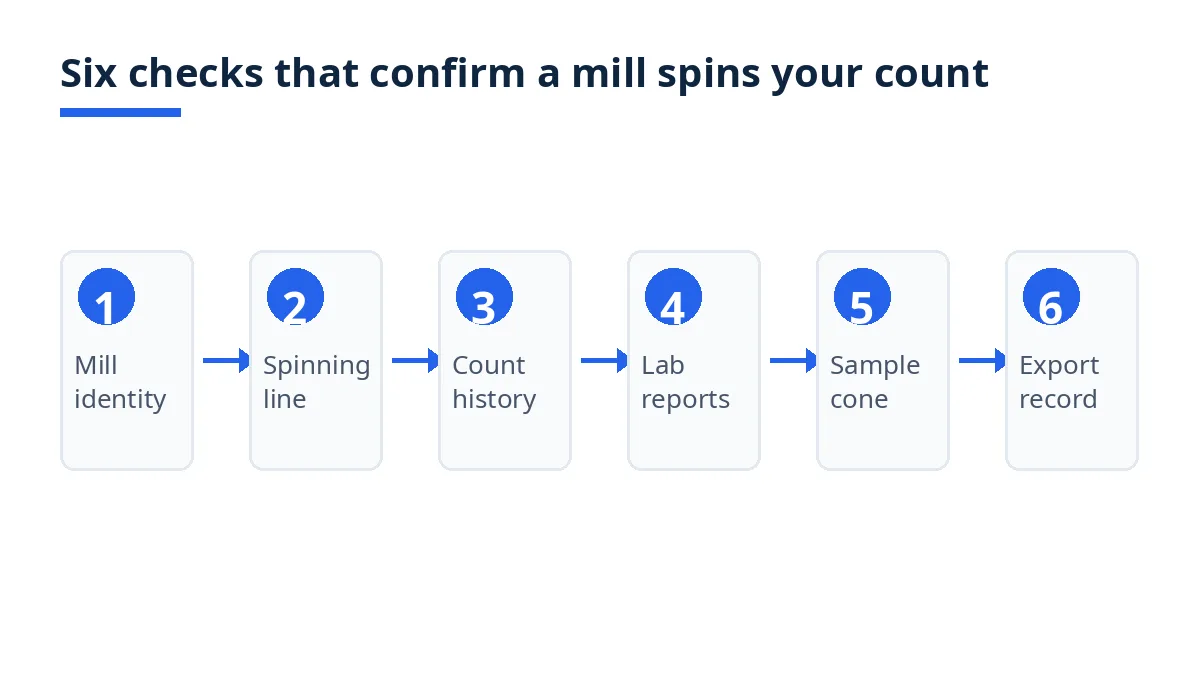
Verification runs in six checks, each finished before the next starts. The diagram below sets out the sequence.
Check | Evidence to collect | What it tells you |
|---|---|---|
Mill identity | Trade licence, export registration, BJMA membership, mill address | Whether the mill is registered at that address4 |
Spinning line | Frame types, spindle count, drawing passages, winding setup | Whether the mill spins yarn or buys it in1 |
Count history | Production records for your count, in lb per spyndle and tex | Whether the mill has run your count2 |
Lab reports | Test reports for the count, with method and date | Whether the yarn meets your specification2 |
Sample cone | A cone spun to your count, ply and put-up, kept as the reference | Whether the yarn suits your end use |
Export record | Buyer references and shipping papers for a recent yarn order | Whether the mill has shipped yarn abroad6 |
The count history check is the one traders fail. Ask for the production record of the last three runs of your count: dates, quantities, and the batch grades used. Match the record against the lab reports: the reports should carry the same count, the same dates, and the same lot numbers.
The sample cone is the reference for the whole order. Approve it in writing, with the count, ply, twist, put-up and colour stated, and keep it sealed and separate from the lot.
What the lab report should show
Research describes jute yarn quality through four measurements: the load at break, the strain at break, the tenacity at break and the tensile modulus.2 The quality ratio ties strength to count: it is the percentage ratio of single yarn strength in pounds to yarn count in lb per spyndle, and a higher ratio shows greater strength.2 Ask the mill to state the quality ratio it expects for your count, with the lab report behind it.
The report should name the method for each value. Strength is measured under ASTM D2256, linear density under ASTM D1907, and twist per metre with a mechanical twist tester, all at a standard atmosphere of 65 percent relative humidity and 20 degrees Celsius, held for 48 hours.2 A report that gives numbers without methods cannot be compared with the next mill's report.
Our quality control checklist for jute yarn works through the cone-level checks in detail: count drift, twist, evenness, thick and thin places, neps, colour across cones, winding faults and packing. Use it at final inspection, and write the lab tests into the purchase order with the method named for each one.
Certifications and documents to ask for
Ask for certificates by name, and check each one with the body that issued it. A mill may hold a quality management certificate, a product certificate for a specific market, or a test report from an independent lab. Each carries a scope, an expiry date and an issuing body, and the scope is the part that matters: a certificate that covers weaving does not cover spinning.
Do not accept a certificate as a photograph alone. Ask for the certificate number, the issuing body and the scope in writing, then check the number with the issuer. If the mill cannot give the number, or the scope does not include spinning, move on.
The export documents travel with the shipment, not with the quotation. The commercial invoice, packing list, bill of lading and certificate of origin should agree on quantity, count, ply and put-up, and the HS code on the invoice should match the code you agreed with your broker. Our HS code guide for jute yarn covers the classification.
Worked example: a shortlist for carpet-backing yarn
A buyer needs 20 tonnes of single jute yarn at 5 lb per spyndle (173 tex) on cones, for carpet backing, with a quality ratio set in the order. The figures below are example figures, except for the count conversion, which follows the research cited above.2
The buyer starts with the BJMA list, picks five mills that show spindle counts, and asks each one the same four questions: which frame spins 5 lb per spyndle yarn, what twist per metre is set for it, what quality ratio the last three runs achieved, and what the lab reports show for load at break and strain at break.4 2 Two mills answer with frame types and dated reports. One answers with a price and no frame detail.
The buyer drops the three that cannot show the line or the reports, and asks the remaining two for a sample cone each, spun to 5 lb per spyndle, with the twist and the lot number on the label. One cone matches the count when tested; the other measures at 5.6 lb per spyndle, which is a different yarn. The buyer keeps the first mill and writes the count, the quality ratio and the test methods into the purchase order. The shortlist took a week.
Mistakes that waste a yarn order
The first mistake is ordering by price per tonne without naming the count. Two mills can quote the same tonne at different prices because they are quoting different yarns.
The second mistake is accepting a mill that lists every count. A list that covers every count from fine to coarse usually means the mill buys in the counts it does not spin. Ask which counts the mill spun last month.
The third mistake is skipping the lab report and judging the cone by hand. A cone can feel firm and still fail on tenacity, and a cone can look even and still drift in count. The hand check is for handling; the lab report is for the values that decide whether the yarn survives the loom.
The fourth mistake is approving the sample cone and then letting the bulk run without a reference. Keep the approved cone sealed and compare cones from the bulk lot against it.
Next steps on Exportain
Start with the quality control checklist for jute yarn to set the tests in your order, then check the HS code guide for jute yarn so the shipment carries the right heading. When the shortlist is ready, search Bangladeshi suppliers and post an RFQ with the count in both units, the ply, the put-up and the quantity.
Sources
- Jute Spinning Process - An Overview. Textile Learner, (accessed )
- A Prognostic Based Fuzzy Logic Method to Speculate Yarn Quality Ratio in Jute Spinning Industry. MDPI, (accessed )
- Company History & Milestones. Janata Sadat Jute Mills (accessed )
- List of BJMA Member Mills. Bangladesh Jute Mills Association (accessed )
- Jute Diversification Promotion Centre weaves success for 1,100 entrepreneurs. Daily Sun, (accessed )
- EPB charts $66b export roadmap for FY27. The Financial Express (accessed )
About the author
Sourcing from Bangladesh?
Post a request for quotation and suppliers on Exportain can send you their quotes directly.
Post an RFQ