HS Code for Jute Yarn: Classification Guide for Importers
Jute yarn is examined under indicative heading 5307: single yarn at 5307.10, multiple (folded) or cabled yarn at 5307.20, with the full national code confirmed in the destination tariff for the entry date.
Short answer
Jute yarn is examined under indicative heading 5307: single yarn at 5307.10 and multiple (folded) or cabled yarn at 5307.20. The fibre must sit in heading 5303, and bleaching or put-up do not create a further six-digit split in the texts opened here. Confirm the full national code in the destination tariff for the entry date.
On this page
A shipment described only as jute yarn does not yet carry a finished classification. Customs will ask a narrower question: is this yarn single, or multiple (folded) or cabled, and what does the destination tariff add after the shared six digits. Answer those questions from the yarn itself, not from the product it will later become.
Verify note: every heading and code named here is indicative only. Confirm the six-digit subheading and the full national code in the destination tariff for the entry date, and put a doubtful yarn to a broker or the binding ruling route before filing.
Quick answer: indicative HS heading (with verify note)
The indicative heading for yarn of jute, or of other textile bast fibres of heading 5303, is heading 5307.1 2 At six digits it splits only two ways: 5307.10 for single yarn, and 5307.20 for multiple (folded) or cabled yarn.1 2 That split is the whole six-digit decision for jute yarn, with no further six-digit split for colour, finish, or put-up.
Many importers arrive at 5307 with a supplier description covering ply count, put-up, fineness, or intended use, and try to map each detail onto a different code. At the international level, only the single versus multiple (folded) or cabled distinction changes the subheading. The other details help a broker confirm the subheading, appear on the entry description, and in some destinations drive a further national split. They do not create a third six-digit line.
How HS codes are structured (2-4-6 digits)
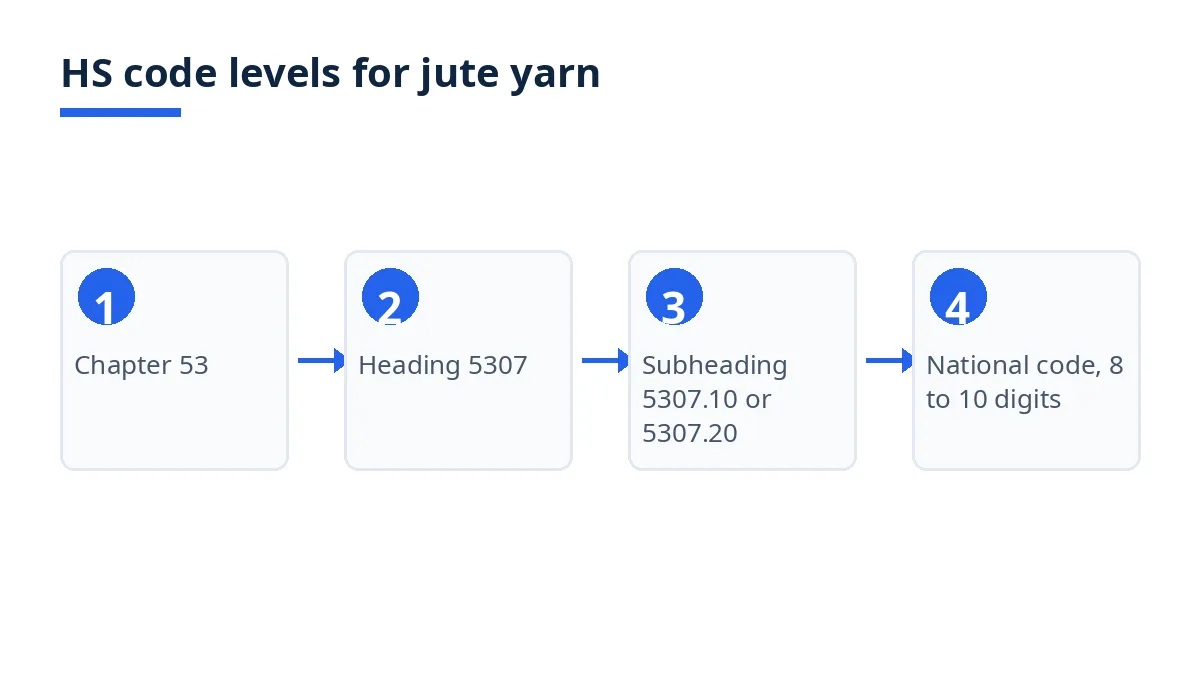
The code narrows in stages. The first two digits are the chapter. Chapter 53 covers other vegetable textile fibres, paper yarn, and woven fabrics of paper yarn.1 The next two digits make the four-digit heading, here 5307. The final two digits of the six-digit code make the subheading: 5307.10 or 5307.20.1 2
Only the first six digits are internationally shared. Beyond them, each destination adds its own digits. The United States schedule extends the subheading to a 10-digit number, shown here as 5307.10.00 and 5307.20.00.3 The European Combined Nomenclature builds 8-digit codes on the same six digits, and TARIC adds further digits.4 Read the full national line, not only the heading.
The chain also runs in the other direction. Raw or processed jute fibre that has not been spun sits in heading 5303, not 5307.1 2 Spun yarn sits in 5307. Woven fabric made from that yarn sits in heading 5310.1 A finished article made from the fabric, such as a packing sack, is a different question, covered by the jute bags guide, and not answered by the yarn code. Keep each step in its own heading.
The diagram below shows that narrowing.
Factors that decide the code for jute yarn
First, count the strands. A single yarn is one strand. A multiple (folded) or cabled yarn is made by twisting two or more single yarns together. The tariff texts opened here draw the line exactly there: 5307.10 is single, 5307.20 is multiple (folded) or cabled.1 2 3 A two-ply, three-ply, or cabled yarn all sit on the multiple side at six digits, whatever their ply count. Record ply count anyway, as a national line may use it.
Second, confirm the fibre. Heading 5307 covers yarn of jute or of other textile bast fibres of heading 5303.1 2 Flax yarn is not in 5307 at all; it has its own heading, 5306.1 Yarn of other vegetable fibres that are not bast fibres of heading 5303, such as coir yarn, sits in heading 5308.1 A yarn described as a vegetable fibre yarn is not automatically a 5307 yarn. Check the fibre itself would sit in heading 5303 first.
Third, treat bleaching, dyeing, and finish with care. The six-digit split for 5307 in the texts opened here does not turn on whether the yarn is bleached or unbleached.1 2 3 That differs from neighbouring yarn headings: flax yarn, for example, is split in the Combined Nomenclature text opened here by put-up and by unbleached versus other lines.4 Do not carry a flax-yarn split across into jute yarn. Record bleaching or dyeing anyway, but do not present it as a six-digit factor for 5307 unless the destination tariff says so.
Fourth, treat put-up with the same care. The Section XI notes define "put up for retail sale" for yarn, with weight limits by form of put-up and exceptions for yarn on supports indicating industrial use, such as cops, tubes, pirns, or conical bobbins.5 But that note, as written, applies to chapters 50, 51, 52, 54, and 55, and the 5307 texts opened here contain no retail-sale split at six digits.5 1 A small retail ball and a large industrial cone of the same single yarn therefore sit in the same six-digit subheading. Put-up still belongs in the classification file, but it does not change 5307.10 to 5307.20 on the texts opened here.
Fifth, watch the boundary with fabric. Yarn woven into cloth is no longer a yarn question: woven fabric of jute or of other textile bast fibres of heading 5303 is heading 5310.1 For yarn on cones, hanks, or reels, the question is 5307.10 versus 5307.20.
Worked description | First test | Indicative treatment, with caution |
|---|---|---|
Single jute yarn on cones for a weaving mill | One strand, industrial put-up | 5307.10 area; confirm the national line |
Two-ply jute yarn in hanks | Two strands twisted together | 5307.20 area; ply count does not create a further six-digit line |
Single yarn of another heading 5303 bast fibre | Fibre in heading 5303, one strand | 5307.10 area; fibre name alone does not split it |
Flax yarn, single or multiple | Fibre is flax, not a heading 5303 bast fibre | Heading 5306, not 5307; do not use the 5307 split for flax |
Jute yarn already woven into cloth | Goods at import are fabric, not yarn | Heading 5310 area; the yarn code does not carry over |
Unspun jute fibre, raw or retted, in bales | Fibre has not been spun | Heading 5303, not 5307; spinning moves fibre to yarn |
National codes: US HTS, EU CN/TARIC, UK commodity code
In the United States, the Harmonized Tariff Schedule extends the six-digit subheading to a 10-digit import number, shown here as 5307.10.00 for single yarn and 5307.20.00 for multiple (folded) or cabled yarn.3 Confirm the current United States line for your entry date.
In the European Union, the Combined Nomenclature code builds on the six-digit subheading, and TARIC adds further digits. The text opened here shows single yarn at 5307.10 and multiple (folded) or cabled yarn at 5307.20.4 One older version further split single jute yarn by fineness, measured in decitex, into two 8-digit lines.6 That older split is a warning, not a current code: open the entry-date Combined Nomenclature rather than copying an older table.
In the United Kingdom, the commodity code is also built on the shared six-digit foundation with national extensions, and United Kingdom guidance refers readers to the UK tariff for the full code.7 For Great Britain, use the UK tariff; for Northern Ireland, the Northern Ireland (EU) tariff. Do not assume the United Kingdom line matches the European Union line digit for digit.
How to confirm the code officially
Start with the destination tariff text, not a supplier invoice, a marketplace listing, or a search result. Open the current chapter 53 text, read the heading wording and the notes, and work down to the national line.
Next, build a classification file for each yarn style: fibre heading, construction, ply count, fineness where stated, bleaching or dyeing, put-up, and intended use. A broker and a ruling authority will both work from that file.
Where the answer is still doubtful, seek a binding decision. In the United States, a binding ruling request goes to United States Customs and Border Protection. For Northern Ireland and the European Union, a Binding Tariff Information decision is applied for through the EU Customs Trader Portal, with a separate application for each type of goods, made before all customs procedures have been completed.8 For Great Britain, the equivalent route is an Advance Tariff Ruling, which requires a GB EORI number and an intention to import into or export from Great Britain.7 A binding decision covers only the goods described in it.
Common classification mistakes
The first mistake is quoting the fibre heading for the yarn. Heading 5303 is jute fibre, raw or processed but not spun.1 Spinning changes the heading, so a bale of fibre and a cone of yarn from the same fibre do not share a code.
The second mistake is quoting the fabric heading for the yarn, or the yarn heading for the fabric. Heading 5310 is woven fabric of jute or of other textile bast fibres of heading 5303.1 If the goods have been woven, 5307 no longer applies; if they have not, 5310 does not apply.
The third mistake is importing a split from a neighbouring heading. Flax yarn splits, bleached versus unbleached lines, and retail-sale lines in other yarn headings do not automatically apply to 5307.4 5 Check the 5307 line itself, not the pattern of the heading next to it.
The fourth mistake is copying a code from a different yarn. A single yarn code copied onto a two-ply shipment, or a supplier code for a different fibre, fails the first test here: count the strands, then confirm the fibre. The fifth mistake is stopping at the heading or subheading, or using a code from the wrong destination or date. Writing 5307, or even 5307.10, on an entry leaves the national extension undecided.
Related duties and documents
The HS code does not by itself state what an importer will pay. No rate is stated in this article. Ask your broker for the treatment for your code, origin, and entry date.
Documents that normally travel with a jute yarn shipment are the commercial invoice, the packing list, the bill of lading or airwaybill, and the certificate of origin where a preference or a buyer requirement calls for one. The invoice description should match the classification file: fibre, construction, ply count, put-up, and quantity. A mismatch between entry, invoice, and origin claim is a common source of delay.
FAQs
What is the HS code for jute yarn?
The indicative heading is 5307, for yarn of jute or of other textile bast fibres of heading 5303.1 2 At six digits it splits into 5307.10 for single yarn and 5307.20 for multiple (folded) or cabled yarn.1 2 Confirm the full national code in the destination tariff for the entry date.
Is the HS code the same in every country?
Only the first six digits are shared. Each destination adds its own digits after the sixth digit, as the 10-digit United States lines and the 8-digit Combined Nomenclature lines show.3 4 The same yarn can therefore carry a different full code in each destination.
How do I confirm the correct code?
Read the destination tariff text for chapter 53, apply the heading wording and the notes, and test the yarn's fibre and its single versus multiple (folded) or cabled construction.1 2 Then get a broker confirmation in writing, or seek a binding decision: a United States ruling, a Binding Tariff Information decision for Northern Ireland and the European Union, or an Advance Tariff Ruling for Great Britain.7 8
What happens if I use the wrong code?
A wrong code can delay clearance while customs re-examines the goods, and it can change the treatment that applies to the entry. It can also create a mismatch between entry, invoice, and any origin claim.
Next steps on Exportain
For background, read HS Code: Harmonized System Explained and HS Codes: How to Classify Your Product. When you are ready to source, browse suppliers on Exportain and compare yarn construction and put-up before asking for a quotation. To start sourcing, Post a free RFQ on Exportain.
Sources
- Chapter 53: Other vegetable textile fibres; paper yarn and woven fabrics of paper yarn (HS 2012). World Customs Organization (accessed )
- Chapter 53 - Other vegetable textile fibres; paper yarn and woven fabrics of paper yarn (Customs Tariff). Canada Border Services Agency (accessed )
- Harmonized Tariff Schedule of the United States, Chapter 53. United States International Trade Commission (accessed )
- Commission Regulation (EU) No 861/2010, Annex I, Chapter 53 (Combined Nomenclature). European Union (legislation.gov.uk) (accessed )
- Canadian Export Classification: Section 11 - Textiles and textile articles (Section XI notes). Statistics Canada (accessed )
- Commission Regulation (EC) No 1359/95, Annex I, Chapter 53 (older Combined Nomenclature, decitex split for single jute yarn). European Union (legislation.gov.uk) (accessed )
- Apply for an Advance Tariff Ruling. HM Revenue & Customs (GOV.UK), (accessed )
- Apply for a Binding Tariff Information decision. GOV.UK (accessed )
About the author
Sourcing from Bangladesh?
Post a request for quotation and suppliers on Exportain can send you their quotes directly.
Post an RFQ