Quality Control Checklist for Jute Yarn From Bangladesh
Jute yarn quality control checklist for Bangladesh orders: count, twist, strength, evenness, faults, colour across cones, cone winding, labels, buyer-specified tests, and truss and bale packing, with a numbered checklist, failure fixes, and a summary table.
Short answer
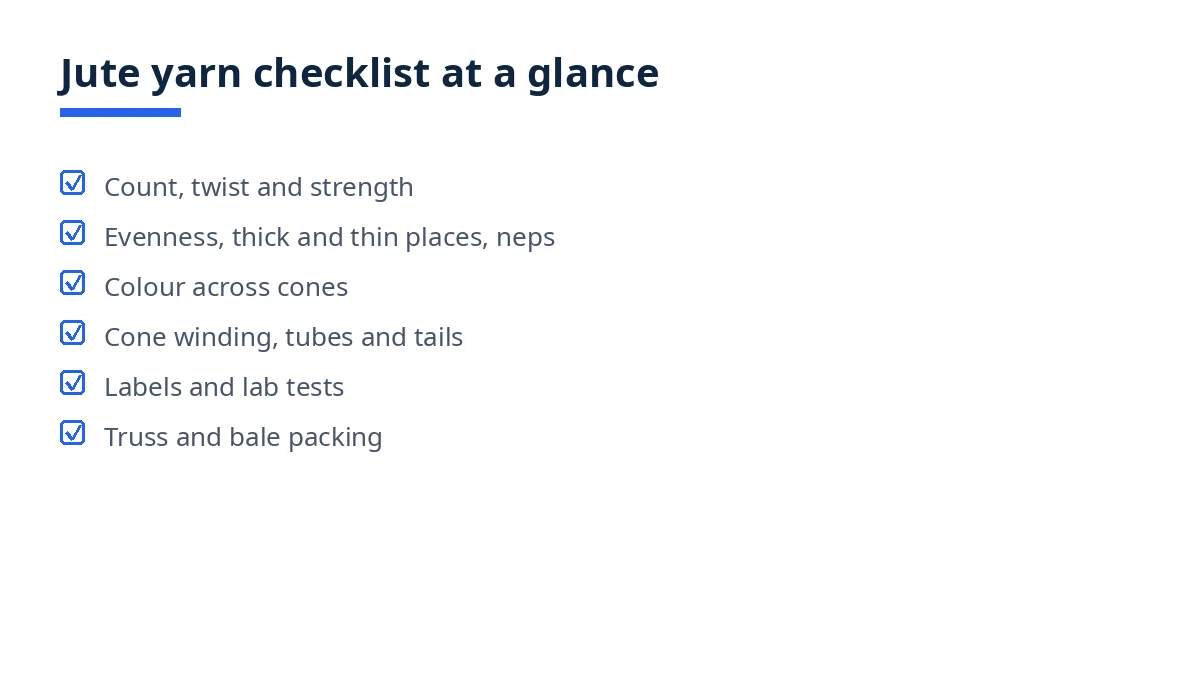
This jute yarn quality control checklist covers count and linear density, twist, tensile strength, quality ratio, evenness, thick and thin places, neps, slubs, hairiness, colour across cones, cone winding, tube and tail checks, moisture as a buyer-spec item, labels, buyer-specified lab tests, and truss and bale packing, with a numbered checklist, a published-table sampling example, failure fixes and a summary table.
On this page
A cone of jute yarn can look uniform and still fail in the loom. Count may drift from cone to cone, twist may be too low to hold the yarn under tension, or a thick place may break the end during weaving. These faults are hard to see in a photograph and easy to miss if the check stops at colour and packing. A yarn check must therefore follow the yarn itself: count, twist, strength, evenness, faults, colour across cones, winding, and then packing.
Jute yarn quality, in the research literature, is described through load at break, strain at break, tenacity at break and tensile modulus, measured under named laboratory methods.1 Every lab item below names the method and asks for the result to be recorded against the order value. No item here carries a universal pass mark.
Why this checklist matters
Yarn is an intermediate product, so a defect in yarn becomes a defect in something else. A thick place or slub shows up as a fault in woven cloth, a weak place breaks during weaving, and a shade difference between cones shows up as striping in finished fabric. Checking yarn before shipment is cheaper than sorting cloth later, and it gives the buyer a record tying each cone lot to a named test and a dated result.
Variation between cones is the second reason. Jute is a coarse natural fibre, and count, twist and colour can drift within a lot even when the average looks right. The checklist below therefore samples across cases, compares cones against each other and against the approved cone, and records cone and lot numbers.
Before you start
Freeze the reference set before inspection: one sealed approved cone per count and colour, the purchase order, the yarn specification, the defect list classed as critical, major or minor, the sampling plan, the packing specification, and the label artwork. Keep the approved cone sealed and separate from the lot.
Agree three things in writing in the purchase order. First, the defect list and the class of each defect, with reference photographs for borderline cases. Second, the sampling plan, including the standard, level and acceptance and rejection numbers for each class. AQL, defined in ISO 2859-1, sets how many units to sample and how many defective units can be found before the lot is rejected.2 Third, the buyer-specified tests, each named with its method and result. A pre-shipment inspection is a sampling inspection of finished, mostly packed goods, not a check of every piece and not a guarantee.3 Book the final check when production is complete and goods are mostly packed.
The full checklist (numbered, printable)
Tick each item Pass, Fail, or Not applicable. Record cone, case and lot numbers for every sample.
Approved cone map. Each count, ply and colour has its own sealed approved cone.
Fibre identity and blend. Check fibre and any blend against the approved cone and the order.
Count, buyer-spec item. Record the linear-density test method and result against the order value only.1
Twist, buyer-spec item. Check twist direction, Z or S, and twist per metre against the order.1
Ply construction where plied. Count the strands and check ply twist against the approved cone.
Tensile strength, buyer-spec item. Record the breaking-load test method and result against the order value only.1
Quality ratio where named. Record the ratio and its inputs, judged only against the order value.1
Strain at break, buyer-spec item. Record the strain-at-break test method and result against the order value only.1
Evenness. Unwind a length from each sample cone and check for visible unevenness.
Thick, thin places and neps. Photograph each fault with cone number and position.
Slubs, snarls and kinks. Check for abnormally thick areas with less twist, and for kinks from insufficient tension.
Bad piecing and knots. Check joins for unduly thick piecing and oversized knots or splices.
Hairiness. Check fibre ends projecting from the yarn surface, recording any named test result only.
Foreign matter, oil and dirt. Check for foreign matter, oil stains, grease and dirt on the cone surface.
Colour across cones. Compare colour cone to cone and case to case under the agreed light.
Cone winding. Check for patterns, bands, high or falling edges, ridges, grooves, and hard or soft packages.4
Tube condition. Check for crushed, nicked or cut tubes, especially at the nose end.4
Tail and crossed ends. Check for a usable tail and crossed ends that are not matted.4
Cone weight and length, buyer-spec items. Record both against the order value only.
Odour, dampness, mould and soiling. Photograph affected cones with their case numbers.
Moisture content, buyer-spec item. Record the test method and result against the order value only, never against a figure from this guide.
Labels on cones and cases. Check count, colour, lot or merge number and net weight, and that any barcode scans and matches the case.
Lab tests, recorded in full. Run each named test by its named method, recording specimen count, method and result, with no universal grade applied.
Quantity and assortment per case. Count cones per case and per truss or bale against the packing list, by count and colour.
Packing of spools, trusses and bales. Check complete covering on all sides and secure binding where bales are used.5
Shipping marks. Check description of material, net and gross mass, bale or truss number and manufacturer identification, marked on two sides unless otherwise agreed.5
No damaged spool in a truss. A truss must contain only the spools specified by the buyer, with handling loops or dog-ears provided.5
Sampling decision on the finished, packed lot. As a published-table example only, a lot of 3,201 to 10,000 cones at General Inspection Level I gives code letter J and a sample of 80 cones.2 With buyer-specified AQL 1.0 for major and AQL 2.5 for minor defects, the published table gives 2 and 3 for major defects and 5 and 6 for minor defects.2 Those are buyer-agreed order values from the published table, not standard-mandated values for jute yarn.6 A pre-shipment inspection samples finished, mostly packed goods, and is not a guarantee.3
Common failures and how to fix them
Count drifting from cone to cone. Cones measuring differently from each other point to count variation within the lot. Hold the lot and compare counts cone by cone.
Soft yarn from low twist. Yarn that feels soft and breaks often during unwinding points to twist below the order value. Hold the lot and check twist on a fresh sample.
Thick and thin places with neps. Repeated thick places, thin places and neps point to drafting or carding variation on that run. Hold the run and segregate affected cones.
Shade split across cases. Cones matching under one light and differing under another point to dye or fibre lots, or to the lighting used. Re-check under a second light and keep the lots apart.
Winding faults that stop unwinding. Cones with bands, ridges, soft winding or falling edges cause breaks downstream. Hold affected cones and send faulty cones for rewinding.
Dampness or mould inside packing. Cones smelling damp or showing mould inside a case or bale point to storage or packing before shipment. Hold the case or bale and trace storage conditions.
Mixed lots under one label. Cases holding two counts, two colours or two lot numbers under one label cause the wrong yarn to reach the loom. Hold the cases, re-sort and re-label.
Downloadable template / summary table
No file download is offered with this article. The table below is the template.
Group | What to record | Result |
|---|---|---|
Count, twist, strength | Count, twist, breaking load, strain, quality ratio | Pass/fail |
Evenness, faults | Evenness, thick/thin places, neps, slubs, snarls, piecing, hairiness | Pass/fail |
Colour, foreign matter | Colour across cones, oil, dirt, foreign matter, odour, dampness, mould | Pass/fail |
Winding, tubes | Proper wind, tube condition, tail, crossed ends, cone weight | Pass/fail |
Labels, tests | Cone/case labels, barcodes, lab tests with methods | Pass/fail |
Packing, marks | Cones per case, truss/bale packing, shipping marks, numbers | Pass/fail |
Sampling decision | Lot size, level, code letter, sample size, Ac/Re per class | Pass/fail |
Copy the table into the inspection report with lot number, date, inspector name and approved cone reference, and attach photographs of every failed cone.
How Exportain helps
Exportain does not inspect goods itself. A buyer can use this checklist to write the inspection into the purchase order, book an independent inspector against it, and compare the report with the order line by line. Inspection providers can be found through Exportain, but the inspection contract is between the buyer and the provider. Exportain supplier verification is a document and photo review, not a factory inspection, so it does not replace the checks in this guide.
FAQs
When should this checklist be used?
Use it at final inspection, when production is complete and yarn is mostly packed, and again after any rework, with a fresh sample.
Who should complete it?
The buyer own inspector, a third-party inspector booked by the buyer, or the supplier quality team can each complete it, but roles must stay separate in the report. Whoever books the inspection is the firm client and receives the report.3
What are the most common failures?
The failures that recur here are count drift across cones, low twist, thick and thin places with neps, shade differences between cones, winding faults that stop unwinding, dampness or mould in packing, and mixed lots under one label. Each is a cone-level fault, so a check that looks only at the outside of a case will miss most of them.
Can a third party do it?
Yes. A pre-shipment inspection is usually arranged through an independent third-party firm, and the buyer sends that firm the purchase order, specification, approved cone details and packing requirements.3 Agree in the order who pays for re-inspection after a failure, and what happens after a fail.
Next steps on Exportain
Read the AQL acceptance quality limit guide before fixing the sampling plan for a new order, since lot size, level and AQL per class must be agreed before inspection. Then read the pre-shipment inspection guide for the booking sequence and the pass, fail and re-inspection steps.
Sources
- A Prognostic Based Fuzzy Logic Method to Speculate Yarn Quality Ratio in Jute Spinning Industry. MDPI (accessed )
- AQL Calculator | Sample Size and ISO 2859-1 Tool. AQMBD (accessed )
- Pre-Shipment Inspection (PSI). Exportain (accessed )
- List of Yarn Package Defects in Spinning. Textile Engineering (accessed )
- IS 14342: Textiles - Jute yarn/twine - Packaging code. Bureau of Indian Standards (accessed )
- AQL Meaning: Acceptance Quality Limit, Tables. Exportain (accessed )
About the author
Sourcing from Bangladesh?
Post a request for quotation and suppliers on Exportain can send you their quotes directly.
Post an RFQ