FOB vs CPT: Key Differences, Costs and Which One to Choose
FOB is sea-only and delivers on board; CPT works for any mode and delivers at the first carrier. Here is how the costs and the risk split, with a worked example.
Short answer
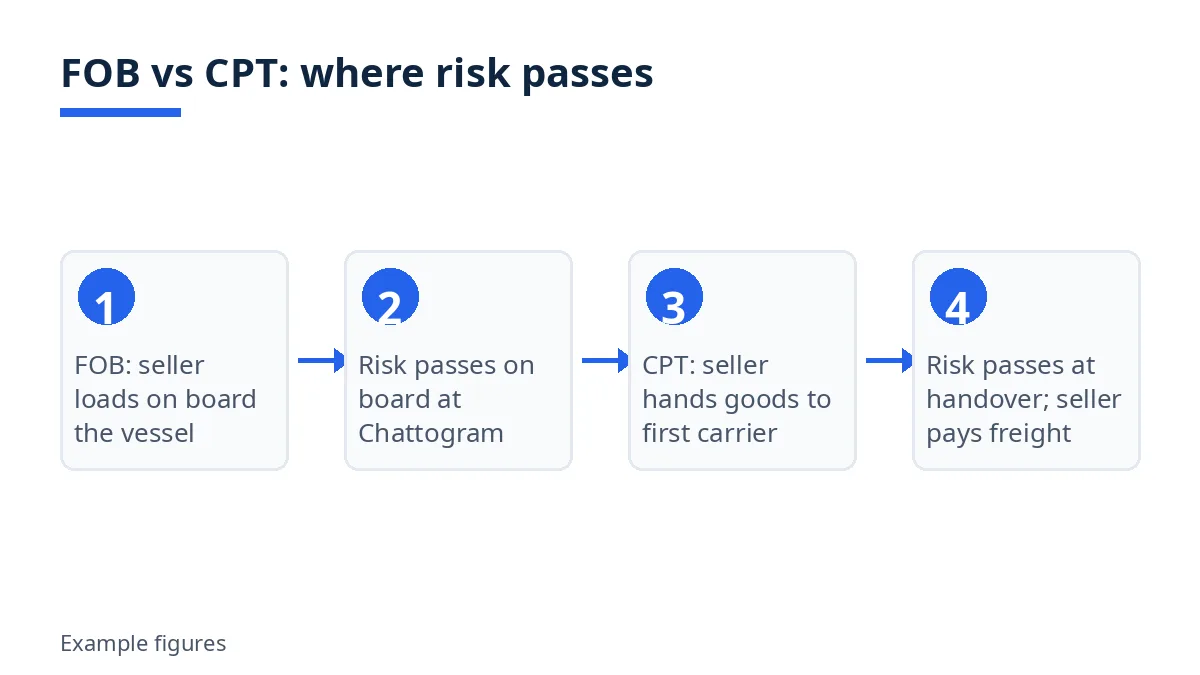
FOB works only for sea and inland waterway transport and delivers when the goods are loaded on board the vessel, with the buyer paying the freight. CPT works for any mode, including containers and multimodal routes, and delivers when the goods are handed to the first carrier, while the seller pays the carriage to the named destination. Risk passes at delivery under both rules, so under CPT the buyer carries the transit risk even though the seller paid the freight.
On this page
Key takeaways
FOB is sea and inland waterway only; CPT works for any mode, including containers and multimodal routes.
FOB delivers on board the vessel; CPT delivers when the goods reach the first carrier.
Under CPT the seller pays carriage to the destination but risk passes at the first-carrier handover.
Neither rule requires the seller to buy cargo insurance; the buyer arranges its own cover.
For containerised cargo CPT matches the real handover point; FOB fits bulk and break-bulk loaded directly on board.
A buyer comparing an FOB quotation with a CPT quotation is not comparing two prices for the same service. The two rules start from different transport. FOB only works on water, and it ends when the goods are on the ship. CPT works on any transport, and its risk ends when the goods reach the first carrier, even though the seller keeps paying the carriage to the destination. That split shapes everything that follows: which cargo each rule suits, who books the transport, and where the buyer's insurance must start.
Why does the transport mode decide this comparison?
Incoterms 2020 sorts its eleven rules into two families. Seven rules work for any mode of transport, and CPT is one of them. Four rules work only for sea and inland waterway transport, and FOB is one of those four.1 The split is not a detail. A rule built around a vessel assumes the goods cross a ship's rail at the load port, which is how bulk and break-bulk cargo moves. A container does not move that way: it is usually handed to a terminal or a carrier's yard days before the vessel sails, so the moment FOB names as delivery, goods on board, happens long after the seller has let go of the box.1
That is why the ICC guidance warns against using FOB, CFR or CIF for containers, and points buyers to FCA, CPT or CIP instead.1 CPT fits the container's real journey because its delivery point is the handover to the first carrier, which can be a truck at the factory gate, a rail terminal, or a container yard. FOB fits cargo that is loaded straight onto the vessel: bulk grain, bagged cement, steel coils, or timber that goes from the quay onto the ship in one move.
FOB vs CPT: the cost and risk split
Question | FOB | CPT |
|---|---|---|
Transport modes | Sea and inland waterway only | Any mode, alone or combined |
Seller delivers when | Goods are on board the vessel at the port of shipment | Goods are handed to the first carrier |
Risk passes to the buyer | On board the vessel | At handover to the first carrier |
Who books the main carriage | Buyer | Seller |
Who pays carriage to the destination | Buyer | Seller |
Cargo insurance | Buyer arranges its own cover | Buyer arranges its own cover |
Export clearance | Seller | Seller |
Import clearance and duty | Buyer | Buyer |
Unloading at the destination | Buyer | Buyer |
The table shows two differences that matter and two lines that do not differ at all. The mode and the delivery point differ, and so does the payer of the main carriage. The insurance line does not differ: neither rule obliges the seller to insure the goods, so under both rules the buyer arranges cover if it wants any.2 The clearance lines do not differ either: the seller clears the goods for export under both rules, and the buyer clears import and pays the duty under both.2
What happens to risk when the seller pays the freight?
CPT sits in the C group of Incoterms, where the seller takes on the carriage cost beyond the point where risk changes hands.2 Risk passes when the goods reach the first carrier the seller contracted, usually in the seller's country, while the seller's payment runs on to the named destination.2 3 The buyer therefore carries the risk through the longest part of the journey, the main carriage itself, even though it did not book or pay for that carriage.
CPT names two places in one contract, and they sit far apart. The delivery point is the spot where the seller passes the goods to the carrier, and risk moves there. The destination is the place written after the letters CPT, and it marks the end of the seller's carriage bill, nothing more.3 So "CPT Felixstowe" tells you the seller's freight account runs to Felixstowe, while the risk has sat with you since the first carrier collected the container in Bangladesh.3 On a route with several legs, the first carrier is the one that matters for risk, and the seller's payment still runs through every leg to the destination.2
The insurance gap follows from the same split. The ICC does not require the seller to buy insurance under CPT, so the buyer is expected to arrange and pay for cover independently, starting from the moment the goods leave the seller's facility.3 If a container is lost at sea, the buyer bears the loss and claims on its own policy, while the seller's duty to pay the freight stands.2 A buyer that wants the seller to carry the insurance as well should ask for CIP, which adds seller-bought Clause A cover to the same CPT structure.1 2
Worked example: one container of jute bags to Felixstowe
Example figures. Take 500 cartons of jute shopping bags, packed for export, shipped in one container from Chattogram to Felixstowe in the United Kingdom. The goods are worth $12,000. The numbers are illustrative, and they compare the two rules on a single shipment. The container is handed to the carrier's terminal in Chattogram, which is the point that matters for the delivery comparison below.
Cost line | Under FOB | Under CPT |
|---|---|---|
Goods, packing, export clearance | $12,000, in the FOB price | $12,000, in the CPT price |
Carriage, Chattogram to Felixstowe | $2,400, paid by the buyer | $2,400, paid by the seller |
Cargo insurance | $180, paid by the buyer | $180, paid by the buyer |
Import duty, 5% of the $14,580 CIF value | $729, paid by the buyer | $729, paid by the buyer |
Delivery to the buyer's warehouse | $380, paid by the buyer | $380, paid by the buyer |
Total the buyer pays | $15,689 | $15,689 |
The two columns arrive at the same total: $15,689. A CPT invoice reads $14,400 because the $2,400 carriage is folded into the seller's price; an FOB invoice reads $12,000, with the carriage, insurance, duty and delivery paid separately by the buyer. The totals match because the same costs are paid in both cases — what differs is the delivery point behind the invoice. Under FOB the seller's duty ends on board the vessel, days after the container left the seller's hands at the terminal, so the risk point FOB names does not match the handover that actually happened.1 Under CPT the handover and the risk point are the same event, and the seller's freight payment runs on to Felixstowe. Duty in this example is 5% of the $14,580 CIF value; the valuation basis varies by importing country, so confirm it with a customs broker before settling the term.
Four mistakes buyers make with FOB and CPT
Reading "carriage paid" as "risk carried". Under CPT the seller pays the freight to the destination, but the buyer carries the risk from the first carrier. If the container is lost at sea, the buyer absorbs the loss unless it holds a policy of its own.2 3
Putting FOB on a container booking. A container handed to a terminal days before the vessel sails is not on board at the delivery point FOB names. Use CPT when the seller pays the carriage, or FCA when the buyer arranges it.1
Naming a country where a place belongs. "FOB Bangladesh" and "CPT United Kingdom" do not fix a delivery point or a destination. Name the rule, the place and the edition: "FOB Chattogram, Incoterms 2020" or "CPT Felixstowe, Incoterms 2020".1
Assuming CPT includes insurance. It does not. The seller pays the carriage and nothing else on the insurance side. If the cargo is worth protecting and you want the seller to insure it, ask for CIP, which requires Clause A cover.1 2
Which term fits your shipment?
Choose FOB when the cargo loads directly onto the vessel, in bulk or break-bulk, and you want to pick the carrier, see the freight rate, and control the sailing yourself. It suits a buyer that imports often and already has a forwarder working Bangladesh shipments.
Choose CPT when the cargo moves in a container or across more than one mode, and you prefer a single seller price that already includes carriage to your destination. Insure the goods yourself from the first-carrier handover, and ask the seller to break out the carriage element in the quotation so you can check it against your own rates.
Two near neighbours are worth knowing. If you want seller-paid carriage plus seller-bought insurance on a container, CIP adds Clause A cover to the CPT structure.1 If you want to keep control of the freight on a container, FCA is the buyer-arranged equivalent of CPT. The step before loading is covered in FAS vs FOB.
Next steps on Exportain
For the sea-only freight comparison, FOB vs CFR shows the same on-board risk point with the seller paying the freight, and FOB vs CIF adds the seller's minimum insurance to that picture. The wider mode question is covered in FAS vs CPT. When you are ready to get prices, look through Bangladeshi suppliers and compare what they offer. Post an RFQ with the rule, the place and the edition written into the requirement, and how to buy walks through the steps once you have ordered.
Sources
- Incoterms 2020 Explained: All 11 Rules, Chart & Meaning. Xflowpay (accessed )
- CPT Incoterms 2020: Carriage Paid To Rules for International Trade. TopShipping, (accessed )
- What Does CPT Mean in Shipping? Incoterms Explained. LegalClarity (accessed )
About the author
Sourcing from Bangladesh?
Post a request for quotation and suppliers on Exportain can send you their quotes directly.
Post an RFQ