CIF vs DAP: Key Differences, Costs and Which One to Choose
CIF stops at your port with minimum insurance inside the price; DAP runs to your warehouse with the seller carrying the risk but no promised policy. A worked jute-bag example from Chattogram to Jebel Ali prices both terms at $17,784 and shows how to choose.
Short answer
Under CIF, the seller pays ocean freight and buys Clause (C) insurance to your named port, while the risk passes to you when the goods are loaded on board at Chattogram. Under DAP, the seller carries the goods and the risk to your named place, ready for unloading, with no insurance obligation. Both leave import clearance, duty and unloading with you. Choose CIF for a port destination with a named policy, and DAP for a delivered price to your warehouse.
On this page
Key takeaways
Under CIF the seller pays ocean freight and buys minimum Clause (C) insurance to your named port, but the risk passes to you on board at Chattogram.
Under DAP the seller carries the goods and the risk to your named place, ready for unloading, with no obligation to insure.
Import clearance, duty, taxes and unloading stay with you under both rules; DAP is not duty-paid.
On the same shipment the totals match: $17,784 under both terms in the worked example, because only the payer changes.
Two quotations for the same jute bags from Bangladesh can both look complete and still describe different shipments. One reads "CIF Jebel Ali" and stops at the port, with a marine policy tucked inside the price. The other reads "DAP buyer warehouse, Dubai" and runs to the warehouse gate, with no policy promised at all. The gap is the handling, the road leg, the voyage risk, and the insurance only one rule obliges the seller to buy.
The one-sentence difference
Under CIF (Cost, Insurance and Freight), the seller pays the ocean freight and buys minimum marine insurance to your named port, while the risk passes to you the moment the goods are loaded on board at Chattogram.1 2 Under DAP (Delivered at Place), the seller carries the goods and the risk to the named place at destination, ready for unloading, while you clear the goods for import and pay the duty and taxes.1 3
Question | CIF | DAP |
|---|---|---|
Seller pays carriage to | Named destination port | Named place at destination |
Delivery happens | On board at Chattogram | At the named place, ready for unloading |
Risk passes to you | On board at Chattogram | At the named place |
Cargo insurance | Seller buys minimum cover | No party must insure |
Import clearance and duty | You | You |
Unloading | You | You |
Transport mode | Sea and inland waterway only | Any mode, alone or combined |
Three points decide most choices: CIF ends at a port and DAP at a place; CIF splits cost from risk while DAP keeps them together; and the border is yours under both rules. The rule that moves import clearance and duty to the seller is DDP (Delivered Duty Paid), not DAP.3
How far does the seller's money run?
A CIF price runs from the factory gate in Bangladesh to the named port at destination. It contains the goods, the packing, the inland transport to Chattogram, the export clearance, the ocean freight and the minimum insurance premium. Everything after the port is yours: the terminal handling, the import clearance, the duty and taxes, and the onward carriage to your warehouse.2
A DAP price runs further. It contains the same goods, packing, inland transport, export clearance and ocean freight, and it keeps going through the destination terminal and along the road to the named place. The seller arranges and pays for that onward leg, and it bears the risk while the goods travel it. The import clearance, the duty and the taxes, and the unloading stay with you.1 3
Cost line | CIF Jebel Ali | DAP Dubai warehouse |
|---|---|---|
Goods, packing, inland transport, export clearance | Seller | Seller |
Ocean freight to Jebel Ali | Seller | Seller |
Minimum marine insurance | Seller | Seller may insure its own risk |
Terminal handling at Jebel Ali | Buyer | Seller |
Onward road carriage to Dubai | Buyer | Seller |
Import clearance and broker fees | Buyer | Buyer |
Import duty and taxes | Buyer | Buyer |
Unloading at the warehouse | Buyer | Buyer |
The diagram below traces the same split.
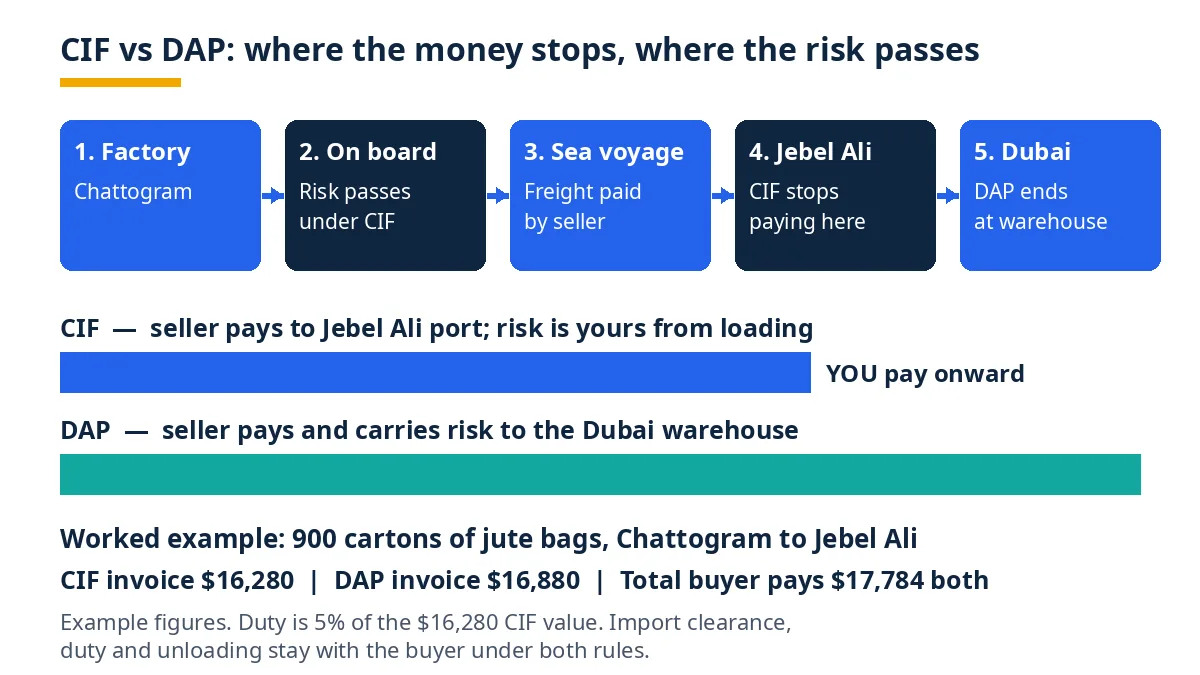
Under CIF, whether you or the seller pays the unloading and quay charges depends on the contract of carriage, so settle that point in writing before the vessel sails.2 A DAP price is therefore higher than a CIF price for the same goods: it contains the handling and the road leg that the CIF price leaves out.
Where risk passes, and why CIF splits cost from risk
Delivery and risk pass at the same point under both rules, but the points sit at opposite ends of the journey. Under CIF, the seller delivers the goods when they are loaded on board at Chattogram, and the risk passes to you at that moment, even though the seller keeps paying the freight and the insurance to Jebel Ali.1 2 Under DAP, the seller delivers when the goods are placed at your disposal at the named place, ready for unloading, and the risk passes to you only then.1
That split defines the C group, the group CIF belongs to: the seller pays the carriage to the destination but hands the risk to the buyer much earlier, at origin. In the D group, cost and risk travel together to the destination.1 Incoterms 2020 has been in force since 1 January 2020.4
Under CIF, if the container is damaged or lost at sea after loading, the loss is yours, and your claim is against the insurer, not the seller.3 Under DAP, if the same container is damaged at sea or on the road to Dubai, the loss is the seller's, because the risk has not yet passed to you.1
Insurance: the one clause only CIF carries
Insurance is the hinge this pair turns on. Under CIF, the seller must obtain insurance that meets Institute Cargo Clauses (C), the minimum level of cover, for at least 110 percent of the contract value, in the currency of the contract, from the port of shipment to at least the named port.3 2 The seller buys the policy, but you are the beneficiary, and you claim directly from the insurer.2
Clause (C) is a short list of named perils. It covers major casualties such as fire, explosion, vessel sinking, grounding and collision, and it does not cover theft, water damage from heavy weather and handling damage.2 If the goods need broader cover, agree Institute Cargo Clauses (A) in the contract.2
Under DAP, no party is obliged to insure the goods.3 The seller carries the transit risk, so it usually insures at its own cost, but the rule itself does not require a policy, and it does not name a clause level or a sum insured. If the cargo is worth protecting, write the cover into the contract: the clause level, the sum insured and who pays the premium. Under CIF, you hold the risk from loading but you did not choose the carrier, the route or the insurer. The seller chooses all three.2
Which documents does each term hand you?
Under CIF, the seller must deliver the commercial invoice, the insurance policy or certificate, and an on-board bill of lading, because without those documents you cannot take delivery, clear customs or file an insurance claim.2 Ask for the insurance document before the vessel sails, and check the insured value, the clause level and the voyage it covers.2
Under DAP, the seller's transport document runs to the named place, and the delivery proof is the handover record at that place. The seller still provides the commercial invoice and the packing list, because you need them to clear the goods for import. Where payment is by letter of credit, a credit covering a sea shipment frequently requires an on-board bill of lading, which CIF produces as a matter of course.3 Under DAP, confirm with your bank what transport document the credit will accept. Incoterms say nothing about the price of the goods, the payment method, or when legal ownership passes to the buyer.1 Write the term in full, with the exact port or the full warehouse address, never a country name alone.3
Worked example: jute bags from Chattogram to Jebel Ali
Example figures. A buyer in the United Arab Emirates orders 900 cartons of jute bags from a supplier in Chattogram, goods worth $14,000. The CIF named port is Jebel Ali; the DAP named place is the buyer's warehouse in Dubai. The duty rate is an illustrative 5 percent of the CIF value.
Cost line | Under CIF | Under DAP |
|---|---|---|
Goods, packing, inland transport, export clearance | $14,000 | $14,000 |
Ocean freight, Chattogram to Jebel Ali | $2,100 (seller) | $2,100 (seller) |
Minimum marine insurance | $180 (seller) | $180 (seller) |
Terminal handling at Jebel Ali | $260 (buyer) | $260 (seller) |
Road carriage, Jebel Ali to Dubai | $340 (buyer) | $340 (seller) |
Import duty, 5% of the $16,280 CIF value | $814 (buyer) | $814 (buyer) |
Unloading at the Dubai warehouse | $90 (buyer) | $90 (buyer) |
Total the buyer pays | $17,784 | $17,784 |
Both columns land on $17,784, because the same legs are priced once on each side and only the payer changes. Under CIF the seller's invoice is $16,280 and you pay the other $1,504: handling $260, road carriage $340, duty $814 and unloading $90. Under DAP the seller's invoice is $16,880 and you pay the remaining $904: duty $814 and unloading $90. The gap between the two invoices is $600, the handling and the road carriage that move to the seller's side under DAP.
The duty line uses a CIF value of $16,280, the goods at $14,000 plus freight at $2,100 plus insurance at $180, at 5 percent, giving $814. The minimum sum insured under CIF is 110 percent of the $14,000 contract price, or $15,400.3 2 The totals match, so the decision is about who carries the voyage risk.
What stays with you under both rules
The two rules part company on reach, risk and insurance, but they agree on the border. Under both, the seller clears the goods for export and you clear them for import, pay the duty and the taxes, and act as the importer of record.1 3 You need your import registration, your customs broker and your duty budget in place before the vessel sails. Unloading is the second shared job: under DAP the goods reach you still loaded on the arriving vehicle, and you arrange the crew and the dock time, at your cost.1
A decision rule: four questions before you sign
Choose CIF when the cargo loads directly on board at Chattogram, the destination is a port you already work with, and you want a named insurance policy inside the price. It fits bulk or break-bulk cargo.2
Choose DAP when the destination sits inland from the port and you want one delivered price at your warehouse, with the seller carrying the risk until the truck arrives. It fits a first order from a new supplier and an occasional buyer with no forwarder of its own.3
Ask four questions before you sign. Does the mode match the journey. Who carries the risk on the longest leg, and is there a policy behind it. Can you act as the importer of record. Have you priced both terms to your warehouse on the same basis. If the answer to the third question is no, ask for DDP, under which the seller clears import and pays the duty, or bring in a broker first.3
FAQs
Is CIF cheaper than DAP?
Not on the same shipment. The CIF seller price is lower because it stops at the port; the DAP seller price is higher because it runs to your warehouse. In the worked example, both cost the buyer $17,784 in total.
Does CIF insurance cover the whole journey to my warehouse?
No. The seller must buy cover from the port of shipment to at least the named port, at Clause (C) minimum level for at least 110 percent of the contract value.3 2 The road leg to your warehouse sits outside that cover unless the policy is extended in writing.
Can I use CIF for air freight or for a container handed to a terminal?
No. CIF is sea and inland waterway only.2 For air freight, use CIP. For a container handed to a carrier at a terminal, DAP or another any-mode rule matches the handover.
Next steps on Exportain
Start with the eleven-rule Incoterms table to see all eleven rules in one place, then open the CIF rule in full, or FOB vs DAP and CFR vs DAP to compare the same delivered-price question from other starting points. Once you have picked a term, browse Bangladeshi suppliers and send an RFQ that states the rule, the port or place, and the Incoterms 2020 edition.
Sources
- Incoterms 2020 Explained: Complete Guide (2026 Update). Inecta (accessed )
- CIF Incoterm Explained: 7 Critical Rules Every Importer and Exporter Must Know in 2026. ejet (accessed )
- FOB, CIF or DDP? Incoterms 2020 for importers. NovaLink, (accessed )
- Incoterms® rules. International Chamber of Commerce (ICC) (accessed )
About the author
Sourcing from Bangladesh?
Post a request for quotation and suppliers on Exportain can send you their quotes directly.
Post an RFQ