CFR vs DAP: Key Differences, Costs and Which One to Choose
CFR stops at Hamburg port; DAP carries the goods to a warehouse in Munich. Follow one knitwear shipment and see who pays for each leg, where the risk passes, and which rule fits your order.
Short answer
CFR and DAP both make the seller pay the carriage, but they end in different places. Under CFR the seller pays ocean freight to the named port of destination, while the risk passes to the buyer when the goods are loaded on board at Chattogram. Under DAP the seller pays carriage to a named inland place and carries the risk until the goods arrive there ready for unloading. Import clearance and duty stay with the buyer under both rules.
On this page
Key takeaways
CFR ends at the named port of destination; DAP ends at a named inland place such as the buyer's warehouse.
Under CFR risk passes when the goods are loaded on board at Chattogram; under DAP it passes at the named place, ready for unloading.
The seller pays ocean freight under both rules; the handling, road carriage and insurance are what move between the two prices.
Import clearance, duty and unloading stay with the buyer under both rules; DAP is not duty-paid.
A buyer in Munich asks a Dhaka supplier for knitwear on two terms. One quotation reads CFR Hamburg, the other reads DAP Munich warehouse. The goods, the vessel and the sailing are the same, so the gap between the two prices is the road from Hamburg to Munich, the handling at the Hamburg terminal, and who carries the risk while the cartons travel that last stretch. This article follows that stretch leg by leg, so you can see what each price contains.
How far does each rule carry the goods?
CFR is one of the four sea and inland waterway rules; DAP is one of the seven rules that apply to any mode, alone or combined.1 That split decides how far the seller's carriage runs. Under CFR the seller pays the ocean freight to the named port of destination, and the payment stops at the port.1 Under DAP the seller pays the carriage to the named place, and that place can be a port, a terminal, a warehouse or a distribution centre.2 The named place under DAP sits on the buyer's side, while the named destination under CFR may or may not be in the buyer's country.3
On a Chattogram to Munich shipment the difference is concrete. A CFR Hamburg price covers the goods, the packing, the inland transport to Chattogram, the export clearance and the ocean freight to Hamburg port, but not the truck from Hamburg to Munich, because that leg sits beyond the port where the seller's carriage ends. A DAP Munich warehouse price covers the same ocean freight and keeps going: the terminal handling at Hamburg and the road carriage to the warehouse sit inside the seller's carriage, because the named place is the warehouse itself. Under DAP the seller arranges that onward carriage; under CFR it sits with the buyer.3
The diagram below traces the five stages of that journey and marks where each rule stops paying.
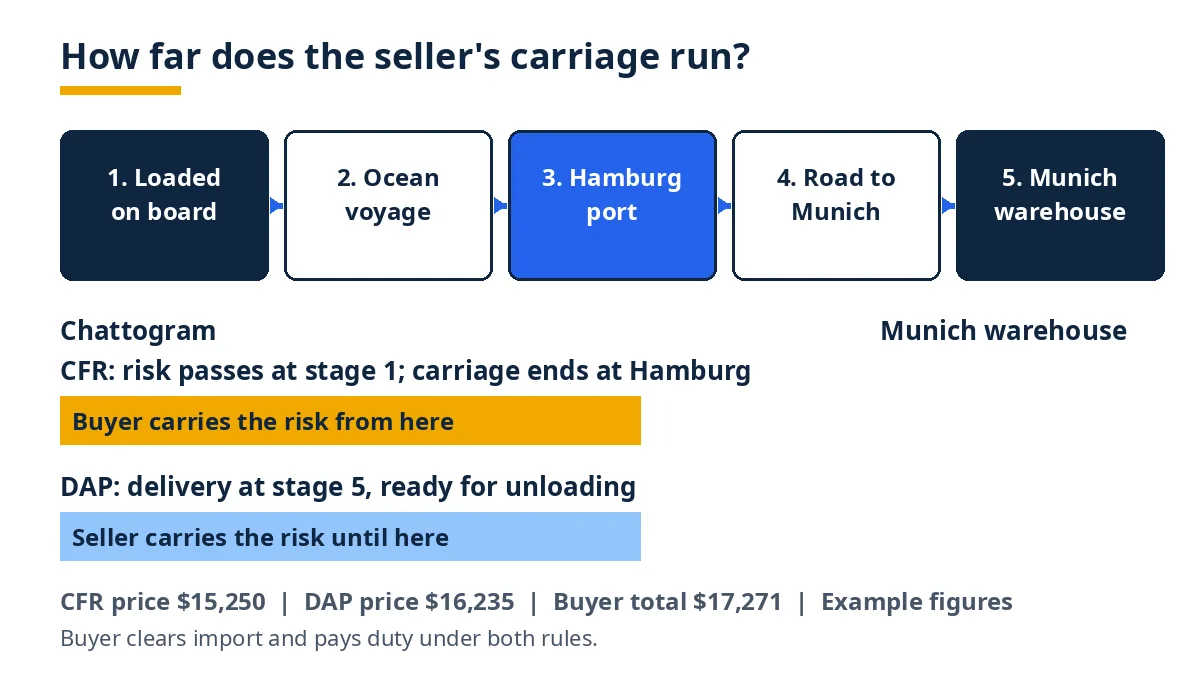
The named place deserves exact wording. A vague destination is the most common failure under DAP: writing "DAP Munich" without a street address leaves the seller free to choose any delivery point inside the city that suits its carrier contract, and a drop at an outlying rail ramp still counts as delivery.4 Write the full warehouse address into the contract, in the form "DAP Musterstrasse 12, 80331 Munich, Germany, Incoterms 2020", and name the port on the CFR side too: "CFR Hamburg, Incoterms 2020", not "CFR Germany". Incoterms 2020 is the current edition, in force since 1 January 2020.1
Where does the risk change hands?
Reach and risk do not move together under CFR. Under CFR the risk passes to you when the goods are loaded on board the vessel at the port of shipment, even though the seller keeps paying the freight all the way to Hamburg.5 The seller's carriage runs to the destination port, but the seller's risk ends at Chattogram. If the container is damaged or lost at sea, the loss falls on the policy you arranged, not on the seller.
Under DAP the two move together. Delivery and risk transfer happen at the named place of destination, when the goods are placed at your disposal on the arriving vehicle, ready for unloading.2 The seller bears the cost and the risk for the whole journey, and the risk only becomes yours when the truck is standing at the warehouse door with the goods still loaded. Even if the goods have already reached Hamburg, the seller keeps bearing the risk until the shipment arrives at the exact agreed place.2
On a CFR Hamburg purchase you carry the risk from loading at Chattogram, across the sea voyage and the Hamburg terminal, and on the road to Munich, because the road leg is your carriage. On a DAP Munich warehouse purchase the seller carries it across the same sea voyage and road leg, and you take it over only when the truck arrives ready for unloading. Our Incoterms guide for shipments from Bangladesh sets out all eleven rules in one table, with the delivery point and the risk point side by side.
Who pays for each leg of the journey?
The table below prices the same shipment twice, once on each rule. Every leg is paid by someone, and the rule only decides who.
Leg of the journey | CFR Hamburg | DAP Munich warehouse |
|---|---|---|
Goods, packing, export clearance | Seller | Seller |
Inland transport to Chattogram | Seller | Seller |
Ocean freight, Chattogram to Hamburg | Seller | Seller |
Terminal handling at Hamburg | Buyer | Seller |
Road carriage, Hamburg to Munich | Buyer | Seller |
Import clearance and duty | Buyer | Buyer |
Unloading at the Munich warehouse | Buyer | Buyer |
Cargo insurance | Buyer arranges its own cover | Neither party must insure; the seller usually insures its own risk |
Three lines in that table do most of the work. First, the ocean freight sits with the seller under both rules, so the difference between the prices is the handling, the road carriage and the insurance, not the freight.3 Second, import clearance and duty stay with you under both rules: DAP is a delivered price, not a duty-paid price, and the rule that moves clearance and duty to the seller is DDP.2 Third, unloading stays with you under both rules, at your cost and risk, and only DPU makes the seller unload.4
Insurance takes one line, because neither rule obliges anyone to buy it. Under CFR you arrange cover from the moment of loading at Chattogram, since the risk is yours from that point. Under DAP the seller bears the transit risk yet has no duty to insure, so confirm the cover in writing or buy a contingency policy of your own.6 CFR sits in the "C" group, where the seller keeps paying carriage after the risk has already moved, while DAP sits in the "D" group, where cost and risk travel together to the destination.1
Worked example: knitwear from Chattogram to a warehouse in Munich
Example figures. A buyer in Munich orders 600 cartons of cotton knitwear from a supplier in Dhaka, goods worth $12,800, shipped in one container from Chattogram to Hamburg by sea and then by road to the Munich warehouse. The figures are illustrative. The CFR named port is Hamburg; the DAP named place is the Munich warehouse.
Cost line | Under CFR | Under DAP |
|---|---|---|
Goods, packing, export clearance | $12,800, in the CFR price | $12,800, in the DAP price |
Ocean freight, Chattogram to Hamburg | $2,450, paid by the seller | $2,450, paid by the seller |
Terminal handling at Hamburg | $280, paid by the buyer | $280, paid by the seller |
Road carriage, Hamburg to Munich | $520, paid by the buyer | $520, paid by the seller |
Cargo insurance | $185, paid by the buyer | $185, paid by the seller |
Import duty, 6% of the $15,435 CIF value | $926, paid by the buyer | $926, paid by the buyer |
Unloading at the Munich warehouse | $110, paid by the buyer | $110, paid by the buyer |
Total the buyer pays | $17,271 | $17,271 |
The two totals match because the same legs are priced once on each side. The CFR invoice is $15,250, the goods at $12,800 plus the ocean freight at $2,450, and you pay the other $2,021 yourself: handling $280, road carriage $520, insurance $185, duty $926 and unloading $110. The DAP invoice is $16,235, the goods plus freight, handling, road carriage and insurance, and you pay the remaining $1,036 yourself: duty $926 and unloading $110. The gap between the two invoices is $985, exactly the handling, road carriage and insurance that move to the seller's side under DAP.
Duty in this example is 6% of the $15,435 CIF value, which is the goods at $12,800 plus the ocean freight at $2,450 plus the insurance at $185, giving $926.10, rounded to $926. The valuation basis differs by importing country, so check it with a customs broker before you settle the term. Price both terms to your warehouse on the same sailing window.
What stays with you under both rules: customs and unloading
The two rules part company on reach and risk, but they agree on the border. Under both, the seller clears the goods for export and the buyer clears them for import, pays the duty and the taxes, and acts as the importer of record.2 5 You need your import registration, your customs broker and your duty budget in place before the vessel sails, whichever rule you choose. A DAP shipment that reaches Munich still cannot leave the port until you have cleared it, and the risk may move to you from the agreed delivery date if your clearance failure holds the goods up.2 You also bear the extra costs of that delay, including demurrage and detention.4
Unloading is the second shared job. Under DAP the goods reach you still loaded on the arriving vehicle, and you arrange the crew, the forklift and the dock time, at your cost and risk.2 The same applies under CFR once the goods reach your warehouse, since the road leg and the unloading are both yours. Book the unloading crew for the delivery day, because a missed forklift booking becomes your delay, not the seller's.
Which rule fits your order?
Choose CFR when the cargo loads directly onto the vessel and the destination is a port you already work with. It fits bulk cargo loaded straight on board at Chattogram, a buyer that holds its own ocean freight rates, and a buyer that groups orders from several suppliers under one freight booking. The trade is control: you book the freight, you choose the sailing, and you carry the risk from loading. Our CFR vs CPT comparison covers the case where the seller pays carriage but the delivery point sits at origin, and FOB vs DAP covers the case where the buyer pays the freight instead.
Choose DAP when the destination sits inland from the port and you want one delivered price at your warehouse. It fits a first order from a new supplier, an occasional buyer with no freight forwarder of its own, and a buyer that wants the seller to carry the transit risk until the truck arrives. The trade is the opposite one: you give up control of the freight and the sailing, and you pay for that service inside the DAP price.
Neither rule works if you cannot act as the importer of record at destination, because the goods will arrive at the named place and still cannot clear customs.2 In that case ask for DDP, where the seller clears the goods for import and pays the duty, or bring in a local customs broker first.
Next steps on Exportain
Start from the destination, then ask for the term that fits it: CFR only when the port is the end of the journey you need, and DAP when the journey has to reach your warehouse. When you are ready to get prices, search Bangladeshi suppliers, then post an RFQ with the rule, the named place and the edition written into the requirement. Our how to buy page walks through the steps once you have ordered.
Sources
- Incoterms 2020 Explained: All 11 Rules, Chart & Meaning. Xflowpay (accessed )
- DAP Delivered at Place: Definition, Costs & Responsibilities. DHL (accessed )
- DAP and CFR under Inco terms 2020. HowToExportImport, (accessed )
- DAP Incoterms Guide: Delivered At Place Rules 2020. Soleil Transportation (accessed )
- Incoterms 2020 Chart: All 11 Rules Explained. Airlift USA (accessed )
- What Are DAP Incoterms? Delivered at Place Explained. LegalClarity (accessed )
About the author
Sourcing from Bangladesh?
Post a request for quotation and suppliers on Exportain can send you their quotes directly.
Post an RFQ