Typical MOQ for Jute Yarn in Bangladesh (and How to Negotiate It Down)
A mill quotes 5 MT when you need 2 MT. Learn what sets a jute yarn MOQ in Bangladesh, the bands by count and order type, and seven levers to negotiate it down in writing.
Short answer
A jute yarn MOQ in Bangladesh is set per count, per colour and per order by each mill, so there is no single published figure. Typical enquiry bands run about 1 to 5 metric tonnes per count. Mills set the floor from the fibre batch, the spinning setup, the dye lot and the packing. Negotiate it down by consolidating counts, sharing a production run, accepting standard packing, committing to repeat orders, or paying a higher trial price.
On this page
Key takeaways
Each mill sets its own MOQ per count, per colour and per order; there is no published standard for jute yarn.
The floor comes from the fibre batch, the spinning setup, the dye lot per colour and the packing.
Typical enquiry bands run about 1 to 5 MT per count, with dyed colours counted per colour, not per order.
Consolidate counts, share a production run, accept standard packing, commit to repeat orders, or pay a higher trial price to bring the minimum down.
A mill quotes a 5 metric tonne minimum for a jute yarn you only need 2 tonnes of. The number is not a refusal. It is the mill's answer to its own setup, batch and packing costs, and it moves when you change the order behind it.
Why a jute mill sets a minimum at all
A minimum order quantity is the smallest quantity a supplier will sell in a single order, and it exists because a production run carries fixed setup costs that must be spread across a minimum number of units. Ask the mill to separate its minimums in writing: an order minimum, a per-count minimum, a material minimum, a dyeing minimum, and a packing minimum may all sit underneath the one number.1
The first driver is the count. Jute yarn is quoted by weight per length, in lb per spyndle and in tex, and a mill sets its batch, carding and draft for the count. A mill that runs your count already can accept a smaller order.
The second driver is the fibre batch. In jute spinning, a batch is a number of bales suitable for handling in the batching department, commonly 5 to 10 bales, made up of one grade or a blend of grades.2 A small order that needs its own batch still consumes a whole batch of fibre.
The third driver is the dyeing lot, where the order is coloured. Dye houses do not dye less than roughly 100 to 200 kilos per dye lot, because every dye bath means mounting and cleaning the machine whatever the volume, and buying below that minimum raises the cost of each unit by 15 to 35 percent.3
The fourth driver is packing. A mill that packs your yarn in its standard cone and case sizes can run a smaller order than one that must buy printed cartons for your order alone. Custom printed packaging carries its own supplier minimum.1
The fifth driver is commercial rather than physical. Others are economic: the mill can spin the smaller quantity, but the order does not recover setup time at the quoted unit price.1 The quoted minimum is often the mill's preferred volume, not its actual floor: the real minimum is often 30 to 60 percent below the quoted one.4
What the MOQ bands look like by count and order type
There is no published standard MOQ for jute yarn. Each mill sets its own floor per count, colour and order type, so the bands below are indicative enquiry bands, labelled example figures. Confirm the binding minimum with each mill in writing. The trade behind them is large: the Export Promotion Bureau has set jute and jute goods exports at 1.017 billion dollars for 2026-27, with jute yarn and twine projected to contribute 620 million dollars.5
Order type | Count and finish | Indicative band per count | What usually sets it |
|---|---|---|---|
Repeat run | Single natural, coarse 8 to 10.25 lb per spyndle | 2 to 5 MT | Setup done, batch running |
Repeat run | Single natural, medium 7 to 8.5 lb per spyndle | 1 to 3 MT | Batch and frame settings in place |
First order, new count | Single natural, any count | 3 to 5 MT | New batch, settings, sample cone |
Fine count | Single natural, 5 lb per spyndle (173 tex) | 1 to 2 MT | Fine spinning is slower |
Dyed, one colour | Dyed, one colour, single or plied | 2 to 5 MT per colour | Dye lot on top of spinning minimum |
Dyed, three colours | Dyed, three colours | 2 to 5 MT per colour, not per order | Each colour needs its own dye lot |
Plied or cabled | Two or more strands twisted together | 2 to 4 MT per ply construction | Extra twisting step |
Trial order | Single natural, standard cones and cases | 1 to 2 MT | Smaller first run, repeat committed |
A coarse sacking yarn at 10.25 lb per spyndle spins fast on frames built for heavy counts, so a mill already running that count can add a 2 tonne order to a scheduled run. A fine 5 lb per spyndle yarn, which is 173 tex, spins on apron draft flyer frames, and research on fine jute yarn of 103 tex shows output rising to 208 grams per spindle hour at 8,000 rpm.6
The dyed rows are where buyers most often misread a quotation: a mill that quotes 2 MT for a dyed order may mean 2 MT per colour, so three colours turn the order into 6 MT. Ask in writing whether the minimum is per order, per count, per colour or per production run. A trial order validates quality and demand, and a supplier that sees a path to repeat business is more likely to accept one at a higher per-unit price.7
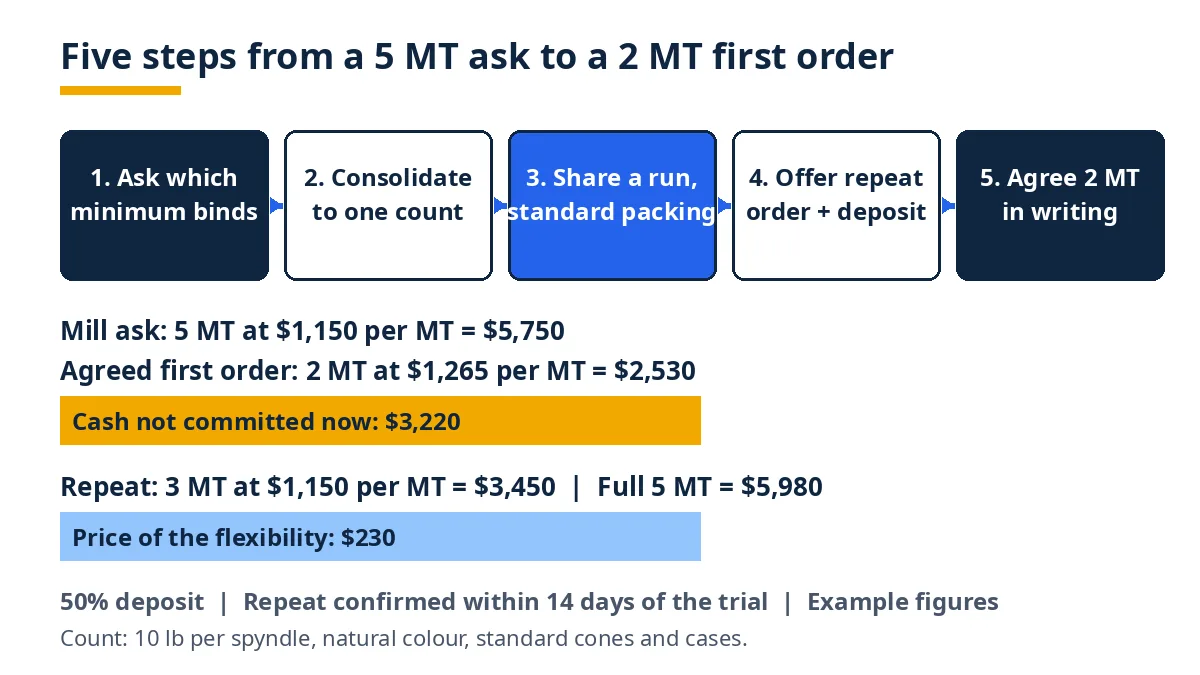
The diagram below sets out the negotiation in five steps.
Seven levers that move a jute yarn MOQ
A lower number follows from changing what creates the minimum, not from asking for a favour. Use the levers one at a time, and get each agreed point in writing.
1. Consolidate counts
Cut the number of counts before you cut the quantity. Each extra count is a new batch, a new frame setting and a new sample cone, so two counts at 2 MT each clear a higher floor than one count at 4 MT.1
2. Share a production run
Ask whether the mill has a run of your count scheduled in the next four to six weeks that your order can join. The mill can add your units to a run already set up, with little extra setup cost.4 The trade is timing: your yarn ships when the main run ships.
3. Accept standard packing and standard colour
Drop the custom requirements first. Standard packing, the mill's existing cone and case with your label, removes the packing supplier's minimum, and a standard colour removes a dye lot.4
4. Commit to repeat orders in writing
Offer the volume in writing but stagger the production: a larger total over six months, with the first small batch shipped now and the remainder produced as you sell through. That gives the mill volume certainty while you pay for yarn as you use it.4 Suppliers lower the MOQ more readily for a first order with a clear repeat plan behind it.7
5. Offer better payment terms
Cash-flow risk is one reason a mill holds its minimum high. A buyer that pays a larger deposit, or pays in full upfront, removes the risk that the mill spins yarn nobody collects. Offering 50 percent or even 100 percent prepayment can lower the MOQ, because it signals serious intent and covers the mill's material cost.7 Some mills will drop the minimum by 30 to 50 percent for full upfront payment, though the tactic only belongs with a mill you have already checked.4 Never pay in full upfront to a mill you have not verified, using our jute yarn manufacturers guide.
6. Time the order for the off-season
Ask when the mill's frames are quiet: a mill with a gap in its schedule can take a smaller run to keep frames turning, and a flexible production window may trade for a lower minimum.1
7. Pay the setup separately and accept a higher unit price
The simplest negotiation is to absorb the small-run premium: pay the batch and setup work as a separate line, or accept a higher per-tonne price for the trial quantity, so the mill recovers its fixed work without spreading it across tonnes you do not need. The fee is itemised, so the same setup serves the repeat order without being charged twice.1 A 25 percent premium for a much smaller first commitment is often the right trade.4
Worked example: negotiating a 5 MT ask down to a 2 MT first order
Example figures. A buyer needs single jute yarn at 10 lb per spyndle, natural colour, on standard cones, for a weaving trial. The mill quotes a 5 MT minimum at 1,150 dollars per MT. The buyer needs 2 MT for the trial and wants the remaining 3 MT only if the trial weaves well.
The buyer asks which minimum binds. The mill answers that the floor comes from a new batch for 10 lb per spyndle yarn, with no dye lot because the yarn is natural. The buyer consolidates to that one count, and the mill adds the 2 MT to a scheduled run, which removes the setup charge.
Line | Original ask | Agreed first order |
|---|---|---|
Quantity | 5 MT | 2 MT |
Unit price | 1,150 dollars per MT | 1,265 dollars per MT, a 10 percent trial premium |
Goods value | 5,750 dollars | 2,530 dollars |
Setup charge | Included in the unit price | 0 dollars, absorbed by the shared run |
Cash committed now | 5,750 dollars | 2,530 dollars |
Repeat commitment | None stated | 3 MT within 90 days at 1,150 dollars per MT, if the trial passes |
The first order is 2 MT at 1,265 dollars, which is 2,530 dollars. The premium is 115 dollars per MT, which is 10 percent of 1,150 dollars. The cash the buyer does not commit now is 5,750 dollars minus 2,530 dollars, which is 3,220 dollars. The repeat order, if the trial passes, is 3 MT at 1,150 dollars, which is 3,450 dollars. The full 5 MT programme then costs 2,530 dollars plus 3,450 dollars, which is 5,980 dollars, against 5,750 dollars for the original ask: 230 dollars for the flexibility.
The buyer also agrees to pay a 50 percent deposit and to confirm the repeat within 14 days of the trial weaving result. The mill writes the 2 MT quantity, the 1,265 dollar trial price and the 3 MT repeat at 1,150 dollars into the proforma invoice. If the trial fails, the buyer holds 2 MT of usable yarn instead of 5 MT, and the repeat never triggers.
What to put in the order
Once the lower MOQ is agreed, lock it in. The order should specify the agreed quantity and unit price, whether the price is a first-order trial rate or a permanent rate, the trade-offs accepted, the lead time and shipping terms, and all quality criteria as for any other order.4 Get the negotiated MOQ in the proforma invoice and the order text. Record any agreed lower minimum on the quotation and the purchase order, with the count split it applies to.
Write the count in both units, with single or plied construction, colour, put-up and packing stated. Name the test methods for count, twist and strength, and judge every lab result against your order value only, using the checks in our jute yarn quality control checklist. State the HS code on the invoice and confirm it with your broker; single yarn and multiple or cabled yarn sit under different six-digit subheadings, as our HS code guide for jute yarn sets out. Keep the approved sample cone sealed as the reference for the bulk lot.
Next steps on Exportain
Start by confirming the mill spins your count, using our jute yarn manufacturers guide, then set the count, twist and strength tests with our jute yarn quality control checklist and check the classification in our HS code guide for jute yarn. When you are ready to ask for prices, search Bangladeshi suppliers and compare replies to the same specification, then post an RFQ with the count in both units and the quantity per count. Our how to buy page walks through the steps.
Sources
- How to Negotiate a Lower MOQ With Chinese Suppliers. Oceanportlink (accessed )
- The Jute Industry: from Seed to Finished Cloth. BookRags (accessed )
- How many units to produce: calculating clothing MOQ. GAT (accessed )
- How to Negotiate MOQ with Chinese Factories — 9 Working Tactics. Quality Sourcing From China, (accessed )
- EPB charts $66b export roadmap for FY27. The Financial Express (accessed )
- Effect of Spindle Speed on Textile Properties and Productivity of Fine Jute Yarn. Daffodil International University Journal of Science and Technology (accessed )
- MOQ Tips for Small Buyers: Negotiate & Reduce Minimum Orders. Yellowbees, (accessed )
About the author
Sourcing from Bangladesh?
Post a request for quotation and suppliers on Exportain can send you their quotes directly.
Post an RFQ