Power Transformers From Bangladesh to Canada: A Buyer's Import Checklist
Twelve checks in four stages for a Canadian power transformer import from Bangladesh: specification and CSA approval, CARM registration, tariff and GST, bilingual labelling, and clearance at Montreal or Vancouver, with a costed 500 kVA example to Toronto.
Short answer
To import a power transformer from Bangladesh to Canada, register in the CARM Client Portal with a BN9 and RM number, classify the unit under heading 8504, confirm the duty rate with a broker, and settle the CSA approval route before production: certification to CSA C88 by a Standards Council of Canada accredited body, or field evaluation under CSA SPE-1000. GST of 5% applies on the value of the goods including duty, and the unit clears at Montreal or Vancouver.
On this page
Key takeaways
Register in the CARM Client Portal with a BN9 and RM number before the first shipment; a broker cannot register your business for you.
A unit is approved in Canada by certification to CSA C88 from a Standards Council of Canada accredited body, or by field evaluation under CSA SPE-1000.
GST of 5% applies on the value of the goods including any duty, and is collected when the goods go through customs.
For Toronto, clear at Montreal; for a western site, clear at Vancouver, and confirm the heavy lift before the vessel sails.
A power transformer ordered from Bangladesh for a Canadian site passes through four gates: the specification and approval route in Canada, the build and export file in Bangladesh, the border file at the Canadian port, and the receiving tests at the site. Every check below names the document or confirmation that closes it.
How this checklist works
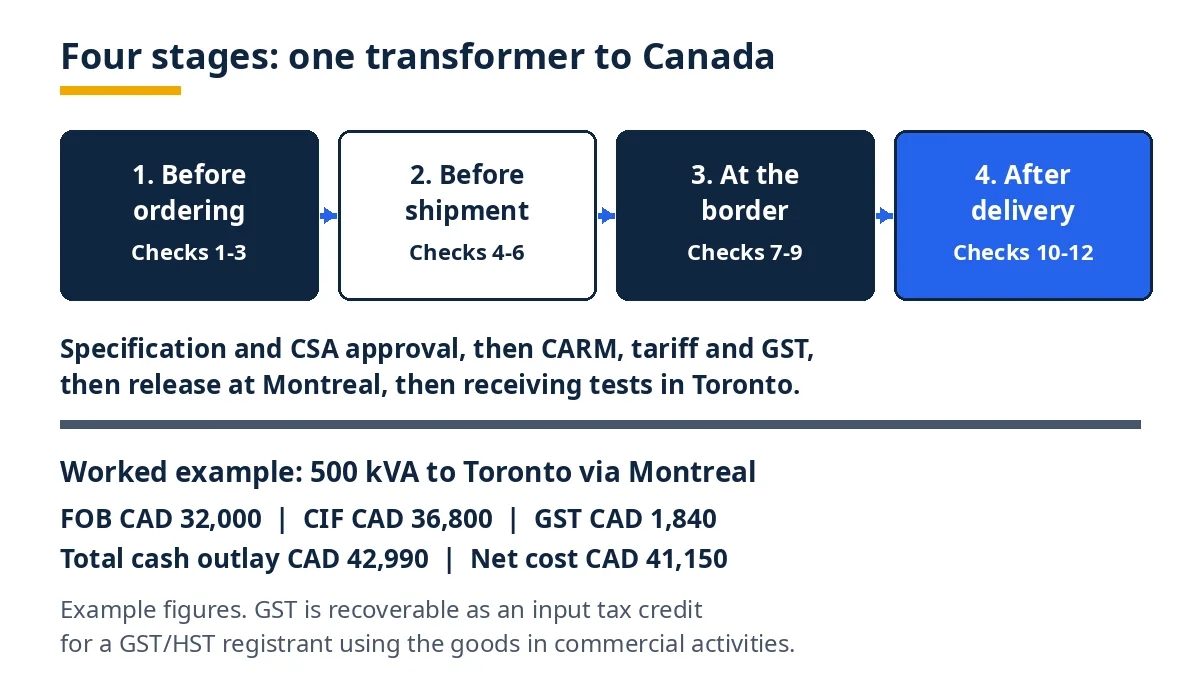
The four stages follow the order of the order itself. A stage is finished only when you hold the evidence its checks name. Figures in the worked example are labelled as example figures. The diagram below shows the four stages and the worked-example totals for one 500 kVA unit to Toronto.
Stage 1: Before ordering — write the specification and the approval route
Check 1: Write the specification and check the supplier
List every rating before you contact a supplier: kVA, voltages, frequency, vector group, impedance and tolerance, tap range and changer type, cooling method, guaranteed losses, insulation levels, and fittings. Ask each maker to reply in the same format. Shortlist makers whose range covers the size and type, and check trade licence and export registration, with the same name, address and bank account on each; the Export Registration Certificate (ERC) is issued by the Chief Controller of Imports and Exports.1 Ask for the design pack before production and sign off in writing.
Check 2: Settle the approval route, the CSA standard and the authority
In Canada, electrical equipment used in an installation must be approved, and of a kind, type and rating approved for the purpose for which it is used, under Rule 2-024 of the Canadian Electrical Code, Part I (CSA C22.1).2 Equipment is approved when it is certified by a Standards Council of Canada accredited body, or field-evaluated under CSA SPE-1000, or otherwise accepted by the authority having jurisdiction.2 A factory test report, a CE marking, or a United States certification does not by itself make a unit approved in Canada.2 For liquid-filled power transformers the standard is CSA C88. Ask for the Canada-recognised mark on the nameplate: cULus, cETLus, the CSA mark or the ULC mark. A United States only UL Listed mark, with no "c" indicator, is not accepted in Canada.2 The authority is provincial: the Electrical Safety Authority (ESA) in Ontario, Technical Safety BC in British Columbia, and the Régie du bâtiment du Québec (RBQ) in Québec.2
Check 3: Write in the cold climate, then register in CARM
Put the site conditions in the specification as numbers: lowest ambient temperature, oil behaviour at that temperature, and cold-weather tap changer and bushing operation. Register the business in the CARM Client Portal before the first shipment: CARM is the official system of record for the collection of duties and taxes on commercial imports.3 A business needs a nine-digit business number (BN9) from the Canada Revenue Agency and an import-export program account, the RM number, such as RM0001.3 Importers must register their own business in the portal; customs brokers cannot register a client's business on their behalf.3 Once registered, delegate authority to the broker in the portal.
Stage 2: Before shipment — settle the border file while the unit is built
Check 4: Classify each rating and price the duty and GST together
Power transformers sit under heading 8504, and the six-digit subheading follows the cooling medium and the power handling capacity: liquid dielectric transformers take 8504.21 where the capacity does not exceed 650 kVA, 8504.22 where it exceeds 650 kVA but does not exceed 10,000 kVA, and 8504.23 where it exceeds 10,000 kVA, while other transformers above 500 kVA take 8504.34.4 Put each rating on its own invoice line. Our HS code guide for power transformers explains the cooling-medium and kVA-band split in full. Read the duty rate beside your confirmed national code for Bangladesh as the origin and the entry date: the most-favoured-nation duty shown for tariff item 8504.23.00 is Free, as checked on 8 November 2026.5 Imports are generally subject to 5% GST, collected at customs on the value of the goods including any applicable customs duties.6 A GST/HST registrant can claim an input tax credit for GST paid on imports used in commercial activities.6
Check 5: Fix the port, the heavy lift, the delivery terms and the insurance
Name the entry port in the order and the freight booking. The Port of Vancouver is Canada's largest port, handling 3.5 million TEUs and 146 million tonnes of cargo.7 The Port of Montreal, the eastern container hub, handles 1.7 million TEUs and 36 million tonnes.7 For Toronto, Montreal is the nearer entry port. A transformer rarely fits a standard container, so it usually travels on a flat rack or as break-bulk cargo. Before the vessel sails, confirm that the sailing can lift the unit as packed and that the onward haul to the site is booked with a vehicle and crane matched to the packed weight. Name the delivery rule with its place in full, write down who books the vessel, who insures the cargo and who clears the goods, and insure the cargo for its full value over the whole route.
Check 6: Settle the bilingual labelling and the Bangladesh export file
Mandatory label information must be shown in English and French, except for the dealer's name and principal place of business, which may appear in either language.8 Products for commercial, industrial or institutional use only are exempt from the Act and Regulations.8 Agree the rating plate, manual, warning labels and test reports in both English and French, and ask your compliance adviser about the French-language rules that apply where the unit will be installed, including in Québec. On the Bangladesh side, the export is declared on the EXP form, an 11-digit number: branch code, Export Register serial number, and year.1 The exporter files the EXP electronically in the Online Export Monitoring System (OEMS) before customs formalities, Customs then issues the Bill of Export, and within 14 days of shipment the exporter gives the bank a signed hard copy of the EXP form with the certified Bill of Export and the shipping documents.1 The invoice must carry the ERC number and HS code.
Stage 3: At the border — release, accounting and payment
Check 7: Confirm the release file is complete
A missing line at the port delays release by days. Check the commercial invoice, packing list, bill of lading, certificate of origin, insurance certificate, routine test report for each serial number, and the approval evidence from Check 2 or the field-evaluation plan from Check 10. The exporter, buyer and bank account names must agree across the quotation, invoice, declaration and payment papers.
Check 8: Account through CARM and check the value for duty
CARM is the official system of record for duties and taxes on commercial imports, managed through the CARM Client Portal.3 The broker files the accounting through the portal, and the duties and taxes are calculated and collected through that system. Ask the broker to send you the filed accounting before the unit is released. Confirm the value for duty in Canadian dollars, and check the duty line against the broker's written confirmation from Check 4.
Check 9: Pay the duty and GST, or use Release Prior to Payment, and keep the file
As a rule, GST on taxable imports is collected when the goods go through customs, and the importer of record pays it.6 Where the business has enrolled in the Release Prior to Payment program, accounting and payment follow release under that program's terms.3 Ask the broker in writing, before the vessel berths, whether this shipment pays at release or under Release Prior to Payment. Keep the broker's accounting, invoice, bill of lading, certificate of origin, test reports and approval evidence in one shipment file.
Stage 4: After delivery — receive, test and energise
Check 10: Receive the unit, test it, and field-evaluate it if it has no Canada-recognised mark
When the unit lands, compare it with the file before you sign: count units against the packing list, match each rating plate to the approved design pack, and record damage on the delivery note at once. Get a routine test report for each serial number, and hold the balance until the reports pass where the contract allows. Our power transformers quality control checklist covers the same evidence. If the unit arrived without a Canada-recognised mark, the route to a legal energisation is field evaluation under CSA SPE-1000: a recognised body inspects and tests the specific units on site, and a unit that passes receives a field-evaluation label the inspector accepts.2
Check 11: Settle the Québec tax position where the unit is delivered there
Where the unit is delivered into Québec, the bringing of property into Québec is generally subject to 9.975% QST.6 A QST registrant bringing property in exclusively for commercial use, where an input tax refund can be claimed, does not have to pay QST on it; otherwise the QST payable must be reported in the return.6 Confirm the position with your tax adviser before the unit crosses into Québec.
Check 12: Get the energisation sign-off in writing
Do not energise the unit until the authority having jurisdiction for the province has accepted the approval evidence. Each jurisdiction adopts the CE Code with local amendments, and the local inspector decides whether the evidence is acceptable.2 Keep the approval evidence and test reports in the installation file for the life of the unit.
Worked example: one 500 kVA transformer to Toronto via Montreal
Example figures. One 500 kVA liquid-filled transformer, FOB Chattogram, shipped to Montreal and delivered onward to Toronto. The unit takes tariff item 8504.21.00, for liquid dielectric transformers not exceeding 650 kVA.4 Duty is shown as $0; the rate shown for tariff item 8504.23.00 is Free, and the broker must confirm the live rate for 8504.21.00 in writing.5
Cost line | Example figures (CAD) |
|---|---|
Product cost, FOB Chattogram | 32,000 |
Freight and insurance to Montreal | 4,800 |
Value for duty | 36,800 |
Customs duty, broker-confirmed rate | 0 |
GST at 5% | 1,840 |
Customs broker fee | 750 |
Montreal port charges | 1,100 |
Delivery to Toronto | 1,600 |
Arrival inspection and testing | 900 |
Total cash outlay | 42,990 |
Check it: 32,000 plus 4,800 is 36,800; 5% of 36,800 is 1,840; 36,800 plus 1,840 is 38,640; 750 plus 1,100 plus 1,600 plus 900 is 4,350; 38,640 plus 4,350 is 42,990. The GST of 1,840 is recoverable as an input tax credit for a GST/HST registrant using the goods in commercial activities, so the net cost excluding recoverable GST is 41,150.6 Replace each line with your own quotations.
What usually goes wrong on a first Canadian order
First, ordering on a factory test report and a CE marking and treating them as Canadian approval, when a Canada-recognised mark or a field-evaluation label is what the inspector accepts.2 Second, pricing on another country's duty rate, when the rate belongs to the exact Canadian line and the entry date.5 Third, forgetting that GST is charged on the value of the goods including any applicable customs duties, and is collected when the goods go through customs.6 Fourth, leaving the heavy lift, the entry port and the authority having jurisdiction until the vessel sails, and shipping English-only paperwork for Québec.
Next steps on Exportain
Start with the specification in Check 1 and the approval route in Check 2, then search Bangladeshi suppliers whose range covers your ratings and post an RFQ with the rating-plate fields, the CSA standard, the tariff line and the test scope in the requirement. See how to buy for the steps once you have ordered, and the general guide to importing power transformers from Bangladesh for the same product with no destination attached.
Sources
- The EXP form, from number to filing cabinet. Open Trade Bangladesh (accessed )
- Transformer approval & certification in Canada. Entogo (accessed )
- Get started with CARM. Canada Border Services Agency (accessed )
- Classification Detail — HS, 2012 - Code 8504. United Nations Statistics Division (accessed )
- Power transformers (85042300): CA customs duty Free. Tariff Radar (accessed )
- Imports of Tangible Personal Property. Revenu Québec (accessed )
- Largest Ports in Canada. Freightos, (accessed )
- Guide to the Consumer Packaging and Labelling Act and Regulations. Competition Bureau Canada, (accessed )
About the author
Sourcing from Bangladesh?
Post a request for quotation and suppliers on Exportain can send you their quotes directly.
Post an RFQ