HS Code for Power Transformers: Classification Guide for Importers
Power transformers sit in heading 8504: liquid dielectric units take 8504.21, 8504.22 or 8504.23 by kVA band, other transformers above 500 kVA take 8504.34, and national codes run to 8-10 digits.
Short answer
Power transformers are classified in heading 8504 by cooling medium and rated kVA. Liquid dielectric transformers take 8504.21 up to 650 kVA, 8504.22 above 650 up to 10,000 kVA, and 8504.23 above 10,000 kVA, while other transformers above 500 kVA take 8504.34. Only the first six digits are shared worldwide, so confirm the full United States, European Union or United Kingdom national code for the destination before filing.
On this page
Key takeaways
Liquid dielectric transformers take 8504.21 up to 650 kVA, 8504.22 above 650 up to 10,000 kVA, and 8504.23 above 10,000 kVA; other transformers above 500 kVA take 8504.34.
Cooling medium is tested before capacity: a dry-type unit above 500 kVA belongs on 8504.34, not on a liquid dielectric line, even at the same kVA rating as a liquid-filled unit.
Band boundaries are literal: a liquid dielectric transformer rated at exactly 650 kVA sits in 8504.21 and one rated at exactly 10,000 kVA sits in 8504.22.
Only the first six digits are shared worldwide: the European Union extends them to eight digits in the Combined Nomenclature, and the United States and United Kingdom carry them to ten.
Parts, static converters and inductors have their own lines at 8504.90, 8504.40 and 8504.50, and chapter 85 note 2 removes goods described in headings 8511, 8512, 8540, 8541 and 8542 from heading 8504.
A power transformer does not carry one HS code for the whole product family. The six-digit line follows two facts from the unit itself: whether it is a liquid dielectric transformer or another type, and its power handling capacity in kVA. Change either fact and the line can change, even when the product name on the quotation stays the same.
The Harmonized System is a multipurpose international product nomenclature developed by the World Customs Organization (WCO), comprising more than 5,000 commodity groups, each identified by a six-digit code, and used by more than 200 countries and economies as a basis for their customs tariffs.1 Heading 8504 covers electrical transformers, static converters and inductors, with parts listed separately.2 This article covers classification only.
Quick answer: indicative HS heading (with verify note)
Power transformers sit in heading 8504. The deciding split is cooling medium first, then kVA band. Liquid dielectric transformers take 8504.21, 8504.22 or 8504.23 by capacity, while other transformers above 500 kVA take 8504.34.2 3
Transformer | Indicative six-digit line | Tariff wording |
|---|---|---|
Liquid dielectric, not exceeding 650 kVA | 8504.21 | Having a power handling capacity not exceeding 650 kVA2 |
Liquid dielectric, exceeding 650 kVA but not exceeding 10,000 kVA | 8504.22 | Having a power handling capacity exceeding 650 kVA but not exceeding 10,000 kVA2 |
Liquid dielectric, exceeding 10,000 kVA | 8504.23 | Having a power handling capacity exceeding 10,000 kVA2 |
Other transformers, exceeding 500 kVA | 8504.34 |
Treat every line above as indicative until the full national code is confirmed for the destination and entry date. The six digits are shared, but each country adds its own digits after them, and the national line is the one the entry is filed on.
How HS codes are structured (2-4-6 digits)
The system is organised in a hierarchy by sections, chapters (2 digits), headings (4 digits) and sub-headings (6 digits).4 For power transformers the chain reads: Chapter 85 for electrical machinery and equipment, heading 8504 for electrical transformers, static converters and inductors, then a six-digit subheading that narrows by transformer type and capacity, for example 8504.21 for a liquid dielectric transformer not exceeding 650 kVA.2
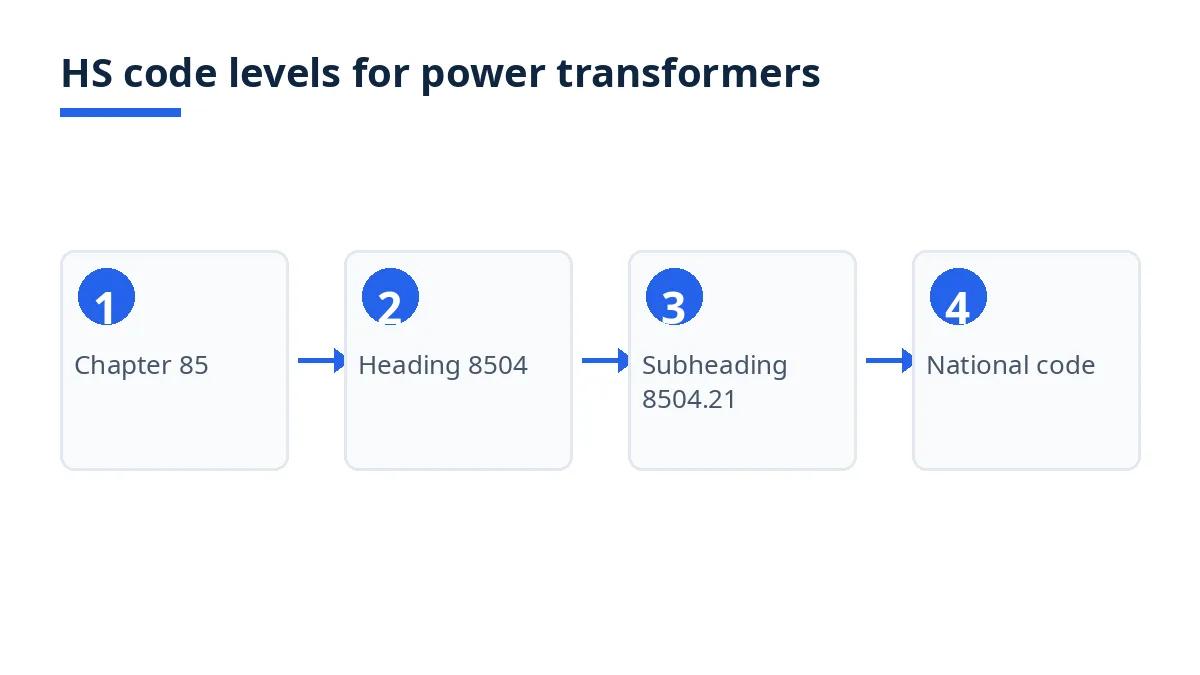
Countries further subdivide the six-digit categories into national subheadings for greater specificity, and the Combined Nomenclature of the European Union uses eight-digit codes.4 The United States and the United Kingdom both carry the code to ten digits on their own schedules.2 3
Factors that decide the code for power transformers
Cooling medium comes first. The tariff separates liquid dielectric transformers from other transformers before it separates by capacity.2 A liquid-filled unit and a dry-type unit of the same kVA rating therefore start on different lines: the liquid-filled unit is tested against 8504.21, 8504.22 or 8504.23, while a dry-type unit above 500 kVA is tested against 8504.34.2 3 Record the cooling medium on the specification, not just the kVA rating, because a quotation that says only "power transformer, 1,000 kVA" does not contain enough information to choose between 8504.22 and 8504.34.
The kVA band is read from the nameplate rating. The bands use exact boundary words: "not exceeding" includes the stated figure, and "exceeding" excludes it.2 A liquid dielectric transformer rated at exactly 650 kVA sits in 8504.21, not 8504.22, and one rated at exactly 10,000 kVA sits in 8504.22, not 8504.23.2 The same boundary logic applies to other transformers: 8504.33 covers other transformers exceeding 16 kVA but not exceeding 500 kVA, so a dry-type unit above 500 kVA moves to 8504.34.2 3
A complete transformer is not its parts. Heading 8504 lists parts separately at 8504.90, including parts of transformers.2 3 Bushings, cores, coils, tap changers and cooling equipment shipped as parts do not take the transformer line. The United States schedule also notes, for statistical reporting under 8504.21, 8504.22, 8504.23, 8504.32, 8504.33 and 8504.34, that the weight of the transformer is its total nameplate weight including cooling equipment and systems, cores, coils and tap changers, but not pallets or rigging.2 Keep parts and complete units on separate invoice lines.
Static converters and inductors are neighbours, not transformers. Heading 8504 also covers static converters at 8504.40 and other inductors at 8504.50.2 3 A rectifier, inverter or power supply unit shipped with a transformer installation is classified on its own line, not folded into the transformer line.
The chapter notes can remove a unit from heading 8504 entirely. Chapter 85 note 2 states that headings 8501 to 8504 do not apply to goods described in heading 8511, 8512, 8540, 8541 or 8542.2 A unit described by one of those headings is not filed in 8504 because it contains a transformer. Check the notes before settling on 8504 for any unit that combines transformer function with another function.
Smaller other transformers have their own bands. Other transformers below the power-transformer range sit at 8504.31 for not exceeding 1 kVA, 8504.32 for exceeding 1 kVA but not exceeding 16 kVA, and 8504.33 for exceeding 16 kVA but not exceeding 500 kVA.2 3 An order mixing a large power transformer with smaller control or instrument transformers therefore carries several 8504 lines, one per unit.
National codes: US HTS, EU CN/TARIC, UK commodity code
United States: HTS, ten digits. The United States schedule carries the 8504 lines to ten digits, with statistical suffixes under the six-digit subheadings.2 Read the full ten-digit line for the exact unit, because the suffixes split the 8504.21 band further by kVA range. The schedule opened for this article is Revision 15 (2026) of the Harmonized Tariff Schedule.2
European Union: CN at eight digits, TARIC for measures. The Combined Nomenclature uses eight-digit codes, building on the six-digit HS lines with EU subdivisions.4 Take the eight-digit CN line for the cooling medium and kVA band, then check TARIC for the measures that apply on the entry date. Do not file an EU entry on six digits alone.
United Kingdom: commodity code, ten digits. The United Kingdom tariff lists the heading 8504 lines as ten-digit commodity codes, for example 8504 2100 00 for a liquid dielectric transformer not exceeding 650 kVA, 8504 2210 00 and 8504 2290 00 splitting the 650 to 10,000 kVA band, 8504 2300 00 above 10,000 kVA, and 8504 3400 00 for other transformers exceeding 500 kVA.3 Take the full code from the United Kingdom tariff for the unit and entry date.
How to confirm the code officially
Write a description: complete unit or parts, liquid dielectric or other type, rated power handling capacity in kVA from the nameplate, voltage, and any combined function that could bring another heading into play.
Start from the official tariff for the destination: the USITC Harmonized Tariff Schedule, TARIC and the Combined Nomenclature, or the United Kingdom Trade Tariff, and read the heading text and chapter notes rather than a supplier code.2 3
Check published rulings for similar units. The United States International Trade Commission notes that the Bureau of Customs and Border Protection is solely authorized to interpret the Harmonized Tariff Schedule and to issue legally binding rulings on tariff classification, and it directs traders seeking such rulings to CBP.5
For a borderline unit, such as a transformer at an exact band boundary or a unit combining transformer and converter functions, apply for a binding decision before shipping. In the European Union, a Binding Tariff Information decision is generally valid for 3 years, and a separate application must be made for each type of product.6 7
Give your broker the description and the confirmed national code for each unit, and use the same codes across the invoice, packing list and entry.
Common classification mistakes
Filing a dry-type unit above 500 kVA on a liquid dielectric line. The liquid dielectric lines 8504.21, 8504.22 and 8504.23 apply only to liquid dielectric transformers.2 A dry-type unit above 500 kVA belongs on the other-transformers line 8504.34.3
Misreading a band boundary. A liquid dielectric transformer rated at exactly 10,000 kVA does not exceed 10,000 kVA, so it sits in 8504.22, not 8504.23.2 Read "not exceeding" and "exceeding" literally on every unit.
Filing parts as a complete transformer. Parts of transformers sit at 8504.90.2 3 A shipment of cores, coils or bushings does not take the 8504.21 to 8504.23 or 8504.34 line of the finished unit.
Filing a converter or inductor as a transformer. Static converters sit at 8504.40 and other inductors at 8504.50.2 3 Keep each function on its own line.
Filing a unit described by another heading in 8504. Chapter 85 note 2 removes goods described in headings 8511, 8512, 8540, 8541 and 8542 from headings 8501 to 8504.2 Test a combined-function unit against those headings first.
Copying a code from another country. Only the first six digits are shared. The European Union extends them to eight digits in the Combined Nomenclature,4 and the United States and United Kingdom schedules carry them to ten.2 3 A code copied from one destination tariff is incomplete in another.
Using a catalogue product name as the code. "Power transformer" is a product name, not a tariff line. The line follows cooling medium and kVA rating, and a single order can legitimately carry several different 8504 lines.
Related duties and documents
This article states no duty rates: the code decides which duty line customs applies, and a rate on one 8504 line does not carry to another. Read the rate beside your confirmed national code for your origin and entry date, and check what proof of origin a preference claim requires. The Harmonized System is used as a basis for customs tariffs and for the collection of trade statistics,1 so the code also shapes how the shipment is recorded, not only what is charged.
Keep the specification, the nameplate rating, the confirmed national code for each unit, any binding decision and the origin evidence together in the shipment file, with each 8504 line as a separate invoice line. If the rating or cooling medium changes after the code is confirmed, re-check the line before shipping: a change from liquid-filled to dry-type, or a rating change across a band boundary, can move the unit to a different line.
FAQs
What is the HS code for power transformers?
Power transformers sit in heading 8504. Liquid dielectric transformers take 8504.21 up to 650 kVA, 8504.22 above 650 kVA up to 10,000 kVA, and 8504.23 above 10,000 kVA, while other transformers above 500 kVA take 8504.34.2 3 Confirm the full national code for the destination before filing.
Is the HS code the same in every country?
Only the first six digits are shared worldwide. Beyond six digits, each country adds its own lines: eight digits in the European Union Combined Nomenclature,4 and ten digits in the United States and United Kingdom schedules.2 3
How do I confirm the correct code?
Describe the unit precisely, including cooling medium and nameplate kVA rating, read the heading text and chapter notes in the destination tariff,2 3 and check published rulings, such as CBP rulings for the United States.5 For a borderline unit, apply for a binding decision before shipping, such as Binding Tariff Information in the European Union.6
What happens if I use the wrong code?
Duty, trade statistics and any measure attached to the line are worked out from the code on the declaration, because the Harmonized System is the basis for customs tariffs and trade statistics.1 A wrong code therefore brings the wrong treatment. A binding decision taken in advance removes that uncertainty for the unit it covers.6
Next steps on Exportain
Browse Bangladeshi suppliers on Exportain, then post a free RFQ at Exportain RFQs with the cooling medium, nameplate kVA rating and confirmed national code stated for each unit. For the ordering steps, read how to import power transformers from Bangladesh. Exportain is not a party to the goods contract and does not inspect goods, book freight or clear customs, so keep your broker and your binding decision at the centre of the entry.
Sources
- What is the Harmonized System (HS)?. World Customs Organization (accessed )
- Harmonized Tariff Schedule of the United States, Chapter 85: Electrical machinery and equipment and parts thereof (Revision 15, 2026). United States International Trade Commission (accessed )
- Electrical transformers, static converters and inductors - UK Integrated Online Tariff, Heading 8504. GOV.UK (accessed )
- Harmonised System. European Commission (accessed )
- Classification of Exports and Imports. U.S. International Trade Commission (accessed )
- Validity period of BTI decisions. European Commission, Taxation and Customs Union (accessed )
- Application for Binding Tariff Information (BTI): General Information. European Commission, Taxation and Customs Union (accessed )
About the author
Sourcing from Bangladesh?
Post a request for quotation and suppliers on Exportain can send you their quotes directly.
Post an RFQ