Jute Yarn Exporters in Bangladesh: Verified Supplier Checklist
How to find jute yarn exporters in Bangladesh, tell an exporter from a trader, and check each firm with seven steps before you compare quotes.
Short answer
To find jute yarn exporters in Bangladesh, start with the BJMA mill directory and the BJGEA exporter list, then check each firm in seven steps: business identity, Export Registration Certificate, association listing, spinning or sourcing, shipment evidence, lab report and sample cone, and a written quote. Ask every firm the same five questions, compare quotes on identical count, ply, Incoterm and port, and keep only the firms whose papers match their claims.
On this page
Key takeaways
An exporter can sell yarn abroad, clear it in its own name, and put its own name on the export papers; a firm that fails any part of that test is not an exporter.
The ERC from the Chief Controller of Imports and Exports is the first export step, and banks must confirm registration under the 2023 Order.
Start with the BJMA directory and the BJGEA list, then judge firms with the same seven checks, asked the same way.
Compare quotes only on identical count in lb per spyndle and tex, ply, Incoterm and port; a quote far below the others is a signal, not a bargain.
A buyer who asks for jute yarn exporters in Bangladesh is asking a narrower question than it sounds. The firms that move yarn fall into three groups: mills that spin and ship their own yarn, mills that spin for the home market and sell through someone else, and trading firms that hold no spindles at all. A shortlist that mixes those groups will produce quotes that cannot be compared. This article shows how to sort them.
The trade behind the search is active. In the 2025-26 fiscal year, Bangladesh earned 545.8 million dollars from jute yarn exports, up 18.18 per cent on the year before, on 428,000 tonnes of yarn.1 In 2024, Bangladesh exported jute yarn worth 389 million dollars, ahead of Turkey at 12.4 million dollars and India at 11.4 million dollars.2
What counts as a jute yarn exporter
An exporter, for this article, is a firm that can sell yarn to a buyer abroad, clear it for export from Bangladesh in its own name, and put its own name on the export papers. A firm may spin yarn and still fail if it has no export registration, and a firm may hold a registration and still fail if it has never shipped yarn.
The three groups differ in what they control. A spinning mill that exports controls the frames and the shipment. A spinning mill that sells at home controls the frames but not the shipment. A trading exporter controls the shipment but not the frames. Judge each firm by what it actually controls, and the quotes will start to make sense.
A trading exporter is not a problem to avoid. It is a different kind of supplier: part of the price pays for the mill, and part pays for the trader's handling, consolidation and risk.
Where to look for exporters first
Start with the association lists, because they show firms with addresses and contact details. The Bangladesh Jute Mills Association keeps a directory of member mills that pairs each mill with a head-office address, a mill site, and counts of looms and spindles.3 The directory is long and partly dated, with some mills marked closed.
The Bangladesh Jute Goods Exporters Association publishes a member list of exporting firms, with firm names, tax identification numbers, telephone numbers and email addresses.4 That list is dated 29 October 2020, so check whether each firm still trades and still sits at the address shown.
The Export Promotion Bureau is the third place to check. EPB publishes the export figures that show which products move and where they go, and reporting of EPB data puts jute yarn at 545.8 million dollars in 2025-26.1 EPB figures work as a cross-check, not as a directory.
The seven-check exporter verification flow
Verification works best as a sequence, with each check finished before the next one starts. The diagram below sets out the seven checks; the list under it gives the proof to ask for at each step.
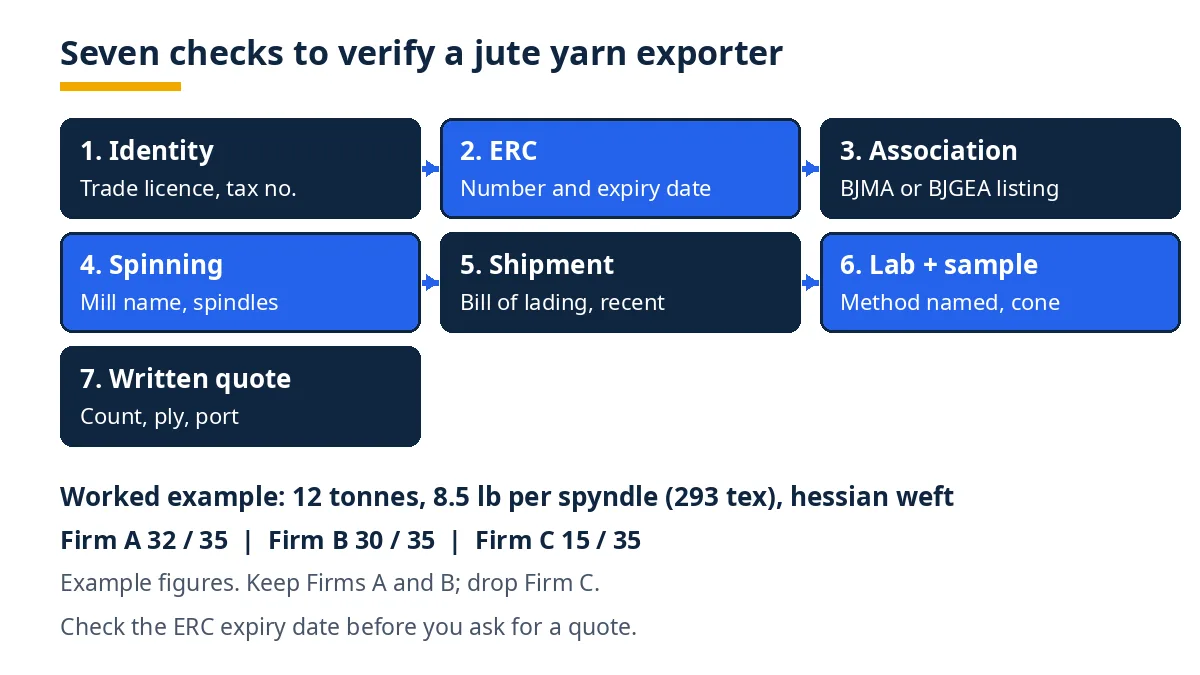
Business identity. Trade licence, tax identification number, business address.
Export registration. Export Registration Certificate (ERC), with number and expiry date.5
Association listing. BJMA or BJGEA listing, with the firm name spelled the same way.3 4
Spinning or sourcing. Mill name and spindle counts, or the mill that supplies each count.3
Shipment evidence. Bill of lading or export papers for a recent yarn shipment.
Lab and sample. Lab report naming the test method, and a sample cone spun to your count.
Quote in writing. A written quote naming count, ply, put-up, quantity, Incoterm and port.
The ERC is the check buyers most often skip, and it decides whether a firm can export at all. The certificate is issued by the Office of the Chief Controller of Imports and Exports, and the Export Policy 2024-27 names it as the first step in the export process.5 Banks are told to confirm that every exporter is registered under the Importers, Exporters and Indentors (Registration) Order 2023.5 Ask for the number and expiry date in writing; renewals can run for any full term from one to five years, and the guidance is to apply at least 60 days before expiry.5
Shipment evidence separates an exporter from a firm that has only ever quoted. Ask for the papers of one recent yarn shipment, with the count, ply, quantity and destination port visible, and match the firm name on the papers to the name on the ERC. A bill of lading in another firm's name is someone else's shipment.
How to tell an exporter from a trader in five questions
Five questions, asked in writing to every firm on the shortlist, will sort the mills from the traders. First, who spins the yarn. A mill names its frames, its spindle count and the counts it ran last month; a trader names the mill it buys from, or changes the subject to price. Second, what is the ERC number and when does it expire. Third, what was the last yarn shipment, and where did it go. Fourth, what does the lab report show for this count, and which method did the lab use. Fifth, can the firm send a sample cone spun to your count, with the count, ply and lot number on the label.
A mill that spins your count can talk about the batch it runs for that count and the lab values it expects. A trader that buys the count in can pass on the mill's lab report, but the report should name the mill and the lot.
What to ask for before a quote
Do not ask for a price first. Ask for the documents that make a price meaningful, in one message: the ERC number and expiry date, the trade licence, and the tax identification number; the mill name and address for your count, or the mill that supplies it; one recent bill of lading for a yarn shipment; a lab report for your count, naming the test method for each value; and a sample cone, spun to your count, with the count and lot number on the label.
State your count in both units in that first message. Give the count in both units: lb per spyndle, where one spyndle is 14,400 yards, and tex, in grams per kilometre. Tex equals lb per spyndle multiplied by 34.45.6 A yarn at 8.5 lb per spyndle is 293 tex.6 State the ply as well: single yarn is one strand, and multiple or cabled yarn twists two or more strands together, and the two sit under different six-digit subheadings, 5307.10 for single yarn and 5307.20 for multiple (folded) or cabled yarn.7
Put the sample approval in writing, naming the count, ply, twist, put-up and colour, then store the approved cone sealed away from the lot. The cone-level tests are set out in our quality control checklist for jute yarn; use that list at final inspection.
How to compare exporter quotes on the same terms
Quotes for jute yarn are often quoted FOB, and FOB only works when both sides mean the same port and the same point of delivery. Under FOB, one of the eleven Incoterms 2020 rules, the seller places the goods on board the vessel the buyer names at the port of shipment, after clearing them for export, and risk moves to the buyer at that moment.8 The buyer pays the ocean freight and everything after loading, and FOB applies only to sea and inland waterway transport.8
Ask every exporter to quote on the same lines, in writing, so the quotes can be laid side by side. A quote that leaves a line blank is not cheaper than a quote that fills it in; it is incomplete.
Ask for each line in writing: count and ply, stated in lb per spyndle and tex, single or multiple, matching your enquiry;6 7 quantity and put-up, in tonnes and cones per case; Incoterm and port, FOB Chattogram, or FCA where the cargo is containerised, named in full;8 export documents, and who pays for each one; lab tests, with the method named for each value; the sample cone, and what it costs if the order does not go ahead; and payment terms, with the shipment window in writing.
Read the quantity line with care. A mill that runs your count already can accept a smaller order than a mill that has to set a new batch for it. The MOQ guide for jute yarn works through the minimums that sit under one quoted figure, and the manufacturers guide covers the spinning line behind the exporter. For the wholesale bands, see our wholesale jute yarn guide. A quote far below the others is a signal, not a bargain.
Worked example: shortlisting three exporters for hessian weft yarn
A buyer in the United Arab Emirates needs 12 tonnes of single jute yarn at 8.5 lb per spyndle (293 tex) on cones, for hessian weft, FOB Chattogram. All figures in this example are illustrative, except the count conversion, which follows the standard cited above.6 The buyer starts with the BJMA and BJGEA lists and sends six firms the same first message.3 4
Three firms reply. Firm A is a spinning mill that exports under its own name: it gives an ERC number with two years left, a bill of lading for a yarn shipment to Turkey, a lab report naming the test method, and a sample cone at 8.5 lb per spyndle. Firm B is a trading exporter: it gives an ERC number, a bill of lading in its own name, and a lab report from the mill that spins its yarn. Firm C has no ERC of its own: it says a partner handles export, sends a proforma invoice as shipment evidence, and offers a sample cone with no lot number.
The buyer scores each firm out of five on each of the seven checks, for a maximum of 35 points: Firm A scores 5, 5, 4, 5, 5, 4 and 4, for a total of 32; Firm B scores 5, 5, 4, 4, 4, 4 and 4, for a total of 30; Firm C scores 4, 1, 2, 2, 1, 2 and 3, for a total of 15. The buyer keeps Firms A and B, asks both for a sample cone, and drops Firm C.
Red flags that end a shortlist
Some signs are worth a question, and some are worth ending the conversation. The first is no ERC, or an ERC number the firm will not give in writing: a firm that cannot export in its own name and will not say who exports for it is not an exporter. The second is shipment evidence in another firm's name, with no explanation. The third is a lab report with no method named, or a report for a different count from the one you asked for. The fourth is a sample cone with no count, ply or lot number on the label. The fifth is a quote that changes when you ask for the documents to be named.
Mistakes that waste an exporter search
The first mistake is starting with price. A buyer who asks for a price before asking for the ERC, the shipment papers and the lab report will get a number that cannot be compared with any other number, because the firms are quoting different things. Ask for the documents first, and let the price come last. The second mistake is treating an association listing as a guarantee. The BJMA and BJGEA lists show membership at the date they were published, and both are partly dated.3 4 The third mistake is accepting a marketplace badge as proof of export readiness. On Exportain, badges record a review of documents and photos, not a factory inspection, a certification or a guarantee, and Exportain is not a party to the goods contract and does not inspect goods, book freight or clear customs.
Next steps on Exportain
Once two firms pass the seven checks, look through Bangladeshi suppliers and raise an RFQ that states the count in both units, the ply, the put-up and the quantity, so every exporter quotes the same order. Before that, read the manufacturers guide and the quality control checklist for jute yarn.
Sources
- Jute exports rise 37 per cent as Bangladesh plans to double earnings by 2031. The Financial Express, (accessed )
- Jute Yarn (HS: 5307) Product Trade, Exporters and Importers. The Observatory of Economic Complexity (accessed )
- List of BJMA Member Mills. Bangladesh Jute Mills Association (accessed )
- Bangladesh Jute Goods Exporters' Association (BJGEA) Member List 2019-2020. Bangladesh Trade Portal, (accessed )
- Start an Export Business in Bangladesh (2026 Guide). Entrepreneurs.bd (accessed )
- IS 3689: Conversion factors and conversion tables for yarn counts. Bureau of Indian Standards, (accessed )
- SCG 2000 - 5307 - Yarn of jute or of other textile bast fibres of heading No. 53.03. Statistics Canada (accessed )
- FOB Incoterms Explained: A Complete Guide for Importers and Freight Forwarders 2026. GoFreight (accessed )
About the author
Sourcing from Bangladesh?
Post a request for quotation and suppliers on Exportain can send you their quotes directly.
Post an RFQ