Top Jute Sacks Manufacturers in Bangladesh: How to Find and Verify Them
How to find jute sack manufacturers in Bangladesh and confirm them by grade: read the A-Twill and B-Twill grades, shortlist mills that weave sacking cloth, and check looms, grade history, test reports and a fill-tested sample sack.
Short answer
Find jute sacks manufacturers in Bangladesh through the Bangladesh Jute Mills Association member list, then shortlist mills that weave your grade of sacking cloth in-house. Confirm a maker by checking its sacking looms, its production records for your grade, fabric and seam test reports with methods named, an IJO 98/01 conformity certificate for food-grade lots, and a sample sack that passes a fill test with your goods before you order.
On this page
Key takeaways
B-Twill is 44 by 26.5 inches at 1,020 grams for 80 to 90 kg; A-Twill is the same size at 1,190 grams with a double warp for 100 kg.
A sack maker is a composite mill, a stitching unit or a trader: ask which stages run under its own roof.
Food-grade sacks need yarn batched with food-approved vegetable oil under IJO 98/01, with a conformity certificate for the lot.
Write the grade, size, sack weight, porter and shot, test methods and sampling plan into the purchase order before production starts.
A sack order goes wrong at the grade choice, not at the port. A buyer takes the lowest price per sack and finds at the filling line that the cloth is a lighter grade than the order named, and the lot has to be re-bagged. This guide shows a buyer of bulk packing sacks from Bangladesh how to read the grade, tell a mill that weaves sacking cloth from a stitching unit or a trader, and confirm the maker.
What a jute sack is, and what it is not
A jute sack is a made-up packing sack of heavy twill-weave sacking cloth, sewn and hemmed, built to carry a bulk fill. Its usual fills are grain, rice, sugar, coffee, cocoa, potatoes, seed and cement, and the load sets the design: cloth weight, weave density, seam and mouth all follow the weight the sack must hold.1
A sack is not a shopping bag. A shopping bag is a lighter, plain-weave or laminated bag with handles, made to carry retail goods and show a brand, while a sack has no handles and no retail finish. Our guide to jute bag makers in Bangladesh covers the shopping-bag side. Hessian is the lighter plain-weave cloth, while sacking is the heavy twill-weave cloth of grain and sugar bags; sacking bags are heading 6305.10, and hessian cloth is heading 5310.1 Our HS code guide for jute sacks works through the classification in full.
Read the grade before you read the price
Sacking bags are named by construction: the name carries the weight, the weave and the fill. The table gives the trade grades as a commodity broker lists them, with the 50 kg foodgrain sack alongside for scale.1 2
Grade | Size | Sack weight | Weave | Fill |
|---|---|---|---|---|
B-Twill | 44 x 26.5 in (112 x 67 cm) | 2.25 lb (about 1,020 g) | 6 x 8 porter and shot | 80 to 90 kg |
A-Twill | 44 x 26.5 in (112 x 67 cm) | 2.62 lb (about 1,190 g) | 8 x 9 porter and shot, double warp | 100 kg |
Binola or C-Twill | 44 x 26.5 in (112 x 67 cm) | 2.0 lb (about 907 g) | Lighter construction | Lighter fill |
Heavy Cees | 43 x 29 in | 2.5 lb (about 1,134 g) | Green stripes | 100 kg |
50 kg foodgrain sack | 94 x 57 cm | 580 g | Per IS 16186 Types A and B | 50 kg |
Porter and shot is the weave density count the mill states for the cloth. B-Twill and A-Twill share the same 44 by 26.5 inch size: A-Twill is the heavier cloth with a double warp for a 100 kg fill, while B-Twill carries 80 to 90 kg.1
State the grade, size, sack weight and fill in every enquiry, for example "B-Twill, 44 x 26.5 in, 1,020 g, 6 x 8 porter and shot, for 80 to 90 kg of coffee".
How a sack is made, and what that tells you about the maker
A sack passes through ten stages: fibre selection and grading, batching and softening, carding and drawing, spinning, winding and weaving, fabric inspection, cutting, stitching and reinforcement, printing, and final inspection and packing.3 The fibre is graded, then batched with moisture and batching oil; carding runs through breaker and finisher stages, drawing straightens the sliver, and spinning draws it to the required count and adds twist. The count is the first thing to ask about, because the cloth follows it: jute yarn count is stated in pounds per spindle, with one spindle representing 14,400 yards.3 Our guide to jute yarn manufacturers in Bangladesh explains how to read a count.
Weaving turns yarn into cloth. Before cutting, the cloth is checked for yarn breaks, missed picks, uneven weaving, holes, stains and uneven weight.3 Cutting follows an approved plan, and stitching joins the panels.3
That chain sorts makers into three kinds. A composite mill runs spinning, weaving and stitching under its own roof. A stitching unit buys sacking cloth and cuts and sews it. A trader buys finished sacks and sells them on.
Food-grade sacks add one check: the batching oil. IJO Standard 98/01, of 1998 and revised in 2005, requires bags for coffee, cocoa and shelled nuts to be woven from yarn batched with non-toxic, food-approved vegetable oil in place of mineral oil, with unsaponifiable matter not above 1,250 mg per kg, and such bags are sold as hydrocarbon-free or vegetable-oil-treated, known as VOT.1
Where to look for sack manufacturers
Start with the membership lists. The Bangladesh Jute Mills Association publishes a member list giving each mill's head office address, mill location and loom count, so a buyer can see which mills weave and where they sit.4 The list is long and partly dated, so use it as a directory to check against, not as a shortlist on its own. There is no published, audited ranking of jute sack manufacturers in Bangladesh.
The Jute Diversification Promotion Centre, known as JDPC, is a second directory, but a secondary one for bulk sacks. JDPC was set up by the Ministry of Textiles and Jute in 2002, and it has 1,100 registered entrepreneurs producing 282 product types, supported by six service centres in Dhaka, Rangpur, Jashore, Chattogram, Tangail and Jamalpur.5
The Export Promotion Bureau lists exporters, and its data put jute sacks and bags exports at 132.3 million dollars in the 2025-26 fiscal year, up 5.03 per cent on the year before, inside total jute and jute goods earnings of 883.7 million dollars.6 Earnings from sacks and bags fell 13 per cent in July and August of the 2026-27 fiscal year even as the sector as a whole rose.6
The shortlist method: six questions on one page
Send the same six questions to every maker, and score the replies side by side.
Which sack grades do you weave in your own mill, and which do you buy in as cloth or as finished sacks?
For a food-grade order, which batching oil do you use, and will you issue an IJO 98/01 certificate for the lot?1
How many sacking looms run your grade, and how many sacks a day can you make?
Which buyers in my market have you shipped this grade to, and can I contact one?
Will you send a sample sack made to my grade and size for a fill test with my goods?
What is the price per sack, how many sacks go in a bale, and on which Incoterm?
Seven checks that confirm a sack manufacturer
Verification runs in seven checks, each finished before the next starts.
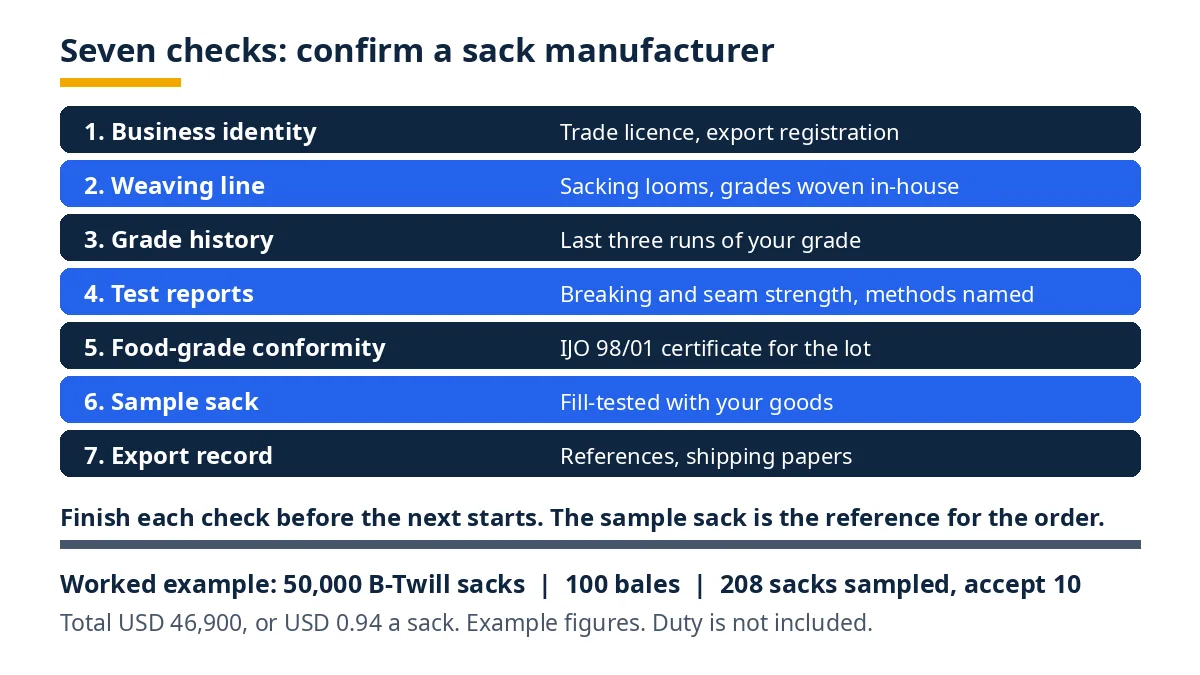
Check | Evidence to gather | What it shows |
|---|---|---|
Business identity | Trade licence, export registration certificate, bank account in the company name | Whether the maker is registered there |
Weaving line | Sacking looms, cloth output, grades woven in-house | Whether the maker weaves sacking3 |
Grade history | Production records for your grade: dates, quantities, sack weight | Whether the maker has run your grade1 |
Test reports | Fabric and seam strength, with the method named | Whether the cloth and seam carry your fill2 |
Food-grade conformity | IJO 98/01 certificate for the lot, batching oil record | Whether the sack suits food contact1 |
Sample sack | A sack made to your grade, fill-tested, kept sealed | Whether the sack holds your fill in practice |
Export record | Buyer references, shipping papers for a recent order | Whether the maker has shipped sacks abroad6 |
Grade history is the check traders fail. Ask the mill for the records of its last three runs of your grade. Match it against the test reports, which should carry the same grade, dates and lot numbers.
The test reports need methods, not just numbers. The 50 kg foodgrain standard sets the fabric breaking strength at a minimum of 1,570 newtons warpway and 1,420 newtons weftway, and the seam strength at a minimum of 490 newtons, each by the ravelled-strip method, with moisture regain not above 22 per cent.2 Those are the standard's values for its sack, not pass marks for yours: write your own values into the purchase order. Ask for the export registration certificate in the exporter's own name; our checklist for jute bag exporters in Bangladesh covers the registration detail.
The sample sack is the reference for the whole order. Fill it with your goods, lift it, stack it and empty it, then approve it in writing with the grade, size, sack weight, porter and shot and fill stated.
Set the sampling plan before the bales close
A pre-shipment inspection samples the finished, packed lot; it does not check every sack. The sampling rules come from ISO 2859-1, also published as ANSI/ASQ Z1.4, which sets the sample size from the lot size and the inspection level.7 General Inspection Level II is the default for visual checks; Level I takes a smaller sample and Level III a larger one.7 For a lot of 5,000 pieces, Level II draws 200 samples, against 80 at Level I and 315 at Level III.7
For the 50 kg foodgrain sack, the standard samples bales on an AQL of 2.5 per cent: up to 25 bales, 5 sampled, 80 sacks, acceptance 5; 91 to 300 bales, 13 sampled, 208 sacks, acceptance 10; 301 to 500 bales, 20 sampled, 320 sacks, acceptance 14.2
Worked example: shortlisting for 50,000 coffee sacks
A buyer in the United States needs 50,000 B-Twill sacks for coffee, food-grade VOT, printed with the roaster's mark. The figures below are example figures, except for the grade weights and sampling numbers, which follow the sources cited.
The buyer starts with the BJMA list, picks six mills that show sacking looms, and sends each the six questions.4 Three answer with loom counts, grade detail and a batching oil record; two answer with a price and no grade detail; one does not answer. The buyer sets aside the three that cannot show the line or the oil record, and asks the remaining three for a sample sack each, made to B-Twill at 1,020 grams.1
Two sacks arrive. The buyer fills each with 85 kg of coffee and lifts it. One sack holds; the other's bottom seam opens at the lift. The buyer keeps the maker of the first sack and writes the grade, size, sack weight and test methods into the purchase order.
At 1,020 grams a sack, 50,000 sacks weigh 51,000 kilograms, or 51 tonnes.1 At 500 sacks to the bale, the order fills 100 bales, and the standard's sampling for a lot of 91 to 300 bales draws 13 bales, 208 sacks in all, with an acceptance number of 10 at an AQL of 2.5 per cent.2 The cost build is example figures: 50,000 sacks at 0.85 dollars a sack is 42,500 dollars; inspection 600 dollars; freight 3,800 dollars; the total is 46,900 dollars, or 0.94 dollars a sack.
Mistakes that waste a sack order
Ordering by price per sack without naming the grade. Two mills can quote different cloths at different prices.
Taking a shopping-bag maker for a bulk sack order. The stitching may look the same, but the cloth, loom and seam are different.
Treating stripes as proof of grade. A sack can carry three blue stripes at the wrong weight and the wrong weave, so weigh the sack and check the porter and shot.
Skipping the fill test. A sack can look sound when empty and still open at the bottom seam once filled.
Next steps on Exportain
Start with the HS code guide for jute sacks so the shipment carries the right heading, then use the quality control checklist for jute sacks to write the inspection into the order. Once the shortlist is set, search Bangladeshi suppliers and post an RFQ, naming the grade, size, sack weight, food-grade requirement and quantity.
Sources
- Jute Bags & Hessian Cloth Supplier — HS 6305.10. Commbril (accessed )
- IS 16186:2014: Textiles — Light Weight Jute Sacking Bags for Packing 50 kg Foodgrains — Specification. Bureau of Indian Standards (accessed )
- Jute Bag Manufacturing Process: 10 Steps Explained. Jute For Good (accessed )
- List of BJMA Member Mills. Bangladesh Jute Mills Association (accessed )
- Jute Diversification Promotion Centre weaves success for 1,100 entrepreneurs. Daily Sun, (accessed )
- Jute exports rise 37 per cent as Bangladesh plans to double earnings by 2031. The Financial Express, (accessed )
- How The AQL Inspection Levels In ISO 2859-1 Affect Sampling Size. QualityInspection.org, (accessed )
About the author
Sourcing from Bangladesh?
Post a request for quotation and suppliers on Exportain can send you their quotes directly.
Post an RFQ