Jute Bags Exporters in Bangladesh: Verified Supplier Checklist
Six checks that test a jute bag exporter in Bangladesh: ERC, trade-body standing, export and LC history, bank documents, the factory behind the firm, and inspection agreed before production.
Short answer
A jute bag exporter in Bangladesh is checked on six points: a current Export Registration Certificate in its own name, membership of a trade body such as BJGEA that can be looked up, a shipping record with buyer references and bank proof, the ability to handle a letter of credit and the export documents, a named factory behind the bags, and an inspection plan agreed before production starts.
On this page
Key takeaways
An exporter is any business that exports in its own name, including trading exporters and buying houses, not only manufacturers.
The ERC must be current, issued by CCI&E, and in the same name as the quotation and the bank account.
BJGEA membership and JDPC registration are cross-checks against published lists, not guarantees on their own.
Export proceeds must normally be repatriated within four months, and jute goods may ship on terms of up to 360 days against irrevocable confirmed letters of credit.
The exporter must name the factory behind the bags, and inspection under ISO 2859-1 AQL must be agreed before production starts.
A jute bag exporter in Bangladesh is the firm that sells the bags abroad and signs the export documents. That firm may weave and stitch the bags itself, or it may buy finished bags from factories and ship them under its own name. This checklist tests the exporter: its registration, its shipping record, its bank and paperwork, and the factory behind it.
What counts as a jute bag exporter?
An exporter is any business that exports goods in its own name, and that includes manufacturers, trading exporters and buying houses that invoice buyers or ship samples.1 The name on the invoice, the letter of credit and the shipping documents is the party you can hold to the contract. A factory that makes the bags but never exports them is not your exporter; the trading house that buys the bags and ships them is.
Each check below asks for one piece of evidence and states what a pass looks like.
Which exporter type are you dealing with?
Ask the firm to state its type in writing at the first enquiry: a manufacturer-exporter is judged on its own factory, while a trading exporter is judged on the factories it buys from and how openly it names them.
Exporter type | What it does | Your main check |
|---|---|---|
Manufacturer-exporter | Makes the bags in its own factory and exports them itself | The factory address, its capacity and its own export record |
Trading exporter | Buys finished bags from one or more factories and exports under its own name | The names of the supplying factories and its own shipping record |
Buying house or agent | Sources and follows up on your behalf, usually for a fee | Who pays the fee, and whether it ever takes title to the goods |
A trading exporter is not a weaker choice by itself; many mixed orders can only be filled by a firm that buys from several makers. The risk is a firm that will not say which type it is, because then you cannot tell whether its promises rest on its own production or on factories you have never seen.
Check 1: Is the ERC current and in the exporter's own name?
The Export Registration Certificate, known as the ERC, is the first registration a Bangladesh exporter needs. Exporters must be registered under the Importers, Exporters and Indentors (Registration) Order 2023, issued by the Ministry of Commerce and in force from 1 April 2024.1 The certificate is issued and renewed by the Office of the Chief Controller of Imports and Exports, known as CCI&E.1
Ask for a copy of the ERC and check four things: the business name matches the name on the quotation and the bank account exactly, the certificate covers export activity, the expiry date is still ahead, and the number is the one the firm puts on its invoices. In Bangladesh the commercial invoice must include the ERC number and the Harmonised System (HS) code of the goods.2 Any business that exports goods in its own name needs an ERC, including trading exporters and buying houses that invoice buyers or ship samples.1
Ask also whether the certificate has ever been suspended or cancelled: the 2023 Order allows both, and cancellation stops the bank from processing new export documents.1 The ERC number appears on the bank's proceeds realisation certificate, so a lapsed ERC surfaces quickly in the banking record.1
Check 2: Does the exporter belong to the trade bodies it claims?
Membership of a trade body is a cross-check, not a guarantee. It confirms that a firm is known to its sector and that its stated identity can be matched against a published list. The Bangladesh Jute Goods Exporters' Association, known as BJGEA, publishes a member list with firm names, addresses and Taxpayer Identification Numbers; its 2019-2020 list is dated 29 October 2020 and gives the association's address as A and A Tower, 173 Arambagh, Motijheel, Dhaka.3
Ask the exporter which associations it belongs to, then look the firm up rather than taking the claim at face value. A firm that claims BJGEA membership but does not appear on the list, or appears under a different name, should explain the difference before you go further.
The same test applies to diversified jute products. The Jute Diversification Promotion Centre, known as JDPC, was established by the Ministry of Textiles and Jute in 2002 and has 1,100 registered entrepreneurs producing jute items for domestic sales and export markets.4 JDPC registration is a supporting check; it does not replace the ERC.
Check 3: Has the exporter shipped jute bags before, and been paid for them?
An export record is the strongest evidence an exporter can offer. Ask for two buyer references you can contact, and for shipping documents from a recent jute bag order with prices and buyer names blanked out. A reference that cannot be reached, or documents that show only domestic sales, tell you the export history is unproven.
Every export must be declared on an EXP form through an authorised dealer bank, and full export proceeds must normally be repatriated within four months of shipment.1 Ask the exporter to confirm that its past shipments were declared and that proceeds were received inside that window.
Raw jute and jute goods may be exported on terms of up to 360 days against irrevocable confirmed letters of credit, or under open account rules with payment cover.1 An exporter that has handled confirmed letters of credit before will be able to explain its bank's requirements and what happens if a presentation is refused.
Check 4: Can the exporter handle the bank and the documents?
A letter of credit is a financial document issued by a bank that guarantees the buyer's payment to the seller.2 Before you agree payment terms, confirm that the exporter's bank will accept the credit you plan to open, and that the exporter can produce every document the credit will call for.
The papers for a jute bag shipment are few, and each one must match the others. The commercial invoice lists the goods, the value and the sale terms, and it is the document customs uses to value the shipment; in Bangladesh it must carry the ERC number and the HS code.2 The packing list records how the shipment is packed, with the type, count and weight of each package.2 The certificate of origin states where the goods were made and is asked for by many destination countries when they set import duty; a local Chamber of Commerce or another authorised body issues it.2 The bill of lading is the sea carrier's contract and also acts as a document of title.2
Match the papers before the container closes: the invoice, packing list and bill of lading must show the same quantities, and the HS code must be the one your customs broker agreed. Our guide to the HS code for jute bags covers the classification to use.
Check 5: Who actually makes the bags?
A manufacturer-exporter should give you its factory address, its daily capacity and its current order book, and allow a visit or an inspector's report. A trading exporter should give you the name and address of each factory that will make your bags, and state in writing whether any part of the order will be passed to a factory you have not been told about.
Ask three questions and record the answers. First, does the exporter make the bags itself or buy them in, and if it buys them in, from whom. Second, has the supplying factory shipped export orders before, and can the exporter show shipping documents for bags from that factory. Third, who inspects the bags at the factory, and does the exporter see the report before the goods are packed.
A refusal to name the factory is a stop sign, as is a factory address that turns out to be an office with no production. Our guide to jute bag makers in Bangladesh covers the factory visit and the JDPC directory in detail; use it to check the maker once the exporter has named one.
Check 6: Is inspection agreed before production starts?
Inspection is agreed in the order, not after the goods are packed. AQL, the acceptable quality limit, comes from ISO 2859-1, also published as ANSI/ASQ Z1.4. It fixes the size of the sample an inspector draws from a lot and the number of defective units that sends the lot back.5 General Inspection Level II is the usual level for consumer goods, with AQL 2.5 for major defects and AQL 4.0 for minor defects.5
Lot size | Sample drawn, Level II | Major, AQL 2.5 | Minor, AQL 4.0 |
|---|---|---|---|
281 to 500 | 50 | Accept 3, reject 4 | Accept 5, reject 6 |
1,201 to 3,200 | 125 | Accept 7, reject 8 | Accept 10, reject 11 |
10,001 to 35,000 | 315 | Accept 14, reject 15 | Accept 21, reject 22 |
Count the defects in the sample: at or below the accept number the lot passes, and at the reject number it fails.5 Put the level, the AQL values, the inspector's name and the re-inspection payer in the order before production starts. Our quality control checklist for jute bags lists the inspection points to run on the sample and on the bulk run.
Score the exporter before you order
Run the six checks above as a scorecard. Give each check a pass, a fail or a hold, and do not place the order while any check stands at fail.
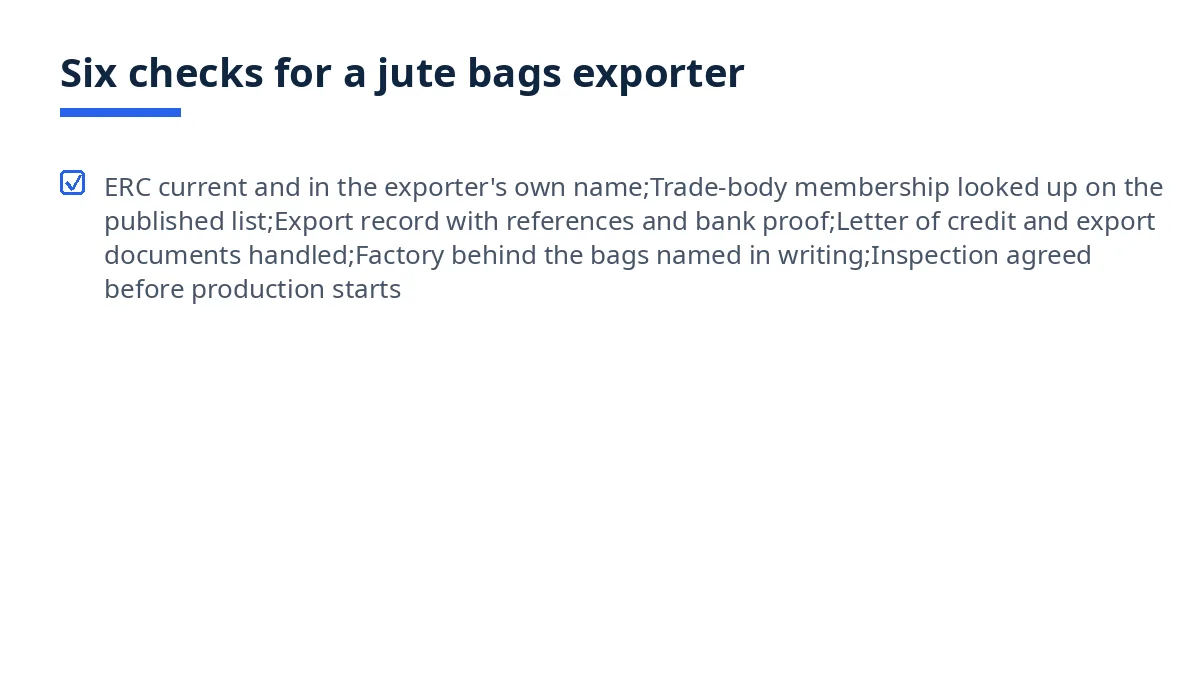
A pass on the ERC, the trade-body cross-check and the export record is the minimum for a first order. Keep the scorecard with the order file, and re-run the ERC and membership checks on every repeat order.
Red flags that end the conversation
An ERC in another name, or no ERC at all: the firm is not the exporter on the documents. A claimed membership that does not appear on the published list: a genuine member can be found. An export history that cannot be shown: references that do not answer, or shipping documents that show only domestic sales. A factory the exporter will not name: if you do not know who makes the bags, you cannot check the maker. Payment or inspection terms left open until after production: a credit the exporter's bank has never handled, or a standard agreed once the goods are packed, leaves you with no route to refuse a bad lot.
Next steps on Exportain
Start with the maker behind the exporter: our guide to jute bag makers in Bangladesh covers the factory visit and the JDPC directory, and the quality control checklist for jute bags gives you the inspection points to write into the order. For the order itself, read wholesale jute bags from Bangladesh and jute bags MOQ in Bangladesh. Then use search Bangladeshi suppliers or post an RFQ, and ask each reply to state its exporter type, its ERC number and the factory behind the bags.
Sources
- Export Law Bangladesh 2026: Critical Rules for Exporters. TRW (accessed )
- Essential export documents for shipping from Bangladesh. DHL (accessed )
- Bangladesh Jute Goods Exporters' Association (BJGEA) Member List 2019-2020. Bangladesh Trade Portal, (accessed )
- Jute Diversification Promotion Centre weaves success for 1,100 entrepreneurs. Daily Sun, (accessed )
- Free AQL Calculator, Chart & Sampling Table. Tetra Inspection (accessed )
About the author
Sourcing from Bangladesh?
Post a request for quotation and suppliers on Exportain can send you their quotes directly.
Post an RFQ