Wholesale Jute Bags From Bangladesh: Prices, MOQ and Reliable Suppliers
Wholesale jute bags from Bangladesh: how the channel works, what sets MOQ bands and price, and what to confirm in writing before ordering a production run.
Short answer
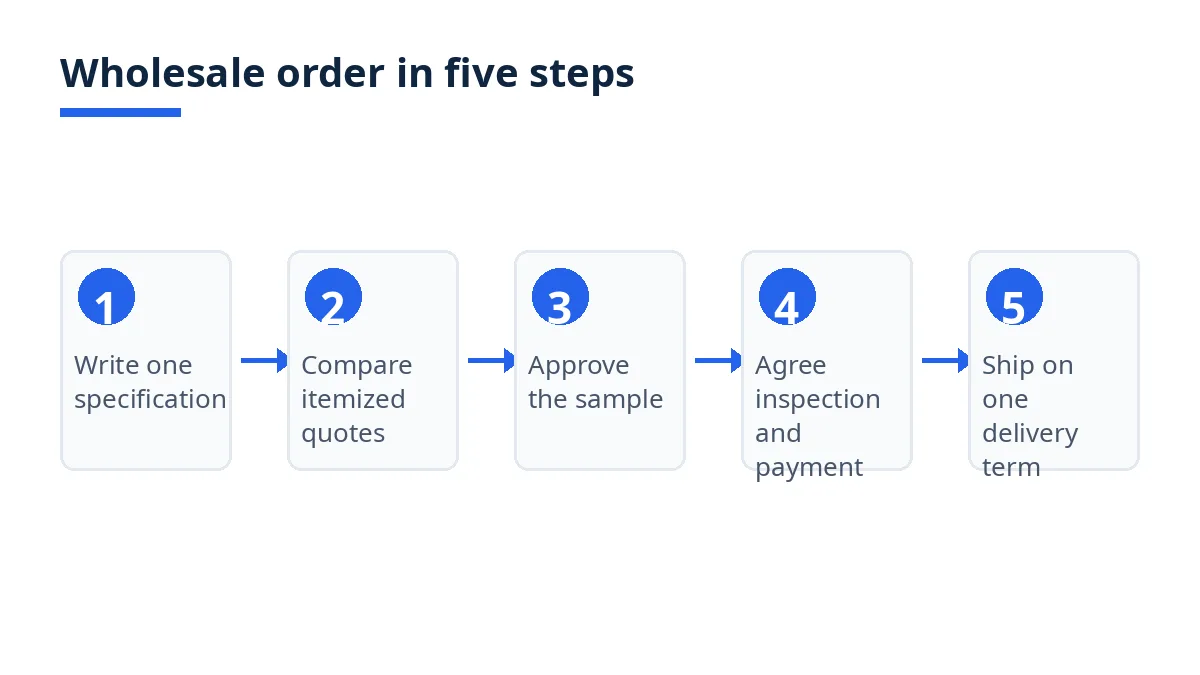
Wholesale jute bags from Bangladesh are bought as production runs for resale, retail or packing, not as single purchases. Compare suppliers by type — mills, trading companies and buying houses — and by MOQ band, fabric weight, print and delivery term. Ask for an itemized quotation, approve a sample in writing, agree an inspection plan, and compare only landed cost per bag on the same specification and term.
On this page
Key takeaways
Wholesale jute bags are bought as production runs, so compare landed cost per bag, not the unit price alone.
Mills, trading companies and buying houses price and deliver differently; ask each supplier to state its type in writing.
Custom-design MOQs are typically reported at 500 to 1,000 units, with bulk discounts generally from 5,000 units.
Fabric weight, print colours, quantity and delivery term set the price; ask for every cost line separately.
Approve the sample in writing and agree the inspection plan before bulk production starts.
Wholesale buying of jute bags from Bangladesh is a different purchase from ordering a few hundred printed totes for one event. A wholesale order is stock for resale, for a retail chain, or for packing a commodity — a production run, not a product off a shelf. The questions that decide whether it works are about the channel: who actually makes the bags, what quantity brings the unit price down, how the price is built up, and what gets checked before the bulk run starts.
Bangladesh is a sound place to buy at volume. Exports of jute sacks and bags earned $132.3 million in the 2025-26 fiscal year, up 5.03 per cent on the year before, inside total jute and jute goods exports of $883.7 million.1 The same report notes earnings from sacks and bags fell 13 per cent in July and August, with exporters pointing to flood damage pushing up raw jute prices, so fix the price basis in the order.1
Which supplier type fits a wholesale order?
Wholesale jute bags move through mills, trading companies and buying houses, and each prices and delivers differently. Knowing which one you are dealing with matters more than the headline unit price, because it decides who holds the stock and who answers when the print smudges.
Supplier type | What it does | Suits | Watch for |
|---|---|---|---|
Jute mill or integrated maker | Weaves the fabric, cuts, stitches and prints in house | Large runs of one bag type, repeat orders | Long set-up; may refuse small orders |
Trading company | Buys from one or more makers and resells, sometimes adding inspection or repacking | Mixed orders, smaller lots | A margin over the mill price |
Buying house or sourcing agent | Sources, negotiates and follows up on the buyer's behalf, usually for a fee | First-time buyers, multi-product orders | Confirm who pays the fee |
A mill that weaves its own fabric controls the main cost and the main quality variable, which is the fabric itself. A trading company suits a mixed order, because it can place each part with the maker that does it well, while a buying house suits a buyer new to Bangladesh that wants someone on the ground to follow the order; confirm in writing how the agent is paid, because a fee paid by the maker sits inside the unit price.
Ask every supplier to state whether it manufactures, trades or acts as an agent for the bags on offer, and where the fabric is woven. Our jute bags manufacturers guide explains how to check a maker through the JDPC directory and a factory visit.
How do MOQ bands work by bag type?
Minimum order quantity (MOQ) is not one number. It is set per bag type, per design and per production run, and it moves with the amount of set-up the order needs. A plain sack in a standard size needs almost no set-up, so the minimum can be low; a laminated tote with a custom print, dyed fabric and woven handles needs plates, screens, dyed lots and a stitching set-up, so the minimum is higher.
A wholesale sourcing guide reports that established manufacturers typically require 500 to 1,000 units for custom designs, while smaller operations may accept orders from 300 pieces, and bulk discounts generally apply at 5,000 units and above.2 Treat those figures as a starting point, not a market rate: every supplier sets its own minimum, and the figure that matters is the one on your quotation. Ask which figure its minimum is set on — pieces, print runs, fabric lots or container loads.
Bag type | What drives the minimum | What to ask |
|---|---|---|
Plain packing sacks | Fabric lot and bale size; standard sizes need little set-up | Minimum per size, and whether sizes can be mixed in one run |
Printed shopping totes | Print plates or screens per design and colour | Minimum per design, not per order, and the cost of an extra colour |
Ask whether the minimum falls for a repeat order in the same design, since the plates and screens already exist.
What sets the wholesale price?
No guide can state a wholesale price for jute bags as a market fact, because each supplier prices your exact bag, fabric weight, print, quantity and delivery term. Ask for the price broken into its parts — fabric, stitching, handles, printing, packing, transport, export handling, freight and insurance — and compare quotations only when every part is on the same basis.
Fabric weight is the main cost driver. A heavier fabric costs more per bag and makes a stronger bag, so a quotation that looks cheap may simply be quoting a lighter fabric. Ask for the fabric weight in grams per square metre on the quotation, and check the sample against it. Print is the next driver: each colour adds a plate or screen and a pass through the press, so a four-colour design costs more per bag than a one-colour design, and the difference grows at small quantities.
The delivery term changes the price as well. Under the Incoterms 2020 rules, 11 rules allocate cost, risk and obligations between buyer and seller, so a price that bundles freight and insurance cannot be set beside one that leaves them out.3 Ask every supplier to quote on the same term — FOB Chattogram is the usual starting point — and to break out freight and insurance as separate lines where the term includes them.
How do sampling and payment work at wholesale volume?
Sampling is where a wholesale order is won or lost, because a specification error multiplies across every bag in the run. A wholesale sourcing guide reports sampling timelines of 10 to 21 days depending on design complexity, with standard logo applications taking about 10 days and custom woven handles or dyed fabrics extending the process to three weeks.2 Most suppliers provide production-quality samples at cost, with shipping paid by the buyer, and some waive the fee for confirmed bulk orders above 5,000 units.2 Agree the terms before the sample is made: who pays, how many corrections are included, and what happens if it is rejected.
Approve the sample in writing, against the written specification, and keep it as the inspection reference for the bulk run. It should be made to the exact specification — the same fabric weight, print method and handles — because a sample in heavier fabric or with a different print is a different product. The jute bags quality control checklist lists the checks to run on the sample and on the bulk run.
Payment terms are part of the negotiation. Common practice is a deposit with the balance by letter of credit or telegraphic transfer against the shipping documents, but the split, the timing and the documents that trigger payment should all be written into the order, along with what happens if the inspection fails: rework, replacement or refund, and who pays for the re-inspection.
What should quality control cover on a bulk order?
A bulk order is too large to inspect bag by bag at arrival, so the control is a sampling plan agreed before production starts: who inspects, how many cartons are opened, what is checked, and what happens to rejected cartons. Check the fabric weight and weave, the stitching at the handles and the base, the print quality on the rough jute surface, the handles and lining, and the finishing — loose threads, uneven seams and damp or musty fabric are all signs of corners cut.
Food-grade sacks need an extra check. The IJO 98/01 standard sets guidelines for the production and use of jute bags in food packaging, so that sacks used for storing and transporting food are safe, hygienic and free from harmful chemicals.4 If your bags will hold food, ask the supplier to confirm in writing that the sacks meet that standard.
Classification matters at volume too. Sacks and bags of jute for packing goods fall under HS 6305.10, while handled tote bags that resemble handbags can fall under 4202.92, so the code turns on the bag's design and intended use.5 The Harmonized System is maintained by the World Customs Organization, and the first six digits are shared worldwide.5 The jute bags HS code guide sets out the classification. Confirm the code with your customs broker before the order ships.
Worked example: one order of 10,000 laminated totes
Example figures. A buyer orders 10,000 laminated shopping totes from a mill in Dhaka, FOB Chattogram, with a two-colour print. The numbers below are illustrative: they show how the landed cost is built up, not a market price.
Cost line | Amount |
|---|---|
Goods, 10,000 totes at $1.40 each | $14,000 |
Print plates and set-up, two colours | $300 |
Inland transport to Chattogram | $250 |
Export handling | $150 |
Freight to Rotterdam | $1,800 |
Insurance | $120 |
Duty at 5% of the $16,620 CIF value | $831 |
Total landed cost | $17,451 |
Landed cost per bag | $1.75 |
Goods plus set-up plus transport plus handling comes to $14,700; adding freight and insurance gives a CIF value of $16,620; duty at 5 per cent of that value is $831; and $17,451 divided by 10,000 bags is $1.75 per bag. The duty rate is illustrative, so ask a customs broker to confirm it before you fix the order.
The plates and set-up cost $300, or $0.03 per bag; on a repeat order in the same design, that line disappears.
Wholesale mistakes to avoid
The first mistake is comparing quotations on the unit price alone. Two suppliers can quote the same bag at different unit prices because one is quoting lighter fabric, fewer print colours, or a different delivery term. Compare the landed cost per bag, on the same specification and term.
The second mistake is ordering the full run before the sample is approved. A sample that is not made to specification is not an approval, and bulk production that starts before sign-off leaves the buyer with no reference when the shipment arrives.
The third mistake is leaving the inspection and rejection route out of the order. Agree who inspects, what is sampled, and what happens to rejected cartons before payment terms are fixed; a wholesale order without an inspection plan is a purchase made on trust, and trust is not a quality control system.
The fourth mistake is treating a marketplace listing as a price. Listings show wide ranges that reflect different fabrics, prints, quantities and supplier types, so use them to find suppliers, then get a written quotation for your exact specification. The jute products sourcing guide explains how to run that comparison.
Next steps on Exportain
Start with the specification: bag type, fabric weight, size, print and quantity, written in one document. Then search Bangladeshi suppliers or post an RFQ with that specification and the delivery term, and ask each reply to state its supplier type, its minimum order, and its price broken into lines. See how to buy before you place the order.
Sources
- Jute exports rise 37 per cent as Bangladesh plans to double earnings by 2031. The Financial Express, (accessed )
- Jute Bags Wholesalers: Bulk Suppliers & Custom Options. Accio, (accessed )
- Incoterms® 2020. International Chamber of Commerce (ICC) (accessed )
- How Wigmore Trading is Revolutionizing Packaging Agriculture Products with Food Grade Jute Sacks. Wigmore Trading, (accessed )
- Bag HS Codes Guide: 6305 Breakdown for Importers. FreightAmigo, (accessed )
About the author
Sourcing from Bangladesh?
Post a request for quotation and suppliers on Exportain can send you their quotes directly.
Post an RFQ