The Ultimate Jute & Jute Products Sourcing Guide for Bangladesh
A working sourcing guide to jute products from Bangladesh: write the specification, build one RFQ, verify operating mills, sample and test, compare itemized quotes and confirm the order in writing.
Short answer
To source jute products from Bangladesh, write the specification first (fibre grade, construction, dimensions, finish and packing), send the same brief to several operating mills, verify the mill and its export record, test production-representative samples, and compare itemized quotes at one Incoterm. There is no standard MOQ, price or lead time: each mill quotes all three per product and order.
On this page
Key takeaways
Source jute by specification, not by product name: fibre grade, construction, dimensions, finish, packing and HS heading go in writing before any price talk.
Bangladesh exported USD 820.16 million of jute and jute goods in FY2024-25 on EPB data; yarn and twine led at USD 461.83 million and sacks and bags were the only category that grew.
Of 266 licensed jute mills, 193 are operational and 73 remain closed, and leased BJMC mills may run under a different operator, so verify the mill and its operator for every order.
There is no standard MOQ, price or lead time for jute products; each mill quotes all three per product and order against your specification.
For food packing, IJO Standard 98/01 caps unsaponifiables at 1,250 mg/kg and one failed lot sample rejects the whole lot, so food-grade status is specified and tested per lot.
This sourcing guide is for importers, brands, commodity packers and sourcing agents in the United States, the United Kingdom, the European Union and the United Arab Emirates who plan to buy jute yarn, fabric, sacks or diversified jute goods from Bangladesh. It is a working guide, not an industry survey: it shows you how to write a jute specification a mill can price, how to build and send a request for quotation (RFQ), how to verify an operating mill, how to sample and test, and how to compare quotes and confirm an order. For capacity, mill history and key players, read the companion pillar on the jute products industry in Bangladesh alongside this guide.
Market overview with latest data
Start sourcing with the export record, because it tells you which product lines are active and where price pressure sits. Export earnings from jute and jute goods were USD 820.16 million in fiscal year 2024-25 on Export Promotion Bureau (EPB) data, down from USD 1.16 billion in FY2020-21, with falls in each year between.1 EPB fiscal years run from July to June, so keep these figures separate from calendar-year series published elsewhere.
Read the total by product line, because you will be buying one line, not the average. Jute yarn and twine is the largest earner at USD 461.83 million in FY2024-25, down 6.22 percent from USD 492.45 million in FY2023-24.1 Raw jute shipments were USD 148.48 million, down 7.94 percent.1 Jute sacks and bags moved the other way: shipments reached USD 125.96 million, and sacks and bags were the only category in the EPB breakdown whose shipments did not fall that year.1 A yarn buyer, a sack buyer and a shopping-bag buyer therefore face three different markets that happen to share one fibre.
Three facts in the same reporting shape your sourcing plan. First, exporters and economists name a low rate of value addition in basic jute goods as a cause of the decline, so diversified goods such as printed bags and home textiles are quoted mill by mill rather than against a deep standard market.1 Second, India's anti-dumping duties on Bangladeshi jute products, first imposed in 2017 and extended on 30 December 2022 after a sunset review, change the economics of any program that resells into India.1 Third, raw jute prices have risen in recent years and exporters name that rise as a direct cause of higher production costs, so a quote is only as stable as its stated validity period.1 The sourcing response to all three is the same: specify tightly, quote competitively and fix terms in writing, which is what the rest of this guide covers.
Main products and production clusters
Buy the product stage, not the fibre name. Jute products are classified across several chapters of the Harmonized System (HS), because the system follows the stage of manufacture. The HS is the international product nomenclature developed by the World Customs Organization (WCO), and it is used by more than 200 countries and economies as the basis for customs tariffs and trade statistics, so the heading you agree at order stage is the heading your duty and your import paperwork will follow.2 The headings you will use most often are:
HS heading | What it covers | Typical Bangladesh products |
|---|---|---|
5303 | Jute and other textile bast fibres, raw or processed but not spun; tow and waste of these fibres | Raw jute in bales, cuttings and tow |
5307 | Yarn of jute or of other textile bast fibres of heading 5303 | Single and folded jute yarn and twine for weaving, carpet and cable use |
5310 | Woven fabrics of jute or of other textile bast fibres of heading 5303 | Hessian cloth, sacking cloth and carpet backing cloth |
Chapter 57 | Carpets and other textile floor coverings | Woven and braided jute rugs, mats and floor coverings |
6305 | Sacks and bags, of a kind used for the packing of goods, including 6305.10 of jute or of other textile bast fibres of heading 5303 | Sacking bags for cocoa, coffee and food grains, shopping bags and promotional bags |
The headings follow the WCO Harmonized System entries for these chapters.3 Agree the six-digit subheading with your supplier and your customs broker for each product before you place the order, and write it into the specification and the purchase order.
Match the supplier type to the stage. A spinning mill is the right source for yarn under 5307 and the wrong source for a printed retail bag under 6305, which needs cutting, stitching, printing and finishing capacity. A weaving mill sells fabric by construction, width and weight. Diversified-goods makers, often smaller units attached to or buying fabric from mills, handle bags, rugs and home textiles. Your specification changes with the stage:
Product | Fields the specification must state | Error that costs the most |
|---|---|---|
Raw jute (5303) | Fibre grade in the grading system the seller uses, moisture basis, bale weight and packing | Buying on a grade name the seller grades differently |
Yarn and twine (5307) | Count, ply, twist direction, winding and packing format | Comparing counts quoted on different systems |
Fabric (5310) | Construction, width, weight per unit area, finish | Quoting by piece when the mill prices by weight and width |
Sacks and bags (6305) | Dimensions, fabric weight, stitch type, print, food-grade status where food is packed | Ordering food packing without the food-grade requirement in writing |
Diversified goods (Chapter 57, 6305) | Dimensions, materials blend, print or dye, retail packing and labelling | Approving a showroom sample that production cannot repeat |
Production sits in two belts that do not overlap, and the distinction matters when you plan visits and fibre supply. The growing belt is in the central and western districts: Faridpur, Rajbari, Magura, Kushtia, Madaripur and Gopalganj are the major producing districts, with Faridpur the largest.4 The mills sit elsewhere, around Dhaka and the river and port towns. Bangladesh has 266 licensed jute mills, of which 193 are operational and 73 remain closed, so a licensed name is not evidence of a running mill.5 Ask every candidate for the mill address, not only the head office address, and for the name of the company that currently operates that mill, for the reason set out in the verification section below.
How to find and verify suppliers
Build the longlist from at least two independent channels so one channel cannot carry a weak supplier through. Useful starting points are the mill and exporter associations whose officers speak on the record about the trade, including the Bangladesh Jute Goods Exporters Association,1 the state mill owner, the Bangladesh Jute Mills Corporation (BJMC), which owns the 25 state-owned mills,5 Bangladesh export data for category context, and supplier listings you can filter by product. On Exportain, you can search published products by keyword and category, filter listings, and review each supplier profile for its verification level, location, main products and declared certifications before you write.6 Send one RFQ rather than five different enquiries: on Exportain an RFQ states quantity and unit, target price, destination, Incoterm, required certifications and deadline, and suppliers in that category quote against the same brief.6 The guide to how to write an RFQ sets out the fields in full.
Verification is a document exercise first. Ask for, and read, the following before you discuss price in detail:
Trade licence and export registration in the company's own name, plus the name of the current operator where the mill is a leased BJMC mill. Production at all 25 BJMC mills was suspended in 2020; by June 2026, 14 had been leased to private operators and nine had resumed production, so the name on the gate may not be the company you contract with.5
Confirmation that the mill is currently operational, checked against the national picture of 193 operational mills out of 266 licensed.5
Export history for your heading and destination: anonymized bills of lading or shipment summaries showing product, volume and recency.
The fibre source and grade behind your product, stated in writing, because yarn count, fabric strength and bag performance are decided at fibre level.
Test reports for the exact construction you plan to buy, including the food-grade evidence in the compliance section where bags will pack food.
A capacity statement by stage: spinning, weaving, cutting, stitching, printing and finishing per day, with subcontracted stages named as subcontracted.
Read platform badges for what they record. On Exportain, verification is free, staff review every submission, and approved checks earn badges shown on the company page, product listings and quotations; the review is a document and photo review, not a factory inspection, and membership plans never grant a badge.7 On the buying side, a badge records which checks the Exportain team has reviewed and is not a capacity or quality guarantee.6 Use a badge as a first filter, then run the six document checks above yourself or through an inspection firm you appoint.
Two answers end a conversation early. A mill that quotes a firm price before it has seen your full specification is pricing a product you did not describe. A supplier that cannot state whether its mill is operational, and who operates it, has not answered the first capacity question in a sector where 73 licensed mills remain closed.5
MOQ, pricing and lead times
There is no industry-wide minimum order quantity (MOQ), standard price or standard lead time for jute products from Bangladesh, and no official body publishes one. All three are quoted per mill, per product and per order, against a written specification. What follows is how each one is built, so you can make two mills answer the same question.
MOQ. The minimum is set by the production stage, not by your carton count. A yarn order carries the spinning mill's minimum per count and ply. A fabric order carries loom and finishing minimums per construction, width and finish. A bag order carries cutting, stitching and printing minimums per size and design, and a printed design adds its own set-up minimum on top of the sewing minimum. State your target quantity per product, per size and per design in the RFQ, and ask each mill to quote its MOQ on the same basis. A single total quantity spread across four designs can clear a sewing minimum and fail every printing minimum at the same time.
Pricing. Your unit price is built from the raw jute grade and its price at the time of purchase, spinning or weaving cost, finishing, cutting and stitching where they apply, printing, packing into bales or cartons, and export costs to the agreed Incoterm point. The FY2024-25 figures show why no single jute price exists: yarn and twine earned USD 461.83 million and sacks and bags USD 125.96 million in the same year, at very different values per tonne and per piece.1 Raw jute is an agricultural input, and rising raw jute prices have lifted mill production costs directly.1 Compare quotes only at the same specification and the same Incoterm, and require each mill to state the fibre grade, the itemized build-up and the price-validity period in writing.
Example figures. The numbers in this paragraph are Example figures, used to show the comparison method and not to state a market price. Example figures: a buyer specifies 10,000 printed jute shopping bags and asks two suppliers to quote FOB Chattogram against the same specification. Supplier A quotes USD 2.10 per bag, itemized as fabric and making USD 1.55, printing USD 0.30 and packing and export costs USD 0.25, a total of USD 21,000 on these Example figures. Supplier B quotes USD 1.92 per bag with no itemization, a total of USD 19,200 on these Example figures. The Example figures show a gap of USD 1,800 that the buyer cannot yet read: the buyer asks Supplier B for the same itemization and for the fabric weight behind the quote before treating the gap as a saving, because on a jute bag an unexplained gap is usually a lighter fabric or a cheaper print method. Every figure in this paragraph is an Example figure.
Lead times. A lead time is a chain, not a single number: raw jute purchase and grading, spinning, weaving, finishing, cutting and stitching where they apply, inspection and booking, then transit. The first stage is seasonal. Jute is sown from around mid-March to April, takes about 90 days to be fit for harvest, and harvest runs in full swing from July to the end of August; an early flood can force an early harvest and change the quantity and grade of fibre available.4 Ask for the lead time broken into stages with the fibre stage stated separately, and agree in writing what starts the clock, normally written order confirmation plus an approved sample, not the first enquiry.
Quality, certifications and compliance
Quality is controlled at three points: the specification you write, the samples you approve, and the tests you require. A specification an inspector cannot measure will not protect you, so write it in measurable fields: fibre grade, yarn count and ply, fabric construction and weight per unit area, bag dimensions and tare weight, stitch type, print colours and placement, and packing into bales or cartons with pieces per bale or carton. Then run sampling in stages: a first sample against the specification, a pre-production sample made from the production fibre and fabric, and a counter-sample you keep sealed as the reference for inspection. Test production-representative goods, not showroom samples.
Food-grade bags and batching oil. This is the compliance point that decides whole orders of sacking. Jute is softened in manufacture with batching oil, and where mineral-oil-based batching oil is used in bags that pack food, hydrocarbon contamination of the food is the documented concern. IJO Standard 98/01, adopted by the International Jute Council in 1998 and revised in 2005, sets special criteria for jute bags used in the packing of cocoa beans, coffee beans and shelled nuts: batching oil ingredients must be non-toxic and approved for packing materials that come into contact with those foods, the bags must not contain unsaponifiables exceeding 1,250 mg/kg, and no undesirable odours or odours untypical of jute may be present.8 The standard's sampling rules are strict: samples are drawn by lot, and if even one sample fails the test, the whole lot is rejected.8 Food-grade production is therefore segregated production, often described as vegetable oil treated, and it must be specified at order stage, not requested after weaving. Write the standard into the purchase specification and require the lot test report and certificate the standard provides for.
EU fibre labelling. Regulation (EU) No 1007/2011 governs textile fibre names and the related labelling and marking of the fibre composition of textile products placed on the EU market.9 A shopping bag, rug or home textile sold to consumers in the EU needs its fibre composition stated using the fibre names the regulation lists, so a bag woven from a jute blend cannot be labelled as pure jute. Agree the label artwork at sampling stage, while a correction still costs a proof rather than a production run.
Certifications buyers name. Beyond the legal file, buyers may name management, environmental or social audits, or product schemes for organic or recycled content, in their own vendor manuals. Treat each named scheme the same way: ask for the certificate, then check its number, site, scope and validity in the scheme owner's register before you rely on it, because a certificate for one site or one product line does not cover another. No certificate replaces the food-grade test above where it applies, and no audit replaces your own specification and inspection.
Shipping, Incoterms and duties
Jute goods from Bangladesh normally leave by sea from Chattogram, the country's main seaport. Packing drives the freight economics: yarn ships on cones or in bales, fabric in bales or rolls, and finished bags are bulky relative to weight. Confirm bale or carton dimensions and pieces per bale or carton in the specification, because those numbers set your freight cost per unit under any delivery term.
Incoterms® 2020 is the current edition of the ICC rules, in force since 1 January 2020. The rules are eleven three-letter trade terms that clarify the tasks, costs and risks involved in the delivery of goods from sellers to buyers, and they are recognized as the global standard for interpreting the most common terms in foreign trade.10 In your own words, the four rules you will meet most often on jute orders work as follows:
Rule | Who arranges and pays main freight | Where risk passes to the buyer | Practical note for jute goods |
|---|---|---|---|
EXW (Ex Works) | Buyer | At the seller's premises | Buyer carries the export clearance workload; rarely suitable for a first order |
FOB (Free On Board) | Buyer | When goods are on board the vessel at the named loading port | The common Bangladesh jute term; name the port, for example FOB Chattogram, Incoterms® 2020 |
CIF (Cost, Insurance and Freight) | Seller, plus minimum insurance | When goods are on board at the loading port | Seller's freight is convenient, but risk still passes at loading, not at arrival |
DAP (Delivered at Place) | Seller | At the named destination place, ready for unloading | Buyer still clears import and pays duty unless the contract says otherwise |
Always write the rule with its named place and edition, for example "FOB Chattogram, Incoterms® 2020", and compare every quotation on that one term. On Exportain, quotations are versioned with unit price, MOQ, lead time, Incoterm, payment terms and validity recorded, and accepting a quotation creates an order record on those terms.6 Exportain does not book freight or clear customs, so the freight forwarder and customs broker are separate appointments to name in your order paperwork.
Duties are decided by the heading from the products table, the origin of the goods and the destination's preference scheme, in that order. As a least developed country, Bangladesh benefits from the Everything But Arms (EBA) arrangement under the EU's Generalised Scheme of Preferences, which grants duty-free, quota-free access to the EU for exports of all products except arms and ammunition, and 91 percent of Bangladesh's exports to the EU enter duty- and quota-free.11 Bangladesh is the largest beneficiary under the EBA arrangements, with EUR 19 billion in exports benefitting from these preferences in 2024 at a 96 percent utilization rate.11 Jute goods that meet the EBA rules of origin and ship with the required proof of origin therefore enter the EU without customs duty while Bangladesh holds that status. Two cautions apply. First, preference is a property of the consignment, not the country: if the origin evidence fails, the standard third-country duty for the heading applies. Second, India's anti-dumping duties on Bangladeshi jute products, in place since 2017 and extended in December 2022, are a material cost for any program selling into India and must be priced into that route separately.1 For the United States, the United Kingdom and the UAE, read the duty beside your confirmed six-digit code in the destination tariff for the entry date; this guide states no rate for them, because jute rates vary by heading.
Step-by-step buying process
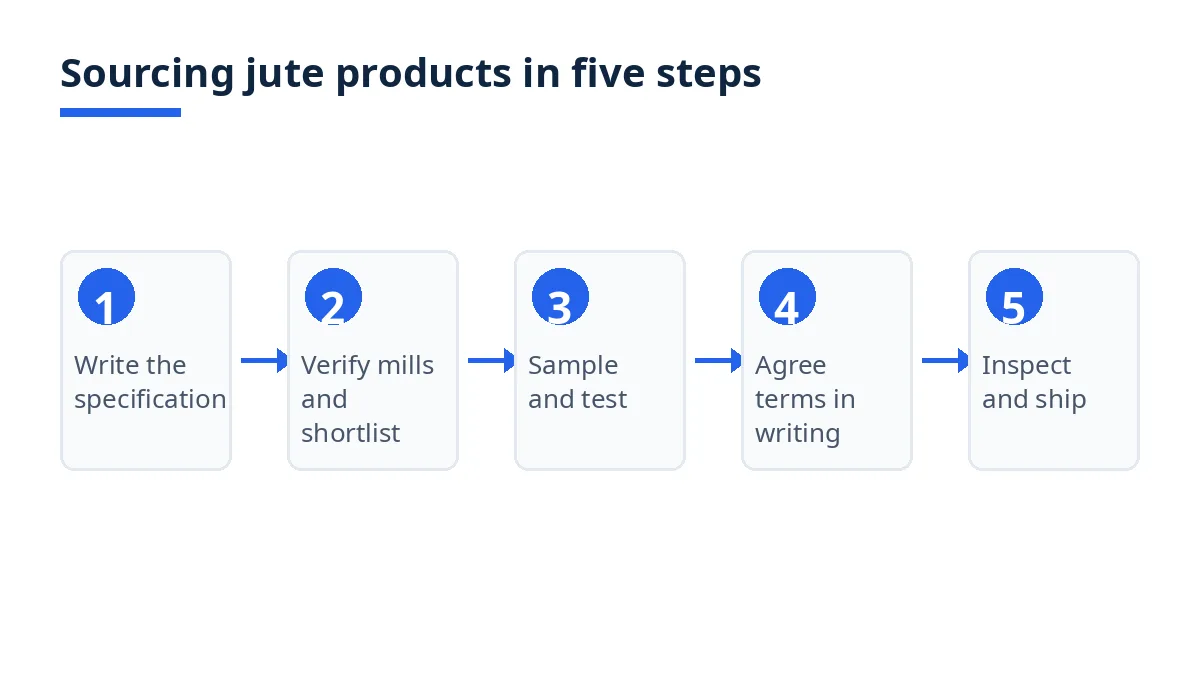
Write the specification sheet. One page per product: HS heading, fibre grade, yarn count or fabric construction, dimensions and weight, finish and print, food-grade status where food is packed, packing, target quantity per product, size and design, and destination market.
Build one RFQ and send it unchanged. Use the same specification, quantity split, destination and Incoterm for every candidate, with a quote deadline and a request for itemized pricing and a stated validity period. See how to write an RFQ for the field list.
Shortlist and verify. Confirm each mill is operational and who operates it, then run the document checks in the verification section before price talks go far.5 7
Sample and test. Order samples against the specification, test production-representative goods for the food-grade limit where it applies and for fibre composition where labelling depends on it, and approve a counter-sample in writing.8 9
Compare quotes on equal terms. Put every reply on one sheet at the same specification and Incoterm: MOQ per product and design, itemized unit price, validity period, staged lead time and inspection point.10
Confirm the order in writing. The purchase order carries the specification, the approved counter-sample reference, price and validity, the Incoterm with its named place, payment terms and the inspection point, so nothing rests on a message thread.6
Inspect and ship. Inspect finished goods against the counter-sample and specification before bales are closed and pressed, confirm the origin evidence your duty position depends on, then ship on the agreed term.11
Related guides
Read the jute products industry in Bangladesh pillar for capacity, clusters and key players behind this sourcing process, how to import from Bangladesh for the general import sequence, and Bangladesh export data for category scale. The guide to Incoterms for shipments from Bangladesh works through the delivery terms in more detail.
FAQs
Is Bangladesh a good place to source jute & jute products?
Yes, where you source mill by mill against a written specification. Bangladesh is the second biggest producer of jute after India,4 holds 266 licensed jute mills of which 193 are operational,5 and exported USD 820.16 million of jute and jute goods in FY2024-25.1 The constraints to price in are the fall from USD 1.16 billion in FY2020-21, low value addition in basic goods, and India's anti-dumping duties.1 The country label does not source the order; the specification, verification and sampling in this guide do.
What is the typical MOQ?
There is no published typical MOQ for jute products from Bangladesh, and no official body sets one. Each mill quotes its MOQ from its production stage: a spinning minimum per yarn count and ply, a loom and finishing minimum per fabric construction, or a cutting, stitching and printing minimum per bag size and design. State your target quantity per product, per size and per design in the RFQ, so every quote answers on the same basis.
How long is the lead time?
There is no standard lead time. Yours is the sum of its stages: raw jute purchase and grading, spinning, weaving, finishing, making-up where it applies, inspection and booking, and transit. The first stage is seasonal, because the crop is sown from around mid-March to April and harvested in full swing from July to the end of August, and a flood-affected harvest changes the fibre mills can buy.4 Ask for the stages separately and agree in writing what starts the clock.
Which certifications matter?
The requirements that matter are the ones your destination market and your buyers require for the exact product. For food packing, the operative standard is IJO Standard 98/01: non-toxic batching oil ingredients, unsaponifiables not exceeding 1,250 mg/kg, and lot testing under which one failed sample rejects the lot, for bags packing cocoa beans, coffee beans and shelled nuts.8 For the EU, fibre composition labelling under Regulation (EU) No 1007/2011 is a legal requirement for textile products, using the regulation's fibre names.9 Buyer-named audits and product schemes sit on top of that legal file and do not replace it; check each certificate by number, site, scope and validity in the scheme owner's register.
Next steps on Exportain
Browse Bangladeshi suppliers by jute product, check the market picture in Exportain trade intelligence, and post a free RFQ at Exportain RFQs with your specification sheet, quantity per product and design, and destination market, so mills quote against one written brief you can compare line by line.
Sources
- Exports of jute and jute goods keep falling. The Financial Express (accessed )
- What is the Harmonized System (HS)?. World Customs Organization (accessed )
- Harmonized System. World Customs Organization (accessed )
- Jute growers expect good yield. The Daily Star, (accessed )
- 9 state-owned jute mills back in production, rest to reopen by Dec: Minister. The Daily Star, (accessed )
- How to source and buy from Bangladesh. Exportain (accessed )
- Supplier verification: Earn trust badges buyers can see. Exportain (accessed )
- IJO Standard 98/01: Special Criteria for the Manufacture of Jute Bags used in the Packing of Selected Food Materials. International Jute Study Group (accessed )
- Regulation (EU) No 1007/2011 on textile fibre names and related labelling and marking of the fibre composition of textile products. European Union, (accessed )
- Incoterms® rules. International Chamber of Commerce (ICC) (accessed )
- EU trade relations with Bangladesh. European Commission, (accessed )
- Incoterms
- quality control
- Bangladesh Export Data
- Category Pillars
- Supplier Sourcing
- Jute Bangladesh
- Jute products
About the author
Sourcing from Bangladesh?
Post a request for quotation and suppliers on Exportain can send you their quotes directly.
Post an RFQ