Typical MOQ for Jute Bags in Bangladesh (and How to Negotiate It Down)
No single MOQ covers every jute bag: mills count containers, finished-bag makers count pieces per print. Here is what sets the number and how to bring it down.
Short answer
A jute-bag MOQ in Bangladesh has no single figure: a mill may set one 20-foot container, about 21 metric tons, for sacking, while bag suppliers list 100 pieces for custom orders to more than 10,000 for bulk. The minimum depends on bag type, fabric weight, print and setup, and it applies per size, colour or print. Buyers bring it down by sharing a fabric run, using a standard size, cutting print colours, committing to repeats, or paying a setup fee.
On this page
Key takeaways
A jute-bag MOQ has no single figure: mills count containers, finished-bag makers count pieces per print.
The minimum usually applies per size, colour or print, not per order total.
Fabric weight, weave grade, print colours and setup costs set the number.
Sharing a fabric run, using a standard size and cutting print colours lower the MOQ.
Paying a setup fee can cost less than buying bags you do not need.
Ask three Bangladeshi suppliers for the minimum order quantity (MOQ) on the same jute bag and you will get three different answers, because each one is counting something different. One counts pieces per print, one counts bales, and a mill counts a container load. This guide is for buyers who need a smaller first order, and it works through what sets the number and the levers that bring it down.
A jute-bag MOQ is not a fixed price list. It is the smallest run a supplier can make without losing money on fabric, setup and handling.
What does a jute-bag MOQ actually count?
A MOQ can be counted in pieces, in bales, in metres of fabric, in metric tons, or in containers, and the unit changes the size of the commitment. A Bangladeshi mill states its standard commercial MOQ as one 20-foot container, about 21 metric tons, for its sacking lines.1 A listing survey of Bangladeshi jute suppliers puts bag MOQs from 100 pieces for custom orders to more than 10,000 pieces for bulk orders, with fabrics from 99 metres and bulk yarn from 50 metric tons.2
Ask every supplier to state the MOQ in the unit that matches your order, and to say whether it applies per size, per colour, per print or per order total. A MOQ of 1,000 pieces sounds small until you learn it is 1,000 pieces per size, and your order has three sizes. A MOQ of one bale sounds small until you learn a bale holds 200 to 500 bags.1
The second thing to pin down is whether the MOQ is per variant. A new size needs new cutting and stitching setup, a new print needs a new screen, and a new fabric weight needs a new loom run. Suppliers treat each change as a separate run, so each change can carry its own minimum.
How does the MOQ change by bag type?
Bag type sets the MOQ band because it sets the fabric, the construction and the buyer. A promotional tote and a food-grade cocoa sack are both jute bags, but they are made on different lines, to different standards, for different buyers.
Bag type | What drives its MOQ | MOQ band to ask about |
|---|---|---|
Promotional tote, one-colour print | Print setup and a light fabric run | 500 to 1,000 pieces per print |
Retail shopping bag, laminated | Heavier fabric, lining, handles, print | 1,000 to 5,000 pieces per size and print |
Sacking bag, A-Twill or B-Twill | Bale packing and container filling | 200 to 500 bags per bale; mill orders by container |
Food-grade sack, VOT treated | Vegetable-oil batching and lab testing | One container or a full bale run per treatment batch |
Heavy-duty sack, 50 to 100 kg | Thick fabric, safety stitching, weight checks | Bale runs; ask per sack weight, not per order |
The bands in the table are ranges to ask about, not prices or promises. A buying guide for printed jute bags puts competitive pricing for wholesale printed bags at 500 to 1,000 units, with complex prints or custom shapes needing higher minimums.3
Sacking bags sit at the other end. One mill lists its A-Twill, B-Twill, Binola and D.W. flour sacks at 907 to 1,088 grams per bag, built for 50 to 100 kg of grain, rice, coffee or bulk sugar, packed in bales of 200 to 500.1
Food-grade sacks carry an extra driver: treatment and testing. Sacks for cocoa, coffee and edible goods are made with vegetable-oil batching, known as VOT, and tested for mineral oil hydrocarbons under the BfR Method 2009.1 A treatment batch and a lab test are fixed costs, so they push the minimum toward a full batch rather than a handful of bags.
What sets the number: fabric weight, print and setup?
Three inputs set most of a jute-bag MOQ, and each one is a question you can ask directly.
Fabric weight is measured in GSM, grams per square metre. A burlap fabric guide puts lightweight fabric at 100 to 180 GSM, medium fabric at 180 to 220 GSM for reusable retail bags and grocery totes, and heavy or industrial fabric at 220 to 300 GSM and above for grain, coffee, potatoes and sandbags.4 A heavier fabric needs more fibre per bag and a larger fabric run, so the minimum rises with the GSM.
Weave matters too. Jute sacking grades have names buyers should use in an enquiry: B-Twill is the standard for food-grade sacks, L-Twill is lighter and suits grains and produce, Binola is used for oilseed and heavy agricultural goods, and Heavy Cees is the extra-durable grade for industrial and bulk use.2
Print is the most common reason a small order gets a large MOQ. Screen printing is the durable and cost-effective method for bulk orders, while digital printing works better for smaller MOQs or complex artwork.3 If your quantity is low, ask for a digital-print quote alongside the screen-print quote. Each colour can add setup: a one-colour logo needs one screen and a four-colour design needs four.
Setup is everything a supplier does once per run: warping the loom, setting the cutting table, making screens, approving a pre-production sample, and packing the first bale. Those costs do not shrink when the order shrinks, so they set a floor under the MOQ. A guide to printed jute bags puts typical lead times at 3 to 6 weeks after pre-production sample approval, with 3 to 5 more weeks for sea freight from Asia.3 Standard items often come with free samples, while custom samples may carry a production fee.2
Which levers actually bring the MOQ down?
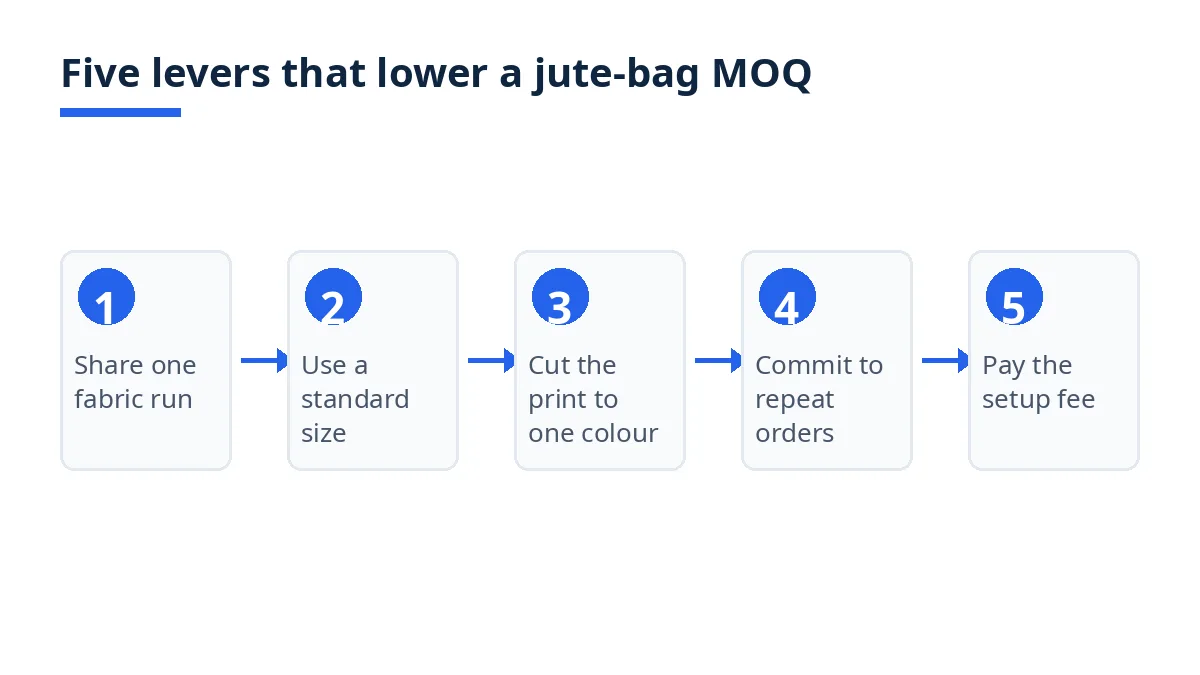
Five levers work, because each one cuts a fixed cost or shares it across more bags.
Share one fabric run. The strongest lever is to use a fabric the supplier already runs. Ask what GSM and width the supplier has on the loom this month, and design your bag around it.
Use a standard size. A standard size uses the supplier's existing cutting pattern and packing plan. A custom size needs a new pattern, a new cutting layout and a new carton plan.
Cut the print to one colour and one side. Each colour and each printed side adds setup. A single-colour print on one side is the cheapest setup a supplier can offer.
Commit to repeat orders in writing. A supplier that sees one order of 1,000 bags sees setup it must recover at once. A supplier that sees a written plan for 1,000 bags a quarter sees setup it can recover over four runs.
Pay a setup fee instead of volume. Some suppliers will run a small order if you pay the setup cost directly rather than through volume. Ask for the setup fee as a separate line, then compare it against the cost of the extra bags you do not need.
Worked example: one size instead of three
Example figures. A buyer needs 1,200 printed shopping totes for a retail launch: 400 small, 400 medium and 400 large, one print, 250 GSM fabric. The supplier quotes a MOQ of 1,000 pieces per size and print, at $2.10 per bag. That is 3,000 bags for an order of 1,200, and 1,800 bags the buyer does not need.
Option | Quantity | Unit price | Setup fee | Total |
|---|---|---|---|---|
Accept the per-size MOQ | 3,000 bags | $2.10 | $0 | $6,300 |
One standard size, one print | 1,200 bags | $2.40 | $0 | $2,880 |
One standard size plus a setup fee | 1,200 bags | $2.40 | $180 | $3,060 |
The arithmetic checks out: 3,000 times $2.10 is $6,300, and 1,200 times $2.40 is $2,880, plus the $180 setup fee is $3,060. The single-size order costs $3,240 less than the per-size MOQ order, and it leaves no unsold stock. The numbers here are illustrative, so use them as a method, not as a price: ask your supplier for its own per-size MOQ, unit price and setup fee, then run the same three-line comparison.
What should your RFQ ask, line by line?
An RFQ that asks the right questions gets a MOQ you can negotiate. Send one enquiry to three or more suppliers with the same specification, and ask each one for the same lines:
MOQ per size, per colour and per print, stated in pieces, and whether it applies per variant or per order total.
Fabric GSM and grade, with tolerance, and whether the fabric is a standard run or a custom run.
Print method, screen or digital, and how the MOQ changes with one colour instead of three.
Setup fees as separate lines: screens, loom setup, sample charge, and any treatment or testing charge.
Tiered prices at 500, 1,000, 3,000 and 5,000 units, so you can see where the unit price drops.3
Lead time from pre-production sample approval to dispatch, and sea-freight time to your port.
Packing: bags per bale, bales per container, and the container payload in metric tons.
Payment terms, and whether a letter of credit is required for the order size you want.
Mistakes that lock you into a high MOQ
The first mistake is asking for a MOQ before giving a specification. A supplier that does not know your GSM, size and print cannot quote a real minimum, so it quotes a safe one, and the safe one is high.
The second mistake is splitting one order into many variants. Three sizes, two colours and two prints can turn a 1,000-piece MOQ into a 12,000-piece commitment. Standardise first, then add variants back one at a time.
The third mistake is treating the lowest MOQ as the right offer. A supplier that offers 200 pieces for a complex printed bag may be quoting a digital print at a high unit price, or a thin fabric, or a supplier with no export experience. A printed-bag guide warns that unusually low MOQs can be a sign of inexperience.3 Compare the MOQ with the GSM, the print method and the unit price, not on its own.
The fourth mistake is forgetting the container. A MOQ in pieces means little if the order fills a tenth of a container and the freight per bag is higher than the bag itself. Ask for the freight per container and the bags per container, and work out the landed cost per bag before you accept a MOQ. The fifth is negotiating the MOQ and not the specification: if the supplier will not move on quantity, ask what specification change would move it.
Next steps on Exportain
For the wholesale picture, read Wholesale Jute Bags From Bangladesh, then use Jute Bags Manufacturers in Bangladesh to find makers and check them before you enquire. Confirm the classification in HS Code for Jute Bags and the inspection points in Jute Bags Quality Control Checklist. When you are ready, search Bangladeshi suppliers or post an RFQ with the specification and the MOQ questions from this guide, and read how to buy for the steps after you have ordered.
Sources
- Jute Bags Manufacturer In Bangladesh | SA Shamim Jute Mills. SA Shamim Jute Mills (accessed )
- Top Jute Product Manufacturers in Bangladesh | Eco-Friendly Solutions. Accio, (accessed )
- The Complete Buyer's Guide to Custom Printed Jute Bags for European Markets 2026. Jucofabs (accessed )
- Burlap Sacks Guide 2026 | Jute Sacks, Hessian Sacks & Gunny Bags. JuteBurlapSacks.com (accessed )
About the author
Sourcing from Bangladesh?
Post a request for quotation and suppliers on Exportain can send you their quotes directly.
Post an RFQ