Quality Control Checklist for Jute Sacks From Bangladesh
Product-specific QC checklist for jute sacks: sack fabric and weave, size and capacity, side and bottom seams, hem and mouth finishing, stitching, printing, moisture and odour checks, buyer-specified tests, and bale packing, with a numbered checklist, failure fixes, and a summary table.
Short answer
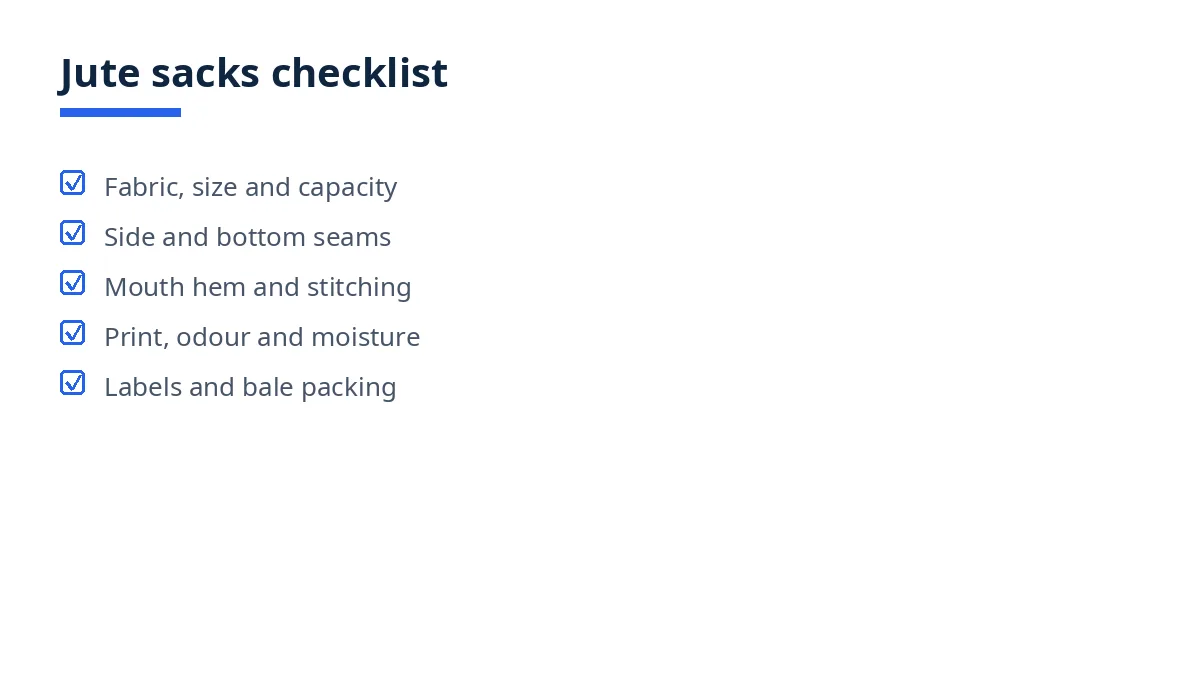
This jute sacks quality control checklist covers sack fabric and weave, fabric weight, size and capacity, side and bottom seams, hem and mouth finishing, stitching and thread, printing and branding, moisture and odour as buyer-specification items, labels, buyer-specified fabric and seam tests, and bale packing, with a numbered checklist, a published-table sampling example, failure fixes and a summary table.
On this page
A jute sack is judged at the filling line, not on a warehouse shelf. A sack that looks sound when empty can split along its bottom seam once filled, shed its mouth hem when lifted, or arrive with print too faint to read after handling. Those are sack failures, and they show up only when the check follows the sack through filling, lifting, stacking and bale opening.
This guide is a sack-first check: fabric, size, seams, mouth, stitching, print, odour and moisture, then bale packing and a sampling decision. Every test item names its method and asks for the result to be recorded against the order value. No item here carries a universal pass mark.
Why this checklist matters
A sack carries a load, so a seam fault is a spill, not a cosmetic flaw. Side seams hold the sack while it is filled, the bottom seam carries the weight when it is lifted, and the mouth hem is handled most often during filling and closing. A check that looks only at the outside of a bale will miss a weak bottom seam, a skipped stitch inside a hem, or a short sack.
Sacks travel in bales, so one fault repeats across hundreds of units. If weave, stitch type or print position is wrong on the approved sack, it is likely wrong across the lot. Catching it before shipment lets the buyer hold the lot, ask for sorting or rework, and re-inspect with a fresh sample.
Before you start
Freeze the reference set before inspection: one sealed approved sack, the purchase order, the sack specification, the intended contents and fill method, the defect list classed as critical, major or minor, the sampling plan, the bale packing specification, and the print artwork. Keep the approved sack sealed and separate from the lot.
Agree four things in writing in the purchase order: the defect list and the class of each defect, with reference photographs for borderline cases; the sampling plan, including the standard, the inspection level and the acceptance and rejection numbers for each class; each buyer-specified test, named with its method and result; and the bale packing and marking specification. AQL, defined in ISO 2859-1, sets how many units to sample and how many defective units can be found before the lot is rejected.1 A pre-shipment inspection is a sampling inspection of finished, mostly packed goods, not a check of every piece and not a guarantee.2 Book the final check when production is complete and goods are mostly packed.
The full checklist (numbered, printable)
Tick each item Pass, Fail, or Not applicable. Record sack, bundle and bale numbers.
Approved sack and intended contents. Each sack size and intended content has its own sealed approved sack.
Fabric construction. Check weave type and construction against the approved sack, including any lengthwise stripe the order calls for.3
Fabric weight, buyer-spec item. Record the fabric weight test method and result against the order value only.
Ends and picks, buyer-spec items. Record thread counts per unit length against the order value only; check the weave is uniform.
Sack size. Measure outside length and width flat, without stretching, against the order and the approved sack.
Capacity and fill behaviour. Fill a sample sack by the agreed method; check it holds its stated contents without seam or mouth strain.
Side seams. Check both side seams along their full length for stitch type, even tension and skipped stitches.3 4
Bottom seam and load path. Check the bottom seam and any bottom closure as the load-bearing seam when the filled sack is lifted.
Hem and mouth finishing. Check mouth hem depth, even turning and secure stitching; raw edges must not stay exposed where a finished mouth is required.3 4
Safety stitch where specified. Where specified, check the safety stitch is present along the inner edge of the main seam.
Stitching and thread. Check thread type and stitch density against the order; check for gap stitches, loose ends and frayed ends.4
Stitch tension and finishing. Check stitches are well tensioned and loose ends knotted or finished against unravelling.4
Selvedges. Check selvedges are firm and straight; record any crushed or damaged selvedge.
Weaving defects. Check for holes, missing picks, cuts, tears, floats, spots and stains.3
Printing and branding. Check print position, legibility and spelling against the artwork; branding material must be safe for food use where the sack will hold food.4
Stripe and mark position. Where specified, check stripe or woven mark position and count against the approved sack.
Colour and shade across bales. Compare colour bale to bale and bundle to bundle under the agreed light; keep differing lots apart.
Odour, oil, dirt and foreign matter. Check for odours untypical of jute, oil stains, dirt and foreign matter.4
Moisture content, buyer-spec item. Record the moisture test method and result against the order value only.
Fabric breaking strength, buyer-spec item. Record the breaking-load method and result for warp and weft against the order value only.
Seam strength, buyer-spec item. Record the seam-strength method and result against the order value only, from a sampled seam specimen.
Labels on sacks where specified. Where sacks carry labels, check content, spelling and position against the order.
Quantity per bundle and per bale. Count sacks per bundle and per bale against the packing list; no joined sack where the order forbids one.3
Bale make-up and covering. Check bale folding, binding and covering against the packing specification.3 4
Bale marks. Check bale marks for description, count, bale number and manufacturer identification.3
Sampling decision on the finished, packed lot. As a published-table example only, a lot of 281 to 500 sacks at General Inspection Level III gives code letter J and a sample of 80 sacks.1 With buyer-specified AQL 2.5 for major and AQL 4.0 for minor defects, the published table gives 5 and 6 for major defects and 7 and 8 for minor defects.1 Those are buyer-agreed order values, not standard-mandated values for jute sacks.5 A pre-shipment inspection samples finished, mostly packed goods, and is not a guarantee.2
Common failures and how to fix them
Bottom seam splitting on filling. A bottom seam that opens on filling points to seam construction or stitching that cannot carry the filled load. Hold the lot and check the bottom seam on a fresh sample.
Mouth hem unravelling during handling. A hem that comes undone on lifting or closing points to shallow turning, loose stitching or unfinished ends. Hold affected sacks and check hem depth and stitch finishing against the approved sack.
Sacks short for their stated capacity. A sack that strains at the seams when filled points to a size or capacity error. Hold the lot, re-measure length and width on a fresh sample, then re-check fill behaviour.
Skipped stitches along a side seam. A side seam with gaps will open under load even when the fabric is sound. Hold the lot and check side seams along their full length, not only at the mouth end.
Print that cannot be read after handling. Faint, misplaced or misspelled print causes sorting and destination problems even when the sack is sound. Hold affected bundles and compare print against the approved artwork.
Dampness, mould or strong odour inside a bale. Sacks smelling damp or showing mould inside a bale point to storage or packing before shipment. Hold the bale, trace storage, and keep damp bales apart from dry bales.
Mixed sacks under one bale mark. Bales holding two sizes, prints or lots under one mark send the wrong sack to the filling line. Hold the bales, re-sort by size, print and lot, and re-mark.
Downloadable template / summary table
No file download is offered with this article. The table below is the template.
Group | What to record | Result |
|---|---|---|
Fabric, size, capacity | Weave, fabric weight, ends and picks, length, width, fill result | Pass/fail |
Seams, hem, stitching | Side seams, bottom seam, mouth hem, safety stitch, thread, density, tension | Pass/fail |
Defects, print, colour | Weaving defects, print and stripe position, shade across bales | Pass/fail |
Odour, moisture, tests | Odour, oil, dirt, moisture method and result, fabric and seam tests | Pass/fail |
Labels, quantity, bales | Sack labels, sacks per bundle and bale, bale covering and marks | Pass/fail |
Sampling decision | Lot size, level, code letter, sample size, Ac/Re per class | Pass/fail |
Copy the table into the inspection report with lot number, date and inspector name, and attach photographs of every failed sack and bale mark.
How Exportain helps
Exportain does not inspect goods itself. A buyer can use this checklist to write the inspection into the purchase order, book an independent inspector against it, and compare the report with the order line by line. Inspection providers can be found through Exportain, but the inspection contract is between the buyer and the provider. Exportain supplier verification is a document and photo review, not a factory inspection, so it does not replace these checks.
FAQs
When should this checklist be used?
Use it at final inspection, when production is complete and sacks are mostly packed, and again after any rework, with a fresh sample.
Who should complete it?
The buyer's own inspector, a third-party inspector booked by the buyer, or the supplier quality team can each complete it, but roles must stay separate in the report. Whoever books the inspection receives the report.2
What are the most common failures?
The failures that recur here are bottom seams splitting on filling, mouth hems unravelling during handling, sacks short for their stated capacity, skipped stitches along a side seam, print that cannot be read after handling, dampness or mould inside a bale, and mixed sacks under one bale mark. Each is a sack-level fault, so a check that looks only at the outside of a bale will miss most.
Can a third party do it?
Yes. A pre-shipment inspection is usually arranged through an independent third-party firm, and the buyer sends that firm the purchase order, specification, approved sack details and bale packing requirements.2 Agree in the order who pays for re-inspection after a failure.
Next steps on Exportain
Read the AQL acceptance quality limit guide before fixing the sampling plan for a new order. Then read the pre-shipment inspection guide for the booking sequence and the pass, fail and re-inspection steps.
Sources
- AQL Calculator | Sample Size and ISO 2859-1 Tool. AQMBD (accessed )
- Pre-Shipment Inspection (PSI). Exportain (accessed )
- IS 12650: Textiles - Jute Bags for Packing 50 kg Foodgrains. Bureau of Indian Standards (accessed )
- Technical Specification Jute Sacks. Cocoa Federation (accessed )
- AQL Meaning: Acceptance Quality Limit, Tables. Exportain (accessed )
About the author
Sourcing from Bangladesh?
Post a request for quotation and suppliers on Exportain can send you their quotes directly.
Post an RFQ