How to Import Sweaters From Bangladesh in 2026: Complete Buyer Guide
End-to-end buyer guide to importing sweaters from Bangladesh: settle the duty first with the DCTS 0% preference, write one specification, approve the sample, agree the AQL plan, clear the Bangladesh export file, and land 3,000 cotton sweaters in the UK with a worked cost example.
Short answer
To import sweaters from Bangladesh, classify each style under heading 6110, confirm the duty for your market, and check the DCTS preference: men's cotton sweaters enter the UK at 0% under the preference instead of the 12% third-country rate. Send one specification to several suppliers, approve a pre-production sample in bulk materials, agree the inspection plan in the order, and clear customs with the certificate of origin and the Shipping Bill documents.
On this page
Key takeaways
Men's cotton sweaters enter the UK at 0% duty under the DCTS Comprehensive preference for Bangladesh, against a 12% third-country rate — claim it with origin evidence or pay the difference.
Sweaters sit under HS heading 6110, with the six-digit line set by fibre; the full 10-digit code comes from the destination tariff.
A 3,000-piece lot inspected at General Inspection Level II takes a 125-piece sample: accept 7, reject 8 major defects at AQL 2.5.
UK import VAT is 20% of the customs value plus duty and incidental expenses to the first UK destination, and a VAT-registered buyer reclaims it.
Importing sweaters from Bangladesh runs in a fixed order: the duty is settled first, the specification is written second, and the goods are inspected before the balance is paid. Bangladesh knitwear earned US$5,963.76 million in July to September 2026, up 6.88 per cent on the same quarter a year earlier, according to Export Promotion Bureau (EPB) data.1 In the same quarter, the US took US$2,220.86 million of Bangladeshi apparel and the UK US$1,292.13 million.1
What duty will you pay? Start there
Start with the duty, not the price, because it changes the landed cost more than any quotation line. Sweaters sit under Harmonized System heading 6110. The Harmonized System 2022 is the seventh edition of the nomenclature, in force from 1 January 2022.2 The first six digits are the same everywhere; each country then adds its own digits.3
For the United Kingdom, a men's cotton sweater takes the ten-digit commodity code 6110 20 91 00, with a third-country duty of 12.00 per cent.4 Bangladesh sits in the Comprehensive Preferences tier of the Developing Countries Trading Scheme (DCTS), which gives 0 per cent import tariffs on 99.8 per cent of products, and the same tariff line carries a 0.00 per cent DCTS Comprehensive preference.4 5 A qualifying shipment therefore pays no UK duty at all. Claim it on the declaration with proof of origin, meeting the rules of origin; without the claim, the 12 per cent rate applies. For the US and the EU, confirm the code and rate with your broker. For detail on the six-digit lines, read our HS code guide for sweaters.
The import in eight stages
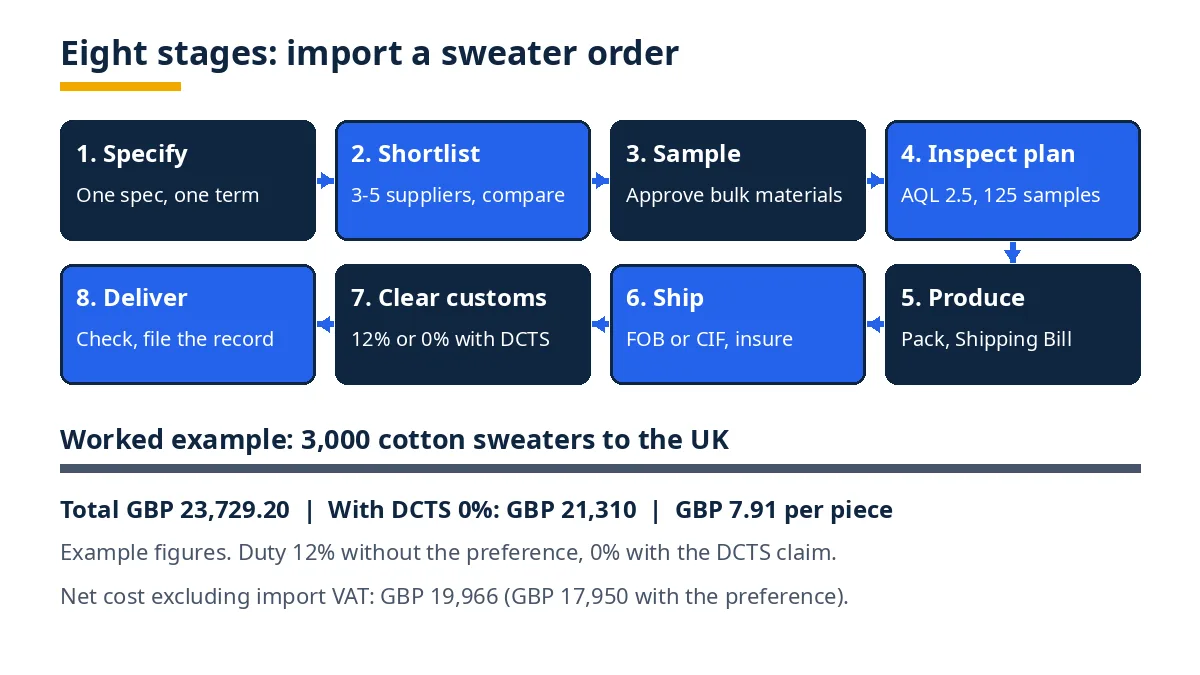
Write the specification. 2. Shortlist and compare quotations. 3. Approve the sample. 4. Set the inspection plan. 5. Produce, pack and file the export documents. 6. Ship and insure. 7. Clear customs. 8. Deliver and file the record.
Stage 1: Write one specification
Write the specification before you contact any supplier: style and silhouette, machine gauge, yarn fibre, count and ply, stitch structure, size chart with tolerances, colour references, trims, labels, packing, quantity per style, colour and size, tests, delivery term and destination. Send the identical document to every candidate, asking each to quote the same delivery term and packing, so the quotations compare line by line. For tech-pack depth, read our custom sweaters OEM guide.
Stage 2: Shortlist suppliers and compare quotations
Shortlist three to five suppliers whose range covers your gauge, yarn and quantity, and compare quotations line by line: yarn and knitting, linking, dyeing and finishing, trims, tests, packing and freight to the named place. Ask each supplier to state the minimum order quantity per style and per colour, and what sets it. Read our MOQ guide before you negotiate.
Settle the delivery term before you compare prices. The Incoterms 2020 rules set out 11 rules that allocate cost, risk and obligations between buyer and seller.6 Under FOB Chattogram the seller delivers on board and you arrange the sea leg and insurance; under CIF the seller arranges carriage and insurance; under DAP the seller carries the goods to your warehouse and you clear customs.6 For the full comparison, read our Incoterms guide.
Stage 3: Approve the sample before bulk
Approve in stages, each in writing: a knitted swatch in the production yarn and gauge, a proto sample for construction, then a pre-production sample in bulk yarn, bulk colour, bulk trims and bulk labels, washed, finished and measured after washing. Approve each lab dip against the physical reference. Keep one sealed, washed sample as the reference for bulk and for inspection. Do not let bulk start on a sample in substitute yarn or an unwashed garment.
Stage 4: Put the inspection plan in the order
Write the inspection into the purchase order before production starts: who inspects, when, against which references, and what happens on rejection. The sampling follows ISO 2859-1, and General Inspection Level II is the default for visual checks.7 For a lot of 3,000 sweaters at General Inspection Level II, the code letter is K and the sample is 125 pieces: at AQL 2.5 for major defects, accept 7 and reject 8; at AQL 4.0 for minor defects, accept 10 and reject 11.8 The current edition is ISO 2859-1:2026; name it in the order.8 Agree the defect classes in writing and draw the sample at random across sizes, colours and cartons. Our sweaters quality control checklist turns these points into inspector checks.
Stage 5: Production, packing and the Bangladesh export file
Check panels after knitting, linked bodies after linking, and finished garments before packing. Pack to the order: fold, polybag, carton assortment by size and colour, carton marks, gross weight, and a packing list that matches the cartons. Before the goods can load, Bangladesh Customs requires a Shipping Bill. The documents for it are the export letter of credit, telegraphic transfer or purchase order, or the export contract or guarantee approved by the negotiating bank. Add a signed commercial invoice and a packing list, the EXP form certified by an Authorized Dealer, the Export Registration Certificate, a certificate of origin for the preference claim, a VAT registration certificate and a taxpayer identification number.9 The certificate of origin supports the DCTS preference claim, so ask for it as part of the export file.
Stage 6: Ship, insure and track
On FOB terms, book the freight and insurance yourself and confirm the sailing. On CIF terms, check the insurance certificate: the default cover is Institute Cargo Clauses (C), and you can agree a higher level.6 The bill of lading is the carrier's receipt and the contract to carry the goods, issued by the carrier to the shipper.9 Ask for the bill of lading and container numbers as soon as they exist. No single transit time applies from Chattogram: work from your forwarder's current schedule.
Stage 7: Clear customs and pay duty and VAT
Give your broker the code, the certificate of origin and the DCTS claim before the vessel arrives. Without the claim, duty is charged at the 12 per cent third-country rate.4 Import VAT is charged at the standard rate of 20 per cent in the UK.10 The value for VAT is the customs value plus any duty payable and the incidental expenses up to the goods' first destination in the UK.11 A VAT-registered business reclaims the import VAT as input tax, with a C79 certificate as evidence, or through postponed VAT accounting.10 Keep the declaration, certificate of origin, invoice, packing list and bill of lading in the order file.
Worked example: 3,000 cotton sweaters to the UK
Every number below is an example figure only. Example figures: 3,000 men's cotton crew-neck sweaters, FOB Chattogram to Felixstowe, delivered to a UK warehouse, with the duty shown with and without the DCTS preference claimed.
Cost element | No preference (GBP) | DCTS 0% claimed (GBP) |
|---|---|---|
Product price, FOB Chattogram | 15,000 | 15,000 |
Freight and insurance | 1,800 | 1,800 |
Customs value (CIF) | 16,800 | 16,800 |
Duty at 12% / 0% of 16,800 | 2,016 | 0 |
Value for VAT | 18,816 | 16,800 |
Import VAT at 20% | 3,763.20 | 3,360 |
Customs broker fee | 350 | 350 |
Port handling | 420 | 420 |
Delivery | 380 | 380 |
Total cash outlay | 23,729.20 | 21,310 |
Net cost ex-VAT | 19,966 | 17,950 |
Cost per piece | 7.91 | 7.10 |
Check it: 15,000 plus 1,800 is 16,800; 12 per cent of 16,800 is 2,016; 20 per cent of 18,816 is 3,763.20; the lines add to 23,729.20, less the VAT 19,966. With the preference claimed, the total is 21,310: a saving of 2,419.20. A VAT-registered buyer reclaims the import VAT, so the lasting cost is the net figure. Broker, port and delivery charges sit outside the VAT value here; HMRC requires incidental expenses up to the first UK destination in the value for VAT.11
Labels: fibre, origin and care
Labels are a market rule, not a factory choice. For the United States, the label must show the fibre content, the country of origin and the business responsible for the item, and care labels are required under a separate rule.12 Confirm the origin wording against where the product was processed or manufactured.12 For the EU, confirm the fibre wording, label language and care information with your market-compliance contact before printing. Check every label element on a printed proof, and keep the approved proof in the order file.
Five mistakes that cost importers money
Paying 12 per cent duty when 0 per cent was available. The DCTS preference is claimed on the declaration with proof of origin. If the certificate of origin was never requested, the claim cannot be made and duty is charged at the third-country rate.
Comparing quotations on different delivery terms. A CIF price includes the sea leg and the insurance; an FOB price stops at the vessel. Put one Incoterms rule and one named place on every quotation before you compare them.
Filing the six-digit code on the declaration. The six-digit HS code is only the start: a UK declaration needs the full ten-digit commodity code, and the duty follows the full code.3
Shipping before the export file is complete. Goods cannot load until the Shipping Bill is approved, and it needs the EXP form, the invoice, the packing list and the certificate of origin.9
Paying the balance before the inspection report is read. Put the inspection plan, sample size and accept and reject numbers in the order before production.8 If the report arrives after the money has moved, a failed lot becomes a negotiation.
Import checklist
File the evidence for each line.
Duty and code confirmed: heading 6110, full national code, DCTS claim, origin evidence.
One specification sent to every candidate, with the delivery term, packing and destination stated.
Three to five quotations compared on the same terms, MOQ per style and colour stated.
Swatch, proto and pre-production samples approved in writing, in bulk materials, washed and measured.
Inspection plan in the order: standard, level, AQL values, sample size, accept and reject numbers.
Order confirmed: specification version, quantities, price, payment terms, test plan, packing, shipment date.
Export file complete: Shipping Bill documents, EXP form, certificate of origin, invoice, packing list.
Freight and insurance booked, bill of lading number received, sailing tracked.
Broker holds the code, the certificate of origin and the DCTS claim before the vessel arrives.
Goods received and checked; order file closed with declaration and inspection report.
FAQs
What duty do sweaters from Bangladesh pay in the UK?
Commodity code 6110 20 91 00 carries a third-country duty of 12.00 per cent.4 Bangladesh sits in the DCTS Comprehensive Preferences tier, so a qualifying shipment pays 0 per cent when the preference is claimed with proof of origin.5
Can I import sweaters without a customs broker?
You can file the declaration yourself, but a first-time importer is better served by a licensed broker, who confirms the code, claims the preference and works out the VAT value.
Do I need a certificate of origin?
You need one to claim the DCTS preference at the UK border. It is issued by the Export Promotion Bureau or a Chamber of Commerce and Industry.9
How Exportain helps
Browse suppliers for Bangladeshi knitwear exporters, then post an RFQ with the specification, quantities, delivery term and inspection plan. Exportain is a B2B marketplace; it does not inspect goods, book freight or clear customs, and badges are document and photo reviews, not factory inspections.
Next steps on Exportain
Open how to import from Bangladesh first for the end-to-end process, then use how to buy for the buying steps, and post an RFQ with the specification, the tariff code and the inspection plan.
Sources
- RMG exports rise 6.10 percent to US$10.58b in July-Sept of FY27. Bangladesh Sangbad Sangstha, (accessed )
- HS Nomenclature 2022 edition. World Customs Organization (WCO) (accessed )
- HS Code vs Tariff Code: UK Commodity Codes. TariffTel, (accessed )
- UK Trade Tariff commodity 6110 20 91 00. UK Trade Tariff (accessed )
- Preference tiers under the Developing Countries Trading Scheme. GOV.UK (Department for Business and Trade), (accessed )
- Incoterms® 2020. International Chamber of Commerce (ICC) (accessed )
- How The AQL Inspection Levels In ISO 2859-1 Affect Sampling Size. QualityInspection.org, (accessed )
- AQL Chart 2.5 and 4.0: Sample Size Tables Explained. ClearLoad (accessed )
- Bangladesh Trade Portal FAQ: Export Registration Certificate (ERC). Bangladesh Trade Portal (accessed )
- UK Import VAT Explained: When, How Much & How to Reclaim. LogisticsEdge (accessed )
- Working out the VAT value using the customs value of the imported goods. GOV.UK (accessed )
- Threading Your Way Through the Labeling Requirements Under the Textile and Wool Acts. Federal Trade Commission (accessed )
About the author
Sourcing from Bangladesh?
Post a request for quotation and suppliers on Exportain can send you their quotes directly.
Post an RFQ