Quality Control Checklist for Sweaters From Bangladesh
Sweater quality control checklist for Bangladesh orders: gauge and stitch density, measurements, color and shade, linking, pilling, shrinkage, trims, labels, and packing, with a numbered checklist, failure fixes, and a summary table.
Short answer
This sweater quality control checklist covers knit construction, gauge and stitch density, measurements, color and shade, linking and seams, pilling, shrinkage, colorfastness, seam strength, trims, labels, and packing. Use it on samples, during production, and on finished, packed goods, with the approved sample, measurement method, defect list, and buyer-specified sampling plan agreed before the final inspection.
On this page
A sweater that looks right on a hanger can still fail in the hand, on the body, or after washing. Knit fabric stretches, relaxes, and changes with finishing, so a visual check alone does not settle quality. This checklist is built for sweaters: knit construction first, then measurements, color, surface, trims, labels, and packing.
Why this checklist matters
Sweater quality problems are often construction problems. A sweater inspection account lists measurement accuracy, linking alignment, loose ends, skipped stitches, seam ridges, pilling, stains, uneven tension, snags, and color and shade consistency as core points.1
A checklist also prevents an argument about whether a fault is a defect at all. The same account notes that brands set agreed tolerances and AQL levels at a pre-production meeting, before bulk work starts.1
Before you start
Gather the reference set first.
Approved sample and tech pack. Keep the sealed, approved sweater with its tech pack, yarn details, gauge, stitch structure, and finishing route. A first-sample guide advises checking fit, hand feel, surface and density, measurements, make-up, and finishing in that order.2
Measurement method in writing. State each point, the lay-flat condition, and whether the sweater is measured relaxed or stretched. The same guide warns that all measurements must be checked in the same condition every time.2
Defect list with classes. Write which faults count as critical, major, or minor for this sweater, with photos for borderline cases.
Sampling plan in writing. Record the standard, inspection level, and AQL values the buyer has specified per defect class, plus the action on a fail: rework, sort, remake, or re-inspection. AQL figures here are buyer-specified values only, never a universal rule for sweaters.
Light, wash, and test details. Record the light source for color, the wash cycle for shrinkage and pilling, and the lab method for each test.
The full checklist (numbered, printable)
Work through the list in order. Mark each item pass, fail, or not applicable, and photograph every fail.
Yarn and knit structure. Fiber content, yarn count, and stitch structure against the tech pack.
Gauge and stitch density. Gauge and stitch density against the sample; stitch definition close up and at normal distance.2
Fabric weight and evenness. Weight consistency across batches; uneven tension, barre, and mis-knit sections.1
Chest width. Chest width in the agreed lay-flat condition, against the chart and buyer-specified tolerance.
Body length. Body length the same way, front and back, checking both match the chart.
Shoulder width. Shoulder width, slope, and symmetry, left and right.
Sleeve length and width. Sleeve length and width, checking both sleeves match.
Neck opening and ribs. Neck opening, cuff and hem width; rib recovery after gentle stretch.2
Color against the standard. Color against the approved standard under the agreed light; shade between pieces, panels, and body and rib.
Color under a second light. Repeat the shade check under daylight and artificial light.1
Linking and seams. Linking alignment, seam ridges, skipped stitches, loose ends, and open seams, especially at shoulder, armhole, and rib joins.1
Surface and fabric faults. Holes, snags, pulls, stains, oil marks, and distortion, front, back, and inside.1
Pilling check. Fuzz and pills; lab pilling method, condition, and grade for the lot. Pilling tests rub or tumble specimens and compare them with reference photos, and methods are not interchangeable, so the spec must name one.3
Shrinkage and dimensional change. Same points before and after the agreed wash cycle, against the buyer-specified allowance. No universal shrinkage percentage is stated here. One sweater account lists dimensional stability and shrinkage after washing among its lab tests.1
Colorfastness evidence. Lab report covering colorfastness to washing and rubbing under the named methods, against the buyer specification.
Seam strength evidence. Linked and stitched seams checked for strength under tension where the buyer specification requires it.1
Trims and attachments. Buttons, zippers, and drawcords: correct type, color, position, secure attachment, and working closure.
Labels. Fiber content, care, size, and origin labels: correct content, spelling, and position; size label matching the measured size.
Hangtags and barcodes. Hangtags correct and correctly placed; barcodes scanned where required.
Folding and packing. Folding, polybag size and sealing, and carton assortment by size and color against the packing list.
Carton and shipping marks. Carton dimensions, gross weight, and shipping marks against the packing instructions.
Sampling decision. Agreed plan applied to the finished, packed lot; defects by class; lot decided only on counts against the agreed acceptance and rejection numbers.
Common failures and how to fix them
Dropped stitches and holes. An isolated fault may be repaired to the buyer specification; a repeated fault points to knitting or linking that must be corrected before more units are made.
Linking misalignment and seam ridges. Re-link the join to the approved construction, then re-measure the shoulder and sleeve points it controls. Pressing alone does not fix a linking fault.
Uneven tension and distortion. Check gauge and stitch density against the sample first, since a density change can explain a shape change. If bulk density has drifted, the correction is a knitting correction, not a pressing correction.
Shade variation between pieces and panels. Ribs and body may come from different lots, so this is a sweater-specific risk. Sort by shade only if the buyer specification allows it, and hold any lot that cannot be matched to the approved standard.
Pilling after washing. Pilling is friction damage: loose fiber ends rise, tangle, and form small balls.3 A result taken only before washing can mislead, because a fabric that passes before washing can fail after a laundry cycle, so the spec should state whether the test runs before or after washing.3
Shrinkage that moves a size. If washed measurements fall outside the buyer-specified allowance, correct the knitting, finishing, or wash route, then measure the corrected lot again after washing.
Twisted or uneven ribs. Check rib measurements in the same relaxed or stretched condition used for the sample, and check recovery after gentle stretch.2 A rib fault repeating across sizes is a construction fault.
Wrong or missing labels and barcodes. A wrong size label, missing care label, or unscannable barcode can fail a lot even when the sweater is sound. Check content, spelling, position, size match, and barcode scan on sampled units in each size.
Packing and assortment errors. A correct sweater in the wrong carton, size ratio, or color ratio is still a failed shipment. Check carton assortment against the packing list during the final inspection.
Downloadable template / summary table
No file download is offered with this article. Copy the table below into your own inspection sheet, add your buyer-specified tolerances and AQL values, and use one row per group.
Checklist group | What to record | Decision |
|---|---|---|
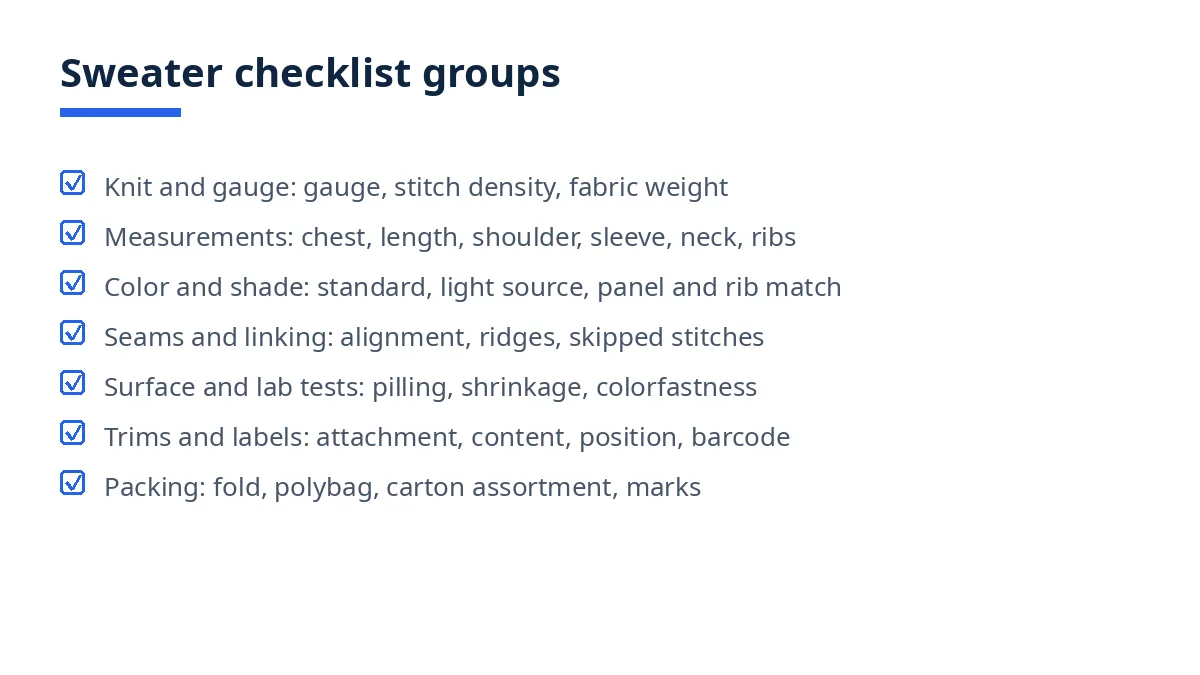
Knit and gauge | Gauge, stitch density, fabric weight, sample compared with | Pass, fail, or not applicable |
Measurements | Chest, body length, shoulder, sleeve, neck, ribs, method used | Inside or outside buyer-specified tolerance |
Color and shade | Standard, light source, piece, panel, and rib match | Match or shade variation |
Seams and linking | Linking alignment, ridges, skipped stitches, loose ends | Pass or rework |
Surface and lab tests | Pilling method and grade, shrinkage after agreed wash, colorfastness, seam strength | Against buyer specification |
Trims and labels | Trim type and attachment, label content, position, size match, barcode scan | Pass or correct |
Packing | Fold, polybag, carton assortment, marks, weight | Match packing list or correct |
Sampling decision | Lot size, sample size, defects by class, acceptance and rejection numbers | Accept or reject |
For the sampling row, use the standard table values for your agreed plan. As a published example only, one apparel AQL guide gives, for a lot of 1,201 to 3,200 units at General Inspection Level II, a sample size of 125, with acceptance and rejection numbers of 7 and 8 for major defects at AQL 2.5 and 10 and 11 for minor defects at AQL 4.0.4 The Exportain AQL guide shows the same values and stresses that the AQL numbers are what buyer and supplier agree and write into the purchase order, not values the standard mandates for apparel.5 A pre-shipment inspection is a sampling inspection of finished, mostly packed goods, not a check of every piece and not a guarantee.6
How Exportain helps
Exportain does not inspect goods itself, and its supplier checks are document and photo reviews, not factory inspections.6
Use Exportain to put the checklist into the order. Post the sweater requirement, including the approved sample reference, measurement method, defect list, lab test methods, and sampling plan, so suppliers reply against the same specification. Note that the Exportain inspection services category page currently renders "No services published in this category yet", so do not rely on that page for a listed provider: arrange inspection directly with a provider and record the booking in the purchase order.
FAQs
When should this checklist be used?
Use it at three points: on the first sample, during production when a fault can still be corrected, and on finished, packed goods before shipment. A sweater account describes pre-production checks on yarn, color, and wash performance, in-line checks on linking and stitch consistency, and final checks on bulk measurement and shading.1
Who should complete it?
The buyer, the supplier, and any third-party inspector should all work from the same checklist. The supplier checks its own work during production; the buyer, or an inspector working to the buyer's checklist, makes the sampling decision on finished goods. Name whoever signs the final decision in the purchase order.1
What are the most common failures?
The most common failures here are dropped stitches and holes, linking misalignment and seam ridges, uneven tension and distortion, shade variation between pieces and panels, pilling after washing, shrinkage that moves a size, twisted or uneven ribs, wrong or missing labels, and packing and assortment errors. Each is listed above with its fix.
Can a third party do it?
Yes. A pre-shipment inspection is usually arranged through an independent third-party firm, and whoever books it is the firm's client and receives the report, so if you book it, the inspector works to your checklist and pass criteria.6 Give the firm the full reference set: purchase order, specification, approved sample details, measurement chart, artwork and labeling files, and packing requirements.
Next steps on Exportain
Write the sweater specification, measurement method, defect list, and sampling plan into one requirement, then read the AQL guide and the pre-shipment inspection guide before you set values. Post the requirement through RFQs.
Sources
- Clothing Inspection: How Brands Ensure Sweater Quality with QC & AQL Standards. HD Merino (accessed )
- What to Check on Your First Knitwear Sample. Dalang Knitwear (accessed )
- The Truth About Fabric Pilling: Tests and Resistance Grades. Wave PLM (accessed )
- AQL Inspection in Apparel: A Practical Guide (2026). Wave PLM (accessed )
- AQL Meaning: Acceptance Quality Limit, Tables. Exportain (accessed )
- Pre-Shipment Inspection (PSI). Exportain (accessed )
About the author
Sourcing from Bangladesh?
Post a request for quotation and suppliers on Exportain can send you their quotes directly.
Post an RFQ