

Custom Sweaters Manufacturer in Bangladesh: OEM Tech Pack to Bulk
Custom sweaters OEM in Bangladesh runs through stage gates: tech pack, yarn and lab-dip, proto, salesman and pre-production samples, then bulk with inline checks. What to approve at each gate, and what to leave unwritten.
Short answer
An OEM custom sweater order in Bangladesh runs through written stage gates: a tech pack, yarn and lab-dip approval, proto and salesman samples, a pre-production sample in bulk materials, and bulk production with inline checks. Approve each gate in writing, with the inspection basis and delivery term in the purchase order, before bulk starts.
On this page
Key takeaways
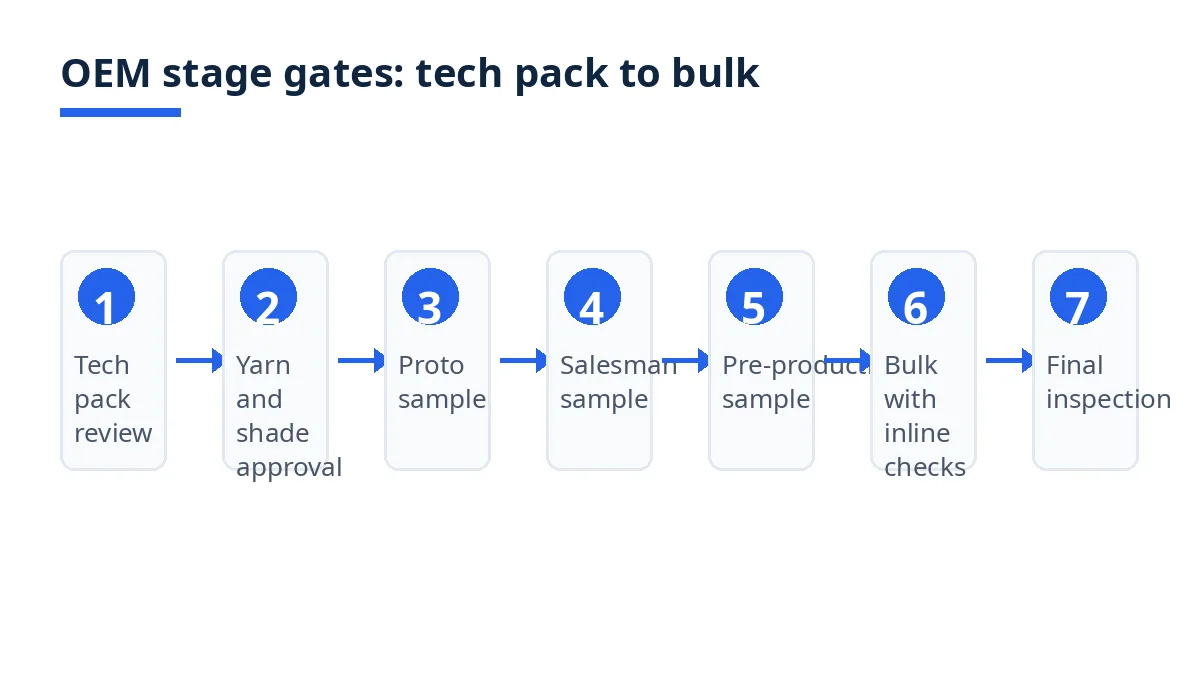
A custom sweater OEM order in Bangladesh is a sequence of written stage gates: tech pack review, yarn and shade approval, proto, salesman and pre-production samples, bulk with inline checks, and final inspection.
The tech pack must settle gauge direction, yarn and color route, stitch structure, measurements and tolerances, construction, trims, labels, and packing before yarn is ordered.
Judge the pre-production sample in bulk yarn, bulk color, bulk trims, and bulk labels, measured after washing and finishing, before bulk starts.
Write the inspection level, AQL values, and acceptance numbers into the purchase order, and state one Incoterms 2020 rule with one named place on every quotation.
Exportain verification is a document and photo review, not a factory inspection, and a badge is not a guarantee of capacity, quality, or delivery.
Send one tech pack to three factories in Bangladesh and the proto samples will rarely match. A custom sweaters manufacturer in Bangladesh working on an OEM basis does not sell a finished sweater from a catalog. The factory knits, links, washes, and finishes to the buyer specification, and each approval gate between tech pack and bulk decides the final garment.
The supplier pool is the knitwear sector. The Bangladesh Knitwear Manufacturers and Exporters Association (BKMEA), established in 1996, is the apex trade body for the knitwear sector and represents approximately 2,540 knitwear member factories.1 Knitwear exports reached $5.96 billion in July to September 2026, up 6.88 percent year on year, within ready-made garment exports of $10.58 billion, according to Export Promotion Bureau (EPB) data.2
The OEM process in one view
An OEM order moves through gates. Each gate has one item to judge and one written decision. A skipped gate passes its uncertainty to the next stage.
Gate | Item judged | Decision recorded |
|---|---|---|
1. Tech pack review | Specification, gauge direction, yarn direction | Feasible, or revised before sampling |
2. Yarn and color | Lab-dip, yarn, and shade direction | Shade approved, or revised and re-dipped |
3. Proto sample | Construction and stitch direction | Proceed, revise, or stop |
4. Salesman sample | Finished garment in the selling color range | Selling sample approved for orders |
5. Pre-production sample | Bulk yarn, color, trims, and labels | Approved for bulk, or corrected and re-sampled |
6. Bulk production | Inline checks at knitting, linking, and finishing | Continue, correct, or hold a lot |
7. Final inspection and packing | Finished garments, measurements, and cartons | Ship, rework, or hold |
A published sweater flow lists the factory order as lab-dip, yarn sourcing, winding, yarn distribution, knitting, first inspection, linking, second inspection, light checking, third inspection, labeling, ironing, quality control, final inspection, and packing.3 The factory runs the machines. You run the decisions.
Why the stage gates matter for buyers and sellers
For the buyer, the gates protect money committed before bulk. Yarn dyed to a buyer color, panels knitted to a buyer pattern, and labels printed with a buyer name cannot be resold. Approving each stage in writing keeps a change cheap while it is still a sample.
For the seller, the gates protect the production plan. A factory that starts knitting before the shade, gauge, and measurement direction are settled will knit, stop, and re-knit. A written approval at each gate gives the factory a fixed target for yarn, machine time, and linking capacity.
Quotations also depend on the gates. One price may assume stocked yarn and an approved shade, another dyed-to-order yarn and a fresh lab-dip round. Compare quotations only when the assumptions match: same tech pack, yarn and color route, sample stages, inspection basis, and delivery term.
Step-by-step: from tech pack to bulk
Send one tech pack to every candidate. Include style, silhouette, stitch structure, gauge direction, yarn fiber and count direction, color references, size chart, artwork method and placement, trim and label requirements, and packing.
Ask for a feasibility reply, not only a price. Ask each factory to confirm the gauge, the yarn, whether the yarn is stocked or dyed to order, and which sample stages the price includes. A factory that cannot knit the gauge direction is the wrong factory.
Approve the yarn and color direction. The lab-dip is developed against the buyer swatch or color reference first, before yarn is committed in bulk quantity.3 Approve the shade against the physical reference, in the light the end customer will use.
Judge the proto sample on construction. Check panel shape, neckline, shoulder and sleeve joins, stitch definition, and proportion. List every correction in writing.
Judge the salesman sample as a selling garment. It should be the finished garment in the selling color range, with trims and labels as they will appear. Confirm the range with your own customers before bulk quantities are fixed.
Approve the pre-production sample in bulk materials. This gate matters most. The sample must use bulk yarn, bulk color, bulk trims, and bulk labels, and go through the intended washing and finishing route. Measure it after washing.
Run bulk with inline checks. Panels are checked after knitting, linked bodies after linking, and garments pass through light checking and measurement checks before packing.3 Agree who checks each stage and what happens on failure. A failure found at knitting costs panels. Found at packing, it costs finished garments.
Inspect, pack, and ship against the approved sample. Final inspection compares finished garments with the approved pre-production sample and the written specification. Keep the approved sample sealed as the reference for any later question.
What the tech pack must settle before knitting starts
Most OEM disputes are tech pack disputes. The drawing looked complete, but the factory had to guess one value, and the two sides guessed differently.
Gauge and stitch structure. Machine gauge is the number of knitting needles per inch, with lower numbers producing coarser stitches and higher numbers producing finer stitches.4 As starting points, 3GG to 5GG is commonly used for chunky knitwear, 7GG to 10GG for mid-gauge products, and 12GG to 18GG for finer knitwear, but the final fabric still changes with yarn, stitch structure, machine setup, washing, and finishing.4 State gauge direction with yarn and stitch structure.
Yarn and color route. State fiber composition, yarn count and ply direction, whether each color is stocked or dyed to order, and the color reference for each colorway. Yarn is allocated by weight after winding and distribution,3 so a late color change reaches back into yarn planning.
Measurements and tolerances. State every measurement point, size range, size ratio, and tolerance, and whether measurements are taken before or after washing. A tolerance only works if both sides measure the same points on a garment finished the same way.
Construction details. State the neckline, shoulder, sleeve, hem, and pocket construction, the linking method for each join, and the finishing route. Panels are linked into a complete sweater in the linking section, then checked, trimmed, light-checked, and mended before labeling and ironing.3
Trims, labels, and packing. State every trim, label content and placement, hang tag, polybag, and carton assortment by style, color, and size. Labels are attached after the measurement check,3 so a late label change still interrupts packing.
Costs, timelines and documents
No single price or lead time describes a custom sweater order. Price follows yarn, gauge and stitch structure, color route, trims and labels, quantity per style and per color, packing, and delivery term. Timeline follows sample gates, dyeing route, and loading. Ask for both against the same gate plan, in writing.
Example figures: a buyer orders 3,000 pieces in three colors at 1,000 per color. If the pre-production sample fails its shade check, only dyeing and sampling repeat. If the same failure is found only at final inspection, the bulk garments are already knitted and linked. The example shows why gate timing matters. It is not a typical price, quantity, or lead time.
The delivery term must be settled before quotations are compared. The Incoterms 2020 rules provide 11 rules with a clear allocation of cost, risk, and obligations.5 State one rule and one named place on every quotation. A price that looks lower because it stops at a different place is not a lower price.
Bangladesh Customs lists, for export clearance, the export letter of credit or, where there is none, the export contract, purchase order, or export guarantee approved by the negotiating bank, plus a signed commercial invoice, a packing list, an EXP form certified by an authorized dealer, a certificate of origin, a VAT registration certificate, and a taxpayer identification number.6 For ready-made garments under a bonded warehouse, a Utilization Declaration is also listed.6 Confirm the set with the factory and freight handler before booking, and name the party responsible for each document in the purchase order.
Bangladesh-specific rules and tips
Classify the product correctly. Heading 6110 covers jerseys, pullovers, cardigans, waistcoats, and similar articles, knitted or crocheted.7 Use the correct heading and subheading for the exact garment, and confirm it with the customs broker or freight handler for the destination market.
Confirm the market label rules early. Regulation (EU) No 1007/2011 covers textile fiber names and related labeling and marking of the fiber composition of textile products.8 For European Union sales, confirm the fiber name and composition presentation, label language, and care information with the party responsible for market compliance before labels are printed.
Check the inspection basis before production. ISO 2859-1 defines a system of acceptance sampling plans for inspection by attributes, indexed by acceptance quality limit (AQL) for lot-by-lot inspection.9 AQL is the maximum average percentage of defective items considered acceptable during random sampling.9 Write the inspection level, AQL values, and acceptance and rejection numbers into the purchase order. The purchase order supplies the agreed values for this order.
Plan around yarn and energy pressure, and treat the association record as a starting filter. EPB data for July to September 2026 showed knitwear growth alongside exporter concern about gas and electricity shortages disrupting production and fabric availability.2 Ask before booking how yarn supply and scheduling are protected for the order dates. BKMEA membership shows a factory sits inside the organized knitwear sector,1 not that it can knit a given gauge or meet a given date. Check the gauge, sample record, and loading separately.
Mistakes and red flags
Approving a shade from a photo. A screen changes color. Approve the lab-dip and dyed yarn against the physical reference, in agreed light, and keep the approved reference sealed.
Approving an unfinished sample. A panel that has not been washed, steamed, or brushed has not been tested. Approve the pre-production sample only after the full finishing route, measured after washing.
Changing the gauge mid-order. Moving a style to a different gauge changes the yarn, stitch counts, artwork scale, and costing.4 Treat it as a new development, with a new sample and a revised quotation.
Comparing quotations on different gate assumptions. A quotation that excludes a sample stage or assumes stocked yarn cannot be compared line by line with one that includes those items. Align the assumptions first.
Reading a badge as a capacity promise. A badge records a document or photo check. It does not record machine capacity, gauge range, or loading. Check capacity from the gauge list, machine list, loading for the order dates, and the samples.
Paying against a verbal approval. Every gate decision, correction, and revised quotation belongs in writing, with the date and sample reference attached.
Checklist
Before bulk production starts, every line below should be answered in writing.
Tech pack sent: style, stitch structure, gauge direction, yarn direction, color references, size chart, trims, labels, packing.
Feasibility reply received: gauge, yarn, stocked or dyed-to-order route, and sample stages included in the price.
Lab-dip and yarn shade approved against the physical reference and recorded.
Proto sample judged on construction, with corrections listed in writing.
Salesman sample approved in the selling color range with trims and labels.
Pre-production sample approved in bulk yarn, bulk color, bulk trims, and bulk labels, measured after washing.
Inspection level, AQL values, and acceptance numbers written in the purchase order, following ISO 2859-1.9
Delivery term stated as one Incoterms 2020 rule with one named place on every quotation.5
Price, quantity per style and per color, and sample and bulk dates confirmed in the purchase order.
Export document set agreed, with the party responsible for each document named.6
How Exportain helps
On Exportain, browse suppliers and post the tech pack summary, gauge and yarn direction, split per color, and delivery term on the RFQ board, so suppliers quote against the same gate plan. Ask each reply for its feasibility answer, sample stages, and per-color position. The sweaters quality control checklist and the HS code for sweaters guides cover the inspection points and classification detail to confirm before ordering.
Exportain verification is a document and photo review by staff, not a factory inspection, and not a check against any government database.10 Exportain Verified means Exportain has checked identity, phone, email, and business registration; Export Verified means it has checked the Export Registration Certificate (ERC); Factory Verified and Trading Company Verified mean it has reviewed photos of the factory or the trading company office or warehouse.10 A badge is not a guarantee of capacity, quality, or delivery.10 See how supplier verification works on Exportain. When a quotation is accepted, Exportain creates one order and issues one proforma invoice from the accepted terms.10 Read the MOQ guide before fixing the split per color.
FAQs
What should I know first about sweaters?
A sweater is a knitted garment built from panels. The OEM job is to fix the knitting, linking, and finishing specification before bulk starts. Heading 6110 covers jerseys, pullovers, cardigans, waistcoats, and similar articles, knitted or crocheted.7 The first decisions are gauge direction, yarn and color route, stitch structure, and measurement points.
What are the typical costs and timelines?
There are no typical figures to rely on. Each factory sets price and lead time for the buyer specification, color route, and loading at booking. Yarn, gauge and stitch structure, trims and labels, the split per color, packing, and the delivery term drive the price, while sample gates, the dyeing route, and loading drive the timeline. Ask for price and dates against one gate plan, with one Incoterms 2020 rule and one named place.5
Which documents are needed?
The order documents are the tech pack, itemized quotation, and purchase order, with gate approvals, the inspection basis, and the delivery term on the purchase order. The export set listed by Bangladesh Customs includes the export letter of credit or the contract, purchase order, or export guarantee approved by the negotiating bank, a signed commercial invoice, a packing list, an EXP form certified by an authorized dealer, a certificate of origin, a VAT registration certificate, and a taxpayer identification number, with a Utilization Declaration for ready-made garments under a bonded warehouse.6
What are the most common mistakes?
Approving a shade from a photo, approving a sample before washing and finishing, changing the gauge without redevelopment, comparing quotations built on different gate assumptions, and reading a badge as a guarantee of capacity. Each mistake moves a cheap sample correction into the bulk run. The control: one specification, one written approval per gate, and one inspection basis in the purchase order.
Next steps on Exportain
Browse suppliers, then post your tech pack summary, gauge and yarn direction, split per color, and delivery term on the RFQ board so factories answer the same gate plan. Before you confirm, read the sweaters and jackets sourcing guide and how supplier verification works on Exportain.
Sources
- BKMEA at a Glance. BKMEA (accessed )
- Exports rise 6.34% in first quarter as monthly momentum weakens. tob.news, (accessed )
- Flow Chart of Sweater Manufacturing Process. TextileLearner, (accessed )
- Sweater Knitting Gauge Guide: 3GG-18GG. KnitSeek (accessed )
- Incoterms® 2020. International Chamber of Commerce (ICC) (accessed )
- Customs Clearance Procedures for Export. Bangladesh Customs, National Board of Revenue (accessed )
- Classification Detail — HS Code 6110. United Nations Statistics Division (accessed )
- Regulation (EU) No 1007/2011 on textile fibre names and related labelling and marking of the fibre composition of textile products. European Union, (accessed )
- ISO 2859-1:2026 - Sampling procedures for inspection by attributes — Part 1: Sampling schemes indexed by acceptance quality limit (AQL) for lot-by-lot inspection. ISO (accessed )
- Trust & Safety Center. Exportain (accessed )
About the author
Sourcing from Bangladesh?
Post a request for quotation and suppliers on Exportain can send you their quotes directly.
Post an RFQ


