Wholesale Jute Yarn From Bangladesh: Prices, MOQ and Reliable Suppliers
Wholesale jute yarn prices vary by count, grade and order size. See listed price bands, the buying channels, the specification to write into the order, and a worked 10-tonne example for carpet backing.
Short answer
Wholesale jute yarn from Bangladesh is priced per metric tonne by count, grade and order size. Listings checked for this guide show 8 lb 1-ply yarn at $1,275 to $1,300 per tonne and 14 lb 2-ply sacking yarn at $1,080 to $1,100, usually with a 26 tonne minimum. Buy direct from a mill, through a trader, or through a sourcing agent, and compare quotations on the same count, grade, quantity, Incoterm and payment term.
On this page
Key takeaways
Wholesale jute yarn is priced per metric tonne by count and grade: listed bands run from about $1,080 to $2,200 per tonne depending on count, grade and finish.
Most listings carry a 26 tonne minimum, and orders of 100 tonnes or more can lower prices by up to 15 percent.
Buy direct from a spinning mill, through a trader, or through a sourcing agent, and always name the mill that spun the yarn.
Write the count, ply, grade, put-up, packing, test methods and payment term into the order before asking for prices.
Compare quotations on landed cost per kilogram at the same quantity and Incoterm, not on the headline price per tonne.
A buyer who needs jute yarn by the tonne faces a different market from a buyer who needs a few cones for sampling. Wholesale quotations are struck per metric tonne, they move with the raw jute market, and the cheapest price per tonne is rarely the cheapest landed cost. This guide covers what sets the price, where the yarn is bought, and how to compare quotations.
What sets the wholesale price of jute yarn
Wholesale jute yarn is priced per metric tonne, and the price moves first with the count. Jute yarn is quoted in lb per spyndle, the weight in pounds of 14,400 yards of yarn, and jute uses a direct counting system, so a higher count number means a coarser, heavier yarn.1 A fine carpet-backing yarn and a coarse sacking yarn are different products, so they are priced differently.
The grade matters as much as the count. Bangladeshi exporters list distinct grades for distinct end uses: hessian quality for industrial yarn, fabric, net and sacks; sacking quality for bags that pack food grains, sugar and cement; CB quality for weaving, knitting, binding and sewing thread, in single or multiple ply; CRM quality, noted for breathability and high tensile strength; fine quality for carpets and decorative fabrics; and piled quality for hessian fabric, coffee sacks, shopping bags, rugs and geotextiles.2 One exporter lists yarn from 6 lb to 48 lb, single and multi ply.2 Without a grade or a count, a quotation cannot be compared with any other.
Listed asking prices show how wide the bands run. On a B2B listings page checked for this guide, the ranges below were listed with different minimum orders, so read them as bands to test against fresh quotations.3
Count and grade | Listed range per tonne | Listed minimum |
|---|---|---|
8 lb, 1-ply, CB quality | $1,275–$1,300 | 26 tonnes |
14 lb, 2-ply, sacking quality | $1,080–$1,100 | 26 tonnes |
13 lb, 1-ply | $1,100 | 26 tonnes |
Hessian quality | $1,700–$2,000 | 26 tonnes |
Recycled yarn | $1,100–$1,500 | 10 tonnes |
16 lb, 2-ply, dyed, in balls | $1,400–$2,200 | 12 tonnes |
A domestic price point gives a second anchor. One Bangladeshi exporter states that, as of mid-2025, the average price ranged between BDT 110 and BDT 140 per kilogram for regular counts, with export-quality and fine yarns costing more.2 The same exporter lists the drivers that move the price: raw jute supply, harvest yield, international demand and government export policy, with seasonal variation, fuel prices and eco-product trends also playing a part.2 Ask every supplier to date the quotation. For scale, the Export Promotion Bureau has proposed a 2026-27 export target of $1.017 billion for jute and jute goods, with yarn and twine projected to contribute $620 million.4
How quantity changes the unit price
Quantity is the lever a wholesale buyer controls most directly. The listings above cluster at a 26 tonne minimum, and the same listings page notes that orders of 100 tonnes or more can lower prices by up to 15 percent.3 A larger order spreads the mill's batching and setting time across more yarn, so mills quote a lower per-tonne price for it. An order below the usual minimum may carry a higher unit price, or may need a trader who consolidates several small orders into one mill run. Treat the minimum order as part of the price: $1,100 per tonne at a 26 tonne minimum and $1,180 per tonne at a 10 tonne minimum are not the same offer.
Where wholesale yarn is bought: mills, traders and agents
There are three buying channels, and each one changes what the price includes. Buying direct from a spinning mill gives the buyer the mill's own price for its own counts. The trade-off is that a mill may only sell at its own minimum and may only run a count when it has enough orders.
Buying through a trader or exporter gives the buyer a wider shelf. Traders list many counts and grades, hold or consolidate stock, and can supply a smaller lot by combining orders, which is how the 10 and 12 tonne minimums in the listings above appear alongside the usual 26 tonne mill minimum.3 The trade-off is a margin on top of the mill price and one more party between the buyer and the spinning line. A trader who cannot name the mill that spun the yarn should be asked which counts that mill actually spun last month. Our guide to jute yarn manufacturers in Bangladesh shows how to tell a spinning mill from a trader.
Buying through a sourcing agent is the third channel. An agent works for the buyer, searches mills and traders, collects quotations on the same specification, and follows the order through production and shipment. The agent is paid by the buyer, as a fee or a commission stated in the agreement, so the cost is visible in the landed cost rather than hidden in the yarn price. This channel suits a first order, or a buyer with no direct mill contact.
The specification to write into the order
A wholesale quotation can only be compared with another if both were priced against the same specification, so write the specification before asking for prices. Start with the count in lb per spyndle, and ask the supplier to state the tex equivalent it uses, since tex is the weight in grams of 1,000 metres of yarn.1 State whether the yarn is single or multiple ply, because single yarn and multiple yarn sit under different six-digit HS subheadings, 5307.10 and 5307.20. Our HS code guide for jute yarn sets out that split.
Then state the grade and the end use in the same line: "8 lb per spyndle, single, CB quality, for carpet backing" leaves no room for a sacking yarn to be supplied at a carpet-backing price. Add the twist direction and the twist per metre the mill sets for the count, the put-up (cones, hanks or balls), the cone weight, and the packing (cases, pallets or bales, and how many cones per case). State the colour or finish where it matters: natural, bleached or dyed, since dyeing adds cost.2 3
Then state the quality values the order will be judged against, with the test method named for each one, and keep one sealed approved cone per count as the reference for the bulk lot. Our quality control checklist for jute yarn works through the cone-level checks, from count drift and twist to evenness, colour across cones, winding faults and packing. Finally, state the commercial terms in the same document: quantity, the Incoterm and named place, the shipment window, the payment term, and the validity period of the price.
Worked example: 10 tonnes of 8s yarn for carpet backing
Example figures. A buyer needs 10 tonnes of single jute yarn at 8 lb per spyndle, CB quality, on cones, for carpet backing. The yarn price used here, $1,290 per tonne, sits inside the listed $1,275 to $1,300 band for 8 lb 1-ply yarn.3 The freight, insurance and delivery figures are illustrative. The order is below the 26 tonne minimum shown on most listings, so the buyer places it through a trader who consolidates the lot.
The diagram below builds the landed cost.
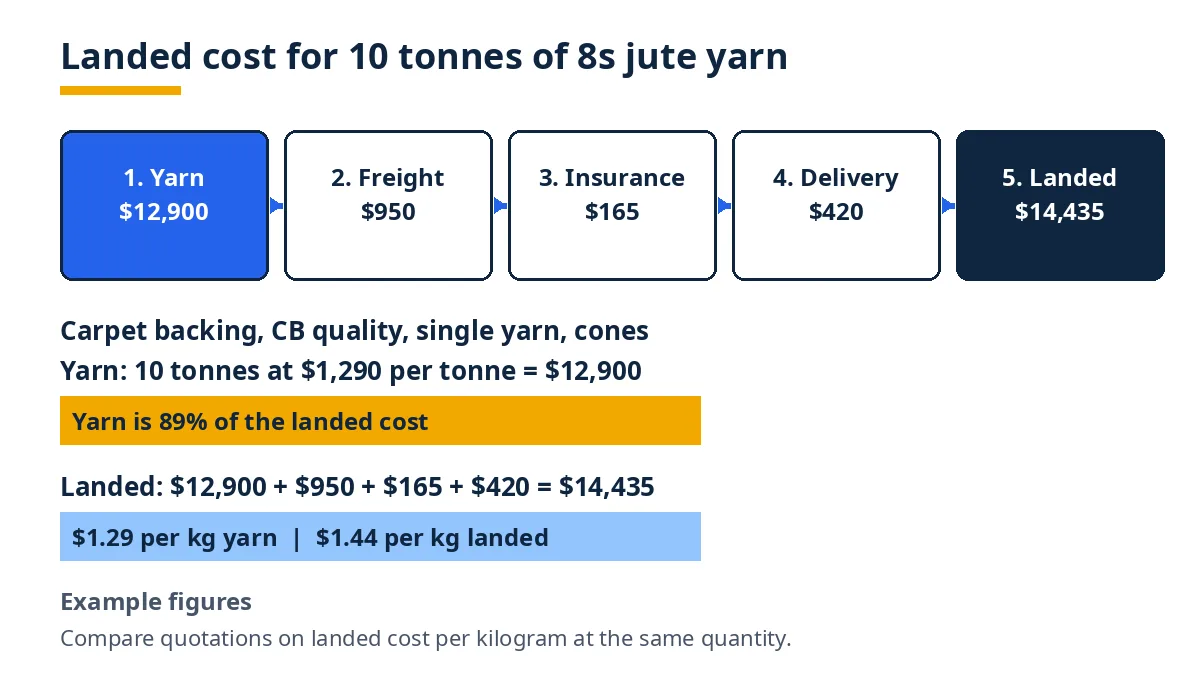
The yarn itself is 10 tonnes at $1,290 per tonne, which is $12,900. Freight from Chattogram to the destination port is $950, cargo insurance is $165, and destination handling and delivery to the warehouse is $420. The total is $12,900 plus $950 plus $165 plus $420, which is $14,435 landed: $1.29 per kilogram for the yarn alone and $1.44 per kilogram landed.
First, the yarn is about 89 percent of the landed cost, so a $50 per tonne movement in the yarn price moves the total by $500 on this order. Second, the 10 tonne order sits below the common 26 tonne listing minimum, so a buyer who can take 26 tonnes should price that quantity as well and compare the landed cost per kilogram at each quantity.
How to compare wholesale quotations line by line
Put every quotation into the same table before comparing anything. A quotation that leaves a row blank has not answered it, and a blank row is not a zero cost.
Line to compare | What to hold constant | What a gap means |
|---|---|---|
Count and ply | Same lb per spyndle, same ply | A different count is a different yarn |
Grade and end use | Same grade, same end use | A different grade is not comparable |
Quantity | Same metric tonnes, same minimum | A lower price at a higher minimum is a volume price |
Put-up and packing | Same cones, same cones per case, same pallet or bale | Unpacked yarn adds handling and damage cost later |
Incoterm and place | Same term, same named port or place | FOB and CIF differ by freight and insurance |
Shipment window | Same month or same sailing window | A short validity is not the same as a long one |
Payment term | Same LC, collection or advance terms | An open-account price carries a different risk |
Validity | Same expiry date on the quotation | An expired quotation is a new negotiation, not a price |
Read the quotation for what it does not say. A price with no validity date can move before the order is placed, and a price that bundles freight without naming the carrier can hide a slow route behind a low number. Ask each supplier to break out the yarn price, the freight, the insurance where included, and the packing, then compare the landed cost per kilogram at the same quantity.
Payment terms: who carries the risk
Payment terms decide who carries the risk while the yarn is on the water, and they are part of the price. With advance payment the buyer pays before the goods are shipped, which suits the seller and carries the most risk for the buyer. With a letter of credit the buyer's bank promises to pay the seller as long as the seller presents the documents the LC asks for, on time, under the ICC rule book UCP 600. With documentary collection the seller's bank sends the documents to the buyer's bank, which hands them over only when the buyer pays, in a cash against documents arrangement, or accepts a bill promising to pay later; the banks carry the documents but do not promise to pay. With open account the seller ships first and the buyer pays later, which suits the buyer and carries the most risk for the seller.5
Jute has its own history with these terms. Cash against documents has long been the usual arrangement for jute goods exports to some markets, and spinners have reported importers withholding payment, pressing for price cuts after shipment, and delaying taking delivery, with cargoes taking nearly 45 days to reach Turkey.6 The spinners' association asked for irrevocable confirmed letters of credit, or payment received in advance, to secure export proceeds, and the government has considered making an irrevocable confirmed LC or advance recovery mandatory for jute goods exports.6 Many exporters start with LCs and move to other terms as trust grows.5 Whatever term is agreed, write it into the purchase order with the bank and the documents named.
Next steps on Exportain
Start with the specification, then ask for quotations on the same basis: count, grade, quantity, Incoterm and payment term all stated, with a validity date. When the shortlist is ready, search Bangladeshi suppliers and post an RFQ with the specification in the requirement, and read our guide to jute yarn manufacturers in Bangladesh before choosing a channel.
Sources
- Yarn Count | Different Counting Systems. TextileTuts (accessed )
- Best Jute Yarns Manufacturer & Supplier In Bangladesh. Imperial Jute, (accessed )
- Jute Yarn Price in Bangladesh 2025. Accio (accessed )
- EPB charts $66b export roadmap for FY27. The Financial Express (accessed )
- Ways to get paid. Open Trade Bangladesh (accessed )
- Jute goods export: L/C to be made mandatory. The Financial Express (accessed )
About the author
Sourcing from Bangladesh?
Post a request for quotation and suppliers on Exportain can send you their quotes directly.
Post an RFQ