CIF vs DDP: Key Differences, Costs and Which One to Choose
CIF ends at your port with minimum insurance in the price and the import work left to you; DDP runs to your warehouse with the duty paid and the seller acting as importer of record. A worked leather-handbag example from Chattogram to Hamburg prices both terms at $20,594 and shows how to choose.
Short answer
Under CIF, the seller pays ocean freight and buys minimum Clause (C) insurance to your named port, while the risk passes to you on board at Chattogram and you clear import and pay the duty. Under DDP, the seller carries the goods to your named place, clears import, pays the duty and taxes, and carries the risk until delivery. Choose CIF for a port price with a named policy; choose DDP when the seller can act as importer of record.
On this page
Key takeaways
Under CIF the seller pays ocean freight and buys minimum Clause (C) insurance to your named port, but the risk passes to you on board at Chattogram and you clear import and pay the duty.
Under DDP the seller carries the goods to your named place, clears import, pays the duty and taxes, and carries the risk until delivery.
DDP is the only one of the eleven Incoterms 2020 rules that makes the seller the importer of record; under the other ten, you import.
On the same shipment the totals match: $20,594 under both terms in the worked example, because only the payer changes.
A buyer in Hamburg gets two quotes for the same leather handbags from Chattogram: "CIF Hamburg" and "DDP warehouse, Hanover". The two prices differ by a few thousand dollars, and neither supplier is wrong. One price ends at the port with a marine policy inside it; the other ends at the warehouse door with the duty already paid. This comparison sets out what each term covers and how to price both to one warehouse.
The border is the hinge: who clears import and pays duty
Incoterms 2020 is the current edition of the ICC's eleven trade rules, in force since 1 January 2020.1 Of the eleven, DDP alone puts import clearance and the duty and import VAT on the seller.2 That single line is the hinge this pair turns on: CIF leaves the border with you, and DDP moves it to the seller.
The party that clears the import is normally named on the declaration as the importer of record, and carries the duty, the import VAT and the responsibility for the accuracy of what was declared.2 A wrong classification can produce a demand long after delivery, and under DDP it comes to the seller.2
Question | CIF | DDP |
|---|---|---|
Carriage paid by seller to | Your named port | Your named place |
Where delivery happens | On board the vessel at Chattogram | At your named place |
Risk moves to you | At loading in Chattogram | At your named place |
Who insures the cargo | Seller buys Clause (C) policy | Nobody must insure |
Who clears import and pays duty | You | Seller |
Named importer of record | You | Seller |
Who unloads | You | You |
Modes allowed | Sea and inland waterway | Any mode or mix |
DDP works by any mode; CIF works only by sea and inland waterway.3 4 Unloading stays with the buyer under both rules; only DPU makes the seller unload.4
What CIF means for a sea shipment from Chattogram
Under CIF (Cost, Insurance and Freight), the seller packs the goods, clears export, loads them at Chattogram, funds the ocean freight to your named port, and takes out minimum marine cover in your favour.3 Risk moves to you as soon as the goods are on board, while the seller still pays the freight and the insurance as far as Hamburg. That split defines the C group: the seller funds the voyage to the destination, yet the risk changes hands at origin.3 If the container is damaged at sea after loading, the loss is yours.
From the port, the work is yours: terminal handling, import clearance, duty and taxes, and carriage to your warehouse. As importer of record, you stand behind the classification, the declared value and the duty owed. A VAT-registered buyer can usually reclaim the import VAT, because it is the importer of record.2 CIF fits cargo that loads directly onto a vessel. For containerised cargo, CIP often fits better, because its risk passes when the carrier takes the goods.3
What DDP means at your warehouse door
Under DDP (Delivered Duty Paid), the seller handles the shipment from start to finish: export clearance, transport, import clearance, duty and taxes, and handover at your warehouse while the goods are still on the vehicle.4 It places the heaviest obligation on the seller of any Incoterms rule.
Some regimes bar a non-resident from acting as declarant, and there DDP cannot be performed as written, whatever the contract says.2 In the United States a foreign seller can act as importer of record, but it needs a customs broker, a power of attorney for that broker, and a customs bond, with commercial imports worth more than $2,500 requiring a bond.4
VAT is the second trap. Import VAT paid by the seller is usually lost to the seller, because a Bangladeshi exporter holds no VAT registration in the buyer's country and has no return to reclaim it on. The amount stays inside the DDP price as a cost, even though a buyer importing under CIF could have recovered the same VAT through its own return.4 Ask for the DDP price broken into parts; a lump sum hides the duty basis and any risk margin.
Insurance: the policy CIF promises and DDP does not
Insurance is the second hinge, and it runs the opposite way: CIF is one of only two rules that oblige the seller to insure, and DDP is not the other one.
Under CIF, the seller must buy a policy that meets Institute Cargo Clauses (C), the lowest level of cover, worth at least 110 percent of the contract price and written in the contract currency, running from the load port to at least the named port.3 The seller pays for the policy, yet the claim belongs to you: you file it with the insurer yourself.
Clause (C) covers sinking, grounding, collision, fire and explosion, and not theft, water damage from heavy weather or handling damage.3 Agree Clause (A) in the contract for broader all-risks cover.3
DDP promises no insurance at all.4 The seller bears the transit risk and will usually insure at its own cost, but nothing in the rule forces a policy or fixes a clause level or a sum insured. A buyer that wants guaranteed cover should write the clause level, the sum insured and the payer into the contract.4
The cost split, line by line
CIF leaves every charge after the port with you; DDP puts every charge up to your door on the seller, unloading aside.
Cost line | CIF Hamburg | DDP Hanover warehouse |
|---|---|---|
Goods, packing and export clearance | Seller | Seller |
Freight, Chattogram to Hamburg | Seller | Seller |
Marine insurance (minimum) | Seller | Seller insures its own risk if it chooses |
Hamburg terminal handling | Buyer | Seller |
Road leg to Hanover | Buyer | Seller |
Clearance and broker fees | Buyer | Seller |
Duty and taxes at import | Buyer | Seller |
Unloading at warehouse | Buyer | Buyer |
The diagram below maps the same split.
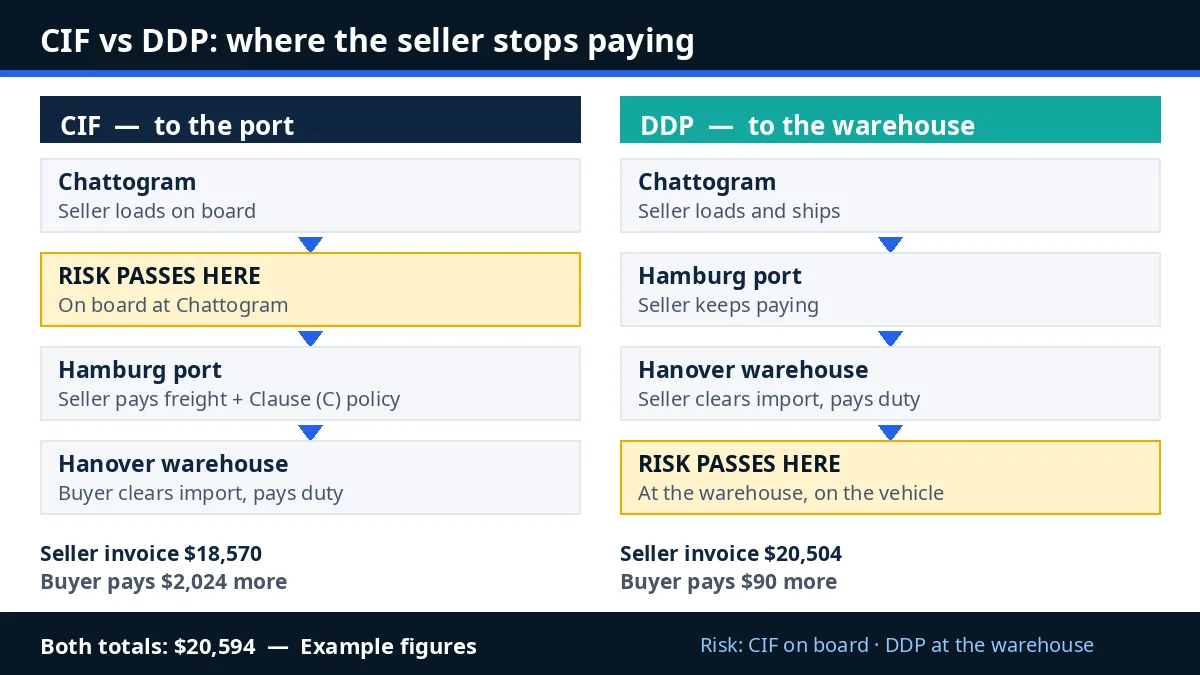
Duty is often worked out from the CIF value, which adds freight and insurance to the price of the goods. Confirm the HS code early, since the code sets the duty rate.2 Under CIF the premium sits inside the price as a named policy; under DDP it sits there as the seller's own cost.
Worked example: leather handbags from Chattogram to Hamburg
Example figures. A buyer in Germany orders 800 cartons of leather handbags from Chattogram worth $16,000. The CIF named port is Hamburg; the DDP named place is the buyer's warehouse in Hanover. The duty rate is an illustrative 6 percent of the CIF value.
Cost line | Under CIF | Under DDP |
|---|---|---|
Goods, packing and export clearance | $16,000 | $16,000 |
Ocean freight to Hamburg | $2,400 (seller) | $2,400 (seller) |
Minimum marine insurance | $170 (seller) | $170 (seller) |
Hamburg terminal handling | $300 (buyer) | $300 (seller) |
Road leg to Hanover | $380 (buyer) | $380 (seller) |
Duty at 6% on the $18,570 CIF value | $1,114 (buyer) | $1,114 (seller) |
Broker fees | $140 (buyer) | $140 (seller) |
Unloading at warehouse | $90 (buyer) | $90 (buyer) |
Total the buyer pays | $20,594 | $20,594 |
Both columns land on $20,594: the same legs, only the payer changes. The CIF invoice is $18,570 and the DDP invoice is $20,504, leaving you $90 to pay.
The duty line uses a CIF value of $18,570 at 6 percent, giving $1,114. The minimum sum insured under CIF is 110 percent of the $16,000 contract price, or $17,600.3 The totals match, so the decision turns on the importer of record and whether the DDP price adds a risk margin.
Where the risk sits on each leg
Under CIF, risk moves early while the cost keeps running. You carry the risk from the moment the handbags are on board at Chattogram, even as the seller keeps funding the freight and the insurance to Hamburg. If the container is damaged, the loss is yours to claim against the Clause (C) policy, and anything outside that list is yours to absorb.3
Under DDP, the seller holds the risk until the truck arrives at your warehouse in Hanover; damage in transit is the seller's loss.4 But DDP moves the border risk onto the seller: a wrong declaration can hold the goods at the border while demurrage and storage build up at the seller's cost.4 Name the place exactly: "DDP Hanover" leaves the delivery point undefined; "DDP buyer's warehouse, Hanover" fixes where the risk passes.4
Documents each term hands you
Under CIF, the seller has to hand over three documents: the commercial invoice, the insurance certificate or policy, and the on-board bill of lading. Without them you cannot take delivery, clear customs or file a claim.3 Check the policy before the vessel sails: value, clause level and voyage.
Under DDP, the delivery proof is the handover record at the named place. The seller still sends the commercial invoice and the packing list, since the import declaration is built from them.4 Where payment is by letter of credit, confirm with your bank what transport document it will accept; CIF produces an on-board bill of lading as a matter of course. Incoterms say nothing about price, payment method or when ownership passes; those belong in the contract of sale.2 Always write the term out in full: the exact port or the full warehouse address, plus the edition. A country name on its own is not enough.2
Four checks before you sign
CIF suits a buyer whose cargo loads straight onto the vessel at Chattogram, who already works with the destination port, and who wants a named policy inside the price. It fits a buyer with a forwarder and a broker.
DDP suits an occasional buyer with no import registration and no broker, who wants a single price to the door with the duty inside it. It suits a first or small order.
Ask four questions before you sign. Can the seller act as importer of record in your country. Does the CIF policy name the right clause and sum insured, or does the DDP price name the insurance position. Have you costed both terms to your warehouse on the same footing. And does your payment method accept the transport document each term produces. If the answer to the first question is no, take CIF with a broker you appoint, or DAP, under which you clear import and pay the duty.2 4
FAQs
Is CIF cheaper than DDP?
Not on the same shipment: the CIF price stops at the port, the DDP price runs to your warehouse with the duty inside it, and both total $20,594 in the worked example.
Does CIF insurance cover the whole journey to my warehouse?
No. Cover runs from the load port to at least the named port, at Clause (C) minimum and for at least 110 percent of the contract price.3 The road leg to Hanover sits outside it unless the policy is extended.
Can a Bangladeshi seller act as importer of record in my country?
It depends on the country. In the United States a foreign seller can act as importer of record with a broker, a power of attorney and a bond.4 In the European Union, the declarant generally has to be established inside the customs territory.2
Next steps on Exportain
For the full set of rules, open the eleven-rule Incoterms table. The CIF rule in full explains the insurance in detail, and CFR vs DDP and CIF vs DAP cover the same border question from other starting points. When the term is settled, browse Bangladeshi suppliers and raise an RFQ naming the rule, the port or place, and the edition.
Sources
- Incoterms® rules. International Chamber of Commerce (ICC) (accessed )
- Incoterms and tax: who pays import VAT under each rule. Quaderno (accessed )
- CIF Incoterm Explained: 7 Critical Rules Every Importer and Exporter Must Know in 2026. ejet (accessed )
- DDP Incoterms Explained: Who Pays, Risk Transfer & VAT. LegalClarity (accessed )
About the author
Sourcing from Bangladesh?
Post a request for quotation and suppliers on Exportain can send you their quotes directly.
Post an RFQ