How to Import Puffer Jackets From Bangladesh in 2026: Complete Buyer Guide
A step-by-step buyer guide to importing puffer jackets from Bangladesh: choose the fill, shell and quilting, claim 0% EU duty under EBA, approve the sample, agree the AQL inspection plan, file the export papers, and land 2,400 jackets in Hamburg with a worked cost example.
Short answer
To import puffer jackets from Bangladesh, first fix the fill, shell and quilting in one specification, then classify the jackets under heading 6201 and claim the 0% EU duty under Everything But Arms with a statement on origin. Approve a pre-production sample in bulk materials, agree the inspection plan in the order, file the Bangladesh export papers, and clear German customs at 19% import VAT on the customs value plus duty and freight.
On this page
Key takeaways
Men's synthetic puffer jackets sit under HS subheading 6201 40 at a 12% most-favoured-nation rate, but Bangladesh qualifies for 0% under the EU Everything But Arms scheme until 24 November 2029.
Fill power, fill weight, shell water resistance and quilting construction belong in the specification before any supplier is contacted.
A 2,400-piece lot inspected at General Inspection Level II takes a 125-piece sample: accept 7, reject 8 major defects at AQL 2.5.
German import VAT is 19% on the customs value plus duty and freight to the first EU destination, and a VAT-registered buyer reclaims it.
A puffer jacket import stands or falls on the jacket: fill, shell and quilting fix the warmth, the weight and the evidence you must collect. This guide takes the order in seven stages to a Hamburg warehouse, with a worked cost example for 2,400 jackets.
Choose the jacket before you choose the supplier
Begin with the fill. Down warms by trapping still air in clusters of fine plumage, while synthetic fill uses polyester fibres shaped to hold air the same way. Down gives more warmth for its weight and packs smaller; synthetic fill holds more insulation when wet and dries faster.
Fill power is the number buyers compare first: the space a fixed mass of down fills when it lofts. Under the United States test method, down at 700 cubic inches per ounce and above counts as extremely high quality.1 A figure alone proves little, because each standard sets its own cylinder size, sample mass, conditioning and units, so ask which standard the test used and whether the result covers the fill lot or the finished jacket.1
Where the fill is down, ask for the welfare evidence too. The Responsible Down Standard (RDS) certifies down and feathers through independent checks of animal welfare and chain of custody, and it prohibits live-plucking and force-feeding.2 Only a product made with 100 per cent certified down and feathers may carry the RDS logo, so ask for the certificate and check it against the issuing body's records.2
Then the shell, the woven outer fabric that keeps weather out and fill in. Most shells are nylon or polyester, often with a durable water repellent (DWR) finish. State the fabric build and weight, the DWR finish and taped seams, and ask for the hydrostatic-head result in millimetres. A tight weave and a downproof finish stop fine plumage working through, so test the shell with the fill you will use.
Then the quilting, the stitched chambers that keep the fill where it insulates. In stitch-through work the shell and lining are sewn straight together, which is light but leaves a cold line at each seam. In box-wall work, fabric walls stand between shell and lining, so each chamber holds full-depth fill. Wide chambers let fill drift; narrow chambers hold it still but add seams and weight. Specify pattern, size and stitch density.
Check warmth on the sample: ask for the fill-power result, the fill weight per size and the shell test results, then handle the washed sample for even loft, thin patches and escaping fill, and keep it sealed as the bulk reference.
What duty will you pay in Germany?
Work out the duty first: it shifts the landed cost further than any single quotation line. A men's synthetic puffer jacket sits under heading 6201, subheading 6201 40 for man-made fibre; the women's equivalent is heading 6202. Six digits stay the same everywhere. The UK tariff lists a third-country duty of 12.00 per cent on the 6201 40 lines, and the EU applies the same 12 per cent most-favoured-nation rate to the matching lines.3 See our HS code guide for puffer jackets for the classification walk-through.
Bangladesh escapes that 12 per cent under the EU Everything But Arms (EBA) scheme, which gives least developed countries duty-free and quota-free access for all products except arms and ammunition.4 Bangladesh is the largest beneficiary: exports worth 19 billion euros entered the EU under EBA in 2024 at a 96 per cent utilisation rate, and graduation from the least developed country category is postponed until 24 November 2029.4
The zero rate needs origin evidence: ask for a statement on origin with the shipment, and confirm with your broker that the product meets the EU origin rules before the goods sail. Put the claim on the declaration with that evidence; leave it off and the 12 per cent rate is charged on the customs value.
The import in seven stages
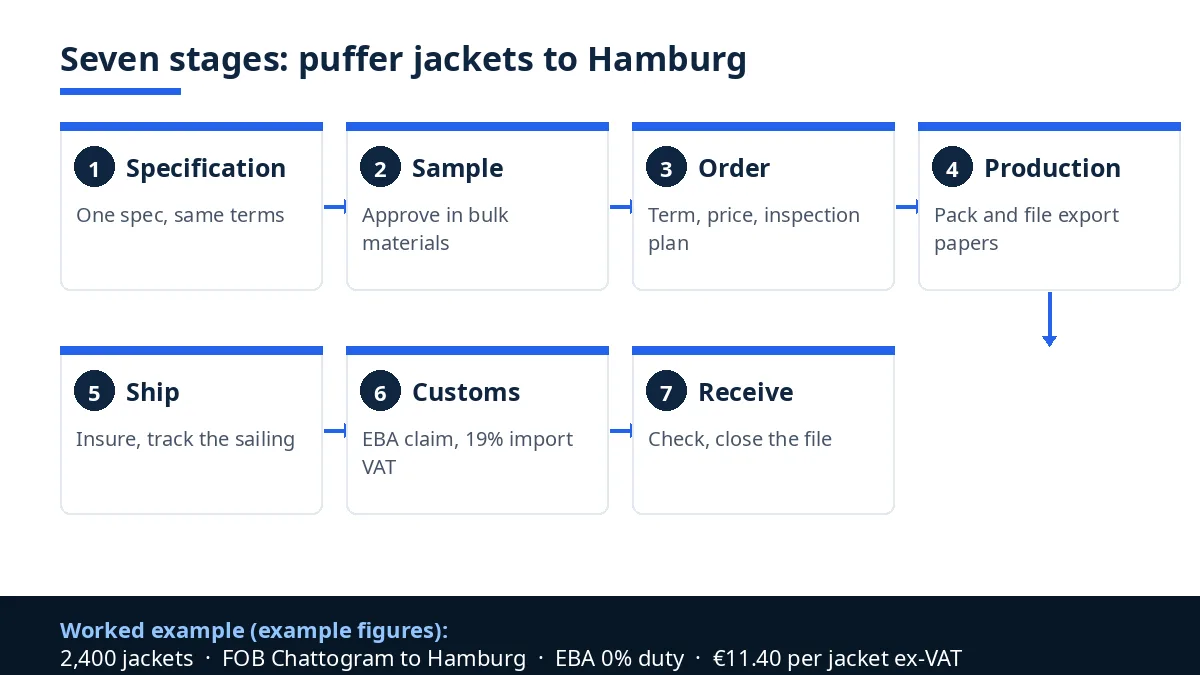
Stage 1: Send one specification and compare quotations on the same terms
Write the specification before you contact any supplier: style, shell, fill, quilting, sizes, colours, trims, labels, packing, tests, quantities, term and destination. Give every candidate the same document. Shortlist with our manufacturers guide, and read our price guide and MOQ guide for the quotation lines and quantity floors.
Stage 2: Approve the sample in the production shell and fill
Approve in stages, each in writing: a fill sample with its test report, a proto sample for fit, then a pre-production sample in bulk materials, washed and measured after washing. Check loft by hand, look for escaping fill, and measure the washed garment. Do not let bulk start on a substitute fill or a shell from another lot.
Stage 3: Put the order, the delivery term and the inspection plan in writing
Fix the delivery term before you judge prices: Incoterms 2020 divides cost, risk and duties between buyer and seller in eleven rules.5 FOB Chattogram leaves the sea leg and insurance with you; CIF adds carriage and cover; DAP delivers to your door and leaves clearance with you.5 Read our Incoterms guide for the full comparison, and put the term, named place, price, payment terms and inspection plan in the purchase order.
Stage 4: Produce, pack and file the Bangladesh export papers
Check lots on arrival, panels in production and finished jackets. Pack each carton to the order: jackets folded and bagged, sizes and colours as agreed, marks and gross weight outside, and a packing list that agrees. No goods load until Customs approves the Shipping Bill, which wants the export contract or purchase order, or the letter of credit or telegraphic transfer, with the bank's approval. Add the certificate of origin, taxpayer identification number, VAT registration certificate, signed invoice, packing list, EXP form certified by an Authorized Dealer and Export Registration Certificate.6
Stage 5: Ship, insure and track
With FOB, you arrange freight and cover yourself and pin down the sailing. With CIF, ask to see the insurance certificate: Clause (C) is the standard cover, and broader cover can be agreed.5 The bill of lading is the carrier's receipt and carriage contract, issued to the shipper. Get both numbers as soon as they exist. Transit time from Chattogram varies, so plan from your forwarder's schedule.
Stage 6: Clear customs in Germany and settle the import VAT
Hand your broker the code, the statement on origin and the EBA claim before the vessel arrives. German import VAT runs at 19 per cent, on the customs value plus duty plus freight and insurance to the first EU destination.7 A VAT-registered business reclaims it as input tax, so for most importers it is a timing cost, not a lasting one.7 Check the label wording for Germany before the label run.
Stage 7: Receive, check and close the order file
On arrival, check the cartons against the packing list, then open a sample across sizes and colours and measure the jackets against the sealed reference sample. Raise any shortfall or defect while the inspection report and photographs are fresh. Close the file with the declaration, the inspection report, the test reports and the final invoice.
Worked example: 2,400 synthetic-fill jackets to Hamburg
Every number below is an example figure only. Example figures: 2,400 men's synthetic-fill puffer jackets, FOB Chattogram to Hamburg, duty shown with and without the EBA preference claimed.
Cost element | No preference (EUR) | EBA 0% claimed (EUR) |
|---|---|---|
Product price, FOB Chattogram | 24,000 | 24,000 |
Freight and insurance | 2,400 | 2,400 |
Customs value (CIF) | 26,400 | 26,400 |
Duty at 12% / 0% of 26,400 | 3,168 | 0 |
Value for VAT | 29,568 | 26,400 |
Import VAT at 19% | 5,617.92 | 5,016 |
Customs broker fee | 300 | 300 |
Port handling | 350 | 350 |
Delivery | 320 | 320 |
Total cash outlay | 36,155.92 | 32,386 |
Net cost ex-VAT | 30,538 | 27,370 |
Cost per piece ex-VAT | 12.72 | 11.40 |
Check it: 24,000 plus 2,400 is 26,400; 12 per cent of 26,400 is 3,168; 19 per cent of 29,568 is 5,617.92. With the preference claimed, the total is 32,386: a saving of 3,769.92, made of 3,168 of duty and 601.92 of VAT on that duty. A VAT-registered buyer gets the import VAT back, so the net figure is the cost that stays.
How inspection works on a 2,400-piece lot
Fix the inspection terms in the order: inspector, timing, references and what follows a rejection. ISO 2859-1 sets the sampling tables, and General Inspection Level II is the level most orders use.8 A 2,400-piece lot at that level takes code letter K and a 125-piece sample. For major defects the AQL is 2.5, giving an accept number of 7 and a reject number of 8; for minor defects the AQL is 4.0, giving 10 and 11.8 Name ISO 2859-1:2026 in the order so the inspector works from the right tables.8 Settle the defect classes before production: leaking seams and thin chambers count as major, loose threads as minor. Our puffer jackets quality control checklist turns these points into inspector checks.
Six mistakes that cost puffer importers money
Missing the zero-duty claim. Without a statement on origin, there is no claim to make, and the full 12 per cent is charged.
Comparing offers on different terms. Under CIF the seller funds the ocean freight and marine cover; under FOB the price stops at loading. Quote the same rule and named place everywhere.
Approving a sample made with substitute fill. A sample sewn with another fill proves nothing about bulk.
Declaring only the six-digit code. The six-digit HS code is only the start: a German declaration needs the full ten-digit code, and the duty follows the full code.3
Loading before the export papers are ready. No goods load until the Shipping Bill is approved, and approval needs the certificate of origin, the invoice, the packing list and the EXP form.6
Releasing the balance before reading the inspection report. Write the inspection plan, sample size and accept and reject numbers into the order before production.8 Once the money has moved, a failed lot turns into a haggle, not a rejection.
Import checklist
Keep the proof beside each line.
Code and duty settled: heading 6201, subheading 6201 40, EBA claim, origin evidence.
One specification in every supplier's hands: fill, shell, quilting, sizes, colours, trims, term, destination.
Three to five offers judged on the same terms.
Fill, proto and pre-production samples signed off in writing, washed and measured.
Inspection fixed before production: sample size, AQL values, standard, level, accept and reject numbers.
Order signed off: price, payment terms, quantities, specification version, packing, shipment date.
Export papers ready: invoice, packing list, certificate of origin, EXP form, Shipping Bill documents.
Freight and insurance booked, bill of lading number in hand.
Broker holding the code, origin statement and EBA claim before the vessel arrives.
Goods checked against the sealed sample, file closed.
FAQs
What duty do puffer jackets from Bangladesh pay in Germany?
The 6201 40 lines carry a 12 per cent most-favoured-nation rate, but Bangladesh qualifies for 0 per cent under Everything But Arms until 24 November 2029.3 4 Put the claim on the declaration with the statement on origin.
Should I choose down or synthetic fill?
Down gives more warmth for its weight; synthetic fill keeps more insulation when wet. Either way, put the fill type, fill weight per size and test report for the fill lot in the specification.
Do I need a customs broker for a first order?
No, but a licensed broker is the safer choice the first time: the broker confirms the code, files the claim and works out the VAT value.
Next steps on Exportain
Start on Exportain by posting an RFQ that carries the full specification, the 6201 40 code and the inspection plan: post an RFQ. For the full Bangladesh import sequence, read how to import from Bangladesh, and see how to buy for the steps after a supplier answers.
Sources
- Explanation of Down and Feather Tests. IDFL (accessed )
- Responsible Down Standard (RDS). Textile Exchange (accessed )
- Of man-made fibres - UK Integrated Online Tariff. UK Trade Tariff (accessed )
- Bangladesh Pushes Back LDC Graduation, Securing Continued Commercial Benefits in Europe. Modaes, (accessed )
- Incoterms® 2020. International Chamber of Commerce (ICC) (accessed )
- Bangladesh Trade Portal FAQ: Export Registration Certificate (ERC). Bangladesh Trade Portal (accessed )
- Shipping from Brazil to Germany: documents, VAT and limits. DHL (accessed )
- AQL Chart 2.5 and 4.0: Sample Size Tables Explained. ClearLoad (accessed )
About the author
Sourcing from Bangladesh?
Post a request for quotation and suppliers on Exportain can send you their quotes directly.
Post an RFQ