

Puffer Jackets Price in Bangladesh: FOB Cost Breakdown for Buyers
Puffer jacket FOB prices in Bangladesh have no single typical figure. This guide reads the price as itemized cost lines up to loading, shows how a specification change moves the total with example figures, and lists the terms, labels, documents and inspection to agree in writing.
Short answer
A puffer jacket FOB price from Bangladesh has no single typical figure. It is the sum of cost lines up to loading on board at the named port of shipment: shell fabric, fill, cutting and quilting, trims and labels, packing, testing and setup, and inland transport and port handling. Compare quotations only as itemized lines on one specification, one quantity basis and one delivery term, with validity dates stated.
On this page
Key takeaways
There is no single typical FOB price for puffer jackets from Bangladesh: the price is the sum of cost lines up to loading on board at the named port of shipment.
Example figures show the structure: in a 100-unit example, shell is 34 units and fill is 28 units, and raising the fill line alone to 36 units raises the total to 108 units.
Under FOB the buyer carries freight, insurance and import costs beyond loading, and FCA may fit containerised multimodal movement better than FOB.
Agree the evidence in writing before payment: an itemized quotation, a sample in production materials, a fill test report and an inspection standard. A badge is a document and photo review only.
A puffer jacket price quoted on a free on board (FOB) basis is not one number to accept or reject. It is a set of cost lines ending when the goods are loaded on board at the named port of shipment. A buyer who reads the breakdown can see whether two quotations describe the same jacket.
Woven garments reached US$4,614.80 million in the first quarter of fiscal 2026-27, within ready-made garment exports of US$10,578.56 million, on Export Promotion Bureau (EPB) data reported by The Financial Express.1 This guide explains how to read each quotation line by line, on the same specification and delivery term, before comparing totals.
Why this matters for buyers and sellers
For the buyer, the FOB boundary decides what the unit price already pays for and what remains to be arranged after loading. The Incoterms 2020 rules give a clear allocation of cost, risk and obligations between seller and buyer,2 and under FOB the seller delivers and transfers the risk of loss or damage once the goods are loaded onto the vessel at the named port of shipment, having completed the export formalities.3 Ocean freight, insurance and import clearance sit beyond that point, so FOB and cost, insurance and freight (CIF) totals cannot be compared on price alone.
For the seller, the same boundary fixes where its cost stops. Fabric and fill are bought in lots, samples and setup work are fixed whether the run is short or long, and testing and labels are separate lines. A headline price that spreads those fixed lines over a larger quantity falls as quantity rises, so price tiers and quantity basis belong in the same comparison as the unit price. The breakdown also protects the specification: each change to fill, shell, quilting, trims or packing should change the price in a visible place.
Step-by-step: how it works
Read an FOB quotation in the order costs are incurred, from specification to loading.
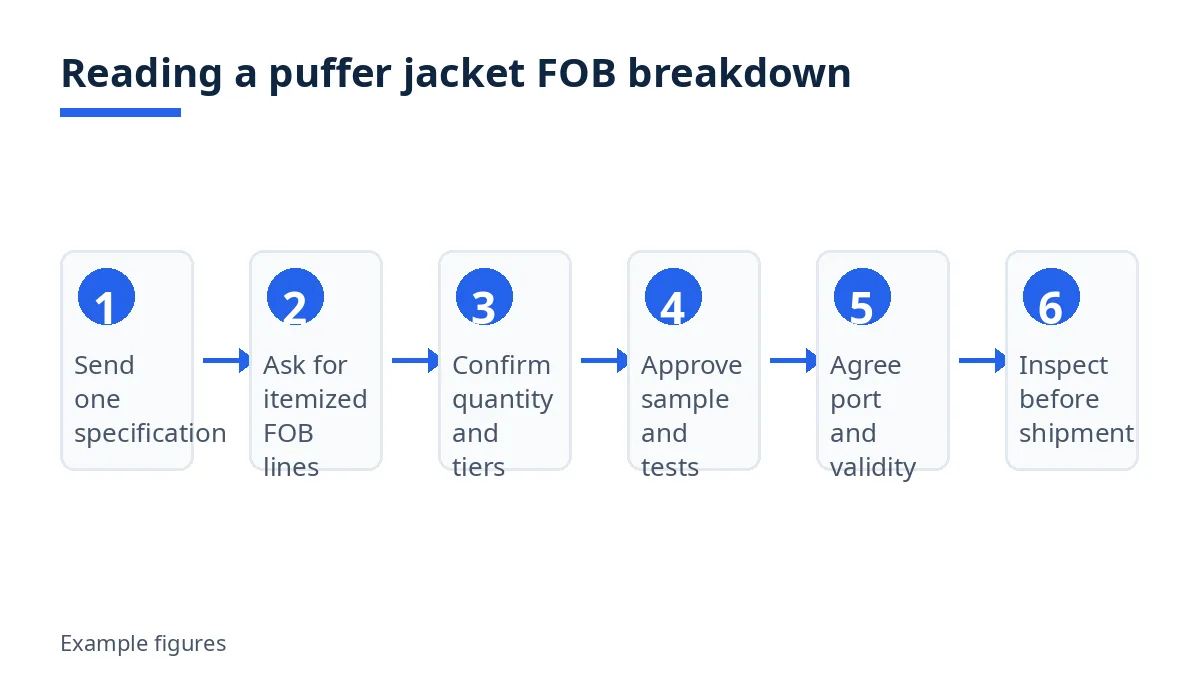
Send one specification to every candidate. State shell fabric, fill type and fill weight, quilting, size range, colors, trims, labels and packing. A photograph and a target quantity do not produce comparable FOB lines.
Ask for itemized lines. Ask for shell, fill, cutting and sewing, trims and labels, packing, testing and setup, and inland transport and port handling as separate lines, each with its quantity basis.
Confirm the quantity basis and tiers. Ask whether the price applies per style, per color or to the total order, where each tier starts, and how long the price stays valid.
Approve the sample in the production materials. Order a sample in the actual shell and fill, with the quilting, trims and labels that will ship. Approve or list corrections in writing.
Agree term, port and validity in one line. State FOB with the named port of shipment, the Incoterms 2020 edition, payment terms and the expiry date, so every quotation is read on the same boundary.3
Agree inspection before production. Name the inspection standard, the sampling basis and who inspects, and keep a sealed sample as the shipment reference.
Costs, timelines and documents
What are the typical costs and timelines?
There is no typical FOB price for puffer jackets, because fill, shell, quilting, trims, quantity, term and destination each move the figure. Ask for a complete set of lines, a lead time by gate, and a validity date, then compare suppliers on the same set.
The table below shows the lines to request. Example figures are used throughout this guide to show structure only. They are not market prices, and no line states what any supplier charges.
FOB line | What moves it | What to ask |
|---|---|---|
Shell fabric | Construction, weight, dye lot, downproofing finish | Fabric spec, color standard, whether the fabric is in stock |
Fill | Fill type, fill weight, test and certification evidence | Fill spec, fill weight per size, test reports required |
Cutting, quilting and sewing | Chamber pattern, stitch density, size range | Quilting construction, size curve, sewing standard |
Trims, labels and packing | Zip, trims, woven labels, hang tags, cartons | Which trims are standard, which labels are custom |
Testing, certification evidence and setup | Fill and fabric tests, label runs, sample rounds | Which tests are included, which setup lines are separate |
Inland transport, port and export handling | Distance to port, handling, export documents | Named port, which handling lines sit inside FOB |
Example figures: an example FOB unit price of 100 units divides as shell fabric 34, fill 28, cutting, quilting and sewing 16, trims, labels and packing 10, testing, certification evidence and setup 6, and inland transport, port and export handling 6. If the fill line rises from 28 to 36 while every other line stays the same, the example total rises to 108. If the shell line rises from 34 to 41, it rises to 107. Use the same arithmetic on real quotations to test whether a price change matches the specification change behind it.
For timelines, ask for dates by gate: specification, sample, fabric and fill ready, production, inspection, and loading. For the general meaning of MOQ and how quantity tiers relate to price, see the guide to MOQ meaning.
What sits outside the FOB price
Under FOB, the buyer contracts and pays for the main carriage from the port of shipment, and carries the risk from loading onward.3 Ocean freight, marine insurance, destination port charges, import clearance, duty and tax, and onward delivery are therefore outside the FOB unit price and must be budgeted separately. A quotation that calls itself FOB but adds freight to the destination is not an FOB quotation.
FOB is to be used only for maritime or inland waterway transportation, meaning port-to-port shipments.3 Where jackets move in containers through more than one mode, ask whether Free Carrier (FCA) fits better, since FCA suits multimodal and container transport while FOB suits port-to-port movement.3 Restate every quotation on the term you will actually use, with the named place or port, before comparing totals.
Which documents are needed?
The order documents are the specification, itemized quotation, purchase order and sample approval record. The product documents are fill test reports, certification evidence and label approvals. The shipment documents follow the export clearance set below. Keep all three sets in one order record, under one legal name for each party.
Bangladesh-specific rules and tips
Confirm the classification as indicative, then verify it. The Harmonized System comprises more than 5,000 commodity groups, each identified by a six-digit code, and is used by more than 200 countries and economies as a basis for customs tariffs and trade statistics.4 Heading 6201 covers men's or boys' overcoats, anoraks including ski jackets and similar articles, not knitted or crocheted, split by fiber, including 620193 for anoraks of man-made fibers.5 Treat any heading as indicative, and confirm the full code with the destination tariff before filing.
Price the label work for the destination market. In the European Union, a textile product shall be labelled or marked with the name and percentage by weight of all constituent fibers in descending order, under Regulation (EU) No 1007/2011.6 Labels are therefore a real cost line: woven and care labels, and any re-labelling after a fiber change, each take time and a print run. Confirm care, origin and fiber rules for the USA, UK, EU and UAE before the label run.
Ask for fill evidence in the terms the test uses. Fill power measures the loft or insulation properties of down products, and each international standard has its own guidelines for cylinder size, piston weight, amount of down used and units of measurement; under the United States standard, extremely high quality down has a fill power of 700+ cubic inches.7 Ask which standard the test follows and whether the result is for the fill lot or the finished jacket. A figure without a standard, lot and report cannot be priced or checked.
Treat a certification claim as a cost line with evidence behind it. The Responsible Down Standard (RDS) is a third-party certification covering animal welfare and chain of custody for down and feathers, prohibiting force-feeding and live-plucking.8 An RDS claim carries chain-of-custody and audit work behind it, which belongs as a named line or exclusion. Check any claim against the issuing body's records, including scope, supplier and product category.
Allow for export clearance in the FOB handling line. Goods shall not be loaded or stuffed in containers or ships for export unless an export declaration, the Bill of Export or Shipping Bill, is submitted to Customs and approved, and the enclosed documents include the export contract or purchase order where there is no export letter of credit, the commercial invoice, the packing list, the EXP form certified by an authorized dealer, and a certificate of origin issued by the EPB or a Chamber of Commerce and Industry.9 Each takes handling time, and omitting them from the FOB handling line delays loading or moves the cost elsewhere.
Agree the inspection standard before production. ISO 2859-1:2026 specifies sampling schemes indexed by acceptance quality limit (AQL) for lot-by-lot inspection by attributes, and AQL is the maximum percentage of defective items considered acceptable in a batch or lot.10 Name the AQL values, level and defect classifications, agree who inspects and what happens to a rejected lot, and price inspection as a line.
Mistakes and red flags
Comparing totals on different delivery terms. An FOB total, a CIF total and an ex works total describe different boundaries.3 Restate every quotation on one term and one named port or place before comparing prices.
Accepting one total without lines. A single unit price hides which line moved when the specification changes. Ask for itemized lines on the first quotation, and require a new version whenever fill, shell, quilting, trims or packing changes.
Ignoring the quantity basis and the tiers. A price that applies per color, per style or above a tier boundary is a different commitment from a price that applies to the total order. Confirm the basis, tier starts and validity date in writing.
Changing the jacket after the price is agreed. A heavier fill, a different shell or a new quilting pattern is a new jacket for costing purposes. Each change needs a new sample, new test evidence where the claim changes, and a new quotation version.
Treating a badge or a listing as price evidence. Verification on Exportain is a document and photo review, not a factory inspection, and membership plans never grant a trust badge.11 A badge records which checks staff have reviewed; it does not establish capacity, quality, delivery or cost lines. Price evidence is the itemized quotation, the sample and the test report.
Cutting testing or inspection to reach a target price. Fill tests, fabric tests and pre-shipment inspection catch a changed fill, a failed shell or a quilting fault before the goods become stock.7 10 Removing them lowers the quotation and raises the cost of a fault.
Accepting a verbal price, validity or tier. Keep specification, quantity basis, tiers, delivery term, payment terms and validity in one quotation version, and agree changes in a new version of it.
Checklist
Before you compare quotations or confirm an order, every line should be answered in writing.
Specification sent: shell, fill type and weight, quilting, sizes, colors, trims, labels, packing.
FOB price itemized: shell, fill, cutting and sewing, trims and labels, packing, testing and setup, inland transport and port handling.
Quantity basis confirmed: per style, per color or total order, with tier starts and validity dates.
Sample approved in writing in the production shell and fill, with quilting, trims and labels.
Fill evidence on file: test standard, lot, result and report, plus certification evidence where claimed.7 8
Delivery term in full: FOB, named port of shipment, Incoterms 2020, payment terms.3
Costs outside FOB budgeted: freight, insurance, destination charges, import clearance, duty and tax.
Classification indicative, confirmed for the destination tariff.4 5
Destination label rules priced: fiber composition, care and origin labels.6
Export set agreed: invoice, packing list, EXP form, certificate of origin, Bill of Export.9
Inspection agreed: AQL values, level, defect classifications, inspector, rejected-lot terms.10
Changes in a new quotation version, with a new sample where the specification changed.
What should I know first about puffer jackets?
Know the jacket as a set of cost lines, not a single price. Shell, fill, quilting, trims, labels and packing each move the FOB price, and the delivery term decides where the seller's cost stops. Heading 6201 covers men's or boys' anoraks and similar articles, not knitted or crocheted, split by fiber.5 Confirm the full code for the destination before filing.
What are the typical costs and timelines?
There is no typical FOB cost or timeline for puffer jackets as a category. Fill weight, shell, quilting, trims, quantity, delivery term and destination each move the figure, and sampling, lots, testing and line capacity each move the timeline. Example figures show structure only: an example FOB unit price of 100 units, with shell 34 units and fill 28 units, rises to 108 units when the fill line alone rises to 36 units. Ask for a breakdown by line, a lead time by gate, and a validity date, and compare suppliers on the same breakdown.
Which documents are needed?
Three sets: the order set (specification or tech pack, itemized quotation version, purchase order stating quantity basis and tiers, sample approval record); the product set (fill test reports, certification evidence where claimed, label approvals); and the shipment set (commercial invoice, packing list, EXP form certified by an authorized dealer, certificate of origin, and the Bill of Export approved by Customs).9 Keep all three sets in one order record, under one legal name for each party.
What are the most common mistakes?
Comparing totals on different delivery terms, accepting one total without itemized lines, and changing fill or shell after the price is agreed without a new quotation version.3 Next, treating a badge or listing as evidence for price or specification: verification is a document and photo review, not a factory inspection.11 Last, cutting testing or inspection to reach a target price, which removes the check that catches a changed fill or quilting fault before shipment.7 10
Next steps on Exportain
On Exportain, browse Bangladeshi suppliers and shortlist by outerwear capability and the badges each profile holds, reading each badge for the checks behind it. Verification is a document and photo review by staff, free, and never granted by membership plans, so sample approval, test evidence and inspection stay with you.11 Read how supplier verification works on Exportain before you shortlist, and compare quotations as versioned offers: every quotation states unit price, MOQ, lead time, Incoterm, payment terms and validity.12
Post a free RFQ on Exportain and get quotes from Bangladeshi suppliers → https://exportain.com/rfqs
Sources
- RMG exports rise 6.10pc to US$10.58b in July-Sept of FY27. The Financial Express, (accessed )
- Incoterms® 2020. International Chamber of Commerce (ICC) (accessed )
- FCA & FOB Incoterms 2020 explained: Key differences. ICC Academy (accessed )
- What is the Harmonized System (HS)?. World Customs Organization (accessed )
- HS, 2012 - Code 6201. United Nations Statistics Division (accessed )
- Regulation (EU) No 1007/2011 on textile fibre names and related labelling and marking of the fibre composition of textile products. European Union, (accessed )
- Explanation of Down and Feather Tests. International Down and Feather Laboratory (accessed )
- Responsible Down Standard (RDS). Textile Exchange (accessed )
- Customs Clearance Procedures for Export. Bangladesh Customs, National Board of Revenue (accessed )
- ISO 2859-1:2026 — Sampling for Inspection by AQL. American National Standards Institute (ANSI) (accessed )
- Supplier verification: Earn trust badges buyers can see. Exportain (accessed )
- How to source and buy from Bangladesh. Exportain (accessed )
About the author
Sourcing from Bangladesh?
Post a request for quotation and suppliers on Exportain can send you their quotes directly.
Post an RFQ


